


6 Graph Database Use Cases You Need To Know

In the age of data-driven decision-making, understanding the dynamics of complex datasets has become pivotal for businesses and organizations. Enter the world of graph databases – a robust solution for navigating and leveraging the interconnectedness of data. In this guide, we delve into the transformative power of graph databases across seven impactful use cases.
What are Graph Databases?
Graph databases emerge as a crucial tool for managing this complex web of information. Unlike traditional data storage methods, graph databases excel in handling interrelated data, offering an intuitive and efficient way to represent relationships in a manner that mirrors real-life scenarios.
A graph database uses nodes, edges, and properties to represent and store data. The nodes represent entities (such as people, places, and things), while edges define the relationships between these entities, often with additional details stored in properties. This structure enables direct and indirect relationships to be easily visualized and navigated.
Advantages of Graph Databases
Performance: Faster Query Times for Interconnected Data
Graph databases specialize in managing interconnected data, offering faster complex relationship queries compared to slower traditional databases with increasing data complexity. Ideal for scenarios valuing relationships as much as data itself, like social networks, they swiftly navigate and analyze extensive user connections, outperforming conventional databases in speed and efficiency.
Intuitive Data Modeling: Closer Representation of Real-world Entities and Their Relationships
Graph databases use an intuitive model that mirrors real-world structures through nodes (entities) and edges (relationships), simplifying the understanding and handling of complex data. This direct representation enhances the efficiency of developers and analysts in conceptualizing and working with interconnected datasets.
6 Graph Databases Use Cases
- Social Networks
- Fraud Detection
- Recommendation Systems
- Networks and IT Operations
- Knowledge Graph
- Healthcare
Graph databases excel in areas where complex, interconnected data queries surpass the capabilities of relational databases. They are particularly suited for handling intricate relationships and queries, showcasing their utility in various popular applications.
Graph Database Use Case in Social Networks
In social networks, graph databases are ideal for managing the complex web of user connections. Each user is a node, and their relationships - like friendships, follows, and group memberships - are edges. This structure makes it inherently efficient to navigate and analyze these connections. Here are several critical use cases:
- Content personalization: Graph databases personalize feeds by analyzing user interactions and preferences, enhancing engagement.
- Community detection: Graph databases identify user communities based on interests, recommending relevant groups for a better social experience.
- Influence and trend analysis: By tracking user activity, graph databases spot trends and influential users to inform content strategy.
- Event planning: Social networks suggest events and meetups tailored to user interests and connections, promoting real-world engagement.
- Privacy management: Graph databases ensure content sharing respects user privacy settings, essential for trust and compliance.
Example: Potential Connections You May Know
There is a social media platform with millions of users, each having their profile, list of friends, interests, activities, and groups they are part of.
It uses a graph database to store each user as a node with attributes like interests, location, occupation, and education. Other nodes could be groups, events, or pages users interact with or follow. It also stores edges representing the relationships between users (e.g., friends, followers) and connections between users and groups, events, or pages they are part of or interested in.
John, a new user on the platform, needs more connections. The graph database can be used in different ways to improve the connections of John:
- Direct Friendships: The graph database initially examines John's existing friends and maps direct connections.
- Mutual Friends: It identifies users who are friends with multiple of John's friends but not with John himself, suggesting a high probability of a real-world connection.
- Shared Interests and Activities: The database scans for users with similar interests to John (e.g., based on pages they like, groups they are part of, or events they attend). It also identifies users who engage in similar activities or discussions on the platform.
- Shared Attributes: It looks for users from the exact geographic location, workplace, educational institute, or attending the same events as John.
- Network Expansion Propensity: The algorithm assesses users with a history of expanding their network in areas similar to John’s interests, suggesting they might be open to new connections.
By suggesting relevant connections, graph databases increase user engagement and network expansion.

Graph Database Use Case in Fraud Detection
Graph databases reveal complex patterns and connections to detect fraud by uncovering hidden networks and activities that might be missed by traditional databases, essential for proactive customer protection.
- Credit card fraud: Graph databases spot fraud by mapping the relationships and patterns in transactions, identifying unusual spending behaviors.
- Insurance fraud: They reveal suspicious patterns in claims and policyholder data, detecting fraudulent activities to protect insurance integrity.
- Healthcare fraud: Graph databases examine healthcare claims and interactions to find billing inconsistencies or prescription fraud, reducing system exploitation.
- E-commerce fraud: Function: Analyzing shopping patterns and user behaviors, they flag potential fraud in online retail, securing transactions.
- Identity Fraud: By scrutinizing account connections and activities, graph databases detect fake profiles and bot networks, maintaining online trust.
Example: Credit Card Fraud Detection in a Bank
A major bank employs a graph database to enhance its credit card fraud detection capabilities. The bank processes millions of transactions daily, making traditional methods of fraud detection challenging due to the sheer volume and complexity of the data.
The graph database creates a network of nodes representing cardholders, accounts, transactions, merchants, and geographic locations. Each transaction is linked to cardholder accounts and involves specific merchants and locations.
As transactions occur, the graph database-powered system evaluates them in real time against the cardholders' historical behavior and broader transaction patterns across the network. It flags transactions that deviate significantly from established patterns.
The system instantly alerts the fraud analysis team when a suspicious transaction is detected. The team can then take appropriate actions, such as blocking the transaction, freezing the account, or contacting the cardholder to verify the transaction.
In this use case, the graph database's capability to intricately map and analyze transaction networks is crucial for the bank to proactively detect and prevent credit card fraud, protecting the institution and its customers from financial losses.

Graph Database Use Case in Recommendation Systems
Graph databases are highly effective in powering recommendation systems across various industries because they can model complex relationships and preferences.
- E-Commerce recommendations: Graph databases tailor product suggestions by analyzing customer data, boosting purchases and satisfaction.
- Content recommendation: Streaming services use graph databases for custom content suggestions, enhancing viewer engagement.
- Personalized news feeds: New platforms curate news feeds based on user interests, improving the reading experience.
- Travel recommendations: Travel platforms offer personalized booking suggestions, increasing loyalty and bookings.
- Health suggestions: Health apps provide personalized wellness plans, supporting user health goals.
- Job matching: Professional networks recommend jobs and connections, aiding in career development.
Example: Optimizing Job Matching and Recommendations
An online platform designed to match job seekers with potential employers based on skills, experience, education, and job preferences.
It uses a graph database with the following nodes:
- Job Seeker Nodes: Represent individual users seeking employment with attributes like skills, work experience, education, and job preferences.
- Employer Nodes: Correspond to companies or organizations looking to hire with details like industry, company size, and culture.
- Job Listing Nodes: Represent available job positions, including requirements like required skills, experience level, and job location.
- Skills and Qualifications Nodes: Include specific skills, certifications, and educational qualifications.
It also contains these edges:
- Job Seeker to Skills/Qualifications: Indicate each job seeker's skills and qualifications.
- Job Listing to Required Skills: Show the skills and qualifications required for each job listing.
- Job Seeker to Applied Jobs: Represent the jobs to which a job seeker has applied.
- Employer to Job Listings: Connect employers to their posted job listings.
The graph database analyzes each job seeker's skills, experience, and preferences, matching them with job listings that require similar qualifications and meet their preferences.
It considers not just direct matches but also related skills and experiences that might be transferable to new roles.
For job seekers looking for career growth or change, the graph database can suggest potential career paths based on their current skill set and educational background, showing them jobs they might not have considered but are well-suited for.
It also recommends additional skills or qualifications they might need to pursue these new roles.
In this example, the graph database's ability to intricately map and analyze the complex web of professional skills, experiences, and job requirements is crucial for creating an efficient and effective job and career-matching platform.

Graph Database Use Casein Network and IT Operations
Graph databases significantly enhance Network Management and IT Operations with their ability to intuitively and scalably map complex network relationships. They excel in visualizing network topologies and are instrumental in root-cause analysis for outages.
- Network topology: Graph databases map and visualize network structures, aiding in performance optimization and troubleshooting.
- Incident management: Graph databases can be used to track relationships between IT incidents and infrastructure to quickly pinpoint root causes.
- Configuration management: Graph databases can be used to manage IT configurations, ensuring system stability and compliance.
- Capacity planning: Graph databases assist in resource allocation and planning, optimizing network utilization for growth.
- Service dependency mapping: Map IT service dependencies to support impact analysis and change management, ensuring service availability.
Example: Failure Impact Detection in a Data Center
A data center uses graph databases to model its network. In this example, the graph would have nodes representing specific devices (like server racks, individual servers, network switches, and storage units), with edges representing physical (wired or wireless connections) and logical (software-defined networks, virtual LANs) connections between these components.
Once a critical server in the data center fails unexpectedly, the graph database would quickly identify and highlight all direct physical connections to the failed server, including network switches it's connected to and storage units it communicates with. It shows which server racks are adjacent and might be physically affected (e.g., due to overheating).
By tracing the logical edges from the failed server, the graph shows which services are hosted on this server and are, therefore, directly impacted. The graph database can further trace which clients or external systems rely on these services, indicating the scope of the impact.

Graph Database Use Case in Knowledge Graphs
Knowledge graphs, a form of graph database, are increasingly popular across various industries for organizing and leveraging large volumes of data. Here are several key use cases:
- Semantic search: Knowledge graphs enhance search by understanding context, yielding more relevant results.
- Data management: Knowledge graphs unify data from various sources for more efficient management and pattern recognition.
- AI and ML: Retrieval-augmented generation (RAG) is an advanced technique in machine learning. This approach is especially beneficial when dealing with complex queries or generating responses requiring factual accuracy and contextual relevance. The knowledge graph acts as a structured and rich data source for the retrieval step in RAG. In scenarios where factual accuracy is crucial, such as in academic or professional settings, it provides a verified and reliable source of information.
- Customer 360: In CRM, knowledge graphs maps customer data to products and services, improving service and marketing precision.
Example: Enhancing Research Collaboration and Academic Networking
A university seeks to optimize its research efforts and foster collaboration among researchers, students, and external institutions. It uses graph databases to build a knowledge graph. The knowledge graph has the following types of nodes:
- Researchers: Represent individual faculty members, postdoctoral researchers, and graduate students with attributes like research interests, publications, and academic background;
- Projects: Correspond to research projects, detailing their focus areas, funding sources, and timelines.
- Departments: Reflect on different academic departments or research groups within the university.
- Institutions: Represent external academic institutions and research organizations that are potential collaborators.
It also contains these types of edges:
- Collaboration Links: Indicate co-authorships, joint research projects, or any form of academic collaboration between researchers.
- Project-Department Relationships: Show which departments or research groups are involved in each project.
- Inter-Institutional Collaborations: Highlight partnerships or collaborations with external institutions.
Then, the university uses the knowledge graph database to analyze existing research collaborations and academic connections, identifying potential areas for new collaborations based on shared research interests or complementary skills. Researchers can find potential collaborators with expertise in specific areas, facilitating interdisciplinary projects.
The database also provides a visual map of ongoing research projects and the expertise available within and outside the university, helping to identify key areas of strength and potential gaps. This aids in strategic planning for future research initiatives and departmental focuses.

Graph Database Use Case in Healthcare
Graph databases play a crucial role in healthcare by managing complex data, improving patient care, advancing research, and optimizing operations through their ability to navigate intricate relationships and provide valuable insights.
- Patient data management: Graph databases integrate health records, lab results, and treatments for a complete health overview, aiding in precise care.
- Drug discovery: Graph databases model relationships between biological entities, aiding in drug target identification and interaction predictions.
- Disease tracking: Useful in epidemics for mapping disease spread through patient data and travel histories, aiding containment efforts.
- Medical imaging: Analyze vast medical imaging data to detect patterns and diagnose conditions early.
- Clinical trial management:Manages data on trial participants and results, improving trial efficiency and outcome analysis.
Example: Managing a Patient with Multiple Chronic Conditions
A large hospital with a diverse patient population and numerous departments, including general medicine, oncology, cardiology, and radiology. It uses a graph database with the following elements stored:
- Nodes: Each node represents an entity such as a patient, doctor, nurse, medication, medical condition, test result, or appointment.
For instance, a patient node contains attributes like medical history, current conditions, ongoing treatments, and demographic information. - Edges: These represent the relationships between nodes, such as a patient seeing a particular doctor, being diagnosed with a condition, or receiving a specific medication.
Jane is a patient with diabetes, hypertension, and a recent diagnosis of breast cancer. In this case, the graph database helps map Jane's interactions with healthcare providers, including her general practitioner, oncologist, cardiologist, and diabetes specialist. This ensures that all her doctors know the various aspects of her health and the treatments she is receiving.
The database identifies all medications prescribed to Jane, checking for potential drug interactions, which is especially important due to her multiple conditions. It helps manage medication schedules and dosages to avoid conflicts and adverse effects.
It can analyze patterns in Jane's data to predict potential health risks, like the likelihood of heart complications due to her diabetes and hypertension. This allows for proactive management of her conditions and scheduling preventive care.

PuppyGraph: Graph Models Without Graph Databases
Graph databases offer numerous practical applications, yet they're often seen as niche due to specific challenges and perceptions. Here's an overview of why this might be the case:
- Complex ETL: Graph databases require building time-consuming ETL pipelines with specialized knowledge, delaying data readiness and posing failure risks.
- Scaling challenges: Increasing nodes and edges complicate scaling due to higher computational demands and challenges in horizontal scaling.
- Interoperability issues: Tool compatibility between graph databases and SQL is largely lacking. Existing tools for an organization’s databases may not work well with graph databases, leading to the need for new investments in tools and training for integration and usage.
The three challenges inspired us to build PuppyGraph - the first and only graph query engine in the market that allows you query one or more of your existing SQL data stores as a unified graph. This means you can query the same copy of the tabular data as graphs (using Gremlin or Cypher) and in SQL at the same time - no ETL required.

PuppyGraph sets itself apart by decoupling storage from computation, capitalizing on the advantages of columnar data lakes to deliver significant scalability and performance gains. When conducting intricate graph queries like multi-hop neighbor searches, the need arises to join and manipulate numerous records. The columnar approach to data storage enhances read efficiency, allowing for the quick fetching of only the relevant columns needed for a query, thus avoiding the exhaustive scanning of entire rows.

With PuppyGraph, you can use the SQL data stores as you normally would, while reaping the benefits of graph-specific use cases such as complex pattern matching and efficient pathfinding. It avoids the additional complexity and resource consumption of maintaining a separate graph database and the associated ETL pipelines.
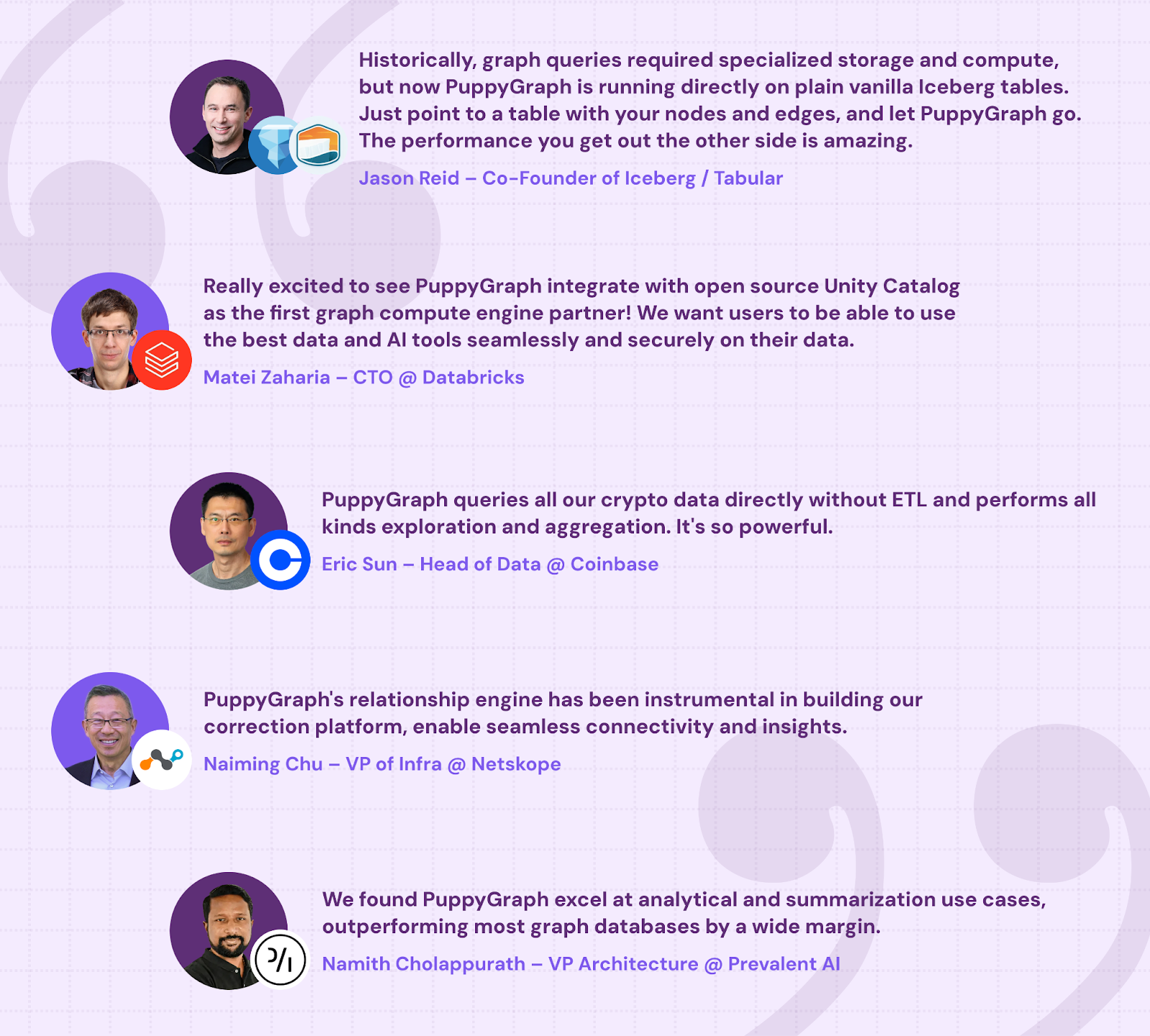
PuppyGraph is already used by half of the top 20 cybersecurity companies, as well as engineering-driven enterprises like AMD and Coinbase. Whether it’s multi-hop security reasoning, asset intelligence, or deep relationship queries across massive datasets, these teams trust PuppyGraph to replace slow ETL pipelines and complex graph stacks with a simpler, faster architecture.
Conclusion
Graph databases have emerged as a powerful tool for managing and analyzing complex, interconnected data across various domains. Their ability to efficiently model relationships brings distinct advantages in applications ranging from social networks and fraud detection to recommendation systems, network and IT operations, knowledge graphs, healthcare, and geospatial applications.
However, their adoption faced hurdles due to complex integration and scaling challenges. PuppyGraph transforms this landscape by introducing the first and only graph query engine for SQL data lakes/warehouses, eliminating traditional barriers. It allows organizations to fully leverage graph technology alongside relational databases, simplifying the implementation of graph analysis.
Ready to add graph models on your existing SQL data? Download the forever free PuppyGraph Developer Edition or begin your free 30-day trial of the Enterprise Edition today.

Danfeng Xu, CTO and Co-founder of PuppyGraph, is a passionate learner with extensive experience across online platforms, streaming services, big data, and developer productivity. He previously worked at LinkedIn, where he led a unified server platform strategy for thousands of microservices and modernized the engagement platform to deliver dynamic, personalized and engaging user experiences. He holds a Master's degree in Computer Science from UCLA.

Get started with PuppyGraph!


Developer Edition
- Forever free
- Single noded
- Designed for proving your ideas
- Available via Docker install
Enterprise Edition
- 30-day free trial with full features
- Everything in developer edition & enterprise features
- Designed for production
- Available via AWS AMI & Docker install