


Top 5 snowflake competitors ( Alternatives ) of 2026
Snowflake helped popularize the cloud data warehouse pattern of separating storage and compute, and it remains one of the most widely deployed cloud data warehouses for analytics on structured and semi-structured data. But the data warehousing landscape in 2026 looks very different from the one Snowflake first entered. Cloud-native lakehouses, serverless query engines, columnar OLAP databases, and unified data platforms have all matured, and many teams are now comparing Snowflake vs newer cloud data warehouses to decide whether a single warehouse is still the right anchor for their data stack.
The questions driving this evaluation are familiar: How predictable are the pricing models at the end of the month? How well does the platform handle open data formats like Apache Iceberg and Delta Lake? Can it serve AI and machine learning workloads as cleanly as it serves BI and SQL analytics? And what happens when workloads outgrow SQL, like graph traversals across customer, transaction, and asset data sources?
This post walks through what Snowflake is, how its architecture works, why teams are exploring Snowflake competitors in 2026, and the five strongest options to compare against it: Google BigQuery, Databricks, Amazon Redshift, Microsoft Fabric, and ClickHouse. We'll touch on other competitors in the data warehousing space (Microsoft Azure Synapse Analytics, IBM Db2 Warehouse, and Teradata) in passing, but the five above are where most Snowflake vs alternative evaluations land. By the end, you should have a clearer picture of which cloud data platform fits which workload, how the leading cloud data warehouses approach data warehousing and data lakes, and how to layer graph analytics on whichever warehouse you choose.
What is Snowflake?
Snowflake is a fully managed cloud data platform, originally launched as a data warehouse and now positioned as a broader "data cloud" that handles data warehousing, data lakes, data engineering, application development, machine learning, and secure data sharing. It runs on AWS, Microsoft Azure, and Google Cloud, and customers consume it as a SaaS. That means that, compared to traditional data warehouses that run on-premises or self-managed cloud installations, there's no infrastructure management at the cluster level. Compute is billed in Snowflake Credits, which are consumed by virtual warehouses; each warehouse size doubles credit consumption per hour.
What set Snowflake apart at launch was the architectural choice to fully decouple compute from storage on cloud object storage like S3, Azure Blob Storage, and Google Cloud Storage. That meant multiple teams could spin up isolated compute resources against the same data, scale them independently, and stop them entirely when idle. The same idea now shows up in most cloud data warehouses and data lakes, but Snowflake's managed implementation, with features like zero-copy cloning, time travel, secure data sharing, and Snowpark for Python, Java, and Scala, is what keeps it on the data warehousing shortlist for most data teams in 2026.
How does Snowflake work?
Snowflake's architecture has three primary layers sitting on top of cloud infrastructure: a database storage layer, a query processing layer, and a cloud services layer. Understanding how they interact is the easiest way to reason about both the platform's strengths and where Snowflake competitors can sometimes do better.
Database storage layer. Snowflake organizes table data into immutable, columnar micro-partitions, typically 50 to 500 MB of uncompressed data (stored compressed on object storage). These partitions live on the underlying cloud providers' object storage and are fully managed by Snowflake. Metadata about partition ranges, statistics, and clustering is held by the cloud services layer, which is what allows Snowflake to prune partitions efficiently at query time without scanning unnecessary data.
Query processing layer. Compute happens inside virtual warehouses, which are independent massively parallel processing (MPP) clusters of compute resources. Each warehouse can be sized from XS to 6X-Large, started, suspended, and scaled out into multi-cluster warehouses for concurrency. Because warehouses don't share compute, an analytics workload doesn't slow down an ELT pipeline running in parallel, and you can right-size each one for its job.
Cloud services layer. This is the brain of the platform. It handles authentication, query parsing and optimization, transaction management, metadata, and security. It also powers features like zero-copy cloning, where a clone of a multi-terabyte table is essentially free because only metadata is copied. Snowflake includes a free allowance for cloud services and charges only when cloud service usage exceeds 10% of daily virtual warehouse usage.
Workloads enter through SQL, Snowpark, or a stream of connectors, hit the cloud services layer for planning, get routed to a virtual warehouse for execution, and read from or write to the shared storage layer. The whole experience is intentionally hands-off: you do not tune indexes, vacuum tables, or manage nodes.
Why explore Snowflake competitors?
For many teams, Snowflake remains a comfortable default. The reasons to evaluate Snowflake vs other cloud data warehouses usually fall into four categories.
Cost predictability and total cost of ownership. Snowflake's per-second compute billing is convenient, but the credit model can be hard to forecast as workloads grow. On-demand credit rates run roughly $2 at Standard up to $4 at Business Critical in US AWS regions (with non-US regions adding a premium), capacity commitments come in lower, and cross-region or cross-cloud data transfer adds a separate line item. Teams running consistent, predictable workloads at scale sometimes find capacity-based pricing models or open-format Snowflake competitors easier to budget.
Openness and vendor lock-in. Snowflake supports Apache Iceberg tables (both externally managed and Snowflake-managed) and can query data in cloud object storage, but its traditional managed-table storage format is Snowflake-managed rather than an open table format like Iceberg, Delta Lake, or Apache Hudi. Organizations standardizing on open data formats as a long-term foundation often prefer a platform where they are the primary citizen rather than one of several supported options, and vendor lock-in concerns push some teams toward more open Snowflake competitors. For teams already committed to a single cloud provider, vendor lock-in pressure can also come from data integration tools and downstream BI investments rather than from the warehouse itself.
Workload fit. Snowflake is excellent at warehouse-style SQL analytics and increasingly capable at data engineering and machine learning through Snowpark, but it is not the obvious choice for every workload. Real-time event analytics, sub-second user-facing dashboards, machine learning training on petabyte-scale unstructured data, big data processing across multiple clouds, and graph traversals across relational data each have Snowflake competitors that are architected specifically for those patterns.
Graph and connected-data analytics. This is the workload that pushes a lot of teams to add tooling alongside Snowflake rather than replace it. Fraud rings, identity resolution, supply chain dependencies, cybersecurity attack paths, and GraphRAG for LLMs all rely on multi-hop traversals that become awkward and expensive to express with repeated SQL self-joins or recursive CTEs as path depth and graph size grow. Historically, the workaround was to ETL data out of the warehouse into a dedicated graph database like Neo4j, but that adds another system to operate, duplicates data, and can leave graph results lagging behind the source of truth. At PuppyGraph, we built our graph query engine specifically to avoid that ETL step, which we will return to in the conclusion.
Top 5 Snowflake competitors
The five platforms below cover the most common directions teams head when they outgrow, replace, or supplement Snowflake. They are not interchangeable. A team optimizing for cost predictability and machine learning will weigh these top cloud data warehouses differently than a team optimizing for serverless SQL or real-time analytics.

Google BigQuery
Google BigQuery is one of the closest Snowflake competitors for teams that want a serverless data warehouse, although it exposes compute through a more slot-based model rather than Snowflake-style virtual warehouses. Compute is built on Google's Dremel engine, storage is the Capacitor columnar format on Colossus, and the two are decoupled.
Google BigQuery does not require you to provision or size a warehouse. Queries are scheduled against pools of slots, which act as units of virtual CPU, and on-demand queries can burst up to 2,000 slots per project. You either pay per TiB scanned (data processed in each query, currently around $6.25 per TiB in many U.S. regions after a 1 TiB monthly free tier), or use capacity-based pricing for reserved slots, with rates that vary by edition, region, and commitment term. That makes Google BigQuery especially friendly for spiky usage patterns and analyst-heavy teams that don't want to think about warehouse sizing.
Where Google BigQuery shines: tight integration with the rest of Google Cloud, including Vertex AI for machine learning, Dataflow for streaming data, and Looker for BI. It supports federated queries across Google Cloud Storage, BigLake on Iceberg, and external data sources, and Google BigQuery ML lets teams train and serve models directly through SQL analytics. Across the Google Cloud Platform stack, this makes BigQuery a strong fit for advanced analytics on the same data already being processed by other Google Cloud services.
Key advantages
- Truly serverless data warehouse: no clusters to size, pause, or tune
- On-demand pricing models per TiB scanned, with capacity reservations available
- Google BigQuery ML and Vertex AI integration for in-warehouse machine learning training and inference
- Strong support for federated queries and Iceberg via BigLake on Google Cloud

Databricks
Databricks took a different architectural path from Snowflake. Rather than starting as a warehouse and adding lake features, it started as a managed Apache Spark data platform and built the lakehouse pattern on top: open Delta Lake tables in cloud storage, with ACID transactions, schema enforcement, and time travel layered in via a transaction log. Today, the platform combines data engineering, streaming data, machine learning, data science workflows, and SQL analytics under Unity Catalog for data governance.
For BI and ad-hoc SQL analytics, Databricks SQL warehouses compete head-on with Snowflake's virtual warehouses. For machine learning and AI, Databricks tends to win on workload breadth: MLflow, model serving, vector search, and tight integration with foundation model APIs are first-class citizens, not separate products. Pricing is based on Databricks Units (DBUs), with rates that vary by cloud, workload type, and tier. Interactive (All-Purpose) workloads have historically been listed around $0.40/DBU at the legacy Standard tier, though new AWS and GCP customers now start at Premium, where rates are higher. Jobs, SQL, and Serverless compute price differently across Premium and Enterprise tiers.
Where Databricks tends to win: open data formats as the default, mature machine learning and AI tooling, strong streaming data support via Structured Streaming and Delta Live Tables, and a single data platform for engineering plus advanced analytics. Where it tends to cost more attention: it asks more performance tuning of your team than Snowflake does, with more knobs around cluster types, runtimes, and Spark tuning.
Key advantages
- Open lakehouse architecture on Delta Lake, with strong Iceberg support
- Best-in-class ML, AI, and notebook tooling for data scientists
- Unity Catalog for unified governance across data and AI assets
- Streaming and batch on the same platform, with Photon for SQL performance
Amazon Redshift
Amazon Redshift was AWS's original cloud data warehouse and remains the natural choice for teams already standardized on AWS services. The current generation runs on RA3 nodes with managed storage, which lets you scale compute resources independently from storage against S3-backed cloud storage, and on Redshift Serverless, which removes infrastructure management entirely.
The architecture is massively parallel processing (MPP) and columnar, with aggressive use of compression, zone maps, and result caching that minimizes the data processed for each query. Spectrum lets teams query data directly from S3 without loading it, and recent investments in Redshift Serverless and Aurora zero-ETL integrations have made it easier to bring transactional data into analytics without building pipelines. Pricing for provisioned RA3 clusters starts at roughly $0.543 per hour with up to 45% reserved discount. Redshift Serverless is billed in RPU-hours with per-second billing and a 60-second minimum: pricing in us-east-1 is commonly cited around $0.375 per RPU-hour, with a 4-RPU base working out to about $1.50 per active hour. Managed storage is priced at around $0.024 per GB-month.
Where Redshift tends to win: deep AWS integration (IAM, S3, Glue, Lake Formation, Kinesis, EMR), competitive pricing models for steady-state warehouse workloads, and the lowest-friction option for teams whose data, data security, and networking already live inside AWS.
Key advantages
- Tight integration with the AWS ecosystem and IAM
- Serverless and provisioned options on the same engine
- Spectrum for querying S3 data without ingestion
- Strong price-performance for AWS-native teams
Microsoft Fabric (and Azure Synapse Analytics)
Microsoft Fabric is Microsoft's unified analytics platform, bringing together what used to be separate products (Microsoft Azure Synapse Analytics, Azure Data Factory, Power BI, Azure Machine Learning, and others) on top of a single storage foundation called OneLake, which acts as a managed Azure Data Lake for the whole stack. OneLake stores data in Delta Parquet format and is shared across every Fabric experience, including the SQL-based Fabric Data Warehouse, Spark-based Lakehouse, Real-Time Intelligence, Data Science, and Power BI. Many existing teams still run Azure Synapse Analytics directly, where dedicated SQL pools serve enterprise data warehousing workloads and serverless SQL pools query data in Azure Data Lake; Fabric is the strategic successor and the place most net-new Microsoft data work is landing.
For Snowflake comparison purposes, the relevant piece is the Fabric Data Warehouse: an MPP SQL warehouse on OneLake with T-SQL support and ACID transactions, combining data warehousing with seamless integration to Power BI and Azure Machine Learning. Pricing models are capacity-based rather than per-credit, and in U.S. pay-as-you-go terms, Fabric Capacity Units (CUs) range from roughly $263/month for F2 to roughly $8,410/month for F64, with regional, currency, reservation, and Power BI licensing differences on top. Storage in OneLake is billed per GB and has free Mirroring allowances tied to the compute capacity you buy.
Where Fabric tends to win: Microsoft-heavy organizations with Power BI as their reporting standard, teams that want one product instead of stitching together a stack, and scenarios that benefit from OneLake's "single copy" model, where Power BI, T-SQL, and Spark can all read the same data without duplication.
Key advantages
- Unified analytics platform: warehouse, lakehouse, streaming, data science, and BI under one capacity
- OneLake as a shared Delta Parquet foundation that combines data engineering with downstream advanced analytics
- Native, tight integration with Power BI and the Microsoft 365 stack
- Capacity-based pricing models that bundle compute across all Fabric workloads
ClickHouse
ClickHouse is the outlier on this list and the most interesting alternative when Snowflake's latency profile doesn't fit. ClickHouse is an open-source, column-oriented OLAP database designed for high-throughput, low-latency analytical queries, and it is often used for sub-second dashboards and real-time analytics over very large datasets. ClickHouse Cloud is the managed service from the original developers, with consumption-based pricing typically starting around $50 to $100/month, depending on region and idling settings.
Architecturally, ClickHouse uses the MergeTree family of table engines, which write data into immutable parts and merge them in the background. Combined with columnar storage and vectorized execution, this lets ClickHouse achieve very high read throughput on modest hardware. The trade-off is that ClickHouse is optimized for analytical reads and append-heavy ingestion, not for the kinds of large, slow-changing dimensions and complex JOIN-heavy queries that traditional warehouses handle well.
Where ClickHouse tends to win: user-facing analytics (dashboards exposed to thousands of customers), real-time observability and product analytics, time-series workloads, and any case where you need warehouse-scale data with sub-second response times and high concurrency. It is the right tool when your "warehouse" is also the backend of a product.
Key advantages
- Sub-second query latency at high concurrency for analytical workloads
- Open-source core with a managed cloud option from the same team
- Excellent fit for user-facing analytics, observability, and real-time use cases
- Efficient columnar storage with vectorized, distributed execution
Conclusion
Snowflake is still a strong default, especially for teams that want a hands-off, SQL-first cloud data platform with mature governance and secure data sharing. But the right Snowflake competitor depends on what you are actually optimizing for. If you want serverless simplicity and Google Cloud integration, Google BigQuery is the closest analog. If you want machine learning, AI, and open data formats as first-class citizens, Databricks is hard to beat. If your team lives inside AWS, Redshift is the lowest-friction option. If you are standardized on Microsoft and Power BI, Fabric (or Azure Synapse Analytics, if you're already there) consolidates the stack. And if your "warehouse" needs to serve sub-second, user-facing analytics on streaming data, ClickHouse is purpose-built for that pattern. Other options like IBM Db2 Warehouse and Teradata still earn enterprise data warehousing budget at organizations with strong existing relationships, but they sit outside the five most common options that teams shortlist today.
There is one workload these platforms are not primarily designed around: interactive graph analytics over connected data. Fraud rings, identity graphs, supply chain dependencies, cybersecurity attack paths, and GraphRAG for LLMs all rely on multi-hop traversals that become awkward and expensive to express with repeated SQL self-joins or recursive CTEs as path depth and graph size grow. The traditional workaround is to ETL warehouse data into a dedicated graph database, but that adds another system to operate, duplicates data, and can leave graph results lagging behind the source of truth.
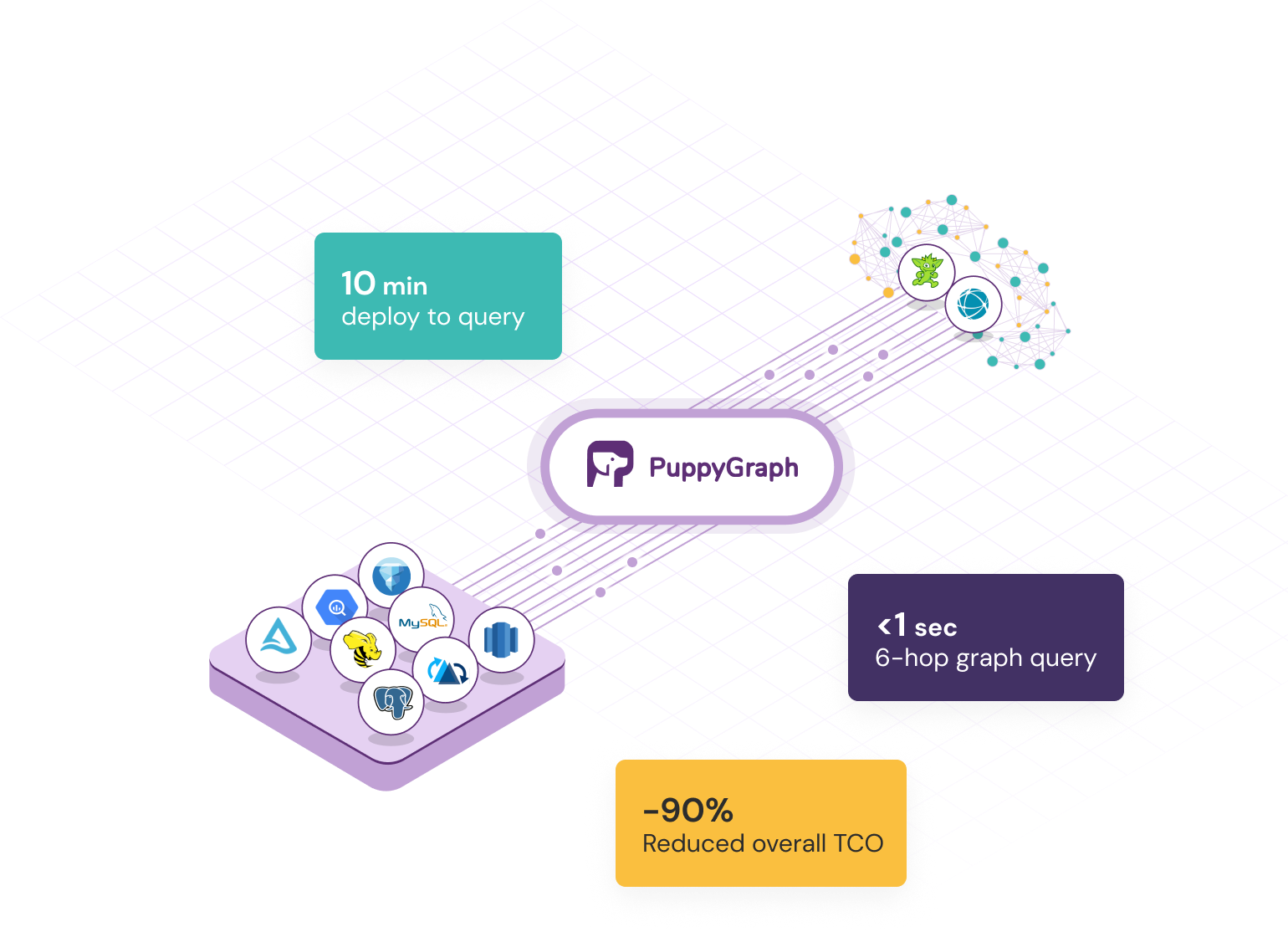
At PuppyGraph, we built our graph query engine to remove that extra copy. We connect directly to Snowflake, BigQuery, Databricks, Redshift, Amazon S3 Tables, and other warehouse and lakehouse sources, map your existing tables to vertices and edges, and let teams query the same data in openCypher or Gremlin alongside the SQL they are already running. No copy, no separate graph store, and no overnight pipeline to keep in sync. Whichever Snowflake competitor you land on, you can layer graph analytics on top of it without rebuilding your stack.
If you're evaluating warehouses and know graph workloads are on the roadmap, the easiest way to see how this fits together is to try the forever-free PuppyGraph Developer Edition on your own data, or book a demo with our team.

Matt is a developer at heart with a passion for data, software architecture, and writing technical content. In the past, Matt worked at some of the largest finance and insurance companies in Canada before pivoting to working for fast-growing startups.

Get started with PuppyGraph!


Developer Edition
- Forever free
- Single noded
- Designed for proving your ideas
- Available via Docker install
Enterprise Edition
- 30-day free trial with full features
- Everything in developer edition & enterprise features
- Designed for production
- Available via AWS AMI & Docker install