

AI in Pharmaceuticals: Applications, Benefits & Examples
Bringing a single new drug to market still takes well over a decade and costs billions of dollars, and most candidates that enter human testing never reach approval. Pharmaceutical work is also among the most data-rich activity in any industry: genomic sequences, high-throughput screening results, decades of assay data, clinical trial records, manufacturing telemetry, and the published literature all sit behind every decision. Artificial intelligence has moved into that gap, and not only at the famous starting point of drug discovery. It now touches target identification, trial design, factory operations, and drug-safety monitoring across the full value chain.
This article defines what AI in pharmaceuticals actually covers, explains why adoption has accelerated, walks through the main applications and the benefits they produce, and points to named, public examples of the technology in use.
What is AI in pharmaceuticals?
AI in pharmaceuticals is the application of machine learning, deep learning, and generative models to the scientific and operational problems of developing, manufacturing, and monitoring medicines. It is less a single tool than a family of techniques applied to different stages of the same long pipeline.
Three technique families do most of the work. Predictive machine learning learns patterns from labeled data to estimate an outcome: whether a molecule will bind a target, whether a patient is likely to respond, whether a manufacturing batch is drifting out of specification. Generative models propose new artifacts rather than scoring existing ones, designing candidate molecules with desired properties or modeling protein structures that have never been crystallized. Natural language processing and large language models read the unstructured side of pharma, mining millions of papers, patents, trial reports, and clinical notes for signals a human team could not review at that scale.
What unites these techniques is that they consume data the industry already produces and turn it into a prediction, a design, or an extracted fact. The defining characteristic is not novelty for its own sake; it is the ability to work over volumes of biological and operational data that exceed what manual analysis can keep up with. That framing matters for the rest of this post, because the limiting factor in most real deployments turns out to be the data, not the model.
Why the pharmaceutical industry is adopting AI
The economics of drug development create strong pressure to do anything that improves the odds. Development timelines stretch across many years, costs run into the billions per approved drug, and the attrition rate is severe: the large majority of candidates that enter clinical testing fail before approval, often in expensive late-stage trials. Any technique that surfaces better candidates earlier, or kills weak ones sooner, changes the economics of the whole portfolio.
At the same time, the inputs to AI have matured. Biomedical data has grown faster than the teams able to analyze it, from cheap genomic sequencing to automated high-throughput screening to accumulated real-world evidence from electronic health records. Compute has become both more powerful and more accessible, and the model architectures that handle sequences, structures, and language have improved sharply over the last several years. The result is that techniques which were academic curiosities a decade ago are now production tools.
Competitive and regulatory dynamics complete the picture. Patent cliffs push large firms to refill pipelines quickly, well-funded AI-native biotechs have raised the baseline expectation for discovery speed, and regulators have begun publishing frameworks for how AI and machine learning are evaluated in drug development. Adoption is happening because the pressure, the data, and the tooling have arrived at the same time.
Key applications of AI in pharmaceuticals
AI shows up at every stage of the pharmaceutical pipeline. The applications below move roughly in order from the lab bench to the patient, and the final one cuts across all of them.
Drug discovery and target identification
Discovery is where AI first proved itself and where it remains most visible. Models help identify and prioritize biological targets by mining genomic, proteomic, and literature data for associations between genes, proteins, and diseases. Once a target is chosen, virtual screening ranks enormous compound libraries for likely binders, and generative chemistry models design novel molecules with desired potency and selectivity rather than searching only among existing ones. Predictive models then estimate ADMET properties (absorption, distribution, metabolism, excretion, and toxicity) so that candidates likely to fail on safety or pharmacokinetics are deprioritized early. Lead optimization, the iterative tuning of a promising molecule against many competing objectives at once (potency, selectivity, solubility, metabolic stability), is increasingly guided by models that predict how a structural change will move each property, narrowing the cycles of synthesis and testing needed to reach a viable candidate. Underpinning much of this is the prediction of protein structure, which turns a slow experimental bottleneck into a computational step and opens up targets that were previously hard to study.
Clinical trial design and optimization
Trials are the most expensive part of development, so even modest improvements compound. AI is used to identify and recruit suitable patient cohorts by matching trial criteria against electronic health records, to select sites likely to enroll and retain participants, and to optimize protocols before a trial begins. Models that predict dropout risk let teams intervene to keep trials adequately powered. More ambitiously, synthetic control arms and patient digital twins use historical and modeled data to reduce the number of participants who must be assigned to a placebo, which can shorten timelines and ease recruitment for conditions where enrollment is hard.
Manufacturing and supply chain
Once a drug is approved, AI moves into the plant. Machine learning optimizes process parameters to improve yield and consistency, predictive-maintenance models flag equipment likely to fail before it halts a batch, and anomaly-detection systems catch quality deviations from sensor and batch-record data faster than periodic manual review. On the logistics side, demand forecasting and supply-chain models help avoid both shortages and waste of products with strict expiry and cold-chain constraints. Contract manufacturers have begun pairing these methods with robotic synthesis, running highly automated labs that need minimal human attention for routine production.
Pharmacovigilance and patient outcomes
After a drug reaches patients, the monitoring problem becomes one of scale. Natural language processing scans adverse-event reports, medical literature, and even social media for early safety signals that warrant investigation. Signal-detection models sift large post-market datasets for associations between a drug and an outcome that manual review would miss, and they help triage the flood of individual case safety reports so that human reviewers spend their time on the cases most likely to matter. Real-world-evidence analysis and patient-stratification models support more personalized treatment decisions by identifying which subgroups respond best, feeding insight back toward both prescribing and future trial design.
Connecting fragmented research and clinical data
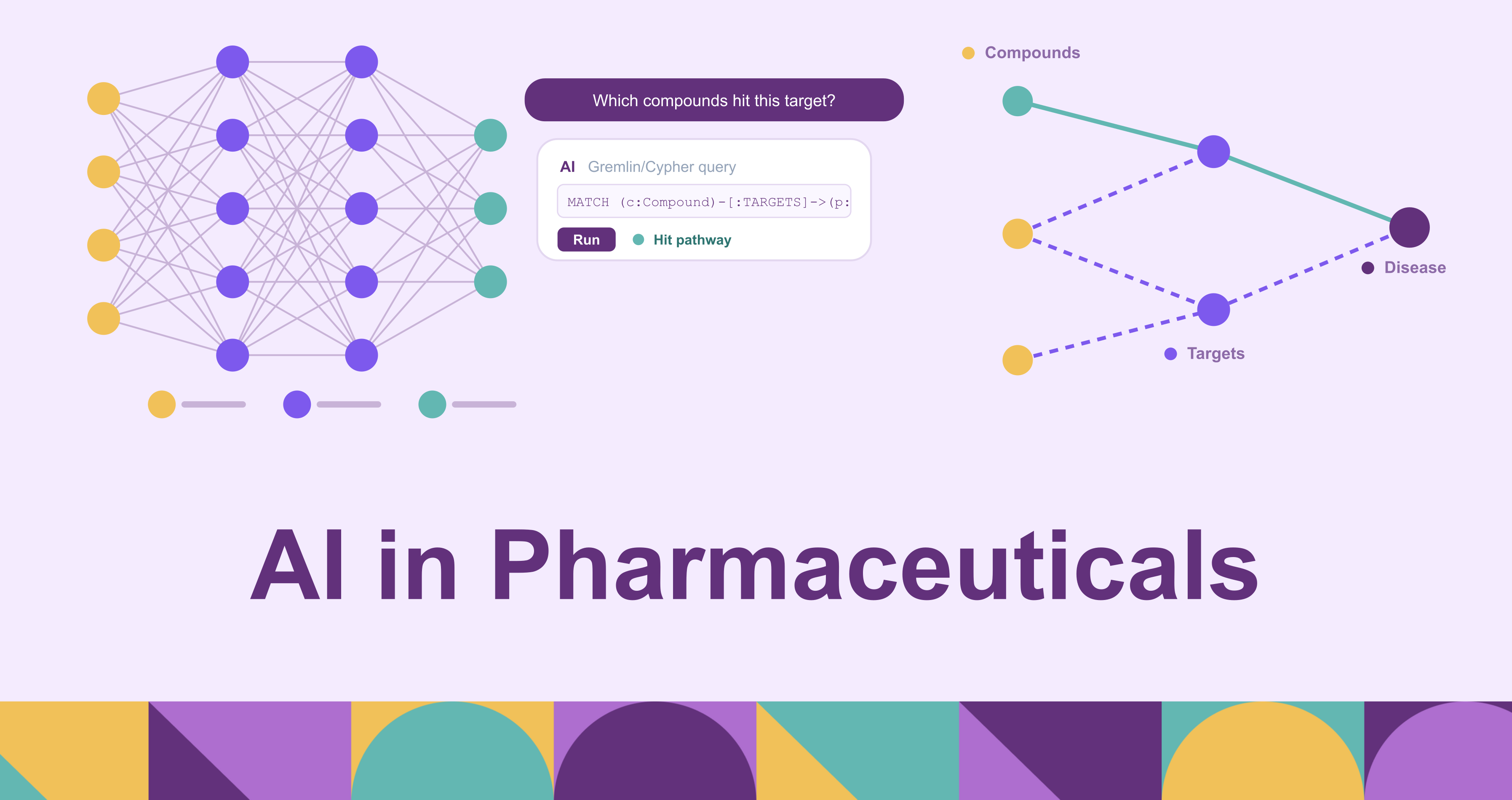
Read back over the applications above and a common dependency stands out: each one needs relationships across data that usually lives in separate systems. A target-prioritization model wants to traverse from a gene to the proteins it expresses, the pathways they participate in, the diseases those pathways implicate, and the compounds and trials already associated with them. A safety signal is more credible when an adverse event can be connected to a compound, its mechanism, the patient subgroup, and similar events seen elsewhere. These are graph-shaped questions, and they are exactly the questions that fall apart when the relevant facts are scattered across molecular databases, assay stores, a clinical-trial warehouse, and a drug-label repository.
Knowledge graphs are the established answer to this in life sciences. By modeling entities (compounds, targets, pathways, diseases, trials) and the typed relationships between them, a graph lets both human scientists and AI systems follow multi-hop connections that a row-and-column view obscures. Drug-repurposing and target-prioritization work increasingly relies on this representation, often using link prediction over the graph to score relationships that have not yet been observed experimentally.
The practical obstacle is that standing up a knowledge graph has traditionally meant copying data out of its systems of record into a dedicated graph database, a pipeline that is costly to build and harder to keep current, which is a particular problem for regulated data that is governed where it already lives. PuppyGraph takes a different route: it is a graph query engine that runs directly on existing relational and lakehouse tables, so the molecular, clinical, and operational data already in a warehouse such as Postgres, Snowflake, or Apache Iceberg can be queried as one connected graph without a separate ETL step or a second copy of the data. A user defines a graph schema (an ontology of the entities and relationships) over those tables, and the tables stay where they are under their existing governance. From there the data can be traversed with openCypher and Gremlin, and standard graph algorithms such as PageRank and community detection run inside the engine, which suits the link-analysis and prioritization patterns common in discovery. Because that schema is an explicit ontology of what the entities are and how they connect, it also gives AI systems a grounded model to query against rather than leaving them to guess the structure of the underlying data.
Benefits of AI in pharmaceuticals
The applications above translate into a handful of concrete payoffs, each tied to a mechanism rather than to optimism.
Faster and cheaper early-stage cycles. Virtual screening and generative design compress the search for viable candidates from a slow physical process into a largely computational one, so teams test fewer dead-end molecules at the bench. The saving is real precisely because it moves effort to the cheapest stage of the pipeline.
Fewer expensive late failures. Predicting toxicity, off-target effects, and poor pharmacokinetics earlier means weak candidates are dropped before they consume a clinical-trial budget. Because late-stage attrition is where most development cost is lost, shifting that decision earlier improves portfolio economics out of proportion to the modeling effort.
Better-targeted trials. Data-driven cohort selection, site selection, and synthetic control arms raise the odds that a trial enrolls the right patients and reaches a clear result, reducing the chance of an inconclusive and unrepeatable study.
Operational efficiency after approval. Process optimization, predictive maintenance, and anomaly detection reduce scrapped batches and unplanned downtime, while forecasting trims both shortages and expiry-driven waste in a supply chain with tight constraints.
Insight from data too large to read. Across discovery and pharmacovigilance alike, NLP and signal detection surface associations buried in volumes of literature and records that no team could review manually, turning a backlog of unread data into usable evidence.
These benefits come with real preconditions, and an honest account names them. Models inherit the gaps and biases of the data they learn from, predictions still need experimental and clinical validation before anyone acts on them, and regulators expect transparency about how a model reached a conclusion that informs a drug decision. None of this negates the payoffs above, but it does explain why the gating factor is rarely the choice of algorithm. The throughline is that AI's value in pharma comes from making better decisions earlier and from working at a scale humans cannot match, and both depend on feeding the models complete, connected, trustworthy data. That is why the data layer increasingly determines how much of this benefit a given organization actually realizes.
Examples of AI in the pharmaceutical industry
Concrete, public cases show how far the technology has moved from promise to practice.
Insilico Medicine took INS018_055 (now named rentosertib), a candidate it describes as the first drug discovered and designed by generative AI, from an AI-identified target through to a Phase 2a trial in idiopathic pulmonary fibrosis. Results published in Nature Medicine in June 2025 reported that patients on the highest dose showed improved lung function, with a mean forced-vital-capacity change of +98.4 mL against a decline of 20.3 mL in the placebo group, an early but concrete clinical readout for an AI-originated drug.
Exscientia, working with Sumitomo Dainippon Pharma, developed DSP-1181, a candidate for obsessive-compulsive disorder that was reported as the first AI-designed molecule to enter human clinical trials. Sumitomo discontinued it at Phase 1 in 2021 after it did not meet the trial's criteria, a useful reminder that compressing the discovery timeline does not by itself guarantee clinical success.
DeepMind's AlphaFold predicted three-dimensional protein structures at a scale and accuracy that reset expectations for the field, and the associated public structure database has become a standard resource for researchers choosing and studying targets.
Platform companies have industrialized discovery around different AI methods rather than a single technique: Recursion, which merged with Exscientia in 2024, pairs high-content phenotypic screening with machine learning; Atomwise applies structure-based virtual screening; and BenevolentAI built knowledge-graph and natural-language approaches over the biomedical literature. The methods differ, but each automates target and candidate selection across multiple disease areas.
Large pharma and infrastructure partnerships signal that this is no longer only a startup story: NVIDIA and Eli Lilly announced a co-innovation lab dedicated to applying AI across pharmaceutical workflows, pairing domain expertise with large-scale compute.
Conclusion
AI is now embedded across the pharmaceutical value chain, from the first decision about which target to pursue, through trial design and manufacturing, to the long tail of post-market safety monitoring. The techniques differ by stage, but the pattern is consistent: models turn the industry's enormous and growing body of data into earlier, better decisions, and they do so at a scale manual analysis cannot reach. As the models themselves become commoditized, the binding constraint shifts toward the data feeding them, and in particular toward connecting facts that today sit in separate systems so that both scientists and AI can follow the relationships between them.
Try the forever-free PuppyGraph Developer Edition and book a demo with the team to see how openCypher and Gremlin queries run over warehouse and lakehouse tables, with no graph-specific ETL, connecting the fragmented research, clinical, and operational data that pharmaceutical AI depends on.

Hao Wu is a Software Engineer with a strong foundation in computer science and algorithms. He earned his Bachelor’s degree in Computer Science from Fudan University and a Master’s degree from George Washington University, where he focused on graph databases.


