

AI in Retail: 10 Use Cases, Benefits, and Examples
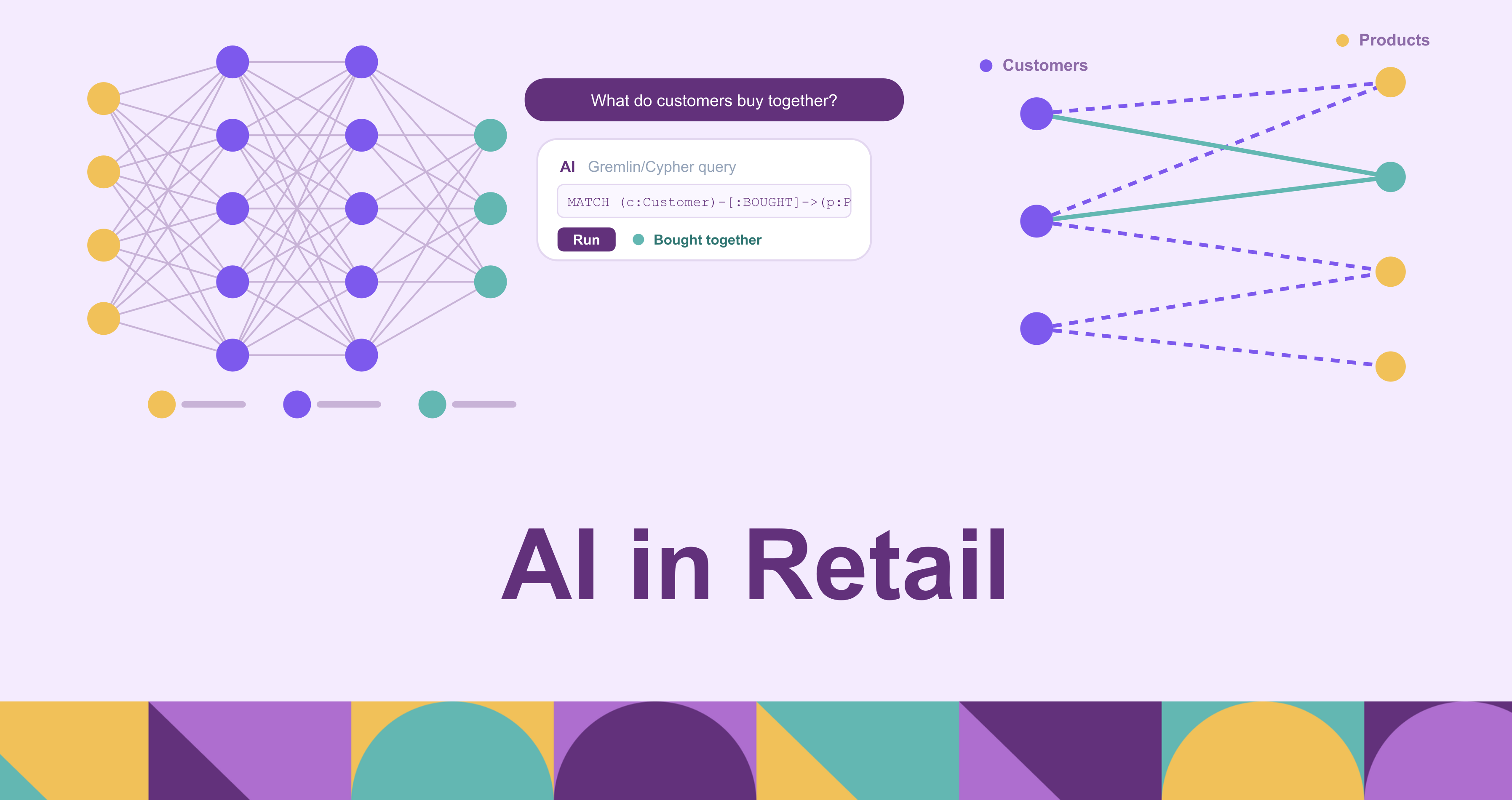
AI in retail has moved past the recommendation-engine pilot. It now runs in production across personalization, pricing, demand forecasting, inventory, store operations, and a growing layer of generative copilots that draft product copy, answer shoppers, and brief planners. The retailers seeing real returns are not the ones with the largest models; they are the ones who connected the data those models depend on. As the tooling matures, the gating factor is shifting from the algorithm to whether the system can reach an accurate, joined-up view of the catalog, the customer, and the supply chain at the moment it has to decide something.
This post defines what AI in retail actually covers, explains why retailers are investing now, maps where AI shows up across the business, walks through ten generative AI use cases with realistic caveats, and closes with the challenges that decide whether any of it pays off in production.
What is AI in retail?
AI in retail is the application of machine learning, computer vision, natural language processing, and generative models to the core functions of a retail business: merchandising and assortment, marketing, pricing, demand planning, inventory and supply chain, store operations, and customer experience. In practice it spans three overlapping waves of technology rather than one.
The first wave is classical machine learning: recommendation systems, demand forecasts, churn and propensity models, and markdown optimization trained on transaction and clickstream history. Most large retailers have run some version of this for years. The second wave is deep learning, which brought computer vision to the shelf and the checkout (planogram compliance, self-checkout loss detection, visual search) and stronger NLP to search and support. The third and most recent wave is generative AI: large language models and image models that produce content and hold a conversation, powering shopping assistants, catalog generation, and associate copilots.
These waves stack rather than replace one another. A modern shopping assistant uses a generative model for the conversation, a classical recommender for the ranking underneath it, and the retailer’s transactional data for grounding. Treating AI in retail as only the generative layer misses where most of the measured value still comes from.
Why retailers are investing in artificial intelligence
The pressure is structural, not faddish. Retail runs on thin margins, and several forces are squeezing them at once while the data needed to respond is already sitting in the retailer’s systems.
Margin and cost pressure. Labor, logistics, and real estate costs have risen faster than prices in many segments, and retailers cannot pass all of it to shoppers. AI that trims markdowns, reduces stockouts, or deflects routine service contacts goes straight to operating margin. The opportunity is large enough to be measured at the sector level: McKinsey estimates that generative AI alone could add $240 billion to $390 billion in value for retailers, a margin lift on the order of 1.2 to 1.9 percentage points across the industry (McKinsey, June 2023).
Competitive and experience expectations. Digital-native marketplaces have set a baseline for relevance, search quality, and delivery promises that shoppers now expect everywhere. A retailer whose site search returns weak results or whose recommendations ignore the last purchase loses the basket to a competitor who got it right.
Labor and store operations. Associate turnover is high and hiring is hard in many markets. AI that handles tier-zero customer questions, drafts schedules, or answers an associate’s product question on the floor lets a smaller team cover more ground.
Inventory economics. Carrying cost, shrink, and markdowns on unsold stock are among the largest controllable losses in retail. Better forecasts and replenishment decisions move real money, which is why demand planning was one of the first places retailers funded AI.
Underused data. Retailers already collect transactions, clickstream, loyalty, and supply-chain data at scale. Much of it is never joined across systems, so it informs no decision. AI is partly a way to finally use data the business already paid to collect.
The common thread is that the driver is not novelty. The competitive pressure and the data are both already present; AI is the lever that connects one to the other.
How AI is transforming the retail industry
AI shows up across the retail value chain, not in a single function. The clearest way to see the breadth is function by function, keeping the focus on outcomes rather than implementation.
Customer experience and personalization. Recommendations, personalized search ranking, tailored offers, and segmentation tune what each shopper sees. Done well, this lifts conversion and basket size; done carelessly, it feels intrusive, which is a real constraint rather than a footnote.
Merchandising and assortment. Models inform which products to carry in which stores or regions, how to localize an assortment, and which items to feature. Computer vision supports planogram compliance and shelf monitoring in physical stores.
Marketing and content. AI segments audiences, optimizes spend across channels, predicts campaign response, and increasingly generates the creative itself. The shift here is from targeting alone to targeting plus content production at volume.
Pricing and promotions. Dynamic and competitive pricing, markdown optimization, and promotion design use demand elasticity models to set prices that balance volume and margin. In regulated or brand-sensitive segments this runs with guardrails rather than fully automatically.
Demand forecasting and supply chain. Forecasting drives replenishment, allocation, and logistics. Better forecasts reduce both stockouts and the overstock that ends in markdown, and they help the supply chain absorb disruptions earlier.
Inventory and store operations. Beyond forecasting, AI supports task management, labor scheduling, self-checkout loss detection, and associate productivity. This is where physical retail differs most from pure e-commerce.
Loss prevention. Vision and analytics target shrink at the shelf and checkout, and analytics on returns and refunds flag organized returns abuse and policy gaming, which have grown alongside e-commerce.
Across all of these, the pattern is the same: the model is only one input, and its quality is capped by how completely it can see the relevant state of the business. A pricing model blind to live inventory, or a recommender blind to the last return, makes confident decisions on a partial picture. That ceiling is the thread connecting every function above, and it is the reason the later sections return to data.
10 generative AI use cases in retail
Generative AI is the newest wave, and it is where most current retail experimentation sits. The ten uses below are the ones with the clearest line to a business outcome. A note before the list: several of these (forecasting, dynamic pricing, recommendations) are historically predictive machine learning, not strictly generative. They appear here in their generative form, as copilots and natural-language interfaces layered on the predictive model, which is how retailers are now packaging them. Each comes with a realistic caveat, because generative systems fail differently from classical ones.
1. Conversational shopping assistants. An LLM-driven assistant helps a shopper find products, compare options, and complete a purchase in natural language, calling search and recommendation APIs underneath. The caveat is accuracy: the assistant must be grounded in live catalog and inventory data, or it will confidently describe products or availability that do not exist.
2. Personalized recommendations and next-best-offer. Generative models add a conversational and explanatory layer over the recommender, so a shopper can ask why something was suggested or refine it in dialogue. The ranking quality still depends on the underlying signals, especially recent behavior and current stock.
3. Product description and catalog generation. Generative models draft product titles, descriptions, and attributes at catalog scale, including localization across markets and languages. This is one of the highest-volume, lowest-risk uses, though it needs human review and brand-voice guardrails to avoid generic or inaccurate copy.
4. Marketing copy, email, and ad creative. AI generates campaign copy, subject lines, and image variants, and tailors them by segment. The speed gain is large; the risk is off-brand or non-compliant output, so this runs with review and, in regulated categories, legal sign-off.
5. Visual search and generated imagery. Shoppers search by image, and generative models produce or adapt product imagery and virtual try-on experiences. Try-on in particular improves online fit confidence, which can reduce returns, while raising its own accuracy and representativeness concerns.
6. Customer-service and post-purchase support. Generative assistants resolve order, return, and product questions across channels, and draft reply suggestions for human agents. The hard part is connecting the assistant to order, shipping, and entitlement data so it answers the actual question, not a generic one.
7. Demand forecasting and replenishment copilots. Rather than replacing the forecast model, a generative copilot lets a planner ask why a forecast shifted, explore scenarios in natural language, and turn the result into a replenishment action. The forecast’s reliability still comes from the predictive model and the data behind it.
8. Dynamic pricing and promotion exploration. A generative interface lets a pricing manager explore “what if” promotion and markdown scenarios conversationally over an elasticity model, compressing analysis that used to take a spreadsheet cycle. The pricing decision should remain governed by guardrails, not handed wholesale to the model.
9. Store-associate and operations copilots. On the floor or in the back office, a copilot answers product questions, surfaces planogram and task guidance, and drafts schedules or shift notes. Its usefulness depends on being grounded in the retailer’s own product, inventory, and operations data rather than general web knowledge.
10. Review summarization and synthetic data. Generative models summarize customer reviews and feedback into merchandising signal, and produce synthetic data to test models where real data is sparse or sensitive. Summaries need grounding in the actual reviews to avoid inventing sentiment, and synthetic data needs validation before it trains anything that ships.
The common dependency across all ten is grounding. The use cases that touch a customer or a planner directly (1, 2, 6, 7, 9) are only as trustworthy as the live, connected data the model can reach when it answers. That dependency is exactly where adoption gets hard, which is the subject of the next section.
Challenges and risks of AI adoption in retail
The use cases are real, but most of the difficulty in retail AI is not the model. It is everything around it: the data it runs on, the trust it has to earn, and the systems it has to fit into.
Data quality and fragmentation. Retail data is scattered across a product information system, an order management system, inventory and warehouse systems, pricing, loyalty and CRM, and supply-chain platforms, often with inconsistent identifiers. A model is only as good as its view of this data, and most of the value in retail questions lives in the joins between these systems, not inside any one of them. Fragmentation is the most common reason a promising pilot fails to scale.
Hallucination and accuracy. Customer-facing generative systems can state product facts, availability, or policies that are wrong. In retail this is not a cosmetic error; a confidently wrong availability claim or product spec erodes trust and can create real liability. Generative output has to be grounded in authoritative data, not left to the model’s parametric memory.
Personalization versus privacy. The same data that powers personalization carries consent, governance, and regional regulatory obligations. Crossing the line from helpful to intrusive, or mishandling consent, costs more than the personalization gains.
Bias and fairness. Pricing, targeting, and offer models can encode bias that produces unfair or non-compliant outcomes. This needs monitoring rather than a one-time check, particularly anywhere pricing or credit-like decisions are involved.
Integration with legacy systems. POS, ERP, and warehouse systems are long-lived and not built for real-time AI access. Wiring AI into them, without standing up yet another copy of the data, is often the bulk of the engineering work.
Cost, talent, and measurement. Model and infrastructure cost, scarce ML talent, and the genuine difficulty of attributing lift to AI (rather than to seasonality or a concurrent merchandising change) all temper how fast adoption pays back.
Several of these challenges share a root: the data the model needs is spread across systems and never connected, and an AI agent answering a real retail question has no grounded, relational view to reason over. The questions that matter are multi-hop and relational. “For this customer’s current basket, which complementary items are in stock at nearby stores, fit their purchase history, and are covered by an active promotion” is a traversal across product, customer, order, inventory, and store, not a lookup in any single table or a similarity match over product descriptions. Flat vector retrieval over a catalog corpus does not answer it, because the answer is in the relationships.
A graph approach to grounding retail AI
One way to close that gap is to give the AI system a connected, queryable model of the data it already has, rather than another copy of it. This is where a graph layer fits. PuppyGraph is a graph query engine that sits as an ontology layer between a retailer’s existing data and the AI agents and analysts querying it. It defines a graph schema over tables that already live in the data warehouse, lake, or an open format such as Iceberg, and queries them in place. There is no ETL pipeline and no separate graph database to keep in sync, because compute and storage stay separate: the tables remain where they are, and the engine provides the graph layer over them.
For an AI agent, the value of that layer is grounding. The graph schema acts as an enforced ontology, a contract describing the entities and relationships that actually exist (Customer, Product, Order, Inventory, Store, and the edges between them). When an agent generates a query that references an entity or relationship the schema does not define, the engine rejects it and returns structured, model-readable feedback explaining the violation in domain terms, so the agent can correct itself rather than return a plausible but wrong answer. This is what keeps a generated query free of semantic hallucination: queries that are syntactically valid but ask for something the data does not model. It complements vector retrieval and the recommendation engine rather than replacing them; the graph captures the relationships that flat retrieval misses, which is also the foundation of GraphRAG approaches to grounding LLMs.
The complementary-in-stock question above becomes a single traversal the agent can run over data the retailer already holds. In openCypher (Gremlin is also supported):
MATCH (c:Customer {id: $customerId})-[:PLACED]->(:Order)-[:CONTAINS]->(bought:Product)
MATCH (bought)-[:COMPLEMENTS]->(rec:Product)<-[stk:STOCKS]-(s:Store)
WHERE s.distance_km <= 15 AND stk.units_available > 0
MATCH (rec)-[:IN_PROMOTION]->(p:Promotion {active: true})
RETURN rec.name, s.name, p.label
ORDER BY stk.units_available DESC
Because the agent reaches enterprise data only through this layer, its reach is bounded by what the schema exposes. An entity left out of the ontology is not reachable through a query, which is a useful consequence when a retail assistant must not surface one customer’s order history or a partner’s wholesale pricing to the wrong party. That bound is a configuration consequence of grounding, not a security product on its own, and it holds only when the agent is actually wired to use the ontology as its single data path, with no side channel to the warehouse. PuppyGraph is used by Coinbase, Dawn Capital, and Prevalent AI, which gives a sense of the deployment shape: a graph over existing tables, not another database to populate.
The point is narrow and worth keeping narrow. Most of retail AI is the model work in the sections above. But the place adoption most often stalls is grounding the model in connected data, and that is a data-architecture problem with a data-architecture answer.
Conclusion
AI in retail is now infrastructure rather than experiment. It runs across personalization, pricing, forecasting, inventory, store operations, and a fast-growing layer of generative copilots, and the use cases with the clearest payoff are the ones tied to a concrete outcome: fewer stockouts, lower contact cost, higher relevance, faster planning. The recurring lesson across all of them is that the model is rarely the bottleneck. The leverage tracks how well the system is grounded in the connected data the retailer already has, and the systems that fail in production usually fail there.
If you are building AI agents or assistants over your retail data and want them grounded in a connected model rather than a fragmented one, you can stand up a graph over your existing tables with PuppyGraph’s forever-free Developer Edition. If you would rather walk through how an ontology layer would fit your catalog, inventory, and customer data, book a demo with the team.

Sa Wang is a Software Engineer with exceptional mathematical ability and strong coding skills. He holds a Bachelor's degree in Computer Science and a Master's degree in Philosophy from Fudan University, where he specialized in Mathematical Logic.


