

What Is AutoML? How Does It Works?
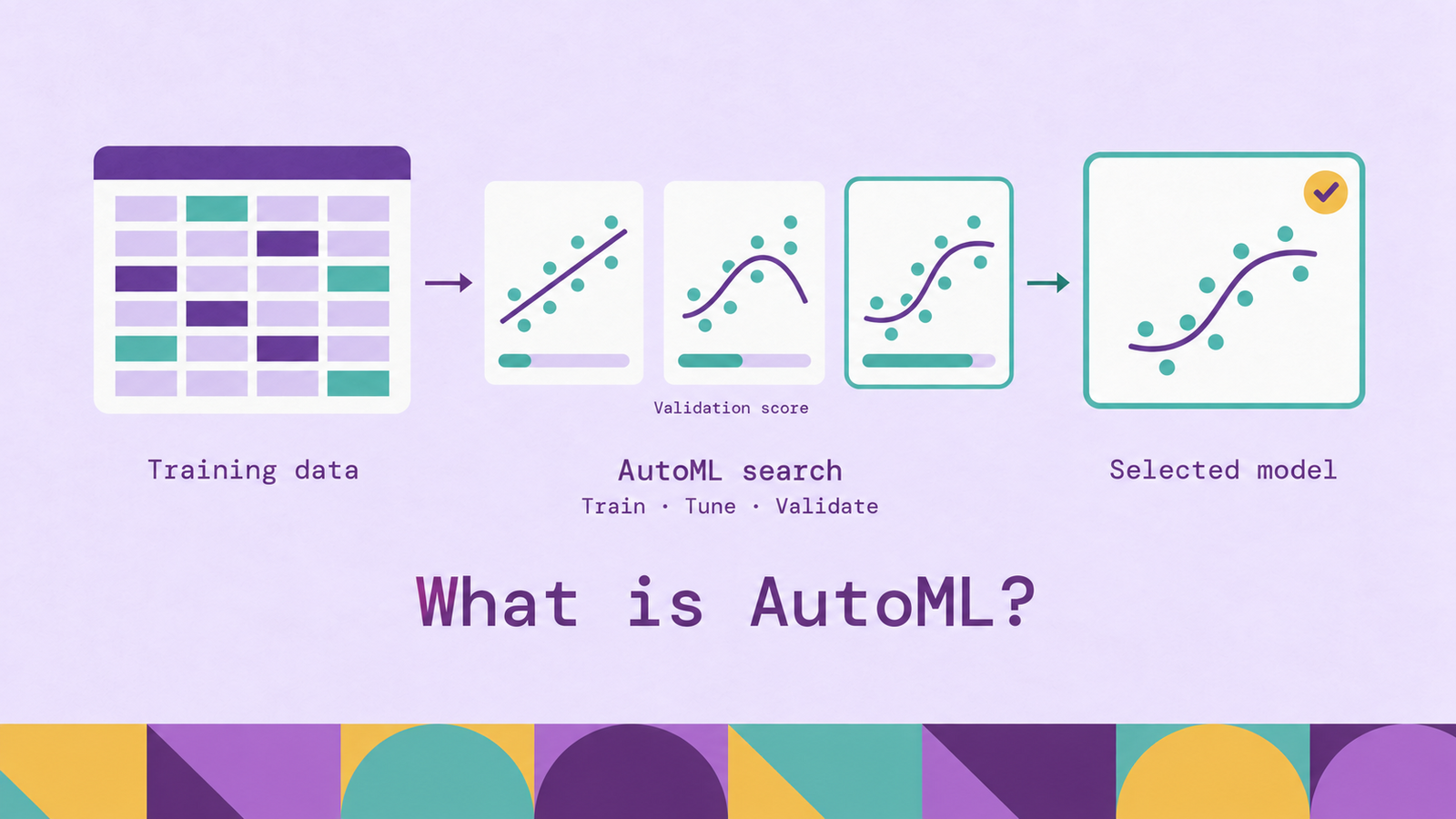
AutoML can shorten the path from a usable dataset to a tested predictive model. Its value comes from automating repeated experiments: trying preprocessing choices, comparing algorithms, and tuning configurations against a defined objective. The quality of that objective and the evidence used to evaluate it still determine whether the result is useful.
This guide explains how automated machine learning works, what each automated stage contributes, and where engineering judgment remains necessary. It focuses on supervised learning with tabular data, then considers broader use cases and the steps needed to implement AutoML responsibly.
What is AutoML?
Automated machine learning, or AutoML, is the automation of selected tasks involved in developing machine learning models. A system explores candidate configurations and evaluates their results, reducing the amount of experiment code and manual coordination a practitioner needs to write.
The scope varies. One tool may focus on algorithm selection and tuning; another may also generate features or assemble preprocessing pipelines. The research field includes hyperparameter optimization, learning from prior tasks, and neural architecture search, as covered in AutoML: Methods, Systems, Challenges. A tabular AutoML project does not need to use all of these techniques.
The practical benefits are faster baseline development, more systematic comparisons, and less repetitive orchestration. Experienced practitioners can use the resulting leaderboard to decide where further investigation is worthwhile. Less experienced users can run experiments through simpler interfaces, but still need to understand the target, validation design, and consequences of errors. Accessibility changes who can start an experiment; it does not remove the need to evaluate its result.
How does AutoML work?
An AutoML run needs training data, a task, an evaluation metric, and resource limits. It searches a configured space of pipelines or model settings, trains candidates, and measures their performance on validation data. Results guide which candidates receive further attention until the run reaches its stopping criteria.
For example, a customer churn experiment might compare different encodings and classifiers using the same development partitions. Each candidate represents a specific recipe, not just an algorithm name. Changing the preprocessing or regularization changes the experiment even when the model family stays the same.
Search strategies differ by system. Some explore randomly chosen configurations; others use previous trial results to propose promising settings or combine multiple trained models. H2O AutoML, for example, automates training and tuning across model families and produces a ranked leaderboard, with stacked ensembles among its candidates.
The winner is the strongest candidate found under that experiment's conditions. It is not proof that no better model exists, or that the selected model will satisfy deployment requirements.
What does AutoML automate?
AutoML coverage is best understood stage by stage. The following table describes possible capabilities, rather than a checklist every product fulfills.
Deployment and monitoring may be available through the surrounding ML platform, but they are separate capabilities to verify. A tool that exports a model has not necessarily provided an endpoint, a feature refresh process, or a way to observe outcomes.
This distinction matters when choosing software. Start with the bottleneck in your workflow. A team with established features and serving infrastructure may only need automated training, while another may need integrated preprocessing and model packaging.
The AutoML workflow
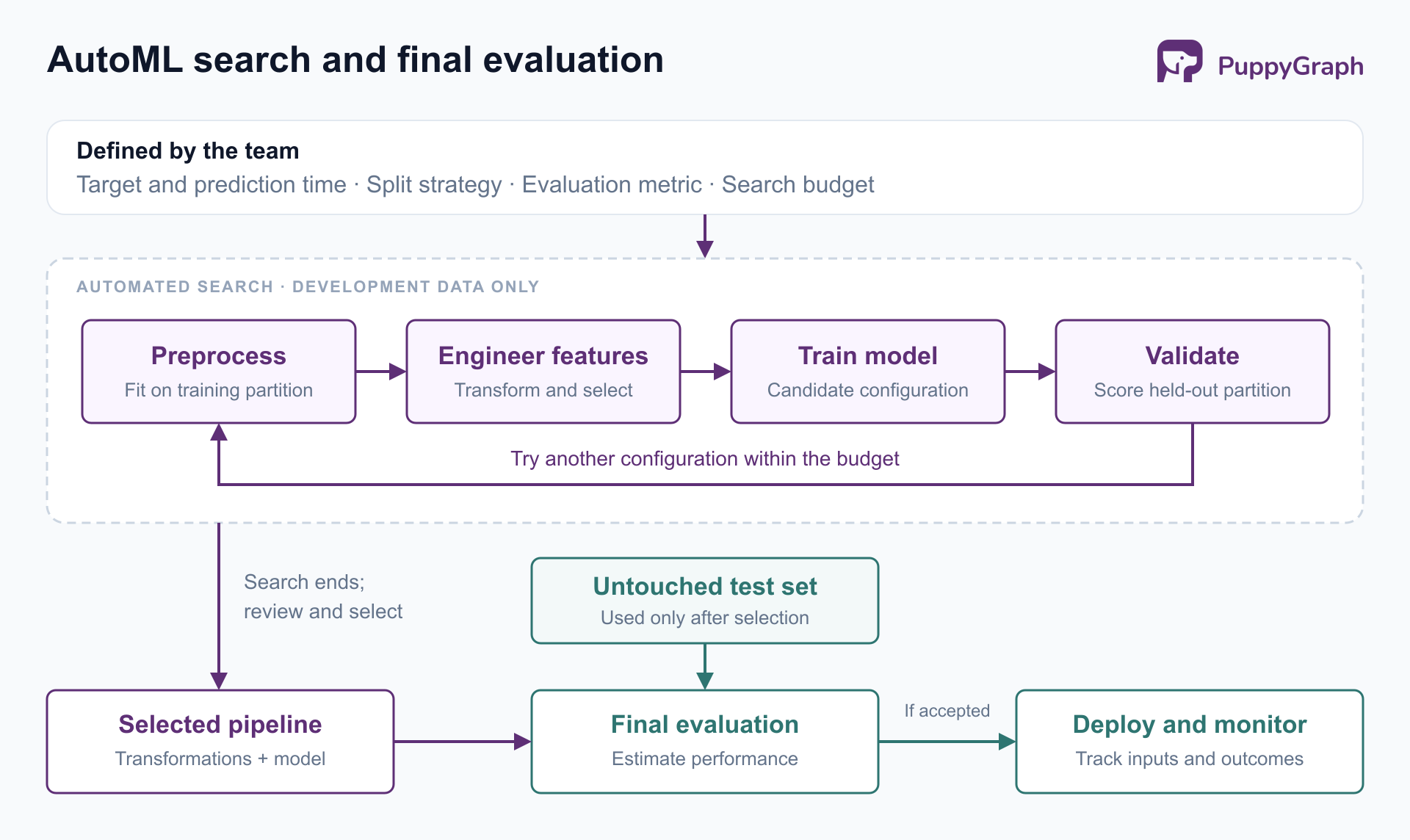
A reliable workflow establishes the experiment before starting the search:
- Define the prediction. Specify the entity, prediction time, target, and outcome window. For churn, identify what counts as leaving and how far ahead the prediction must be made.
- Construct the dataset. Assemble inputs available at that prediction time and attach labels after the outcome window has elapsed.
- Design the partitions. Separate model development from final testing, using a split that represents intended deployment.
- Run the search. Configure metrics, allowed candidates, and resource limits, then train and compare pipelines.
- Select and test. Review shortlisted candidates, settle the selection, and evaluate the chosen pipeline on the untouched test set.
- Deploy and observe. Package transformations with the model, track outcomes, and define when retraining or rollback is needed.
Scikit-learn's cross-validation guide explains why grouped observations and time-ordered data require appropriate splitting strategies. If the goal is to generalize to unseen customers, customer overlap across partitions can make the test misleading. If the goal is future prediction, the split must respect time.
Automated data preparation
Data preparation converts source values into inputs the selected estimator can process. Depending on the tool and algorithm, this may include filling missing values, converting categories, removing constant columns, or scaling numeric values. Some estimators handle missing values or categorical inputs directly, so a single preparation recipe is not appropriate for every candidate.
The distinction between fitting and applying a transformation is critical. An imputer learns replacement values from data; a scaler learns quantities such as means and variances. Those values must come from the training partition within each validation split, then be applied to its validation partition. Learning them from the full dataset leaks information across the boundary. Scikit-learn's data leakage guidance describes this failure and how pipelines help prevent it.
Automatic type detection also deserves inspection. A numeric customer identifier is not necessarily a meaningful quantity. A missing cancellation date might indicate an active account rather than a collection failure. Software can transform either column successfully while preserving the wrong interpretation.
Preparation is complete when inputs have both a usable representation and a defensible meaning. Resolving conflicting identifiers, broken timestamps, and ambiguous business definitions remains upstream data work.
Automated feature engineering
Feature engineering changes how information is represented to a model. Automated operations can extract calendar components from dates, encode text, generate interactions, or remove features that contribute little under the selected evaluation procedure.
AutoGluon's feature engineering documentation describes automatic handling of numeric, categorical, datetime, and text columns. This is useful when a training table contains mixed types: practitioners can inspect generated representations instead of hand-writing every conversion.
Relational feature generation extends this idea across linked tables. Featuretools' Deep Feature Synthesis composes operations such as aggregations and transformations over defined relationships. A customer table linked to transactions can support features such as transaction counts or average amounts. These operations depend on supplied relationships and definitions; the software does not establish what a customer means to the business.
Consider a churn feature measuring support activity. A count of tickets opened before the prediction date may be useful. A count that includes the later cancellation conversation reveals part of the answer. More elaborate feature generation makes the time boundary more consequential, because a downstream aggregate can hide the event that introduced leakage.
Review feature definitions alongside their scores. A useful feature must be reproducible from information available when the model actually runs.
Automated model selection
Model selection compares eligible learning algorithms within the experiment. For a tabular classification task, candidates might include linear models, tree ensembles, and neural networks. Each family offers different ways to represent relationships between inputs and the target.
A fair comparison evaluates candidates using the same intended prediction task and compatible validation conditions. Comparing one model on a random split with another on a later time period confounds algorithm choice with evaluation difficulty.
AutoML may also select an ensemble. An ensemble combines predictions from multiple models; stacking trains another model to combine their outputs. The AutoGluon-Tabular paper describes a system built around multi-layer stacking and repeated bagging, illustrating that AutoML can invest in combining models as well as tuning individual ones.
The highest-scoring candidate may require several models at inference time. Before selecting it, measure prediction latency, memory use, and artifact size in the intended environment. A small score improvement may not justify an operationally expensive pipeline. Treat the leaderboard as evidence for a decision, with deployment requirements applied to the actual candidate artifacts.
Automated hyperparameter tuning
Hyperparameters configure the learning process or model structure. Examples include tree depth, regularization strength, and learning rate. They differ from parameters learned during training, such as a fitted model's coefficients.
Tuning searches possible settings and evaluates their results. Grid search tests specified combinations; random search samples configurations. Model-based approaches use completed trials to help choose subsequent settings. Which strategy is appropriate depends partly on the cost of a trial and the structure of the search space.
Some optimizers also stop unpromising trials before they finish. Optuna's optimization guide separates sampling, which proposes hyperparameters, from pruning, which uses intermediate results to terminate trials. That distinction helps explain how an automated search allocates its budget.
Define the budget before launching a run: elapsed time, trial count, available memory, and parallel capacity all matter. More search cannot compensate for an invalid target or a misleading split. Once a baseline is credible, increase the budget only when the expected improvement warrants the additional experiment cost.
Automated model evaluation
AutoML calculates evaluation metrics and uses them to rank candidates. The chosen metric determines which errors the search rewards avoiding, so it should reflect how predictions will be used.
For classification, accuracy reports the fraction of correct predictions, while precision and recall distinguish false alarms from missed positives. For regression, mean absolute error measures average absolute deviation; root mean squared error gives greater weight to large errors. Scikit-learn's evaluation documentation explains these metrics and connects scoring choices to prediction and decision objectives.
A churn team with limited outreach capacity may care about the customers ranked near the top. A model's overall accuracy does not answer whether that shortlist is useful. Define the operational evaluation before seeing the leaderboard, including how any decision threshold will be selected.
Validation scores support selection, while the reserved test set estimates performance after selection. Repeatedly consulting the test set to choose models turns it into another development set. Microsoft's AutoML documentation explicitly distinguishes repeated validation during tuning from final testing.
Also inspect errors by meaningful cohort, such as customer tenure or region. Aggregate performance can conceal a failure concentrated in the population the application most needs to serve.
AutoML use cases
AutoML fits problems with a defined prediction target, usable historical examples, and a credible way to test generalization. The following scenarios illustrate how those requirements translate into implementation choices.
Customer churn prediction. A subscription team could compare classifiers using account activity, tenure, and service history. Labels need a consistent definition of churn, and features must precede the outreach decision. Predicting who will leave does not establish which customers will respond to an intervention; that requires separate evidence.
Demand forecasting. A retailer could evaluate forecasts for products and locations using historical demand and known calendar information. Use a forecasting-capable tool and evaluate at the horizon the replenishment process needs. Future promotions may be valid inputs when planned in advance; realized future sales are not.
Fraud review prioritization. An investigation team could rank transactions for manual review. Labels may arrive after a delay, and the evaluated sample may overrepresent cases investigators previously examined. The experiment needs to account for how those labels were collected before its ranking can support operational decisions.
Predictive maintenance. An operations team could use equipment history and sensor summaries to estimate failures within a defined horizon. Keep the evaluation aligned with whether the model will serve familiar machines or new equipment. Maintenance actions and sensor replacements can change what the recorded history means.
These applications benefit from systematic model comparison, but the prediction contract differs in each. Establishing that contract is what makes the automated experiment interpretable.
Challenges and limitations of AutoML
Search follows the objective. If a target captures an administrative process rather than the desired outcome, optimization can produce a strong model for the wrong task. A churn model trained on account closure processing dates may answer a different question from one trained on the end of customer activity.
Historical evidence has limits. Missing populations, inconsistent labels, and changing behavior can weaken generalization. A larger search does not create examples of circumstances absent from the dataset. Examine coverage before interpreting a small validation improvement as progress.
Complexity affects operation. A pipeline can contain many transformations and constituent models. Teams need to preserve these dependencies, inspect feature behavior, and reproduce training conditions. A model explanation can support investigation, but does not by itself establish that a relationship is causal or appropriate to use.
Automation consumes resources. Comparing many candidates can shift effort from manual experimentation into compute, storage, and review. Put bounds on the search and record failed trials as well as successful ones. Reproducibility also requires data versions, library versions, configuration, and split definitions; a random seed alone is insufficient.
Production remains an engineering responsibility. Inputs can change after deployment, labels may arrive late, and a model's predictions can influence the data collected next. Assign owners for feature availability, performance review, incident response, and retraining. AutoML reduces work within model development while leaving these system responsibilities explicit.
How to implement AutoML
Start with one bounded prediction problem and a baseline that reflects the existing decision process. Write down the unit of prediction, the outcome window, the metric, and the serving constraint. Then build a versioned dataset with explicit feature availability times and a reserved test partition.
Choose a tool based on the work it must automate. H2O AutoML provides automated model training, tuning, and leaderboards. AutoGluon Tabular integrates tabular preprocessing and model fitting. Evaluate whether the chosen tool can express your split strategy, preserve transformations, and produce artifacts your serving environment can run.
Run a constrained experiment first. Inspect inferred column types, excluded fields, validation assignments, and candidate failures before extending the search. Compare shortlisted pipelines with the baseline, settle the selection criteria, and use the held-out test for the final assessment. Record the complete recipe so the result can be investigated later.
Before deployment, exercise the full prediction path with representative records. Include missing values, categories absent from training, and inputs arriving later than expected. Verify that the application applies the saved transformations and handles failures predictably. Measure the time needed to obtain features as well as the time spent inside the model. A fast estimator can still miss a response deadline when its inputs are expensive to assemble. Finally, define how outcomes will be joined back to predictions, so monitoring can evaluate the same target and horizon used in the original experiment.
Some projects need relationship features before model search becomes useful. For example, a fraud experiment might test whether an account shares devices with other accounts. This requires an explicit account-device model and a time-bounded feature definition.
PuppyGraph lets teams define that entity-and-relationship model over existing tables and query it with openCypher or Gremlin. Its graph schema maps tables to nodes and edges, and its default direct-query path avoids loading a persistent duplicate dataset into a separate graph store. The resulting aggregates can become columns in an AutoML training dataset; the ML pipeline still owns dataset construction, model training, and serving.
For historical training examples, construct those aggregates from appropriately bounded source records and retain the resulting feature dataset. The zero-ETL graph access path does not remove the need for reproducible, point-in-time training inputs.
Conclusion
AutoML makes model experimentation more systematic by automating selected preparation, feature engineering, training, tuning, and evaluation tasks. Its results are most useful when the team supplies a clear target, credible validation design, and operational constraints. Start with a bounded experiment, inspect what the system learned, and judge the chosen pipeline against the decision it must support.
Try the forever-free PuppyGraph Developer Edition and book a demo with the team to see how openCypher and Gremlin queries derive relationship features from warehouse and lakehouse tables, with no graph-specific ETL, for evaluation in your AutoML workflow.

Hao Wu is a Software Engineer with a strong foundation in computer science and algorithms. He earned his Bachelor’s degree in Computer Science from Fudan University and a Master’s degree from George Washington University, where he focused on graph databases.


