

What Is a Background Agent? Benefits & Architecture
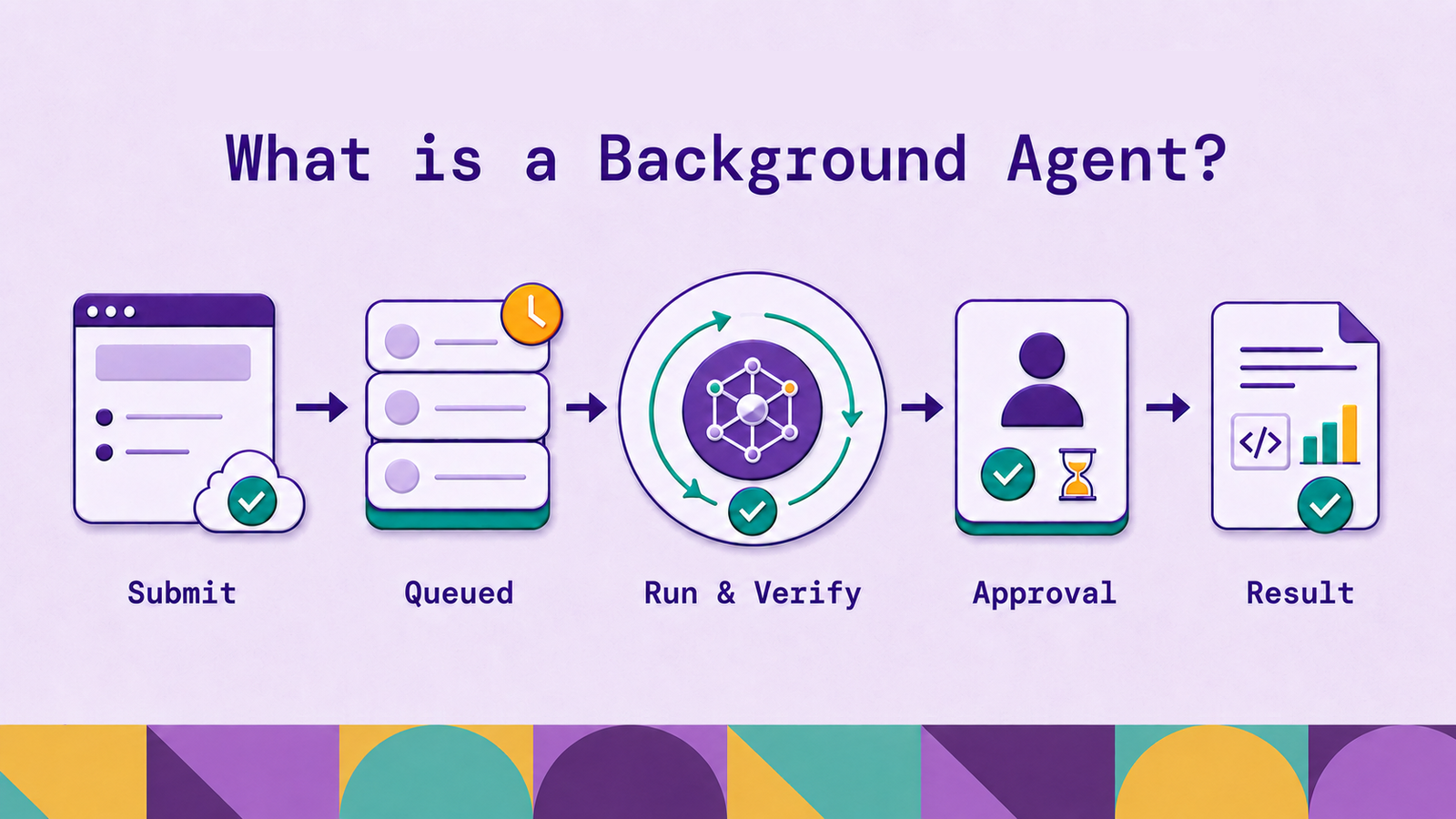
Once agentic work outlasts the request that started it, the application has to treat that work as a durable workload. The system must preserve context, control side effects, and expose progress while the agent researches, calls tools, tests intermediate results, or waits for external events without holding open a browser tab or API connection.
That asynchronous execution model changes more than the user interface. The agent needs a durable run record, a queue or scheduler, an isolated worker, explicit retry and cancellation behavior, and a way to pause for human judgment. This guide explains that architecture, follows a run from submission to completion, and examines where background agents help and where their added autonomy creates operational risk.
What is a background agent?
A background agent is an AI agent that performs a multi-step task asynchronously, outside the request-response cycle that started it. A user or system submits a goal and receives a run identifier or acknowledgment instead of waiting for the final result. The agent then plans, invokes tools, observes their outputs, revises its approach, and eventually saves a result or requests human input. The caller can poll for status, subscribe to events, or return later to review the work.
The term describes an execution pattern, not a particular model or reasoning technique. The same model might answer a short interactive question or power a background repository migration. The second task adds durable state, independent compute, a lifecycle that outlives the connection, and controls for work without continuous supervision.
This also separates a background agent from three adjacent concepts:
A background job follows a predetermined procedure. A worker that resizes an image usually executes known code with known inputs. An agent selects steps at runtime, observes the result, and may alter its plan while pursuing the same goal.
An autonomous agent describes decision authority. Background execution describes when and where work runs. A background agent can still require approval before it changes a production system, sends a message, or spends beyond a threshold. Conversely, an autonomous agent can act during a live interactive session.
An API's background mode may cover only one model response. OpenAI's Responses API background mode runs a long model response asynchronously and lets clients poll or, when streaming was enabled at creation, reconnect to its event stream. A complete background-agent application usually adds its own orchestration, tool permissions, memory, checkpoints, evaluation, and approval workflow around such a primitive.
The defining property is continuity across disconnection. A client can close or a worker can restart, yet the system retains enough state to resume or report a terminal outcome.
Why background agents matter
Interactive agents work well when the result fits a conversation turn. Many tasks do not. Repository analysis may require inspecting many files and running tests. Research involves discovery, extraction, comparison, and source validation. Operations work may wait for a deployment before checking health. A synchronous connection couples all of that work to network timeouts and a person's attention.
Background execution decouples the work's duration from both user attention and connection lifetime. Submission returns quickly while a worker continues. A run can pause, then resume when a dependency finishes or a reviewer responds.
That shape supports several practical use cases.
Software engineering. A coding agent can inspect a repository, implement a bounded change, run tests, and prepare a diff for review. Cloud coding agents make the pattern concrete: each task runs in an isolated environment, while the user can delegate other work and return to the completed result. The Codex cloud documentation describes this parallel, sandbox-per-task model.
Research and reporting. An agent can collect documents, extract claims, reconcile disagreements, and draft a cited report. Source discovery and verification are iterative rather than one model call.
Operations and monitoring. A run can investigate an alert, execute read-only diagnostics, watch a rollout, or summarize recurring failures. Scheduled background agents can also triage issues, inspect CI failures, or prepare a daily brief. These tasks need clear stopping conditions so monitoring does not quietly become an endless loop.
Data and content workflows. Agents can classify records, investigate quality failures, enrich catalog entries, or assemble drafts from approved sources. The cases vary, but input, output, and verification rules remain explicit.
Long-running customer requests. A product can accept a complex analysis, return a run ID, notify the user when it finishes, and preserve the result for later review. This keeps the frontend responsive while making cancellation and progress visible.
The common thread is not simply duration. Background agents matter when the task has variable steps, a checkable outcome, and enough value to justify orchestration around the model. A slow but fully deterministic operation is still better handled as an ordinary background job.
How a background agent works
A background-agent run behaves like a durable state machine. The exact states differ by platform, but the lifecycle usually includes queued, running, waiting, and a terminal state such as completed, failed, or canceled.
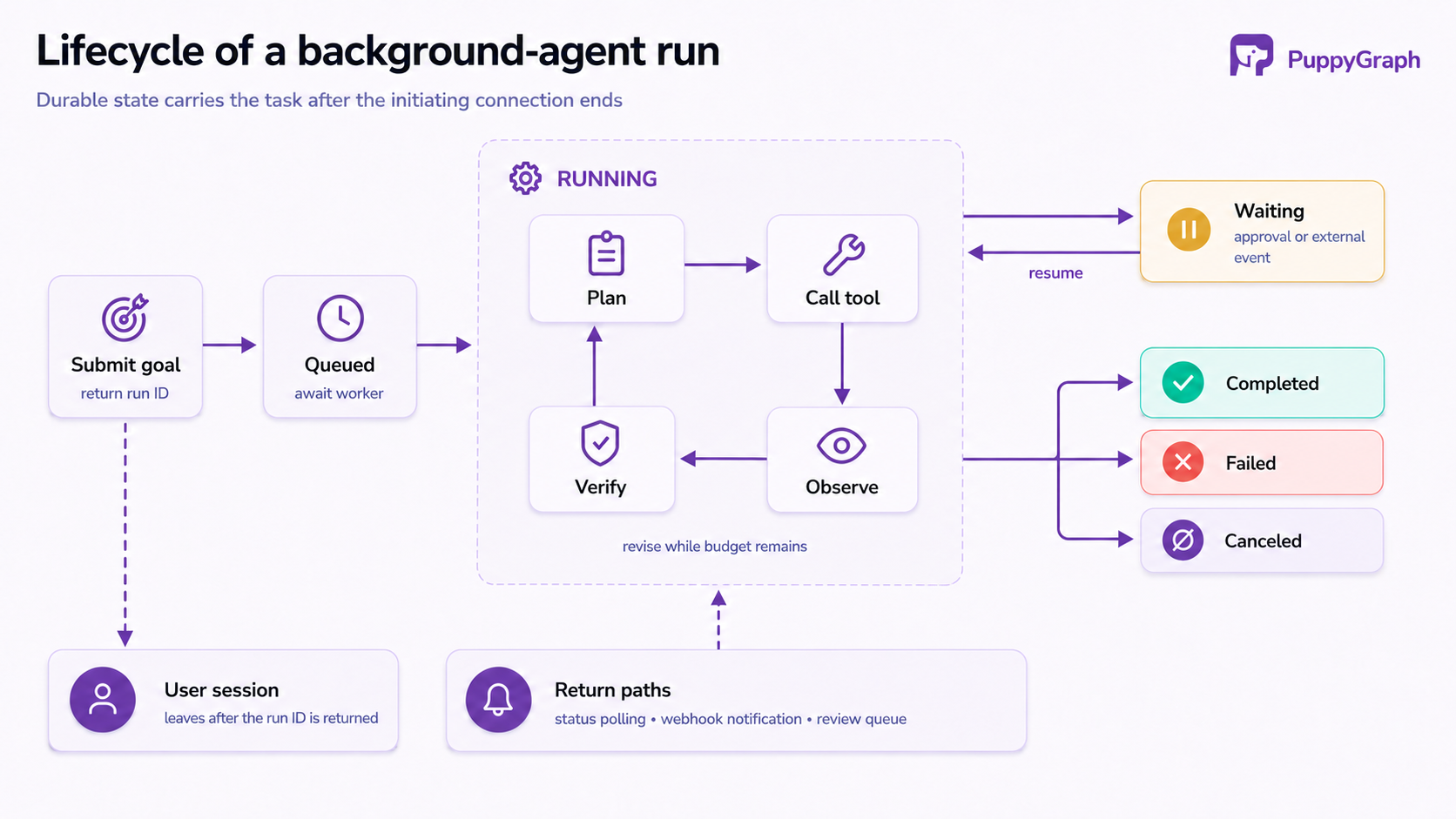
1. A trigger creates the run. A person submits a task, an application emits an event, or a scheduler fires. The control plane authenticates the caller, validates the request, records task metadata, and assigns a stable run ID. It should capture the goal, input references, permissions, budget, deadline, and success criteria before execution begins.
2. The orchestrator places work in a queue. The queue absorbs bursts and separates task intake from worker capacity. Priority, tenant quotas, and concurrency keys decide when the run may start. Concurrency control also prevents two agents from making conflicting changes to the same target.
3. A worker claims the task. The platform provisions or selects an execution environment with the required model, tools, credentials, and resource limits. Isolation matters because a repository-editing agent, a finance-analysis agent, and an incident-response agent should not inherit the same action surface.
4. The agent restores context and plans the next step. It loads the task specification and the latest checkpoint rather than depending on one process's memory. The plan can evolve, but each action should remain within the original goal and authority. If the run resumes after failure, the checkpoint tells it which steps have already completed.
5. The agent calls tools and records observations. A tool might search documents, query data, run code, or invoke an API. Each result informs the next step. The system appends the action, result, timing, and identifiers to the run history.
6. A verifier evaluates progress. Tests, schema checks, business rules, or a separate evaluator decide whether the output satisfies the success criteria. A useful verifier returns structured feedback that the agent can act on. If the check fails but the run remains within budget, the agent revises its plan and continues.
7. The run waits, retries, or escalates. Transient failures trigger bounded retries with backoff. A sensitive action moves the run to waiting. AWS documents the same callback pattern for ordinary workflows: a Step Functions execution can pause for human approval, then resume after the callback. An agent orchestrator adds reasoning around that wait, but should not let the model bypass it.
8. The platform commits the outcome. It saves the artifact, provenance, and verification result before marking success. On failure or cancellation, it records the reason and performs defined cleanup. A notification or review queue exposes the result.
Polling is the simplest status interface, but events or webhooks reduce repeated requests. Streaming can provide live progress without making the run depend on the stream. The durable run record remains authoritative if a client disconnects and later reconnects.
Core components of a background agent
A production design separates the control plane, which decides what should run, from the execution plane, which does the work. This keeps scheduling, permissions, and audit policy consistent across workers.
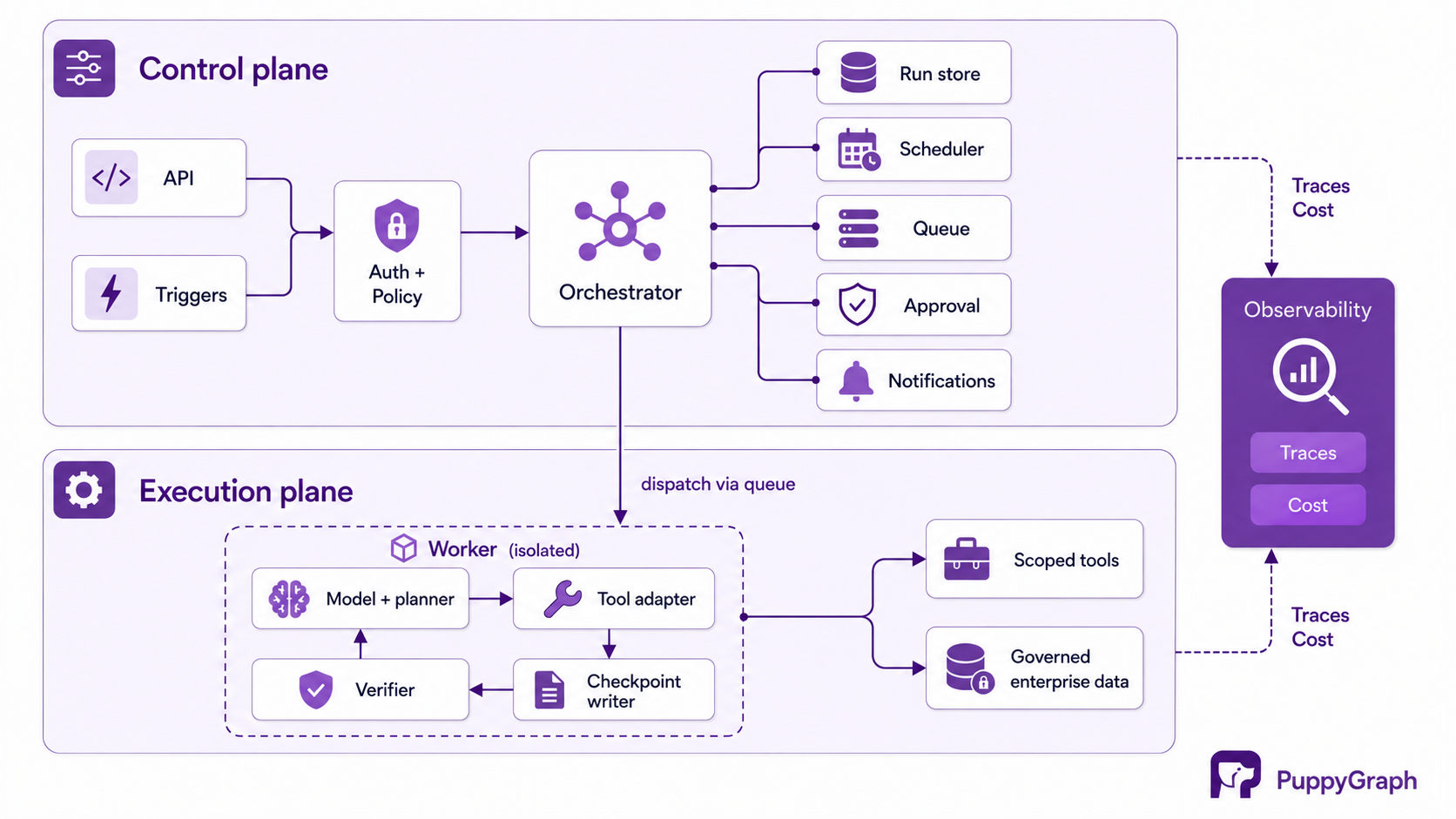
The control plane accepts work, decides when it can run, and preserves its state.
Task API and trigger layer. This is the front door for users, schedules, webhooks, and application events. It validates input, resolves identity, creates the run, and returns the run ID. A good API also exposes status retrieval, cancellation, and human-response endpoints.
Scheduler, queue, and orchestrator. The scheduler starts timed work, the queue buffers tasks, and the orchestrator advances run state. Together they enforce priority, concurrency, deadlines, retries, and backpressure. These controls belong outside the model because they must be predictable.
Durable run state and memory. The run store holds the task, checkpoints, tool results, approvals, and output references. Working memory supports one run; long-term memory may carry selected facts across runs. Each needs its own retention and access policy. Saving every prompt and tool response can expose secrets or carry unsafe content forward.
The execution plane reasons, invokes tools, and decides whether the result is ready to advance.
Agent worker and model runtime. The worker builds model context, asks the model for the next action, invokes the allowed tool, and repeats. Sandboxes or isolated containers limit the effects of code execution and file access. Time, token, tool-call, and cost budgets give every run a finite envelope.
Tool gateway and credentials. The gateway presents narrow, typed operations instead of broad credentials or unrestricted shell access. Authorization is checked when the action executes, not delegated to the model's judgment. The OWASP AI Agent Security Cheat Sheet recommends least-privilege tools, explicit authorization for sensitive operations, structured outputs, human oversight for high-impact actions, and limits on retries and tool chains.
Verifier and approval service. Automated checks handle outcomes a machine can grade. Approval gates cover accountability, business judgment, and irreversible impact. The agent may prepare a change, but the approval service authorizes execution.
Two cross-cutting concerns connect the agent to operators and governed enterprise data.
Observability and evaluation. Logs show events, metrics show rates and resource use, and traces connect a run to its model calls and tool invocations. OpenTelemetry's generative AI semantic conventions model an agent invocation with child spans for model and tool operations, which helps distinguish slow inference from a slow tool or repeated model and tool calls in an agent retry loop. Offline evaluations then test whether completed runs were correct, not merely whether they reached completed.
Optional knowledge and semantic access layer. A background agent acting on enterprise data may need a machine-readable account of which entities and relationships exist. PuppyGraph defines a graph schema over existing SQL databases, warehouses, and lakehouses, including direct reads of open table formats such as Iceberg and Delta Lake. That schema functions as an enforced ontology: openCypher and Gremlin queries are validated against it before execution, and an invalid entity or relationship reference returns structured, domain-level feedback the agent can use to correct its next attempt. On the default direct-query path, the data remains in its governed source, with no graph-specific ETL or separate graph store for the background workflow to keep synchronized.
The model supplies adaptive reasoning. The surrounding components supply identity, persistence, limits, verification, and recovery.
Benefits of using background agents
The main benefits follow from separating a task's execution from a person's active session.
For users, background execution removes the live session from the critical path and makes longer iterations practical.
Responsive applications. Submission can return as soon as the run is durably accepted. Users remain free to navigate away, start another task, or close the client. Progress and completion arrive through status views or notifications instead of a fragile open connection.
More time for iterative work. The agent can search, call tools, check results, and revise. This creates room for verification and correction, though it does not guarantee better output.
For operators, queues and checkpoints make capacity and failure recovery explicit.
Parallelism across independent tasks. Isolated runs can investigate separate issues or hypotheses at once. Queue limits and concurrency groups prevent contention. Shared writes still need serialization.
Recovery from transient failure. Durable checkpoints let a run resume after a worker restart or temporary dependency outage. The system can retry the failed operation instead of replaying every preceding model call. This improves reliability and avoids paying twice for completed work.
Elastic resource allocation. Workers scale separately from task intake. The platform can reserve expensive models or large sandboxes for tasks that need them. Priorities and quotas make that allocation explicit.
For governance, review queues and run histories keep people accountable for delegated work.
Better use of human attention. People review exceptions, approve consequential actions, and judge final artifacts instead of watching every step. The review queue connects asynchronous work to human accountability.
Auditable execution. A run record can connect the initiating identity, task specification, tool calls, approvals, artifacts, and verifier results. This is a stronger operational artifact than a chat transcript alone because it represents state transitions and side effects, not just messages.
Together, these benefits make background agents suitable for delegated work. The useful unit is no longer one response. It is a bounded run that can be submitted, observed, interrupted, reviewed, and reproduced closely enough to diagnose.
Challenges and limitations of background agents
Asynchronous autonomy shifts complexity out of the chat window and into distributed systems, security controls, and product design.
Operational failures require explicit delivery, cancellation, and state-recovery semantics.
Reliability is harder than starting a task. Workers crash, networks partition, callbacks arrive twice, and clients retry submissions after an uncertain response. Many queues provide at-least-once delivery, so the same task may be processed more than once. Amazon SQS explicitly advises designing standard-queue applications to be idempotent. Agent tools that create tickets, send messages, charge accounts, or update records therefore need idempotency keys, deduplication, or a transactional boundary.
Cancellation is cooperative. Marking a run canceled does not undo a message already sent or an external change already committed. Workers must check cancellation between steps, tools need timeouts, and long calls need a termination path. For irreversible actions, approval before execution is more reliable than hoping cancellation wins a race.
State can drift or become unsafe. A checkpoint may refer to a file, schema, or deployment that changed while the run waited. The agent should revalidate assumptions on resume and attach versions to important inputs. Persistent memory adds another risk: untrusted content can survive beyond the run that introduced it and influence later behavior. Memory needs provenance, isolation, expiration, and a deliberate write policy.
Cost and progress become harder for users to see once execution leaves the foreground.
Costs can grow invisibly. A user does not see every retry, tool call, or reasoning turn once the task leaves the foreground. Per-run budgets, global quotas, maximum loop counts, and alerts are necessary. A terminal state such as budget_exhausted is better than quietly converting a hard task into an unbounded bill.
Progress is difficult to communicate. Model-generated percentages are usually guesses. A trustworthy interface reports observable facts: current stage, completed checks, active tool, elapsed time, last checkpoint, and whether the run is waiting for input. The system should distinguish a healthy long step from a stalled worker.
Security controls, evaluation, and task selection determine how much autonomy the system should grant.
Security exposure increases with time and tools. A background agent may read untrusted content and act later without a person watching. Broad credentials magnify planning errors and prompt injection. Scoped identities, short-lived credentials, sandboxes, egress controls, action-level authorization, and human gates reduce exposure. Background operation does not widen authority.
Testing is nondeterministic. The same goal can produce different plans, tool sequences, and wording. Teams need scenario evaluations, recorded fixtures, policy tests, and outcome-based acceptance criteria. Replay is useful for debugging, but an external system may have changed and a model call may not reproduce byte for byte.
Not every task should be agentic. Deterministic workflows remain cheaper to test and easier to operate. Real-time conversations should stay interactive. High-impact decisions with vague success criteria should remain human-led. A background agent earns its architecture when adaptive planning is necessary, the outcome can be verified, and the allowed action surface can be bounded.
Conclusion
A background agent is an asynchronous, durable execution pattern for agentic work. It accepts a goal, continues through model and tool steps after the initiating connection ends, saves its state, and returns a result or a request for human input. Its architecture resembles a distributed workflow system because that is what makes long-running autonomy manageable: queues absorb work, orchestrators track state, workers run in isolation, verifiers judge progress, and approval gates retain human authority where it matters.
The design test is straightforward. Use a background agent when the task is variable, long-running, and checkable. Use an ordinary background job when the procedure is already known. In either case, durable state, idempotent side effects, bounded retries, cancellation, least privilege, and observable progress determine whether asynchronous execution remains reliable after the user leaves.
Try the forever-free PuppyGraph Developer Edition and book a demo with the team to see how openCypher and Gremlin queries traverse relationships across warehouse and lakehouse tables, with no graph-specific ETL, while structured ontology feedback gives the agent a path to correct invalid entity and relationship references.

Hao Wu is a Software Engineer with a strong foundation in computer science and algorithms. He earned his Bachelor’s degree in Computer Science from Fudan University and a Master’s degree from George Washington University, where he focused on graph databases.


