

8 Best Data Governance Software in 2026
.png)
Choosing data governance software means choosing where governance decisions will live and how far they can reach. Cross-platform suites coordinate policy and stewardship across a heterogeneous estate. Platform-native governance layers sit closer to runtime controls and activity inside one ecosystem. The best fit depends on the systems being governed, the people operating the program, and where policy must become enforcement.
This guide explains the category, its evaluation criteria, and eight tools worth considering in 2026.
What is data governance software?
Data governance software is the system used to define, apply, and monitor how an organization manages data. It gives data owners, stewards, platform teams, and consumers a shared place to answer five recurring questions: What data exists? What does it mean? Who owns it? Who may use it? Where did it come from?
Most platforms combine several capabilities. A data catalog inventories databases, tables, files, dashboards, models, and other assets. A business glossary connects technical fields to agreed terms such as customer, net revenue, or regulated identifier. Lineage records how data moves and changes from source to consumer. Classification identifies sensitive or regulated fields. Policy and workflow assign decisions, approvals, issues, and access requests to accountable people. Quality and audit evidence show whether governed assets meet their stated expectations and who changed or accessed them.
Those capabilities do not make governance automatic. Software can harvest metadata and route an approval, but it cannot decide who has authority to define a customer or whether a policy is practical. A governance platform works when an operating model supplies owners and decision rights, and the software makes those decisions discoverable, enforceable, and auditable.
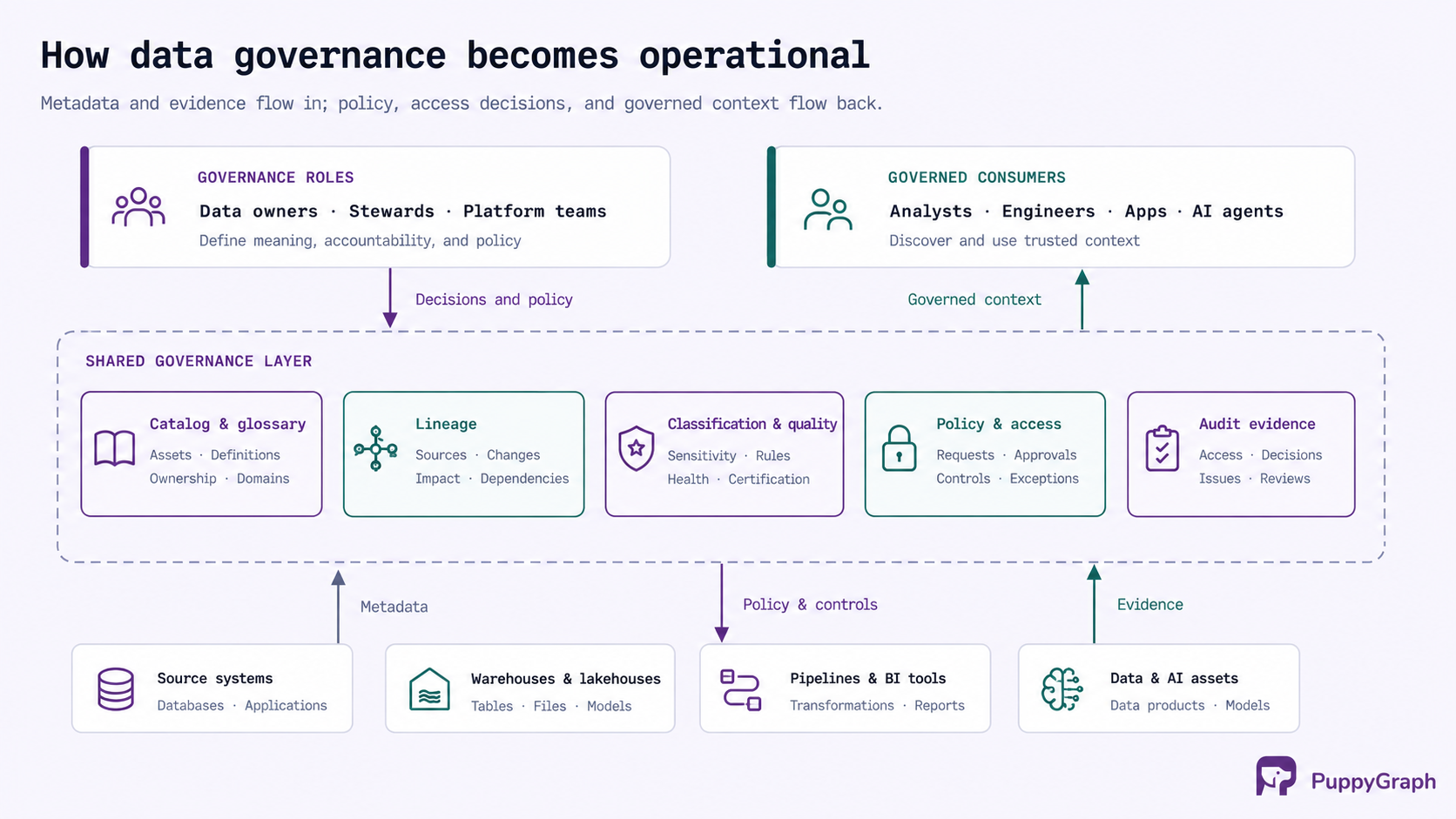
This distinction separates governance software from a catalog alone. A catalog helps users find and understand assets. Governance adds accountability and action: ownership, policy, workflow, control, evidence, and review. The best products join the two so that a definition or classification changes what happens next rather than ending as documentation.
How we evaluated the best data governance software
We evaluated the tools at the level where governance programs succeed or fail, not by counting features on product pages. The useful differences appear in coverage, enforcement, and day-to-day operation.
Metadata coverage and integration. A platform needs reliable metadata from warehouses, lakes, databases, transformation tools, BI platforms, and AI assets. Connector count alone is a weak proxy. Buyers should test each important connector for column-level lineage, classifications, and refresh behavior.
Business context and stewardship. Technical inventory becomes governable when assets have definitions, domains, owners, policies, certification states, and issue workflows. We looked for a usable bridge between engineers who produce metadata and stewards who curate meaning.
Lineage, quality, and impact analysis. Governance decisions depend on relationships. A steward needs to see where sensitive data travels; an engineer needs to know what a schema change will break. Native lineage, quality signals, and links from those signals back to assets carry more weight than a separate diagramming feature.
Policy and access workflows. Some products govern metadata, some orchestrate access requests, and some enforce permissions in the underlying platform. Those are different control levels. We distinguish between recording a policy, routing its approval, and pushing or directly enforcing a technical control.
Operating model and implementation fit. Centralized, federated, and domain-owned programs need different delegation structures. We considered domains, role-specific experiences, workflows, and self-service. Native platforms can capture rich activity with little instrumentation inside their own ecosystem, while cross-platform suites offer broader reach but require connector setup, identity integration, and stewardship design. The estate determines which form of effort is acceptable.
Enterprise pricing usually varies with asset volume, users, modules, or cloud consumption, so public figures rarely support a fair ranking. Request quotes against the same inventory and workload, including implementation, connectors, operations, and required adjacent products.
Best data governance software at a glance
The first four products govern heterogeneous estates from a cross-platform control plane. The final four begin inside a platform ecosystem and make its runtime metadata and controls part of governance. A mixed estate may use a broad catalog for enterprise accountability and native controls close to the data.
8 best data governance software / tools
1. Collibra
Collibra is the governance-suite candidate for organizations that need a formal operating model as much as a technical catalog. Its platform covers cataloging, stewardship, workflow, privacy, data quality and observability, lineage, a data marketplace, and policy controls. The catalog ingests metadata from databases, lakes, warehouses, enterprise applications, ETL tools, BI systems, and AI models, then connects those technical assets to business context. Collibra's current product documentation describes profiling, sampling, classification, technical lineage, data access, and a Control Tower for monitoring policy compliance as related parts of the same platform.
Collibra's strongest distinction is the connection between technical lineage and governance assets. Its lineage service harvests source metadata, stitches discovered objects to catalog assets, and exposes the result alongside ownership, definitions, classifications, and policies. The result serves stewards and auditors as well as engineers.
The same breadth makes implementation design consequential. Teams need an asset model, domain structure, roles, workflows, naming conventions, and connector plan. Even one technical detail can matter: automatic technical-lineage stitching requires an exact, case-sensitive match between the full paths of technical objects and catalog assets. A proof of concept should therefore test actual cross-system lineage and stewardship workflows, not stop after a successful metadata scan. Collibra fits enterprises with a dedicated governance function and enough organizational commitment to operate a configurable platform.
2. Atlan
Atlan approaches governance through active metadata: metadata harvested from the tools where data is produced and consumed, then used to power search, lineage, automation, and collaboration. Atlan's documentation describes an enterprise data graph assembled from warehouses, BI platforms, transformation tools, and observability systems. Users search that graph, inspect ownership and lineage, work with data products, and automate enrichment through playbooks.
This design fits teams that want governance to appear in everyday data work. Personas and policies can scope what different groups see and change. Metadata policies govern descriptions, classifications, glossary associations, ownership, certification, and other catalog properties. Data access policies and integrations can extend the workflow toward the underlying platforms, but buyers should distinguish metadata permissions from permissions on the data itself. Atlan states that distinction directly: its metadata policies do not govern the actual querying and retrieval of data.
Atlan also emphasizes context for AI tools, including metadata retrieval through MCP. Test whether critical connectors produce complete lineage, whether stewards can correct automated enrichment efficiently, and whether policy decisions reach the systems that enforce access. Atlan fits cloud-first teams using platforms such as Snowflake, Databricks, dbt, and modern BI tools, especially when search and adoption are primary goals.
3. Alation
Alation is a catalog-led governance platform built around discovery and the behavior of data users. It inventories technical assets, ingests query activity, captures lineage, and combines machine-generated signals with steward-curated definitions. Its catalog roots remain visible in the user experience: analysts can search for data, see ownership and documentation, inspect lineage, and use trust indicators before writing a query.
The governance layer adds the organizational machinery around that catalog. Alation's current product documentation lists a Policy Center, Workflow Center, Stewardship Workbench, and Governance Dashboard alongside trust flags, a marketplace, lineage, and data quality. Availability varies by deployment and license. Trust flags can warn users about deprecation or quality issues at the point of discovery. Compose, Alation's SQL editor, guides analysts toward trusted sources and preserves reusable queries and query history inside the catalog.
Alation is strongest when the governance program's immediate problem is getting people to find and choose the right data. Its usage signals and analyst-facing surfaces make adoption part of governance rather than a separate training campaign. For technically complex estates, the proof of concept should focus on lineage depth across the actual SQL, ETL, stored procedures, and BI models in scope. Also test how policy and access workflows integrate with the systems that hold the data. Alation fits organizations that want the catalog to become the practical front door for analysts and other data consumers.
4. Informatica
Informatica places governance inside a broader data management platform. Cloud Data Governance and Catalog runs as part of the Intelligent Data Management Cloud, alongside data integration, quality, master data management, privacy, and marketplace capabilities. Informatica has operated as part of Salesforce since the acquisition closed in November 2025, and its products are now marketed as Informatica from Salesforce.
The governance product centralizes technical metadata, business definitions, stakeholders, classifications, policies, and lineage. Its CLAIRE engine assists with discovery and classification, while the wider platform connects governance metadata to quality rules, integration-pipeline lineage, MDM assets, and data access management. Informatica describes Cloud Data Governance and Catalog as a shared catalog and business-context layer with lineage, which is the core of its appeal: governance does not sit apart from the machinery already moving and correcting enterprise data.
That breadth is most valuable when the organization needs several Informatica capabilities or already has significant Informatica lineage. It can be excessive when the requirement is only lightweight discovery and ownership. Evaluate license packaging, migration from legacy Informatica metadata products, connector depth outside Informatica-managed pipelines, and the boundaries between governance, quality, integration, and access modules. Informatica fits large, heterogeneous estates seeking an integrated suite.
5. Microsoft Purview
Microsoft Purview spans data governance and Microsoft's broader security, risk, and compliance portfolio. For this comparison, the relevant products are the Data Map and Unified Catalog. The Data Map captures and stores metadata and lineage. Unified Catalog presents that inventory through governance domains, data products, business concepts, quality signals, health controls, and access workflows.
Microsoft's Unified Catalog documentation shows the operating model clearly. Domains provide business-aligned boundaries for governance responsibility; data products package related assets for consumption; access policies pair self-service requests with right-use requirements; and objectives and key results connect governance work to business goals. This is more than a search page over scanned metadata. It is Microsoft's surface for federated governance, with stewards curating products and consumers requesting governed access.
Purview has the clearest fit in estates built around Azure, Microsoft Fabric, Power BI, and Microsoft identity and compliance services. Integration depth varies across Microsoft services: Fabric assets can appear through live view, while Power BI lineage requires registration and scanning. Cross-platform coverage varies by source and depends on supported scans, connectors, lineage integrations, and APIs. Buyers should test the exact routes they need and distinguish the free and enterprise experiences, since Microsoft's getting-started guidance assigns the full Unified Catalog workflow to the enterprise version. Purview fits organizations that want data governance to share an ecosystem with their analytics, identity, security, and compliance controls.
6. Databricks Unity Catalog
Databricks Unity Catalog is the governance layer built directly into the Databricks platform. It represents tables, views, volumes, functions, models, and services as securable objects. The same layer enforces privileges, records audit activity, supports row filters and column masks, classifies data, monitors quality, and exposes assets through Catalog Explorer.
Its main advantage is proximity to execution. When Databricks runs a governed workload, Unity Catalog can enforce access and capture activity without a separate catalog trying to infer everything afterward. Unity Catalog lineage is captured automatically for supported Databricks queries, down to columns, and can connect tables to notebooks, jobs, dashboards, models, and external assets. Permissions also shape what a user can see in the lineage graph.
Unity Catalog is therefore a strong default for organizations whose engineering, analytics, and AI work centers on Databricks. An Apache 2.0 open-source Unity Catalog implementation also exists as an LF AI & Data sandbox project. The managed Databricks service separately supports external metadata and external lineage and integrates directly with Databricks workspaces and workloads. A cross-platform evaluation should test how much governance context is captured from systems that execute elsewhere, how enterprise glossary and stewardship needs will be met, and whether a separate enterprise catalog is still required. Unity Catalog fits teams that want governance enforced in the lakehouse control plane rather than added as a parallel layer.
7. Amazon DataZone
Amazon DataZone organizes governance around domains, projects, publishing, and subscriptions. Producers bring assets into project inventories, enrich them with business metadata and glossary terms, and publish them to a domain catalog. Consumers discover those assets and request subscriptions on behalf of projects. Owners approve or reject requests, and fulfillment can create the corresponding grants for supported AWS assets.
That producer-consumer workflow is DataZone's clearest strength. It treats a catalog entry as something a team can publish and another team can request, with the purpose and approval preserved. AWS documents managed fulfillment for assets such as AWS Glue tables and Amazon Redshift tables and views through services including Lake Formation and Redshift. Projects also give consumers a working context rather than granting isolated users one asset at a time.
DataZone can catalog data across AWS, on-premises, and third-party sources, but its most direct enforcement paths and analytics environments are AWS-native. Organizations should test external-source metadata depth, lineage requirements, identity boundaries across accounts, and how DataZone relates to Lake Formation, Glue Data Catalog, IAM, and any enterprise-wide catalog already in place. It fits AWS organizations adopting domain-oriented data products and self-service access, especially when data sharing between producer and consumer teams is the governance program's central workflow.
8. Google Cloud Knowledge Catalog (formerly Dataplex Universal Catalog)
Google Cloud Knowledge Catalog, renamed from Dataplex Universal Catalog in 2026, is Google Cloud's catalog and governance layer for data and AI assets. Existing Dataplex Universal Catalog deployments, API endpoints, gcloud dataplex commands, metadata, and configurations remain in place, so the name change requires no migration. The platform automatically ingests metadata from Google Cloud services and can incorporate third-party or custom assets.
The governance foundation includes a business glossary, extensible structured metadata built from aspect types and aspects, search, lineage, profiling, quality checks, and policy-based controls. Search combines semantic and keyword matching while respecting source-system permissions. Lineage tracks supported Google Cloud data flows and is also available through an API. Current Knowledge Catalog capabilities also include generated descriptions, inferred relationships, data products, and context retrieval for AI applications, but buyers should evaluate those as extensions to the core catalog rather than substitutes for definitions and stewardship.
Knowledge Catalog fits organizations centered on BigQuery and the wider Google Cloud data platform. Its native metadata and lineage reduce instrumentation inside that ecosystem, while heterogeneous estates should validate each non-Google source. Dataplex Universal Catalog is the former name of the current service, while the older Data Catalog product is a separate legacy predecessor whose phased shutdown began in June 2026. Compare capabilities against current Knowledge Catalog documentation rather than treating the names as interchangeable.
How to choose the best data governance software
Start with the governance decision that is failing today. If analysts cannot find trusted data, prioritize discovery and certification. If audits require evidence across systems, prioritize classification, lineage, policy, and history. If access requests take weeks, test approval and fulfillment. If domains need autonomy, evaluate delegation and data-product workflows. A precise failure produces a useful proof of concept.
Map the control plane before comparing products. List the systems that store data, transform it, expose it, and enforce permissions. Then mark which platform already has authoritative metadata for each. Unity Catalog, DataZone, Purview, and Knowledge Catalog derive much of their value from being close to execution in their respective ecosystems. Collibra, Atlan, Alation, and Informatica are designed to connect context across systems. The right architecture may combine a cross-platform governance record with native enforcement rather than forcing one product to do both jobs.
Test depth, not connector logos. Select several difficult paths: a source column transformed through orchestration and SQL into a dashboard; a sensitive field copied into a model feature; an access request crossing an account or domain boundary. Verify that the tool captures column-level lineage, ownership, classifications, and policy context all the way through. Record what requires parsing, query logs, an agent, an API, or manual curation.
Run the proof of concept with stewards and consumers. Ask a steward to resolve a definition conflict, assign an owner, certify an asset, and close a quality issue. Ask an analyst to find the approved dataset, understand its grain, inspect its lineage, and request access. Measure time and ambiguity.
Separate documentation, workflow, and enforcement. A policy attached to an asset is documentation. An approval task is workflow. A grant, mask, filter, or query rejection applied in the runtime is enforcement. All three matter, but a product may provide only one or two for a given source. Build the requirements matrix at that level so a broad platform claim does not hide a control gap.
Finally, price the operating model, not just the license. Include connector deployment, identity integration, workflow configuration, migration, steward time, administration, and adjacent modules. A low subscription price can hide continuous manual curation, while a broad suite is wasteful if the organization uses only its catalog.
Check how governance reaches semantic queries. Catalogs and glossaries define meaning, but applications and AI agents still need a query interface that follows those definitions. PuppyGraph complements the platforms in this guide by defining a graph schema over existing SQL databases, warehouses, and lakehouses, including direct reads of open table formats such as Iceberg and Delta Lake. That schema works as an ontology of entities, relationships, and properties. Each openCypher or Gremlin query is validated against it before execution, so invalid entity or relationship references are rejected with structured feedback. PuppyGraph queries the governed source tables in place by default, with no ingestion or persistent duplicate graph store, which avoids creating another data copy with its own access, retention, and lineage obligations. Its graph schema adds a semantic model to the relationship-query path while source tables remain in their existing systems.
Conclusion
The best data governance software is the one that closes the gap between the organization's decisions and its data systems. Collibra and Informatica offer broad enterprise suites. Atlan and Alation put discovery and active metadata at the center. Microsoft Purview, Unity Catalog, Amazon DataZone, and Google Cloud Knowledge Catalog bring governance close to their native platforms and controls. The shortlist should follow the estate, the operating model, and the first governance failure the program needs to fix.
Choose two or three candidates with the right architectural fit, then test the same lineage path, policy decision, access request, and steward workflow in each. The result will reveal more than a feature matrix because it shows how much governance the organization can actually operate.
Try the forever-free PuppyGraph Developer Edition and book a demo with the team to see how openCypher and Gremlin queries traverse relationships in a semantic model over warehouse and lakehouse tables, with no graph-specific ETL, while the source tables remain in their existing warehouse or lakehouse.

Hao Wu is a Software Engineer with a strong foundation in computer science and algorithms. He earned his Bachelor’s degree in Computer Science from Fudan University and a Master’s degree from George Washington University, where he focused on graph databases.


