

7 Best Enterprise AI Tools in 2026
The enterprise AI market has split into three shapes that solve different problems: assistants embedded in the tools people already use, agents that execute multi-step work with some autonomy, and platforms that let organizations build and govern AI over their own data. A useful shortlist spans those shapes rather than ranking seven products that all do the same thing, because most organizations end up adopting one tool per function, not one tool for everything.
This post defines what makes an AI tool an enterprise tool, looks at why the investment is accelerating, lays out the criteria that should drive a selection, and walks through seven tools worth evaluating in 2026, spanning productivity, customer service, automation, analytics, and decision support, with an honest note on where each fits and where it does not.
What are enterprise AI tools?
Enterprise AI tools are AI systems adopted at the organization level rather than by individual users, with the controls that organization-level adoption requires: identity integration (SSO and SCIM provisioning), role-based permissions, audit logs, admin consoles, and contractual guarantees about how business data is handled, including commitments that it is not used to train the vendor's models. The model underneath may be the same one a consumer app uses; what makes the tool an enterprise tool is everything wrapped around the model that lets a security team approve it and an IT team operate it.
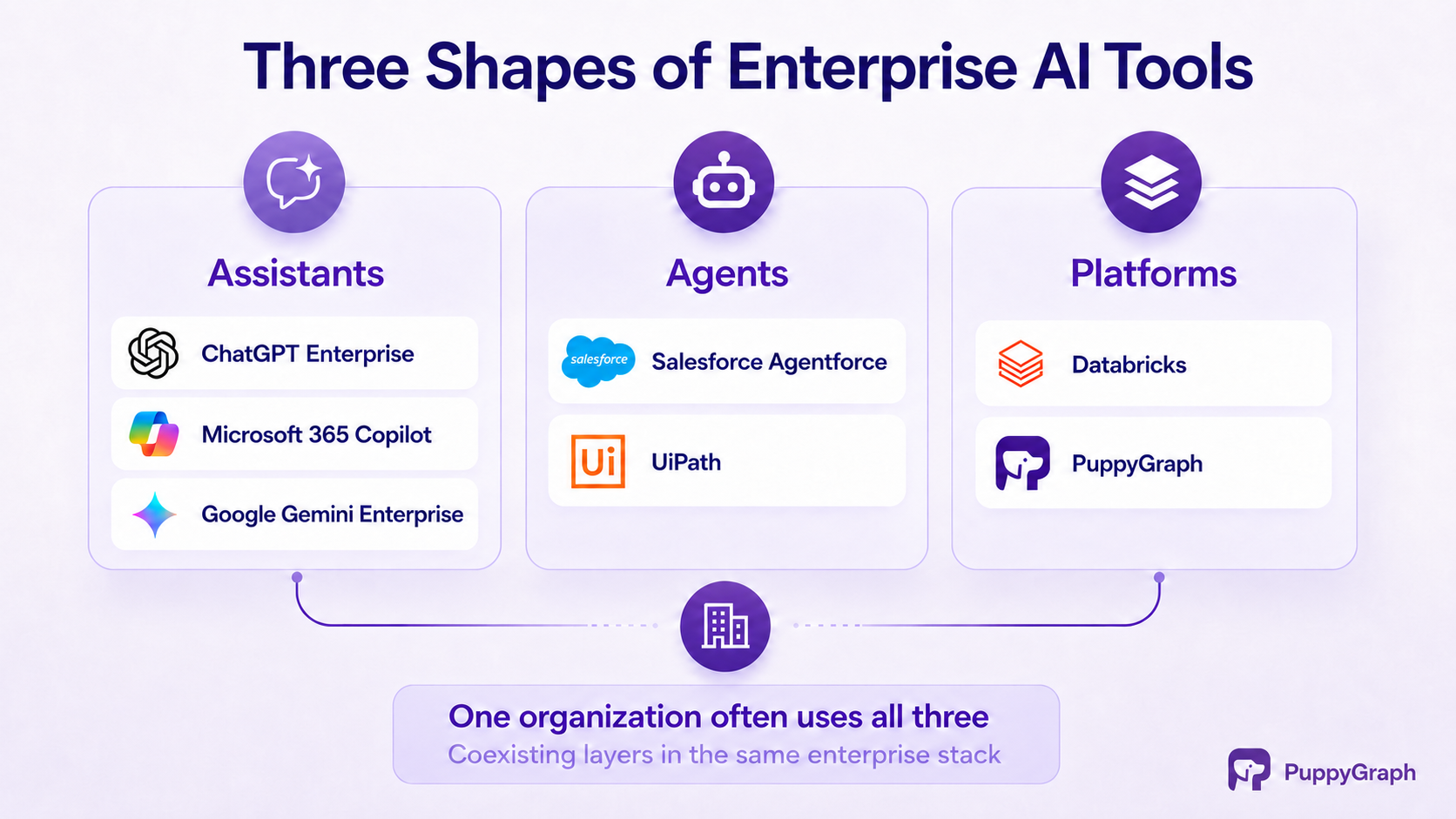
Within that definition, the current market falls into three shapes. Assistants embed generative AI into work people already do: drafting in a document editor, summarizing a meeting, answering questions in a chat interface. Agents go a step further and execute multi-step tasks with a degree of autonomy: resolving a support ticket end to end, processing an invoice through several systems, researching a question across many sources before answering. Platforms are what organizations build on: they provide the models, data connections, governance, and tooling for a company to create its own assistants and agents grounded in its own data.
The other boundary worth drawing is between adopting a function and building a capability. Tools like Microsoft 365 Copilot or Salesforce Agentforce are adopted: they arrive with a defined job and deliver value quickly inside their ecosystem. Platforms like Databricks are built on: they assume engineering capacity and return flexibility for the effort. Most enterprises need both, which is why the list below deliberately mixes the two.
Why businesses are investing in enterprise AI
Adoption is no longer the story; depth is. McKinsey's State of AI survey (November 2025) found that 88 percent of organizations now regularly use AI in at least one business function, up from 78 percent a year earlier. The same survey shows where the pressure has moved: most organizations are still experimenting or piloting rather than scaling, and only a minority report AI deployed broadly across functions. The gap between using AI somewhere and running it as part of core workflows is exactly what enterprise tooling exists to close, and it is why spending keeps climbing even in organizations that already use AI somewhere. Gartner forecasts (May 2026) that worldwide AI spending will total $2.59 trillion in 2026, a 47 percent increase over 2025.
Three drivers explain where that money is going. The first is the shift from chat to execution. The early wave of enterprise AI was conversational: ask a question, get a draft. The current wave is agentic: systems that read documents, call other systems, apply business rules, and complete a process. That shift raises the ceiling on value (an agent that resolves a ticket is worth more than an assistant that summarizes it) and also raises the bar on governance, because autonomous execution demands identity, observability, and guardrails that a chat window never needed.
The second is that the controls became the product. Enterprises that blocked consumer AI apps in 2023 were not rejecting the capability; they were rejecting the data handling. The enterprise tiers that emerged since, with no-training commitments, tenant isolation, permission-aware data access, and compliance APIs, are what turned personal experimentation into sanctioned deployment.
The third driver is data gravity. A model with no access to enterprise data produces generic output; the same model grounded in the company's documents, tickets, tables, and metrics produces work that is specific and checkable. That is why so much of the current tooling investment lands on the data side: connectors, retrieval, semantic layers, and governance over what AI systems can reach. The tools on this list differ most in how they connect that model to what the organization already knows.
How to choose the right enterprise AI tool
The evaluation criteria matter more than the vendor shortlist, because the category is broad enough that two excellent tools can be useless for each other's jobs.
Start from the function, not the model. The model leaderboard changes quarterly; your problem does not. Define the workflow you want to improve (support resolution, document drafting, invoice processing, analytical decisions) and evaluate tools against that workflow. A tool that is second-best in general but embedded where the work happens will usually beat a stronger model in a separate tab.
Data access and grounding. Ask what enterprise data the tool can reach, how it gets there, and what happens to it. Does the tool copy data into its own store or query it in place? Does it respect existing per-user permissions or flatten them? Grounding quality sets output quality, and the failure mode of weak grounding is confident, generic, or wrong answers that erode trust with each occurrence.
Security and governance. The baseline is SSO and SCIM, role-based access, audit logs, and a contractual commitment that business data does not train the vendor's models. For agents, the bar is higher: each agent needs an identity, its actions need to be observable and attributable, and its permissions need to be scoped to its task rather than inherited from whoever deployed it.
Integration surface. An assistant inside the tools people already use gets adopted by default; a new destination app has to earn every visit. For agents and platforms, integration means something more specific: which systems can the tool read and act on, through supported connectors rather than custom work, and how much of your stack does that cover.
Cost model and measurable outcomes. Per-seat pricing is predictable and suits broad assistant rollouts; consumption pricing (per query, per action, per resolution) tracks value more closely but needs modeling against real volumes before commitment, and for platforms the engineering time that turns the platform into a working capability routinely exceeds the license cost. Whatever the pricing shape, decide before rollout what improvement would justify the spend: resolution rate and handle time for service, cycle time for automated processes, time-to-answer for analytics. Tools that cannot show movement on a metric within a pilot rarely improve after an enterprise-wide commitment.
These criteria are not independent; they compound in one direction. Grounding quality sets the ceiling on output quality, so a tool that cannot reach the right data returns generic answers no matter how clean its security model or its pricing. The evaluations that hold up weight data access first and treat the rest as gates layered on top of it, which is roughly the lens to carry into the seven tools below.

7 best enterprise AI tools in 2026
The seven tools below each anchor a different function from the criteria above. They are complements far more than competitors; a realistic enterprise portfolio contains several of them.
ChatGPT Enterprise
ChatGPT Enterprise is OpenAI's organization-level tier of the most widely recognized AI assistant, and for many companies it is the first sanctioned deployment of generative AI. It adds the controls the consumer product lacks: SSO and SCIM, role-based access, admin controls and a compliance API, and a default commitment that business data is not used for model training. Its grounding story has matured considerably: connectors and the company-knowledge feature let ChatGPT answer from sources like Slack, SharePoint, Google Drive, and GitHub while respecting the permissions each user already has in those systems. Teams can also build custom GPTs and agents for repeatable internal tasks. It is best for organizations that want a capable general-purpose assistant across every department without committing to one productivity suite's ecosystem. The limitation is that ChatGPT is a destination: value depends on people bringing work to it, and its knowledge of your business extends exactly as far as the connectors an admin has enabled. Pricing is per-seat, negotiated at contract level.
Microsoft 365 Copilot
Microsoft 365 Copilot takes the opposite approach: instead of a destination, it embeds AI inside Word, Excel, PowerPoint, Outlook, and Teams, grounded in the tenant's own Microsoft Graph data (files, mail, meetings, chats) with existing permissions enforced. That placement is its argument: drafting, summarizing, and answering happen where the work already lives, so adoption requires no new habit. Copilot Studio extends it with custom agents over line-of-business systems. It is best for organizations standardized on Microsoft 365 that want AI woven into daily productivity with minimal behavior change. Two limitations follow from the same design. Value concentrates sharply in Microsoft-centric environments, and Copilot's grounding inherits the tenant's data hygiene: permissions that were quietly over-broad become visible when an assistant starts surfacing what they technically allow. It is priced as a per-seat add-on on top of existing Microsoft 365 licensing.
Google Gemini Enterprise
Google Gemini Enterprise is Google's organization-level AI offering, pairing an employee-facing app (chat, enterprise search over connected sources, and a no-code agent builder) with Workspace integration across Gmail and Docs. At Google Cloud Next 2026 it grew a substantial second half: the Gemini Enterprise Agent Platform, which covers building, scaling, governing, and optimizing agent fleets, including agent identity, a registry, gateway-level guardrails, and evaluation and observability tooling, with access to a broad model garden rather than Google's models alone. It is best for Google Cloud and Workspace organizations, and for teams that expect to run many agents and want the governance apparatus in the same platform they build on. The limitation is newness at the platform layer: the agent tooling is evolving quickly, which favors teams comfortable tracking a fast-moving roadmap, and the tight integration story assumes a meaningful Google footprint. Pricing runs per-seat for the app tiers with consumption-based pricing on the platform side.
Salesforce Agentforce
Salesforce Agentforce is the customer-service anchor of this list: a platform for deploying AI agents over Salesforce CRM data, now packaged as part of Agentforce 360. Its service agents handle customer requests across chat and voice without pre-scripted dialog trees, grounded in the CRM records, knowledge bases, and business rules the organization already maintains, with hybrid reasoning that combines deterministic logic with model judgment and escalates to humans on defined conditions. It is best for enterprises whose customer operations already run on Salesforce and who want agents that act on the system of record rather than beside it. The limitation is the mirror of that strength: value is tied to Salesforce being the system of record, and the consumption-based pricing (including pay-per-resolution options) needs careful modeling against real case volumes, since costs scale with usage in a way per-seat licensing does not.
UiPath
UiPath comes at enterprise AI from the automation side. The company built its position on robotic process automation, and its platform now combines those deterministic software robots with AI agents and human approvals under one orchestration layer, Maestro, which models end-to-end processes and routes each step to the right executor: a robot for the repetitive part, an agent for the judgment call, a person for the exception. That mix matters because most real back-office processes (claims, invoices, onboarding) contain all three kinds of work, and pure-agent approaches give up the auditability that regulated processes require. It is best for organizations automating document-heavy, multi-system processes that need governance over every step. The limitation is platform weight: UiPath assumes a serious automation program, typically with a center of excellence, and a small automation footprint will not justify the operational overhead. Licensing is platform-based and scales with usage.
Databricks
Databricks is the build-platform entry: a data intelligence platform where the lakehouse holding an organization's data and the tooling for building AI over it share one governance layer, Unity Catalog. Its Mosaic AI capabilities cover model training, fine-tuning, serving, and evaluation, and Agent Bricks generates task-specific agents from a description plus connected enterprise data, using automatically generated evaluation benchmarks to tune quality. The through-line is that models, agents, data, and permissions live in one governed platform instead of being stitched across vendors. It is best for organizations with data engineering capacity that want to build AI products and internal capabilities on their own data rather than adopt someone else's packaged assistant. The limitation is that it is a platform in the full sense: nothing arrives turnkey, value depends on the data foundation and the team operating it, and consumption-based costs need active management as workloads grow.
PuppyGraph
PuppyGraph addresses the decision-support layer of the list: the relationship questions that get harder as AI systems reach deeper into enterprise data. It is a graph query engine that adds a graph model, in effect an ontology of the business's entities and relationships, directly on top of existing SQL data stores (relational databases, warehouses, lakes, and open table formats such as Iceberg) with zero ETL: data stays where it lives, and PuppyGraph queries it in place through its own distributed engine rather than translating graph queries into SQL for the source to execute. Analysts and applications query it in openCypher, with Gremlin also supported. What earns it a place on an enterprise AI list specifically is how that ontology behaves as a grounding layer for AI: every query is validated against the schema before execution, so a generated query that references entities or relationships that do not exist is rejected with structured, machine-readable feedback rather than executed into a wrong answer, which gives AI agents a correction signal instead of a silent failure. A built-in AI assistant uses the same loop to answer natural-language questions with graph queries. It is used by teams at Coinbase, eBay, AMD, Dawn Capital, and Prevalent AI. The limitation is scope: PuppyGraph is a data-layer tool for querying and grounding, not a general-purpose assistant or an automation platform, and it assumes your data lives in relational stores over which a graph schema is then defined. It complements the tools above rather than replacing any of them. A forever-free Developer Edition is available alongside commercial tiers.
Comparison of the top enterprise AI tools
The table makes the structural point directly: these seven occupy different layers of the same stack. An organization might roll out Copilot or ChatGPT Enterprise for general productivity, run Agentforce for customer service, orchestrate back-office processes with UiPath, and build its own data products on Databricks, with PuppyGraph supplying the relationship layer that grounds analytical questions and agent data access in the data those systems already produce. Choosing between the tools in this list is mostly a within-function decision; the cross-function decision is how many of these layers your organization actually needs this year, and in what order.
Conclusion
The enterprise AI market in 2026 rewards buyers who match the tool to the function and to where their data lives. Assistants win on placement, agents win on execution with governance, and platforms win on what you can build with them; no single product covers all three, and pretending one does is how pilots stall. The selection criteria compound in one direction: the tools that hold up in production are the ones with honest answers about data access, permissions, and measurable outcomes, not the ones with the best demo. Whatever portfolio you assemble, the data layer decides how good the rest can be, because every assistant and agent on this list is ultimately bounded by what it can reach and trust.
If grounded access to the relationships in your existing data is the layer you are missing, the PuppyGraph Developer Edition is forever-free and runs against the stores you already operate: download it here. To see how an enforced ontology keeps agents and analysts on the same schema across a realistic deployment, book a demo with the team.

Hao Wu is a Software Engineer with a strong foundation in computer science and algorithms. He earned his Bachelor’s degree in Computer Science from Fudan University and a Master’s degree from George Washington University, where he focused on graph databases.


