

7 Best Enterprise Security Tools in 2026
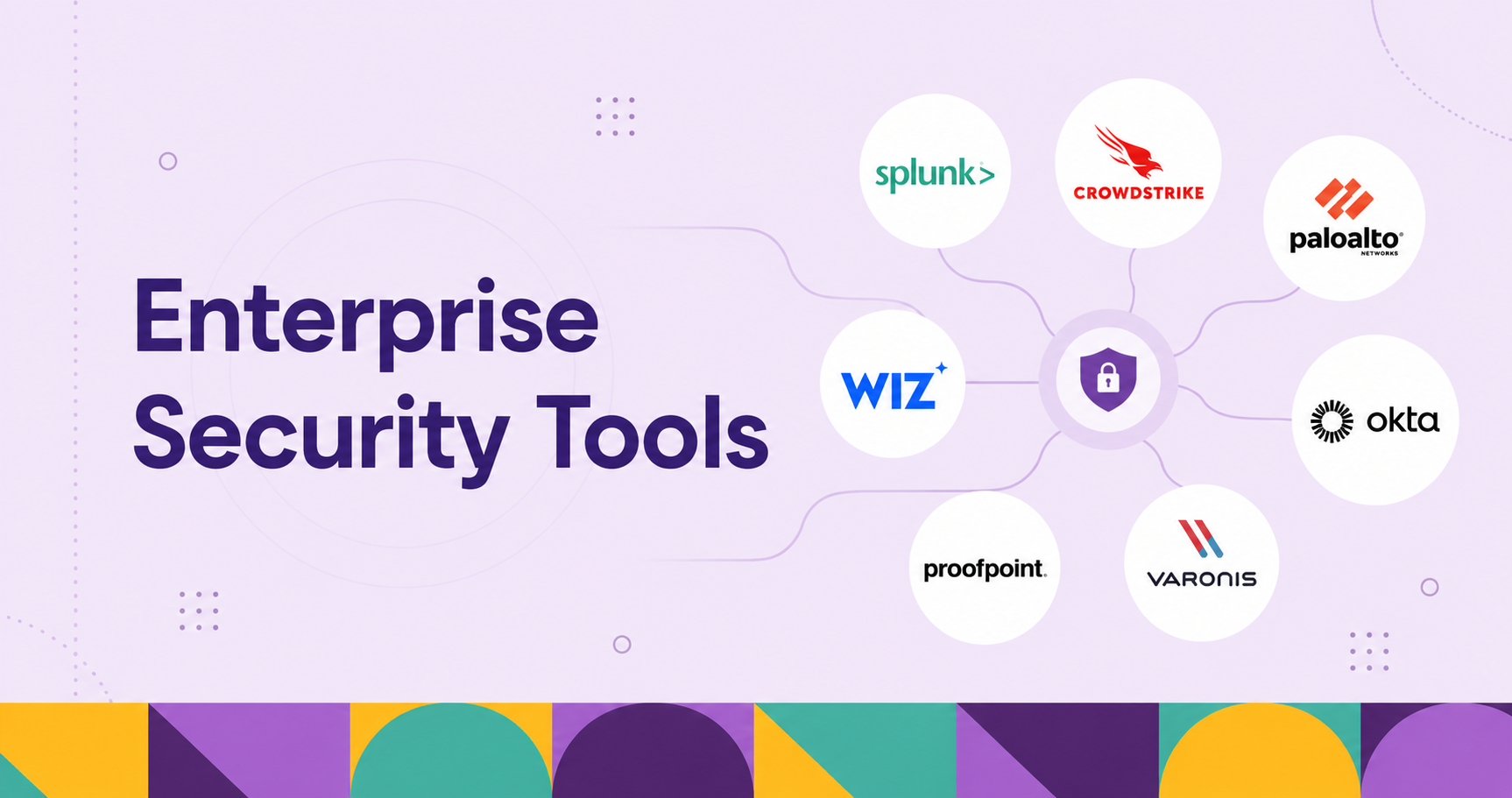
No single tool secures a modern enterprise. The estate is too large and too varied: tens of thousands of endpoints, several clouds, SaaS applications, a distributed workforce, and the identities and data that tie them together. So enterprise security is not one product but a stack of specialized ones, each covering a slice of the surface, and the hard part is choosing the slices that matter and making them work together. The best tools in 2026 are the ones that go deep in their lane and stay open enough to fit the rest of the stack around them.
This post walks through seven enterprise security tools worth knowing in 2026, chosen to span the category rather than pile up in one corner of it: a SIEM, an endpoint platform, a network platform, a cloud-native platform, an identity provider, a data-security tool, and an email-and-human-layer tool. It first defines what these tools are and why they matter, sets out the features that separate them, compares the seven side by side, and closes with how to choose and how to connect what they each find into a picture no single one of them holds.
What are enterprise security tools?
Enterprise security tools are the software platforms a large organization uses to protect its networks, endpoints, cloud environments, applications, identities, and data against cyber threats, the discipline known broadly as enterprise cybersecurity. Each addresses a specific layer of the attack surface: an endpoint tool watches the devices, a network tool watches traffic and access, a cloud tool watches the accounts and workloads, an identity tool governs who can reach what, and so on. Together they form the defensive stack that a security operations team runs.
What makes them enterprise tools rather than small-business ones is less a different feature set than a different operating environment. They have to scale to hundreds of thousands of assets, span platforms no single console covers, integrate with the dozens of other systems already in place, and keep working while the environment underneath them changes by the hour. A tool that protects one office network is a product. A tool that holds up across a global, multi-cloud, continuously changing estate, owned by many teams at once, is an enterprise security tool. The categories below are the standard divisions of that estate, and most mature programs run at least one tool in each.
Why enterprise security tools are essential
The threat volume and cost are both high. The Verizon 2025 Data Breach Investigations Report analyzed over 12,000 confirmed breaches and found ransomware present in 44% of them, up from 32% the year before, and third-party involvement roughly doubled to 30%. The IBM Cost of a Data Breach Report 2025 put the global average cost of a breach at $4.44 million, with the United States average reaching a record $10.22 million. At that scale, the tooling that shortens detection and containment pays for itself against a single avoided incident.
The attack surface has no edge left to defend. Workloads run across on-premises systems, multiple public clouds, SaaS, and short-lived containers, reached by a workforce on home and mobile networks. The perimeter model that trusted an inside and hardened a boundary no longer fits, and the modern posture (zero trust: verify every request regardless of origin) shifts the defensive center of gravity onto identity, data, and continuous monitoring. Covering that surface takes tools purpose-built for each layer, because no single agent or appliance sees all of it.
People remain the most reliable way in. The same Verizon report found the human element present in 60% of breaches: phishing, stolen credentials, and error. That is why the stack has to reach past infrastructure to the human layer (email security, identity, awareness), and why buying more tools is not the same as being more secure. The point of the categories below is coverage without gaps, not console count.
The signal that matters usually spans tools. A real intrusion rarely turns on one alert in one console. It chains a phished credential, an over-permissioned identity, a reachable host, and a path to sensitive data, with each link sitting in a different tool. Enterprise security tools are essential precisely because the surface is too big to defend by hand, but the same fragmentation that makes them necessary is what makes correlating across them the standing problem, one we return to at the end.
Key features to look for in enterprise security tools
The dimensions below are what separate platforms in this space, and they double as the spine of the comparison and the entries that follow.
Coverage of your actual attack surface. The first question is whether a tool covers the layer you most need covered, and how deeply. Breadth and depth trade off: broad platforms touch many layers shallowly, specialists go deep in one. Map a candidate against where your own program is thinnest (endpoint, network, cloud, identity, or data) rather than against a generic feature checklist.
Detection and response, not just visibility. Inventory and dashboards are table stakes. The tools that earn their place add behavioral and threat-intelligence-driven detection, and then let you act: isolate a host, revoke a session, block a path, open a ticket. A tool that only reports leaves the work where the alerts already pile up.
Integration and openness. No enterprise tool operates alone. The ones worth adopting expose APIs, ship connectors to the SIEM and SOAR and ticketing systems already in place, and export their data in formats other tools can consume. A capable platform that cannot share its findings becomes another silo, and silos are the reason cross-tool attacks go unseen.
Scale, deployment model, and operational fit. Agent, agentless, appliance, or SaaS each carries different coverage and rollout costs, and enterprise scale punishes tools that cannot keep up. Weigh how the tool is deployed, how it holds up across hundreds of thousands of assets, and how much operational load it adds to an already stretched team.
Correlation and context across signals. The highest-value property is whether a tool helps connect its findings to everything else, so an exposure shows up as part of an attack path rather than an isolated line item. Few tools do this well across data they do not own, which is exactly the gap the closing section takes up.
No single tool leads on all five. The table and entries below make that concrete.
7 best enterprise security tools
The seven span the standard divisions of an enterprise security program, one strong representative per layer rather than several near-identical products. Each entry names what the tool is genuinely best at and one limitation worth knowing before committing.
The table makes the category’s shape clear: each tool leads on a different layer, so the right set depends less on which is best overall and more on where your own coverage is thinnest.
1. Splunk Enterprise Security
Splunk Enterprise Security is a market-defining SIEM, built on Splunk’s data platform to ingest logs and events from across an estate and turn them into detections, investigations, and dashboards. It correlates signal from endpoints, network devices, cloud services, and applications into a single analytics layer, with risk-based alerting to cut the noise and a rich library of detection content. For a security operations center, it is often the hub the rest of the stack reports into.
Best for: teams that want a central place to detect, hunt, and investigate across many data sources. Limitation: the value scales with the data you ingest, and cost and operational tuning scale with it too, so a poorly scoped deployment gets expensive and noisy before it gets useful.
2. CrowdStrike Falcon
CrowdStrike Falcon is an endpoint protection platform delivered through a single lightweight agent, pairing endpoint detection and response with threat intelligence and, increasingly, identity and cloud modules on the same platform. The single-agent model means an organization can extend from endpoint into adjacent coverage without deploying new infrastructure, and detection draws on CrowdStrike’s view of what attackers are actively doing in the wild.
Best for: teams that want endpoint-led detection and response with room to extend into a broader XDR platform. Limitation: coverage is strongest where the agent runs, so unmanaged assets, network gear, and external-facing surface depend on the platform’s agentless and partner integrations rather than the agent-anchored core.
3. Palo Alto Networks
Palo Alto Networks is the network-security anchor of the group, spanning next-generation firewalls, cloud-delivered secure access (SASE), and a broader platform that reaches into cloud and security operations. Its strength is inspecting and controlling traffic and access across a hybrid estate: segmenting the network, enforcing policy at the edge and in the cloud, and blocking known and behavioral threats in line. For organizations whose center of gravity is still the network and its perimeter, it is a natural core.
Best for: organizations that want deep network and hybrid-perimeter defense, with a path toward a consolidated platform. Limitation: the breadth spans several product lines that are strongest when adopted together, so a partial deployment sees a narrower slice, and the platform carries the rollout weight that network infrastructure implies.
4. Wiz
Wiz is a cloud-native application protection platform (CNAPP) built around an agentless, graph-based model of the cloud. Its scanning connects to cloud accounts through read-only APIs, with an optional runtime sensor for deeper detection, and it builds a security graph of every resource, identity, workload, and finding, then surfaces the toxic combinations where individually minor issues line up into a real attack path. The canonical example is a workload that carries a known vulnerability, is publicly exposed, and has an over-privileged role attached: each is a medium on its own, but together they are a critical cloud path.
Best for: cloud-first and multi-cloud organizations that want deep, agentless visibility into cloud and cloud-identity risk. Limitation: it is cloud-focused by design, so endpoints, on-premises systems, and the network need complementary tools; an estate with a large non-cloud footprint will not get a complete picture from Wiz alone.
5. Okta
Okta is an identity and access management platform that governs authentication, authorization, and the identity lifecycle across an enterprise’s applications. In a world where identity is the real perimeter, it is the control plane: single sign-on, multi-factor authentication, adaptive access policy, and lifecycle automation that provisions and de-provisions access as people and services come and go. Because most breaches involve a compromised or over-permissioned identity, strengthening this layer is among the highest-leverage moves a program can make.
Best for: organizations standardizing identity as the control plane, with strong single sign-on and access governance across many applications. Limitation: it secures identity and access, not the endpoints, networks, or data those identities reach, so it is one essential layer of a stack rather than a standalone defense, and its reach depends on how completely applications are integrated behind it.
6. Varonis
Varonis is a data-security platform focused on the layer most tools treat last: the sensitive data itself and who can reach it. It discovers and classifies data across on-premises and cloud stores, maps the effective permissions around it, watches how it is accessed, and flags exposure and abnormal activity against it. Where identity tools govern access to applications, Varonis reasons about access to the data behind them, which is where the actual loss in a breach occurs.
Best for: organizations that need visibility into sensitive data, its permissions, and its usage, especially where over-broad access has accumulated over years. Limitation: its depth is in data and access, so it complements rather than replaces endpoint, network, and cloud-posture tooling, and getting full value depends on connecting it across the data stores that matter.
7. Proofpoint
Proofpoint is an email-and-human-layer security platform, aimed at the entry point that shows up in most breaches. It filters phishing, business email compromise, and malicious attachments before they reach a user, extends protection into collaboration tools, and adds data-loss and awareness capabilities around the human target. Because the human element is present in a majority of breaches, a tool that hardens email and the people using it defends a surface no firewall or endpoint agent covers directly.
Best for: organizations that want to defend the most common initial-access vector, email and the human using it, with detection tuned to social engineering. Limitation: it protects the human and communication layer, not the infrastructure past it, so it is one specialized layer in a broader stack rather than a complete program on its own.
How to choose the right enterprise security tool
Start from your own gaps, not the vendor’s feature list. The seven above lead on different layers, so the right shortlist is the one that strengthens wherever your program is weakest, whether that is central detection (Splunk), endpoints (CrowdStrike), the network (Palo Alto Networks), cloud (Wiz), identity (Okta), data (Varonis), or email and the human target (Proofpoint). Weigh three practical factors alongside coverage: how the tool deploys and scales to your estate, how much operational load it adds to the team that will run it, and how openly it integrates with the tools already in place. A capable platform that cannot share its findings becomes another silo, and consolidation onto fewer, better-integrated platforms is often worth more than adding a best-of-breed point tool that stands alone.
The pattern that follows from all of this is that no mature program runs just one of these. A real enterprise stack has several, each deep in its own layer and each keeping its own console and its own copy of the truth. That is the correct design, but it leaves a gap the individual tools cannot close: the exposure that matters is usually an attack path that crosses them. A phished credential surfaced by the email tool, an over-permissioned identity flagged by the identity provider, a reachable host tracked by the endpoint platform, and sensitive data mapped by the data-security tool can each look unremarkable in isolation while together they form a route to something critical. No single tool holds all four pieces, so the path is invisible to each of them.
Connecting what the tools find
Stitching those pieces together is a relationship problem across data that already exists somewhere in your environment: asset inventory in a CMDB or warehouse, alerts in the SIEM, identity and access in the identity provider, cloud configuration and data classification in their own systems. Asking “what could an attacker reach if they landed here, crossing whatever tool produced each link” is a multi-hop traversal across all of it, the kind of question that is awkward as a pile of SQL joins but natural as a path through a graph.
This is where a graph approach earns a place alongside the seven, not as an eighth scanner but as a layer that sits over their combined output. PuppyGraph is a graph query engine that runs directly on the tables you already have, in a data warehouse, data lake, or open table format such as Iceberg, with no ETL into a separate graph database. You define a graph schema over the existing asset, alert, identity, and data tables that the tools above already populate, then traverse them as a query. A security engineer can ask, in openCypher, for the path from a compromised identity to the sensitive data it could reach:
MATCH (u:Identity {status: 'compromised'})-[:CAN_ACCESS]->(h:Host)
MATCH (h)<-[:RUNS_ON]-(:Service)-[:READS]->(d:Datastore)
WHERE d.sensitivity = 'restricted'
RETURN u, h, collect(d) AS reachable_data
Because PuppyGraph queries the existing tables in place rather than ingesting a copy, the graph stays current with what the tools are writing, and the compute layer is separate from where the data lives. It speaks openCypher and Gremlin, and because it is a query engine in its own right rather than a layer that translates graph queries into SQL and pushes them down, its traversal performance is not capped by the underlying store’s relational planner. It also ships standard graph algorithms (shortest path, connectivity, and centrality among them) that map onto attack-path questions like which node sits on the most paths to a critical asset. This maps to several of the security use cases PuppyGraph is positioned for, including SIEM graphs, threat and exposure management, and unified asset inventory, and it is used in security programs at companies including Datadog, Netskope, and Trend Micro.
Conclusion
Enterprise security in 2026 is a stack, not a single product. The seven tools here are strong on different layers: Splunk for central detection and analytics, CrowdStrike for endpoints, Palo Alto Networks for the network, Wiz for cloud, Okta for identity, Varonis for data, and Proofpoint for email and the human target. The right shortlist is the one that fills your own thinnest layers and integrates with what you already run, and most mature programs end up with several. The question that follows is how to connect what they each find into the cross-tool paths an attacker would actually take, which no single tool in the stack is positioned to see.
To see what that cross-tool path analysis looks like on your own data, the forever-free PuppyGraph Developer Edition lets you define a graph over your existing asset, identity, and alert tables and trace attack paths across them in openCypher, with no graph-specific ETL. When you want to work through how a graph layer fits alongside the security tools you already run, book a demo with the team.

Sa Wang is a Software Engineer with exceptional mathematical ability and strong coding skills. He holds a Bachelor's degree in Computer Science and a Master's degree in Philosophy from Fudan University, where he specialized in Mathematical Logic.


