

5 Best Entity Resolution Software Tools in 2026
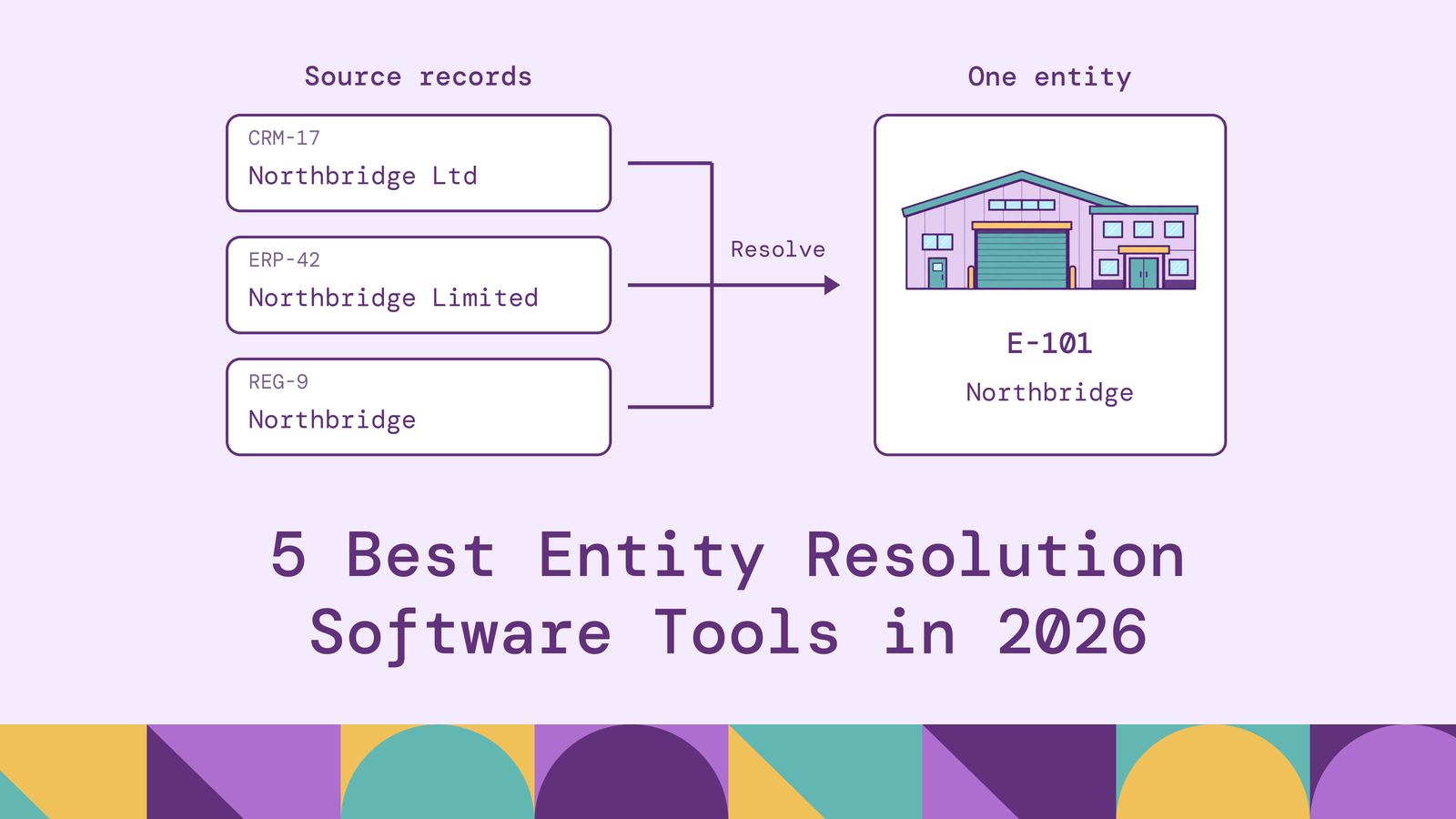
Choosing entity resolution software means deciding how your organization will handle uncertain identities. A false merge can combine two customers' histories; a missed match can hide that several supplier records belong to one company. The matching engine matters, but so do the evidence behind its decisions, the correction workflow, and the way applications consume its results.
This guide compares Senzing, Quantexa, Tamr, Informatica, and IBM Match 360 for different enterprise requirements. It explains how resolution works, where each product fits, and how to evaluate candidates using your own data. The shortlist covers embedded matching, investigation platforms, and master data management rather than treating them as interchangeable purchases.
What is entity resolution software?
Entity resolution software identifies records that refer to the same real-world person, organization, product, or other entity, within a dataset or across sources. It connects information even when source identifiers differ or names and addresses contain inconsistencies. The underlying problem is also commonly discussed as record linkage or deduplication; the Office for National Statistics' data linkage methodology describes approaches for linking records when shared identifiers are unavailable.
Consider a procurement example. An ERP system stores Northbridge Components Ltd, a purchasing application stores Northbridge Components Limited, and a supplier registry contains a registered identifier. Resolution evaluates whether those records represent one legal entity. A similar company name or shared office address alone may be insufficient evidence.
The output can be a mapping from source records to resolved entity identifiers. A broader master data management platform may also produce a golden record, selecting preferred attribute values from the matched records. These are separate decisions: identifying which records belong together does not establish which address is current or which source should supply the legal name.
Resolution also differs from relationship discovery. Two companies can share a director while remaining distinct entities. Keeping that distinction explicit prevents a shared attribute from becoming an unjustified identity merge. The goal is a usable representation of identity that preserves enough source evidence to explain and correct it.
How does entity resolution software work?
Implementations vary, but a typical workflow prepares records, generates candidate matches, evaluates evidence, and maintains the resulting entities. Treat each stage as a possible source of errors, because a pair excluded from every candidate set cannot be scored by the matcher.
Prepare and map records. Map source fields into meaningful attributes such as names, identifiers, addresses, and dates. Normalize formatting while retaining the original values and source keys. For example, standardizing a telephone number can make comparisons easier, but dropping a country code can erase useful distinctions. Decide whether identifiers are globally unique or meaningful only within their source system.
Generate candidates. Comparing every record with every other record becomes expensive as datasets grow. Blocking limits comparisons to plausible candidates, such as records sharing a postal region or part of a name. Multiple passes can recover candidates missed by a single rule. The ONS methodology describes blocking as a way to reduce the search space; the trade-off is that overly restrictive blocks exclude valid matches before scoring.
Evaluate matching evidence. Deterministic methods apply explicit conditions, such as agreement on a reliable identifier. Probabilistic methods weigh agreements and disagreements, while machine learning methods learn comparison patterns. Fuzzy string comparisons can contribute evidence, but a similar spelling does not establish identity. A shared household telephone number, for instance, may support a relationship without proving that two people are the same person.
Form entities and resolve uncertainty. Group records according to the matching logic and route ambiguous cases for review where the product and workflow support it. Thresholds express the balance between false merges and missed matches. IBM's matching configuration documentation illustrates this with separate thresholds for automatic linking and clerical review. Review the resulting groups as well as individual pairs: an erroneous link can bring unrelated records into the same entity.
Maintain and distribute results. Publish identifiers, source mappings, and any mastered attributes to consumers. New records, corrected identifiers, and changing addresses can alter previous decisions, so define how corrections propagate. Preserve provenance and test what happens when an entity splits or two entities merge. Applications need a way to reconcile the identifiers they already hold with the updated result.
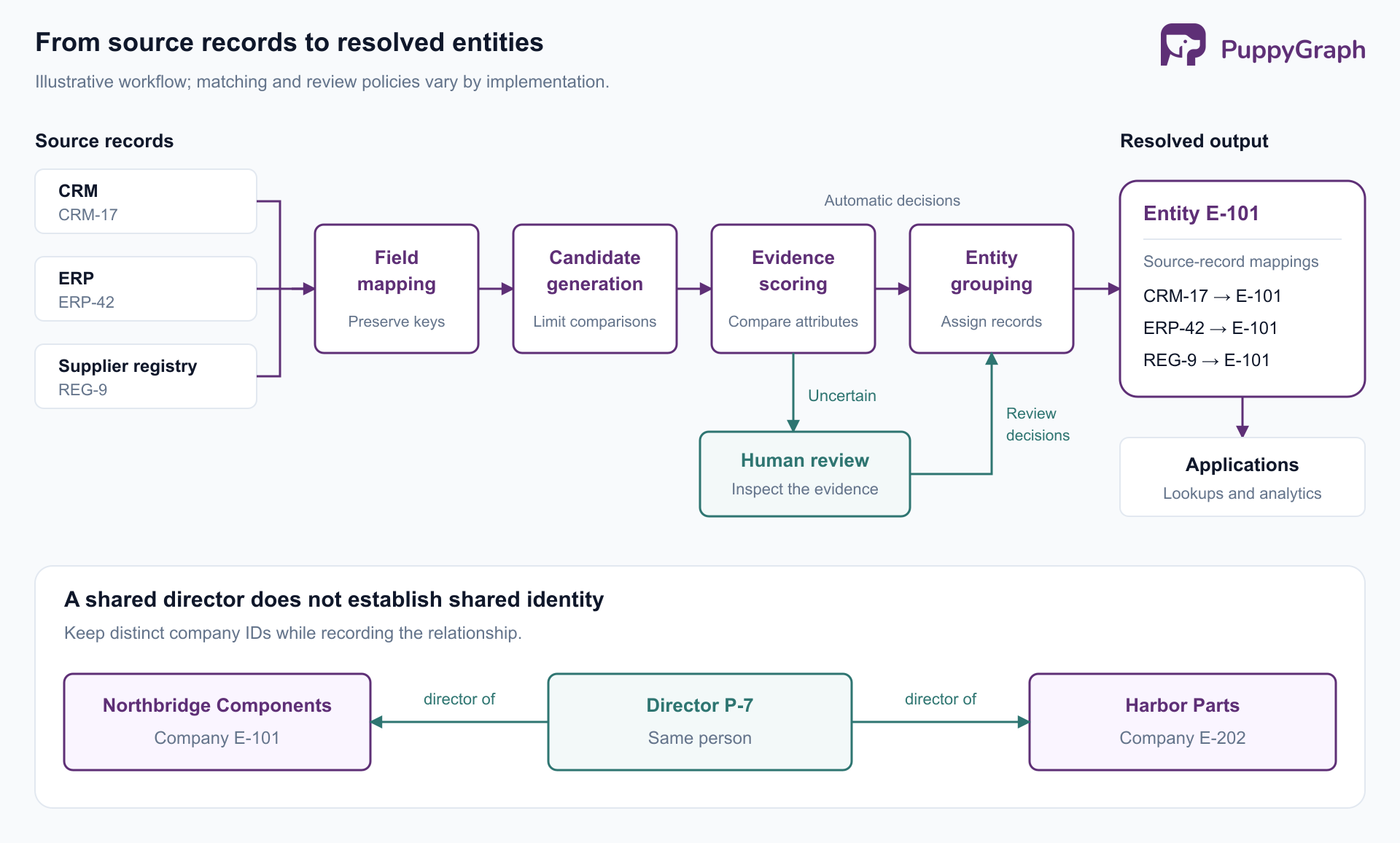
The useful output is more than a deduplicated table. It is an identity mapping whose evidence, updates, and correction behavior downstream teams can understand.
5 best entity resolution software tools
These five tools address different parts of the problem. The recommendations below are assessments of fit based on their documented capabilities, not results from a shared accuracy benchmark. An embedded SDK and an enterprise MDM platform can both resolve entities while assigning very different responsibilities to your team.
1. Senzing
Senzing provides an entity resolution SDK that developers embed in applications and services. It supports deployment on your own infrastructure, on premises or in the cloud. This makes it a candidate when an engineering team wants to add matching to an existing product or pipeline and retain control over the surrounding application.
Capabilities. Senzing supplies pretrained matching capabilities and can reconsider earlier resolution decisions as additional records arrive. Its explainability functions expose why records matched, why they did not match, and how an entity formed. That distinction matters when an analyst needs to investigate an unexpected combination of records rather than merely inspect a final score.
Best fit. Consider Senzing for an application that must associate incoming customer, supplier, or watchlist records with existing identities. An embedded approach lets the team decide where resolution runs and how results enter its workflow. For example, an onboarding service could use matching results to retrieve existing records before creating another account.
Trade-offs. Evaluate the SDK together with the application work you will own: ingestion, source mapping, operational monitoring, review interfaces, and downstream updates. Pretrained matching still needs validation on your data. Senzing's getting-started guidance specifically identifies data mapping as a factor in result quality. During a pilot, inspect difficult matches and non-matches, then test how a later record changes an earlier decision. The engineering question is whether the SDK fits your service boundaries and operational practices.
2. Quantexa
Quantexa's entity resolution sits within its Decision Intelligence platform. It combines internal and external data to build views of entities, with batch resolution and dynamic resolution at request time. Its documented deployment options include on-premises and cloud environments.
Capabilities. The platform combines resolution with graph generation, analytics, and visualization. Investigators can explore connections among resolved entities and trace transaction flows. Its entity resolution capabilities also include explainable models and tools for identifying overlinked and underlinked entities. These features make the surrounding context part of the evaluation, alongside the identity match itself.
Best fit. Consider Quantexa when the deliverable includes investigation or network analysis, such as understanding connections among customers, businesses, and transactions. In a hypothetical fraud investigation, matching company records is only the first step. The analyst also needs to examine ownership and payment relationships without collapsing every connected organization into a single entity.
Trade-offs. Evaluate the platform against the complete analytical workflow you need to deliver. Include source onboarding, entity modeling, network construction, access controls, and investigator usability in the pilot. If your immediate requirement is a narrow matching service, establish which platform components are needed and how results reach your existing applications. Dynamic resolution also makes consistency a useful test: define when different use cases should share an identity view and when different matching policies are intentional. The platform's broader scope is valuable when those capabilities are part of the actual requirement.
3. Tamr
Tamr Cloud is a managed SaaS platform for data mastering. Its data products combine entity resolution, data quality, enrichment, golden-record logic, and human review. The output includes identifiers connecting source records to mastered entities, which gives downstream consumers a way to join information across systems.
Capabilities. Tamr documents an approach combining pretrained machine learning, human feedback, and semantic comparison with large language models. Its data quality and enrichment services support the mastering process. It also provides search and record-management APIs for operational use, so evaluation can cover both consolidated datasets and application interactions.
Best fit. Consider Tamr when your team needs maintained customer, company, or other business-entity data products from heterogeneous sources. A procurement analytics project, for example, could use a mastered supplier dataset to consolidate spend across systems. Business reviewers would help distinguish spelling variations from genuinely separate suppliers.
Trade-offs. Budget for the domain experts who will review uncertain clusters and define acceptable golden-record values. Test how much review your difficult records require and whether the resulting output satisfies downstream needs. Also verify source-key discipline: Tamr's documentation says stable source primary keys are required to retain persistent Tamr IDs. That makes upstream reload behavior part of the implementation. Include a changed source record, a corrected match, and a full source refresh in the pilot. A mastered dataset is useful only if its identifiers and corrections remain understandable to the systems consuming it.
4. Informatica
Informatica MDM and its 360 applications address entity matching within broader master data management. The portfolio covers domains including customers, products, and suppliers. For this comparison, the relevant scope is MDM SaaS, where matching contributes to governed master records and business workflows.
Capabilities. Informatica combines match and merge with stewardship and domain-specific applications. Its MDM SaaS match-and-merge guidance also addresses survivorship: the rules used to choose the values that populate a golden record. This is useful when several sources agree about an entity's identity but disagree about its attributes.
Best fit. Consider Informatica for an enterprise program that needs shared master data across departments, particularly when Informatica already supports integration or data quality work. For a supplier domain, the matching decision might establish that two records represent the same business, while survivorship selects the approved legal name and preferred contact details. Ownership and approval rules matter as much as the comparison algorithm.
Trade-offs. Define the specific application, entity model, and integration requirements before evaluating features. Avoid assuming that capabilities or configuration steps from another Informatica product apply unchanged to the SaaS deployment under consideration. A useful pilot should follow a record from ingestion through matching, review, golden-record construction, and publication. Include a disputed attribute as well as a duplicate record. The practical question is whether the platform supports the organization's stewardship process and delivers usable master data to its consumers.
5. IBM Match 360
IBM Match 360 is now named IBM Master Data Management, as documented in IBM's product announcement. The familiar Match 360 name remains useful when evaluating existing implementations and documentation. IBM describes the service as resolving records from multiple sources into master data entities within its data platform.
Capabilities. IBM provides configurable matching attributes, weighted comparisons, and separate automatic-linking and clerical-review thresholds. Its algorithm tuning workflow uses reviewed record pairs to recommend weights and thresholds. Data engineers can inspect those recommendations before applying them, connecting business judgments about identity to the matching configuration.
Best fit. Consider IBM when you need governed entity resolution alongside an existing IBM data environment. It is also worth evaluating when data stewards must participate directly in matching decisions. A customer-data team could review uncertain pairs, adjust the balance between false merges and missed links, and inspect how the resulting entities change.
Trade-offs. Include configuration and review work in the evaluation. IBM's potential-match workflow documentation states that the clerical review range and the corresponding workflow must be enabled before review tasks are generated. Test the full correction path, including who receives a task and how a link or unlink affects consumers. Confirm deployment and entitlement requirements for the offering you are purchasing. Familiarity with an IBM platform helps orient the evaluation, but the match quality still needs evidence from your own records.
Entity resolution software comparison
Use this table to narrow the shortlist by implementation shape. The evaluation questions reflect the responsibilities and capabilities described above, rather than a ranking of matching accuracy.
Start with the outcome you need to own. An application team embedding a matcher has a different buying problem from an enterprise team assigning stewardship across several domains. Broad feature coverage helps only when those features reduce work your project actually needs to do.
How to choose the right entity resolution software
Build the evaluation around representative data and a downstream decision. A demonstration should show how the product handles uncertainty and corrections in your workflow, as well as whether it finds obvious duplicates.
Define identity and error costs. Decide what counts as one entity: a person, household, legal company, branch, or account. Document ambiguous cases before asking reviewers to label them. Specify the consequences of merging unrelated records and leaving duplicates separate. Those costs should guide acceptance criteria and review policies.
Measure quality on held-out examples. Assemble reviewed matches and non-matches with common names, shared addresses, missing fields, and changes over time. Keep evaluation examples separate from tuning examples. Measure precision and recall: respectively, the proportion of proposed matches that are correct and the proportion of true matches that are found. The ONS data linkage policy explicitly distinguishes these measures from match rate, which reports the proportion of records linked without establishing whether those links are correct. Inspect whole entities and results across different sources, languages, and data-quality conditions.
Exercise corrections and operations. Add, update, and delete records; challenge a match; and test a merge followed by a split. Check how identifiers, provenance, and downstream references change. Measure batch completion, incremental-update latency, and manual review demand under a representative workload. Verify where source data, indexes, and backups reside and how access is controlled. These tests reveal whether a promising match result can become a maintainable service.
Compare the complete cost. Request quotes against the same source volumes, update patterns, environments, and support expectations. Include implementation, infrastructure, data enrichment, steward time, and downstream integration. A license comparison alone cannot tell you which approach requires less work to deliver the intended outcome.
Finally, decide how consumers will use resolved identities. Operational applications may need a lookup API; analytics teams may need entity mappings and relationship tables in a warehouse or lakehouse. Ask how the selected tool exports those results and propagates corrections. Some platforms already include graph analysis, so assess that capability before adding another component.
When resolved entities and their relationships are available in supported tables, PuppyGraph lets analysts query them in domain terms such as customers, accounts, suppliers, and ownership. You define a graph schema over existing tables, mapping entities to nodes and relationships to edges. The model supplies a shared vocabulary for exploring connections after resolution has established the identities.
PuppyGraph supports openCypher and Gremlin queries over data in SQL databases, warehouses, and lakes or lakehouses, including direct reads of open table formats such as Iceberg and Delta Lake. Its default direct-query path requires no graph-specific ingestion or persistent duplicate dataset. For example, an analyst could trace ownership relationships across resolved suppliers whose records already live in a lakehouse. The upstream resolution process remains responsible for matching decisions and corrections; PuppyGraph makes the resulting relationships queryable without loading a separate graph store.
Conclusion
The best entity resolution software fits both your identity problem and the work your team can support. Senzing suits embedded matching evaluations; Quantexa connects resolution to investigation and network analysis; Tamr emphasizes managed mastering; Informatica places matching within enterprise MDM; and IBM provides configurable resolution with steward-guided tuning.
Choose through a pilot that measures false merges, missed matches, review demand, and correction propagation. Then verify that the resolved identities support the application or analytical question that justified the project.
Try the forever-free PuppyGraph Developer Edition and book a demo with the team to see how openCypher and Gremlin queries connect resolved entities across warehouse and lakehouse tables, with no graph-specific ETL, to explore ownership, transactions, and other relationships.

Hao Wu is a Software Engineer with a strong foundation in computer science and algorithms. He earned his Bachelor’s degree in Computer Science from Fudan University and a Master’s degree from George Washington University, where he focused on graph databases.


