

Data Lake in Healthcare: Benefits, Use Cases & Architecture
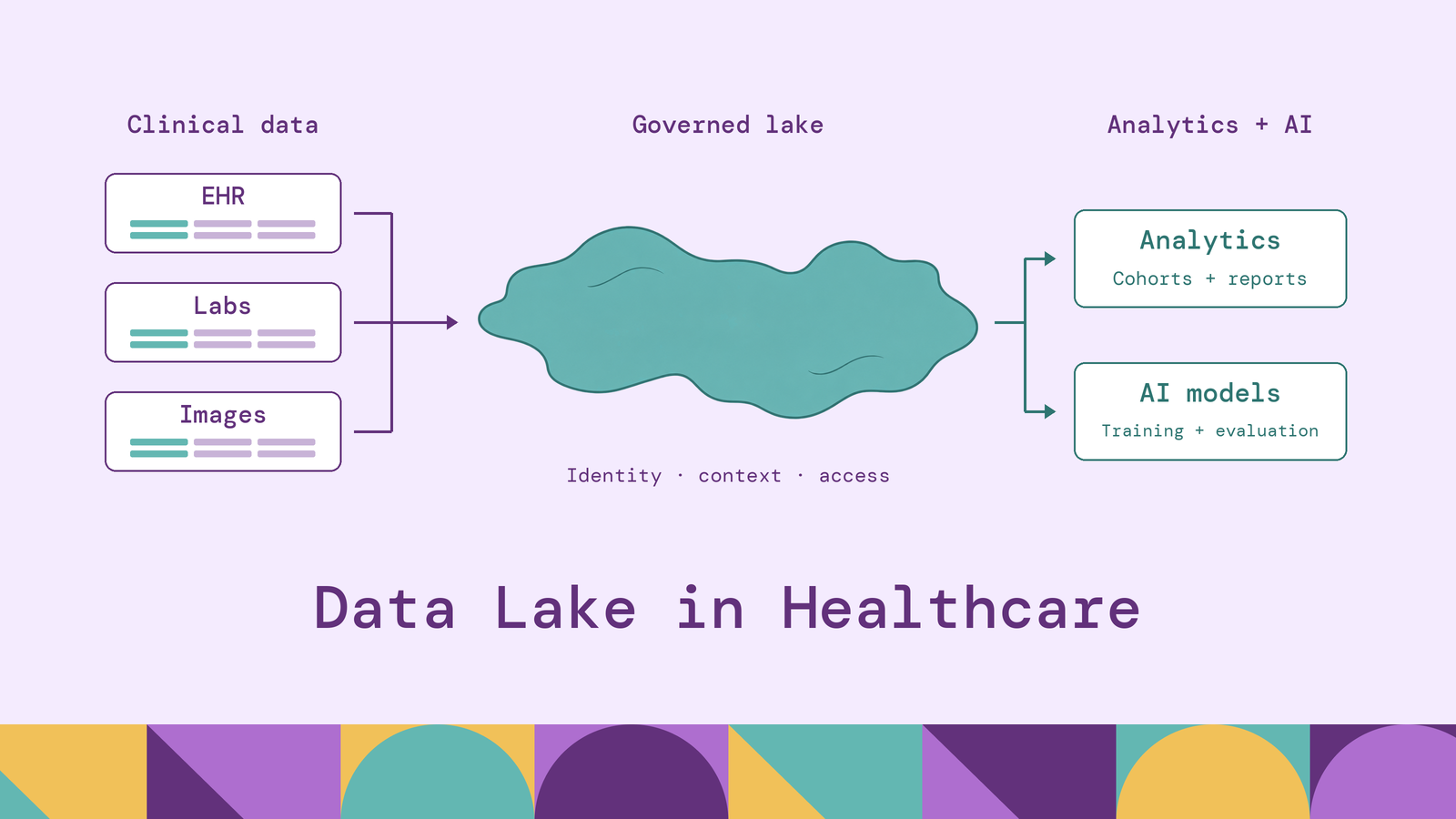
A healthcare data lake gives clinical, operational, and research teams a shared foundation for analyzing records that originate in different systems. Its value depends on preserving the context around those records: which patient they describe, when an event happened, what a measurement means, and who may use it. Putting files in the same storage system is only the beginning.
This guide explains how a data lake in healthcare works, the architecture behind it, and the benefits and use cases it supports. It also covers the security controls and implementation decisions that make the data usable for analytics and AI.
What is a data lake in healthcare?
A healthcare data lake is a repository for clinical, administrative, and research data in multiple formats, supported by metadata, processing, and access controls. It can hold database extracts, healthcare messages, clinical documents, medical images, and device readings. Teams retain source data and derive structured datasets for particular analytical tasks.
The defining flexibility is schema-on-read: data can arrive before every downstream analytical model is settled. That does not mean the data has no schema. An incoming laboratory message already has structure; an analytical table adds decisions about patient identifiers, units, timestamps, and which result revisions to include.
A warehouse emphasizes modeled data for repeatable reporting. A lake also accommodates source files and less structured material that may require further processing. A lakehouse adds table management and analytical capabilities over lake storage, allowing these roles to overlap.
The lake complements operational systems. An electronic health record (EHR) remains responsible for clinical workflows, while the lake supports analysis across selected records and systems. Its usefulness comes from making those records reusable without stripping away their origin or meaning.
How does a healthcare data lake work?
Consider a hospital analyzing whether referrals lead to completed appointments. Referral orders, scheduling events, and encounter records may arrive through different interfaces and on different schedules. The data lake provides a place to reconcile them.
Ingest and preserve. Batch exports, APIs, and event feeds deliver source records into a restricted landing area. Capture the source identifier, extraction time, and event time separately. Preserve source versions within the retention policy so a corrected referral can be distinguished from a duplicate delivery.
Validate and harmonize. Pipelines check required fields, normalize timestamps and units, and map local codes to agreed terminology. HL7 FHIR provides a resource-based framework for exchanging healthcare information, but local profiles and extensions still need interpretation. A shared exchange format does not settle every analytical definition.
Link and curate. Patient matching connects records belonging to the same person across systems, a distinct interoperability task described by ONC's patient matching guidance. Retain source identifiers alongside the resolved identifier and route uncertain matches for review. Then publish tables with documented definitions and quality checks.
Serve and monitor. Analysts query the curated referral and appointment data, while monitoring tracks feed delays and unresolved records. A missing completion event should mean no completion is recorded in the available data. It should not silently become a claim that the patient received no care elsewhere.
Healthcare data lake architecture
A practical architecture separates storage, data preparation, and analytical consumption, with governance across all three. AWS's healthcare data mesh reference architecture illustrates this separation through ingestion, raw and curated data, and downstream analytics. The pattern can be implemented with different infrastructure choices.
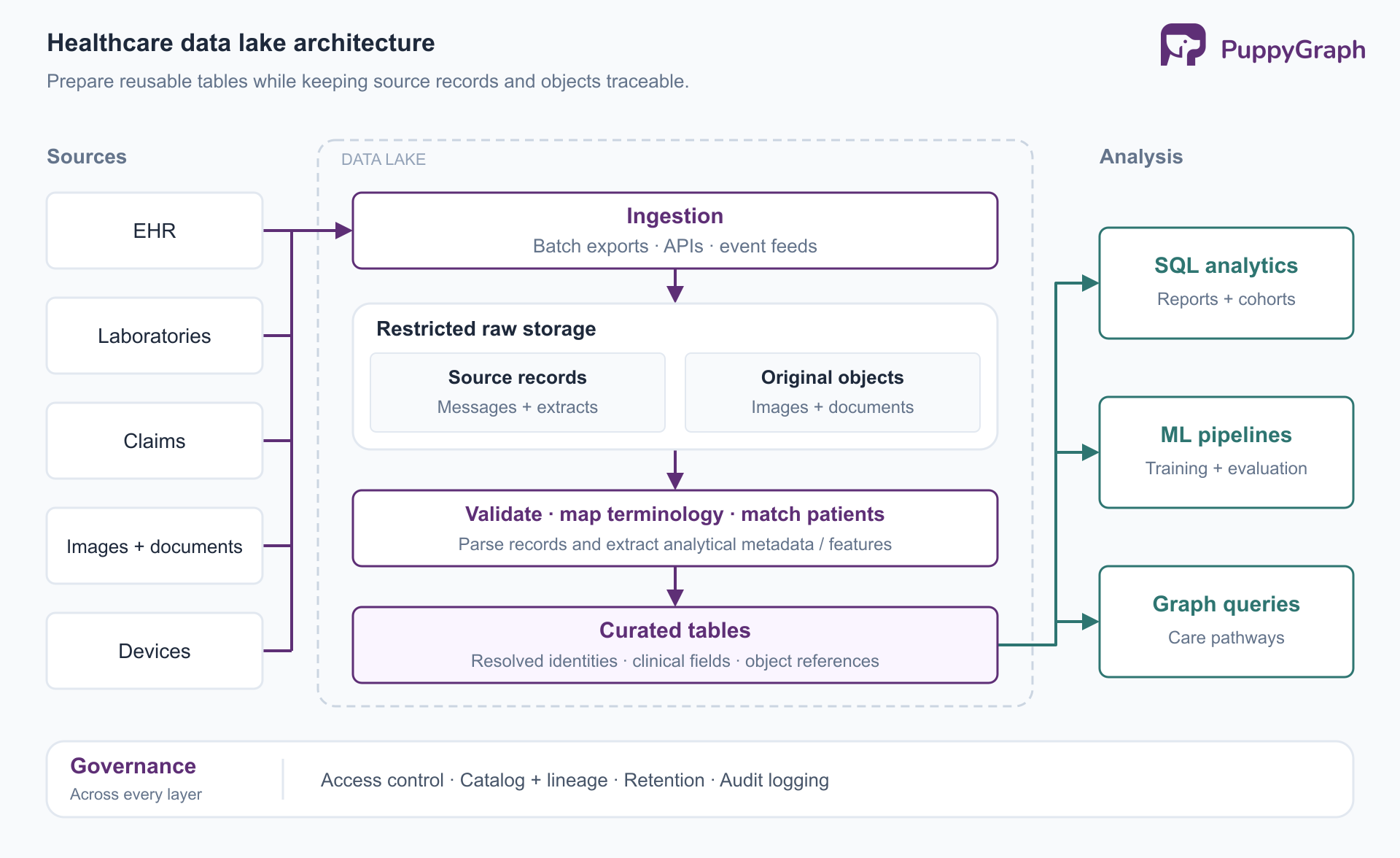
Storage and data zones. Object storage holds source files, documents, and images. Separate raw, curated, and consumption datasets by their quality guarantees and permissions. These are logical boundaries; naming a folder curated does not establish either guarantee.
File and table formats. Columnar files support analytical scans over selected fields. Open table formats add capabilities for managing collections of files as tables. Apache Iceberg, for example, supports schema evolution and snapshot-based time travel. Retained snapshots can help reproduce an analysis, provided the engine supports reading them and the relevant history has not expired.
Catalog and lineage. Record dataset ownership, schemas, clinical definitions, sensitivity, and refresh expectations. Connect transformation lineage to source records and pipeline versions so an unexpected metric can be traced back to its inputs.
Processing and consumption. Transformation jobs produce validated tables; SQL engines serve reporting; ML pipelines consume approved datasets; graph queries follow relationships between entities. Each consumer needs an explicit authorization path to the underlying data.
Storage and compute can scale independently in this design. Operationally, the harder requirement is keeping definitions, permissions, and quality guarantees consistent as more engines begin reading the same data.
Types of data stored in a healthcare data lake
Healthcare data spans several shapes, often within a single workflow. A radiology examination, for example, can produce images, a narrative report, and structured scheduling and billing records.
Formats do not map neatly onto these categories. FHIR resources can use JSON or XML representations. DICOM covers medical imaging information and related data, so an imaging object combines content with structured context.
Large objects can remain in governed object storage while analytical tables hold their identifiers, locations, and derived features. This lets a cohort query select relevant studies without making every query process the image pixels.
Key benefits of data lakes in healthcare
The benefits come from reusing well-described data across workloads. They depend on the curation and governance layers being funded alongside storage.
Broader analytical context. Linking encounters, laboratory results, and claims lets teams examine a question across source boundaries. Coverage remains limited to the participating systems and populations, so completeness should be measured rather than assumed.
Reusable preparation. A validated patient mapping or terminology transformation can support multiple downstream datasets. This reduces repeated integration work and gives teams a shared place to resolve disagreements about definitions.
Flexible analysis. Retained source records allow new fields or revised extraction methods to be applied later. The same foundation can serve routine reporting, exploratory research, and model development, with access tailored to each purpose.
Control over resource allocation. Separating storage from compute lets a team retain approved history while allocating processing capacity to specific workloads. Total cost still includes ingestion, repeated scans, data movement, maintenance, and specialist engineering. A lake is not automatically cheaper than a warehouse for a stable reporting workload.
Traceable results. Versioned transformations, recorded inputs, and documented dataset definitions make it possible to investigate why a report changed. Reproducibility requires keeping those artifacts together; retaining source files alone is insufficient.
The resulting asset is a set of governed datasets that new projects can use with less repeated integration work and a clearer understanding of their limitations.
How data lakes support healthcare
Healthcare use cases differ in their data needs and acceptable delays. Start with the decision a team needs to make, then choose the analytical method.
Population and quality analysis. A quality team can define a cohort from diagnoses and encounters, then examine documented follow-up and relevant measurements. Record the inclusion criteria, observation window, and feed coverage so changes in the dataset are distinguishable from changes in the measured population.
Operational planning. Scheduling, admissions, staffing, and discharge events can support capacity analysis. For example, a hospital can compare arrival patterns with available capacity by location and time. A daily planning report and a live operational dashboard need different freshness contracts.
Research and AI development. Approved datasets can combine clinical variables with features extracted from documents or images. Retain extraction versions and cohort definitions, and design training and evaluation splits to avoid leakage. The joint FDA, Health Canada, and MHRA good machine learning practice principles for medical device development emphasize independent training and test data, including patient and site factors. The lake supplies data for development; model validation and clinical evaluation remain separate work.
Care-pathway analysis. Referral and encounter tables can reveal how patients move between services. An analyst might follow a referral from its originating encounter to a receiving provider and a subsequent appointment, then identify paths with no recorded completion. Modeling the relationships explicitly helps preserve the distinction between a requested visit, a scheduled visit, and a completed encounter.
PuppyGraph lets teams define that entity-and-relationship model over existing tables and query it with openCypher and Gremlin. Patients, encounters, referrals, and providers become graph nodes, with relationships mapped from the curated identifiers. This schema acts as an ontology: it gives analysts a defined vocabulary for following a care pathway across records.
The Iceberg integration reads existing lakehouse tables, while the graph schema defines their mapping to nodes and edges. On the default direct-query path, the tables remain in the underlying store, with no graph-specific ETL or required persistent duplicate dataset. Upstream work still parses healthcare messages, resolves patient identities, and validates relationships. The graph layer adds relationship queries over that prepared data, allowing the referral analysis to extend across multiple services without creating a separate graph data pipeline.
Healthcare data lake security and compliance
Security must cover every route to sensitive data, including source objects, query results, exports, and derived datasets. A well-protected dashboard does little if its users can bypass it and read unrestricted files.
For U.S. HIPAA-regulated organizations, the HIPAA Security Rule requires administrative, physical, and technical safeguards for electronic protected health information (ePHI). Compliance involves the organization, its processes, and its service relationships as well as the platform configuration.
Access and isolation. Define access by role, purpose, and dataset sensitivity. Separate identified clinical data from approved research datasets, constrain service accounts, and test permissions through every enabled engine and storage interface. Review temporary exports and notebook outputs as part of the same access model.
Protection and recovery. Encrypt data in transit and at rest, manage keys deliberately, and log access and administrative changes. Test restoration and incident-response procedures. Availability and integrity matter alongside confidentiality.
Provider responsibilities. HHS cloud guidance explains that a cloud provider maintaining ePHI on behalf of a covered entity or business associate is itself a business associate, even when it lacks the encryption key. The parties must enter into a HIPAA-compliant business associate agreement and should document their respective security responsibilities.
De-identification and permitted use. Removing names or replacing patient identifiers does not by itself establish HIPAA de-identification. HHS guidance describes the Expert Determination and Safe Harbor methods. Apply the selected method to the actual release, including relevant text and metadata, and record its permitted use.
Retention policies should cover source records, derived tables, snapshots, and exports. Align them with applicable obligations and the dataset's purpose instead of treating inexpensive storage as a reason to keep everything indefinitely.
How to build a healthcare data lake
Build a small, usable analytical product first. The referral example provides a concrete starting point because its inputs, outputs, and users can be specified.
- Define the question and acceptance criteria. Agree on what counts as a referral, a completion, and an eligible observation window. Identify the operational owner and the action the analysis will inform. Set freshness and completeness targets.
- Inventory the required sources. Document identifiers, interfaces, update patterns, corrections, and access restrictions. Determine whether the available records can answer the question before choosing a storage platform. Include the work needed to obtain and maintain those feeds.
- Establish governance and architecture. Choose storage, table formats, catalogs, and processing engines against the workload. Define dataset ownership, access policies, retention, and recovery requirements before loading sensitive records. Account for existing infrastructure and the team's operating capacity.
- Implement ingestion and curation. Make retries safe, preserve source versions as required, and quarantine malformed records. Build patient matching and terminology mappings with clinical and data stewards. Test duplicate delivery, corrected results, missing identifiers, and late-arriving events.
- Deliver the analytical interface. Publish documented tables or views and validate the output against reviewed examples. Add relationship modeling when the question requires following paths across entities. Confirm that users see the right records and that missing data is visible in the results.
- Operate and expand. Monitor freshness, quality failures, query cost, and access patterns. Assign owners for broken feeds and ambiguous definitions. Add sources when they improve the agreed analysis, then reuse the established controls for the next use case.
The first useful milestone is a reproducible answer that its intended users can interpret and act on. Expanding ingestion before that point risks accumulating datasets whose quality, ownership, and purpose remain unclear.
Conclusion
A healthcare data lake supports analytics and AI when source records become governed, traceable datasets with consistent identities and definitions. Storage provides the foundation; curation, access controls, and workload-specific query methods make it useful. Starting with a bounded use case gives teams a way to test all of these pieces together.
Try the forever-free PuppyGraph Developer Edition and book a demo with the team to see how openCypher and Gremlin queries connect entities across warehouse and lakehouse tables, with no graph-specific ETL, for care-pathway analysis over curated healthcare data.

Hao Wu is a Software Engineer with a strong foundation in computer science and algorithms. He earned his Bachelor’s degree in Computer Science from Fudan University and a Master’s degree from George Washington University, where he focused on graph databases.


