

Data Lake Strategy: Implementation & Framework
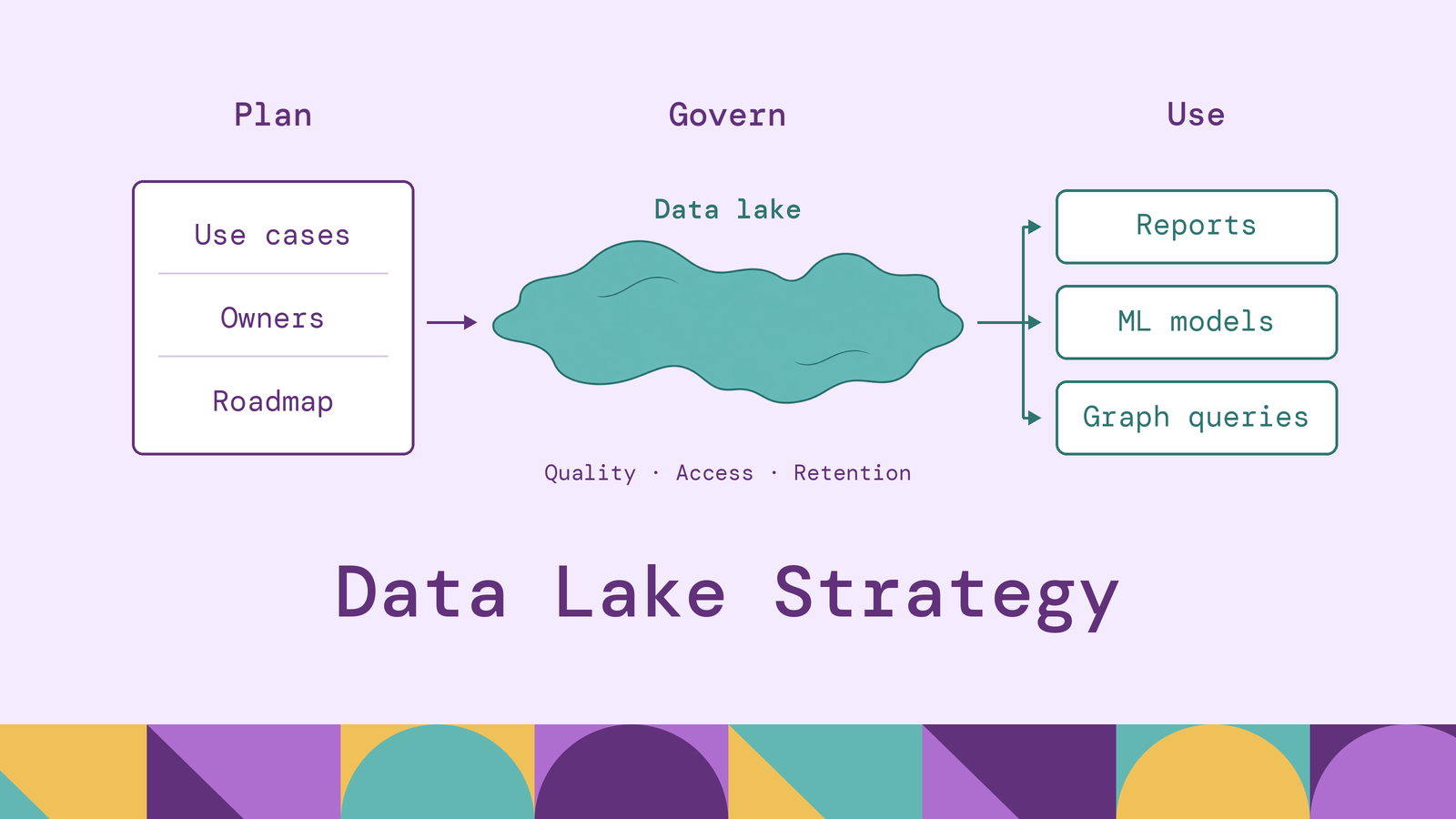
A successful data lake strategy connects the data an organization retains to the decisions people need to make. It establishes which workloads justify the investment, what reliability they require, and who maintains the data after the initial implementation. Those choices determine whether shared storage becomes a useful analytical foundation.
This guide develops those choices into a practical framework, architecture, and implementation roadmap. A hypothetical manufacturer tracing supplier disruptions provides a running example of how business requirements translate into technical decisions.
What is a data lake strategy?
A data lake strategy is a plan for acquiring, organizing, governing, and using data in a lake to meet defined business goals. It covers the lake's scope, architecture, ownership, funding, service expectations, and measures of success.
A data lake holds structured and unstructured data for different analytical uses. The strategy determines which of those uses the organization will support. Keeping purchase orders, equipment events, and supplier documents in shared storage creates possibilities; making them usable requires definitions, access rules, and maintained delivery paths.
The strategy also establishes the lake's relationship to existing systems. An operational database may remain responsible for transactions, while a warehouse continues serving established financial reports. The lake can supply historical events and cross-domain datasets without requiring every workload to migrate.
Architecture describes how the components fit together. An implementation roadmap sequences the work. The strategy gives both their requirements: which consumers matter, which data they need, and what trade-offs the organization accepts. It should also name exclusions, such as workloads with latency requirements the proposed platform cannot meet.
Why is a data lake strategy important?
Data lake decisions affect several teams at once. A source team changes a schema, a platform team runs ingestion, and analysts depend on the resulting tables. A strategy makes their obligations explicit before a failure exposes the gaps.
Reusable data. A governed supplier dataset can support procurement reporting, delivery analysis, and disruption investigations. Agreeing on supplier identifiers and ownership lets those consumers reuse preparation work. Simply collecting their source files in the same bucket does not establish that agreement.
Predictable reliability. A dashboard refreshed overnight and an operational investigation using recent events have different requirements. Naming those expectations allows engineers to choose ingestion schedules, recovery procedures, and alert thresholds appropriate to each workload.
Accountable access. Sensitive fields need an owner who can approve access and a technical path that enforces the decision. Defining retention, classification, and audit requirements early makes them part of implementation acceptance.
Visible costs. Storage is only one expense. Include ingestion, transformations, query compute, file maintenance, network transfer, and operational support. Evaluate the cost of delivering a useful dataset or analytical workflow, alongside the cost of storing its bytes.
These decisions make expansion easier to assess. A proposed workload comes with requirements and an operating cost that can be compared with its expected value.
How to build a data lake strategy
Build the strategy around a bounded use case, then identify the capabilities other consumers could reuse. The manufacturer example starts with a procurement question: which open orders depend on a supplier affected by a disruption, including dependencies through intermediate components?
Define the outcome and baseline. Name the person who will use the answer and the action it enables. Procurement might use the result to prioritize alternative sourcing. Measure the current investigation time, manual reconciliation work, and completeness of dependency coverage. Those measurements provide a baseline for judging the implementation.
Inspect the required sources. Inventory supplier master data, purchase orders, bills of materials, and shipment events. Profile representative records before choosing connectors. Check identifier stability, update frequency, historical availability, missing references, and whether deleted records can be detected. Record source ownership and extraction constraints, including the load each operational system can tolerate.
Set service expectations. Specify freshness, availability, recovery, and quality in terms the consumer can evaluate. An illustrative target might require shipment updates to become queryable within an hour of reaching the source system. Define how late arrivals are reported and what happens when the target is missed. Measure freshness across the full path, including transformation and publication.
Compare implementation options. Decide which data belongs in the lake, which can remain in existing systems, and whether batch delivery satisfies the use case. Evaluate candidate architectures against representative queries, update patterns, security requirements, and team skills. Include the cost of operating catalogs, pipelines, and maintenance jobs in the comparison.
Assign responsibility and funding. Name a business owner for meaning and access decisions, a producer responsible for source changes, and an engineering owner for delivery and recovery. Budget for their ongoing work. Record the accepted trade-offs and the conditions that would trigger reconsideration.
The result should be a short set of executable commitments. For the manufacturer, success means procurement can trace relevant dependencies using maintained data, within an agreed freshness window, at a known operating cost.
Data lake strategy framework
Use the following framework as a working decision record. It connects each strategic concern to an artifact the team can review and an acceptance question the implementation must answer.
Keep the artifacts proportional to the first workload. A source inventory can begin with a few critical systems, provided each has an owner and known limitations. A quality policy becomes useful when it names checks and responses for actual datasets.
For supplier analysis, a quality rule might block publication when order identifiers are duplicated while allowing unresolved supplier references to appear in an exception report. Procurement decides whether partial results remain useful; engineers implement that decision. This distinguishes defects consumers can work around from failures that require withholding an output.
Review these decisions together. A tighter freshness target can change ingestion design and support costs. A longer retention period can change storage requirements and deletion procedures. Adding another engine can introduce a new permission path. The framework makes those dependencies visible before individual teams approve conflicting choices.
Designing a scalable data lake architecture
Separating durable storage from processing and access components lets a data lake scale those resources independently. Design the interfaces between those components explicitly so that expanding one workload does not require redesigning the entire lake.
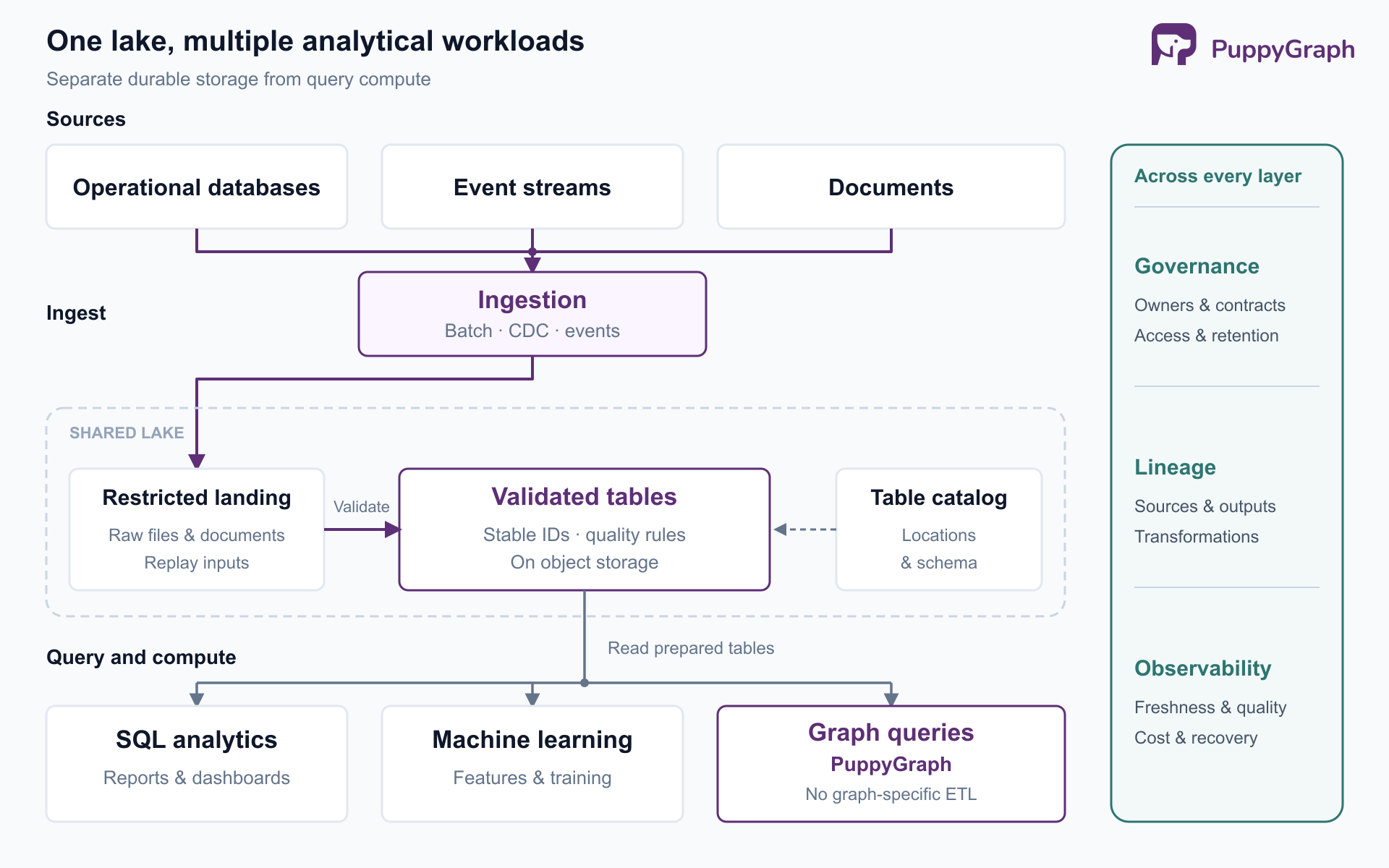
Ingestion and data preparation. Choose batch extracts, change data capture, or event ingestion according to source capabilities and freshness requirements. Define checkpoints, replay behavior, and handling for duplicate or out-of-order records. Separate restricted landing data from validated tables and consumer-specific outputs. Each boundary should have a purpose, such as preserving replay inputs or preventing invalid records from reaching reports. Avoid making every dataset pass through identical transformations merely to satisfy a zone diagram.
Storage and table management. Keep the distinction between files and tables clear. Apache Parquet is a column-oriented file format for analytical storage. A table format manages the files that constitute a table and how its state changes. For example, Apache Iceberg provides atomic table updates and consistent snapshots, allowing readers to work with a coherent table state while changes are committed. Choose table formats based on the required operations and actual engine support. Keep documents in object storage with searchable metadata and stable references where converting them into tables would lose their purpose.
Catalogs and access controls. Use a table catalog to let engines locate and resolve tables, and a discovery catalog or metadata service to expose ownership, definitions, and lineage. These functions may share a product, but both need coverage. Align catalog permissions with engine credentials and storage permissions. AWS Lake Formation's documentation, for example, explains that its permissions do not prevent direct S3 access already allowed by IAM or S3 policies. Test access through each supported route, including notebooks and service identities.
Encrypt stored data and network traffic, separate ingestion and reader identities, and record access to sensitive datasets. Define retention by data class, accounting for derived outputs and retained history. Verify that deletion procedures cover the representations specified by the policy and preserve files still referenced by current or retained table snapshots.
Compute and workload isolation. Give interactive queries, transformations, and model training appropriate compute capacity and limits. Separate resource pools where one workload could consume another's capacity. Benchmark representative filters, joins, and concurrent requests using realistic data distributions. Track query planning and data scanned as well as execution time; adding compute may leave inefficient layouts or excessive metadata untouched.
Relationship queries over shared tables. The manufacturer's disruption question needs a model of suppliers, components, and orders, including how dependencies connect across them. Define those entities and relationships as a semantic layer over the prepared data. A graph expresses that model directly and supports following dependency paths through intermediate components.
PuppyGraph lets teams define this model over existing tables through a graph schema that maps rows and identifiers to nodes, edges, and properties. Analysts query those relationships with openCypher or Gremlin. Its Iceberg integration reads the existing catalog and storage directly. On the default direct-query path, no graph-specific ingestion or persistent duplicate dataset is required; the tables remain in the lake, while PuppyGraph provides graph query compute.
Upstream pipelines still resolve supplier identities and validate component references. The graph model gives that prepared data a shared vocabulary for dependency questions, while the lake continues to support its other analytical consumers.
Data lake implementation roadmap
Sequence implementation by evidence of readiness. Calendar estimates should follow source complexity, integration work, and operating requirements. The following stages provide exit criteria that can be adapted to a team's delivery schedule.
Stage 1: Discovery and design. Confirm the first consumer, decision, source inventory, and baseline. Profile sample data and test access to the source systems. For the manufacturer, establish whether supplier and component identifiers can connect purchase orders to bills of materials. Resolve missing permissions and unknown extraction constraints before committing to a delivery date. Exit this stage with a bounded scope, named owners, service expectations, and an agreed architecture.
Stage 2: A complete pilot workflow. Build ingestion, validation, catalog registration, access controls, and the first analytical output for the selected use case. Include representative difficult records, such as duplicate shipment events or components with missing suppliers. Ask procurement to compare results with known orders and investigate discrepancies. Exit when the consumer can use the output and the team can explain its omissions, freshness, and cost.
Stage 3: Operational hardening. Add monitoring, cost attribution, infrastructure configuration, runbooks, and recovery procedures. Test interrupted ingestion, source schema changes, credential failures, and historical reprocessing. Verify that replay does not duplicate logical records and that restricted data remains inaccessible through alternative paths. Exercise recovery of catalog metadata as well as data files. Exit when the operating team can detect a failure, restore service, and communicate the impact without depending on the original developer's memory.
Stage 4: Expansion and retirement. Add related sources and consumers using the established contracts and platform capabilities. Test each new engine's supported table operations and authorization behavior. Compare business results with the baseline before expanding further. Retire redundant extracts or reports only after their consumers accept the replacement and retention requirements are accounted for. Exit each expansion cycle with documented ownership and evidence that the added workload remains within its service and cost expectations.
Treat adoption as part of delivery. Give consumers examples, definitions, and a clear route for reporting defects. A technically working dataset still needs people who understand when to use it and whom to contact when its meaning is unclear.
Data lake strategy best practices
The strongest practices turn architectural intentions into routine operating behavior.
Publish data contracts with changes. Document identifiers, field meaning, nullability, timestamps, and supported change behavior alongside each important dataset. Require producers to communicate incompatible changes. Technical schema compatibility does not guarantee that a field still means the same thing.
Capture lineage during execution. Record which inputs and transformations produced a published output. The OpenLineage object model represents datasets, jobs, and their runs, providing a common structure for reporting those dependencies. Instrument the paths consumers rely on and make gaps visible. Metadata that a pipeline never emits cannot support impact analysis later.
Make recovery repeatable. Keep transformation code and configuration versioned. Record the source versions, processing parameters, and table snapshots needed to reproduce critical outputs. Test recovery with the actual retention window. A reproducibility plan must account for whether the required input history will still exist when an investigation begins.
Schedule table maintenance. Assign responsibility for file compaction, metadata cleanup, and history retention. Iceberg's maintenance guidance describes small-file overhead and snapshot expiration. Coordinate cleanup with readers, writers, and recovery requirements; deleting files solely because they look old can conflict with valid table references.
Measure consumer outcomes alongside platform health. Monitor freshness violations, failed validations, recovery time, and cost per useful workload. Pair them with procurement's investigation time or another business measure. Review unused datasets and recurring incidents together so that the team can stop maintaining low-value outputs and fund the reliability work consumers need.
Common data lake strategy challenges
Challenges become easier to resolve when the team identifies the specific missing decision or broken interface.
Unclear ownership. A shared dataset becomes difficult to maintain when every team assumes another team owns its definitions. Assign ownership before onboarding, and include response expectations. Escalate disagreements over meaning to the business owner; an infrastructure team cannot determine which supplier record procurement considers authoritative.
Inconsistent identities and semantics. Two systems may use different supplier identifiers or define an active order differently. Build explicit mappings, record unresolved matches, and expose coverage limits to consumers. Keep unknown relationships distinguishable from confirmed absences. Otherwise, an incomplete dependency result can look like proof that an order is unaffected.
Schema changes that break consumers. A table format can support evolution while applications still depend on old names or assumptions. Iceberg supports changes such as adding, renaming, and widening field types, but consumers need their own compatibility tests. Introduce migration windows for incompatible contracts and verify downstream queries before retiring the previous representation.
Performance and cost drift. Growth changes the balance between ingestion frequency, file layout, query patterns, and maintenance. Investigate whether a slowdown comes from extra scanned data, small files, skewed joins, or resource contention before increasing capacity. Use representative workloads to validate the fix, and include maintenance compute in its cost.
Low adoption and duplicate pipelines. Consumers may keep local extracts because access takes too long or published data lacks a needed field. Investigate the concrete reason before mandating migration. Improve the shared dataset where justified, document intentional exceptions, and set retirement criteria for temporary copies. Giving each exception an owner and review date prevents a workaround from becoming an unmaintained dependency.
Conclusion
A data lake strategy succeeds when a defined business question has a dependable data path, accountable owners, and a measurable operating cost. Start with one useful workflow, validate its meaning and reliability, and expand through explicit acceptance criteria. Shared storage then becomes a foundation that additional consumers can use with understood guarantees.
Try the forever-free PuppyGraph Developer Edition and book a demo with the team to see how openCypher and Gremlin queries trace relationships across warehouse and lakehouse tables, with no graph-specific ETL, as part of a data lake strategy that supports dependency analysis alongside reporting and machine learning.

Hao Wu is a Software Engineer with a strong foundation in computer science and algorithms. He earned his Bachelor’s degree in Computer Science from Fudan University and a Master’s degree from George Washington University, where he focused on graph databases.


