

Data Lake vs Data Fabric: Key Differences & Use Cases
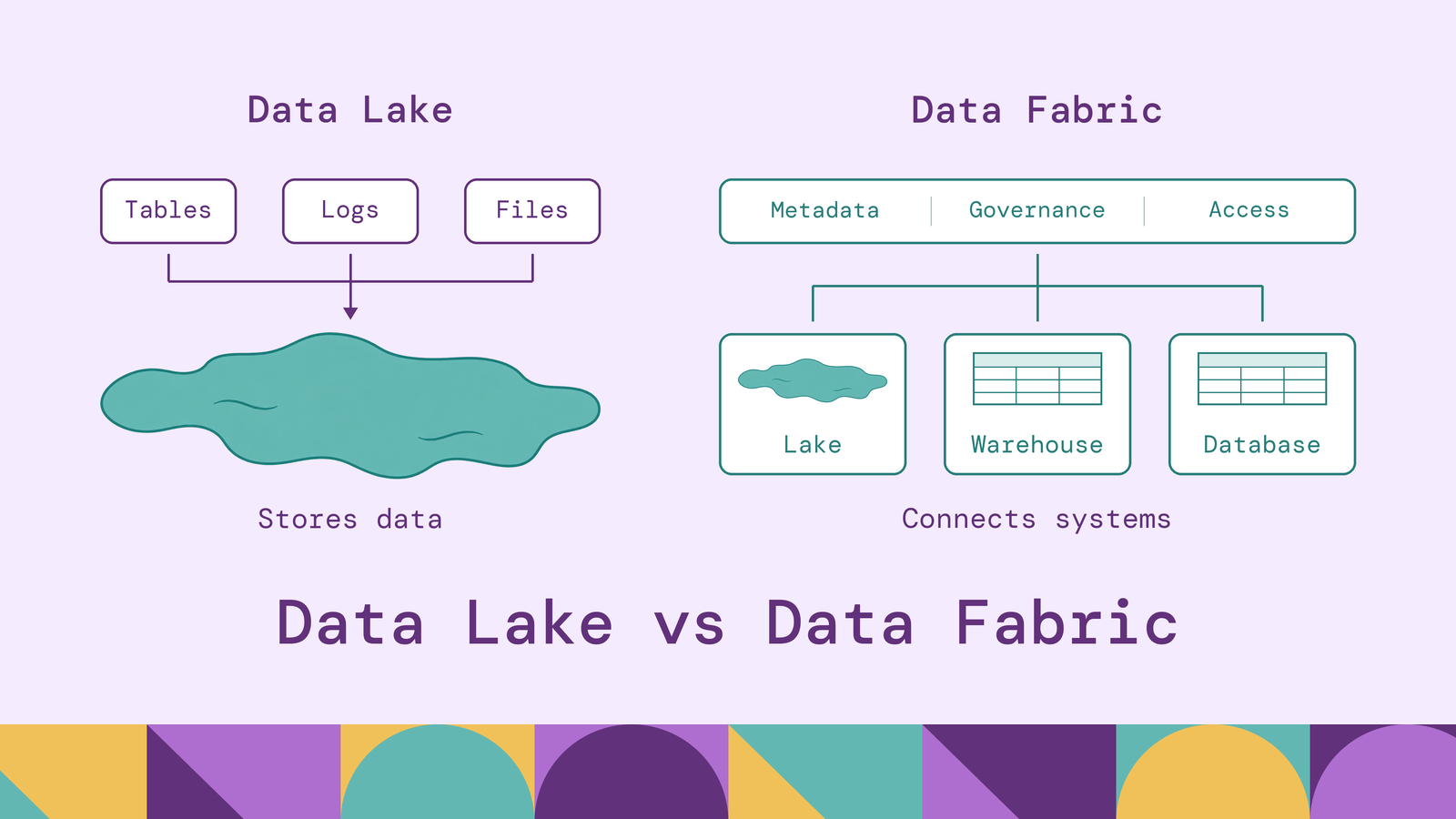
Choosing between a data lake and a data fabric starts with identifying the problem. Retaining detailed records for future analysis calls for storage and processing infrastructure. Making data understandable and accessible across independently managed systems calls for shared metadata, integration, and governance. An organization can need both at once.
The data lake vs data fabric comparison therefore concerns two different architectural responsibilities. This guide explains their differences, how their components fit together, and which workloads justify investing in either or both.
What is a data lake?
A data lake is a repository for structured, semi-structured, and unstructured data, including tables, event logs, documents, and images. It can retain data in its original form before teams know every analytical question they will ask. AWS's data lake overview describes this combination of broad storage and access through different analytical tools.
Modern cloud lakes commonly use object storage, with catalogs and processing engines making the stored data usable. Engineers ingest records, organize datasets, and expose them to SQL queries, batch processing, or machine learning workflows.
The term schema-on-read describes interpreting stored data when it is accessed. It does not require every dataset to remain raw. A lake can contain original files alongside validated, transformed tables. AWS's recommended data layers explicitly separate raw, intermediate, and consumption-ready data.
For example, an equipment manufacturer could retain sensor events and maintenance records, then produce curated tables for failure analysis. Keeping the underlying events allows engineers to recompute features when their assumptions change, provided the relevant history remains within the retention policy.
What is a data fabric?
A data fabric is an architectural approach to managing and delivering data across multiple systems. It connects metadata, integration, governance, and access capabilities so people can find and use data across existing repositories. IBM's description of data fabric includes catalogs, multiple integration styles, governance, and self-service access.
Its defining mechanism is the use of metadata to inform actions. Schemas describe structure; lineage records dependencies; ownership identifies responsibility; usage and quality signals help determine whether a dataset is suitable for a task.
In Gartner's data fabric model, this becomes active metadata: metadata is analyzed to produce recommendations or automate integration and management tasks. A schema change, for example, could trigger an alert to owners of affected downstream datasets. The exact response depends on the connected tools and configured workflows.
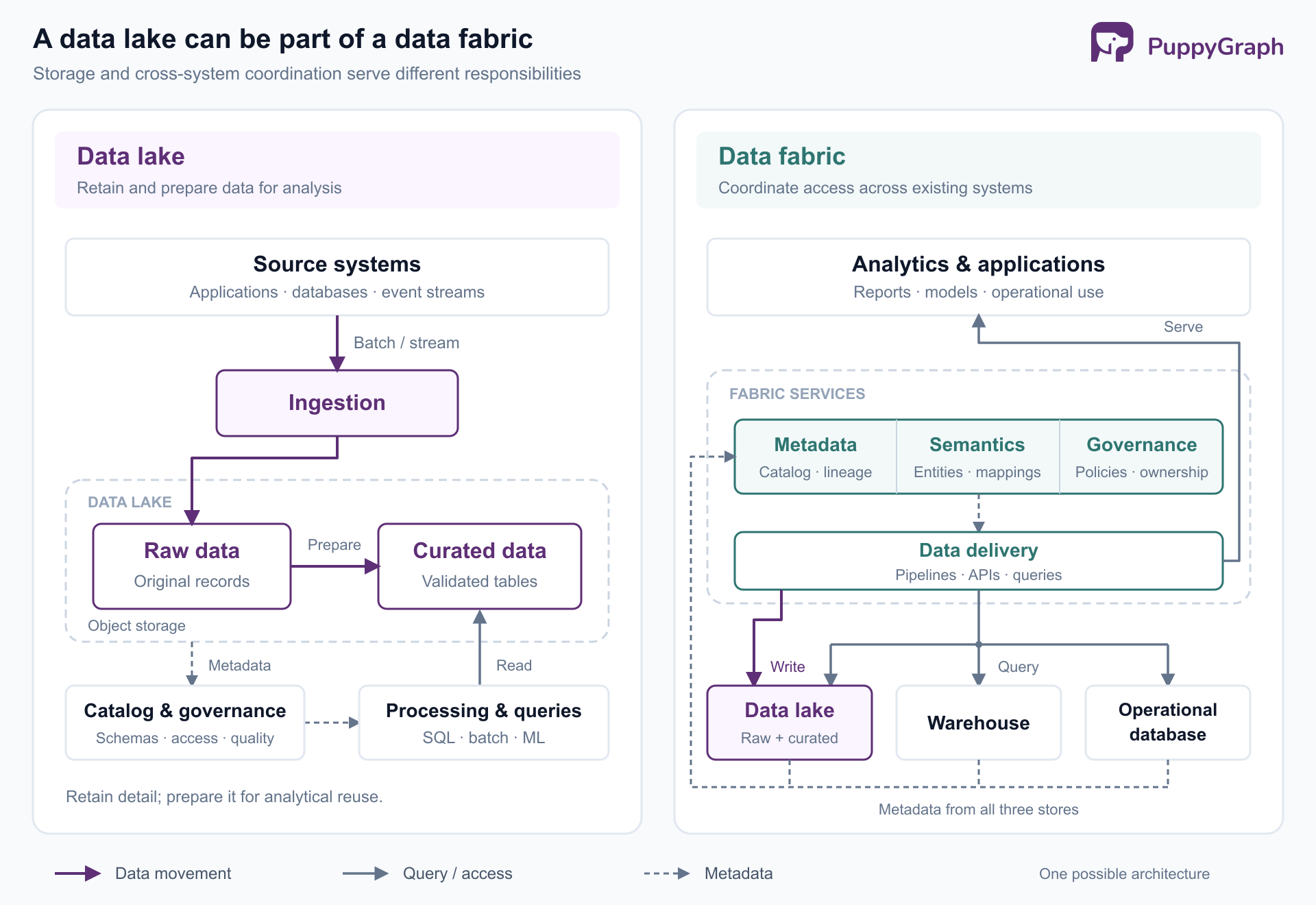
A fabric can incorporate a data lake, warehouses, and operational databases. It can deliver data through pipelines, APIs, or queries against existing sources. It does not require all records to move into one repository, and it does not eliminate data movement. The architectural goal is coordinated access and management across those different paths.
Data lake vs data fabric: key differences
A lake organizes retained data for reuse. A fabric coordinates how data is discovered, connected, governed, and delivered across systems. That difference changes what teams build and what they must maintain.
These are differences in emphasis. A well-managed lake can have catalogs, lineage, quality checks, and automated policies. A fabric extends coordination across the broader environment. Both require explicit ownership and maintenance; neither architecture makes unreliable source records trustworthy by itself.
Data lake vs data fabric: architecture comparison
A lake centers on stored datasets. A typical flow starts with ingestion from applications, databases, and event streams. Data lands in object storage, passes through validation and transformation, and becomes available to analytical engines. Catalogs describe the datasets, while access controls and monitoring cover the processing path. AWS's lake foundation guidance illustrates this progression from source data to prepared outputs.
Open table formats can add reliable table operations over files. For example, Apache Iceberg uses snapshots and atomic metadata updates to support consistent reads and concurrent writes. Adding transactional tables and analytical services moves the design toward a lakehouse. It still leaves a separate question: how will teams coordinate access and meaning across repositories outside that platform?
A fabric connects management and delivery services. Connectors collect metadata from participating systems. Catalog and semantic services relate technical assets to business concepts. Integration services deliver the data, while governance services coordinate the applicable policies. AWS's data fabric architecture includes ETL, ELT, streaming, replication, and virtualization as possible integration methods.
Consider a retailer with orders in a lake, customer records in a warehouse, and service cases in an operational database. A fabric design could connect their definitions and access paths. Engineers must still establish which customer identifiers correspond, how fresh each source must be, and where access restrictions are enforced. A shared catalog entry alone cannot answer those questions.
Querying business relationships adds a semantic access layer. In the retailer example, an analyst might need to follow customers through orders and products to related service cases. PuppyGraph lets teams define those entities and relationships over existing tables, then query them using openCypher or Gremlin. Its graph modeling workflow maps source identifiers and columns to nodes, edges, and properties, making the business model explicit and reusable.
PuppyGraph connects to SQL databases, data warehouses, and data lakes or lakehouses, including direct reads of Iceberg and Delta Lake tables. With direct source access, the tables remain in their existing storage and no graph-specific ETL or persistent duplicate dataset is required. Teams can use this capability as the relationship-query component of a fabric design, alongside their catalog, integration, and governance services. The immediate benefit is a shared model for traversing business relationships across supported sources.
Benefits of data lakes
Retaining detail for new questions. Original events and files preserve information that an aggregate may discard. A team investigating equipment failures can revisit individual readings after discovering that a previously ignored signal matters. This benefit depends on deliberately retaining the relevant fields and history.
Separating storage growth from compute demand. Object storage allows retained datasets to grow independently of the compute allocated to processing them. AWS's analytics architecture guidance identifies separate management of storage and compute costs as the reason for this separation. Teams can size processing resources around workloads instead of keeping them proportional to every stored byte.
Supporting different analytical workflows. A lake can hold source material for exploration, model development, and curated reporting. Different engines can reuse compatible datasets, although format, catalog, and authorization support must align.
The economic benefit depends on the whole workload. Storage charges are only part of the bill; ingestion, repeated scans, transformations, and operations also matter. A lake is most useful when retained detail supports recurring analytical work and the team can maintain usable datasets around it.
Benefits of data fabric
Making distributed data discoverable. Shared metadata can expose definitions, owners, and quality information, alongside lineage, in one discovery experience. An analyst evaluating an orders dataset can see its intended use and update schedule before requesting access. IBM describes cataloging and self-service access as core fabric capabilities.
Reusing integration knowledge. Agreed mappings and reusable delivery paths reduce the need to reconstruct source relationships for every project. For example, a maintained mapping between account and customer identifiers can support both service analysis and revenue reporting, with each use retaining its own definitions and permissions.
Responding to changes across systems. Active metadata can connect a change to its downstream consequences. A quality failure could notify dataset owners or pause a dependent workflow when the integration supports that action. This makes metadata useful during operations, beyond documenting how a system was originally designed.
The benefit grows when many teams repeatedly depend on the same distributed assets. It also creates maintenance obligations: connector coverage, mapping accuracy, and policy enforcement need ongoing validation. Automation can repeat a bad mapping just as consistently as a good one.
Data lake vs data fabric: use cases
The following examples illustrate how the storage requirement and the coordination requirement can arise separately or together.
Predictive maintenance favors a lake for historical analysis. A manufacturer could retain sensor readings, inspection images, and maintenance events for model training. Engineers would build features over the stored history and compare predictions with recorded failures. Fabric capabilities become relevant when equipment identities and maintenance definitions differ across factories.
Customer service analysis can require both. A retailer might store historical interactions in a lake while keeping customer accounts and service cases in other systems. The lake supports retrospective analysis. A fabric approach can help teams discover those sources, reconcile their definitions, and reuse approved access paths. Customer identity matching remains a modeling and data-quality responsibility.
Supplier disruption analysis emphasizes cross-system relationships. Procurement needs to connect suppliers, components, purchase orders, and affected products. When those records span operational and analytical systems, shared definitions and relationship mappings become central. A lake can retain historical snapshots, while fabric services coordinate access to the relevant sources.
Post-acquisition reporting emphasizes integration across existing platforms. Two businesses may need combined reporting before they can consolidate their systems. A fabric approach can organize source ownership, map business terms, and establish selected delivery paths. For repeated large analytical workloads, copying approved datasets into a lake may still be the practical choice.
Across these examples, the deciding factor is where the work stalls: preserving and processing records, or finding and connecting usable data across organizational boundaries.
How to choose between data lake and data fabric
Start with a specific workload and its current failure point. A platform label is too broad to determine whether the next investment should be storage, metadata, integration, or governance.
Prioritize a lake when missing history blocks analysis. If engineers cannot retain detailed events, rerun transformations, or assemble training datasets, build the storage and processing foundation. Establish ownership, retention, access controls, and quality expectations as part of that work.
Prioritize fabric capabilities when existing data is difficult to use across systems. If teams repeatedly search for owners, reconcile definitions, or rebuild the same integrations, start with the metadata and delivery paths for one business process. A catalog can be an initial component; the fabric takes shape as that metadata informs operational decisions and workflows.
Use both when workloads need history and cross-system context. For example, keep historical order events in a lake and connect their business definitions to warehouse customer records. IBM's discussion of complementary data architectures describes a fabric that lets existing databases and platforms participate through different integration methods.
Test operational fit before expanding. Pilot a representative task and measure time to obtain approved data, freshness, query latency, source load, and maintenance effort. Exercise a schema change and an access revocation. Verify what happens when a source is unavailable. These tests reveal whether a proposed integration meets the workload's needs more clearly than a feature checklist.
Choose the smallest set of capabilities that resolves the observed problem, with an owner for every dependency the new design introduces.
Frequently asked questions
What is the main difference between a data lake and a data fabric?
A data lake stores data for analytical reuse. A data fabric coordinates discovery, integration, governance, and access across multiple systems. The lake provides retained datasets; the fabric connects those datasets with the wider data environment.
Is data fabric better than a data lake?
Neither is universally better. A lake addresses storage and processing requirements. A fabric addresses coordination across distributed data. Evaluate which responsibility is missing from the current architecture before choosing an investment.
Can a data fabric replace a data lake?
A fabric does not replace the need to store historical records, source files, or curated analytical datasets. It may change where data is accessed or copied, but those workloads still require underlying storage. An existing lake can continue to serve that role.
Is data fabric a storage solution?
Data fabric describes a data-management architecture, rather than a storage system. An implementation can include storage, caches, and replicated datasets alongside catalogs, integration tools, and access services. Its defining purpose is coordinating those components across systems.
Can a data lake be part of a data fabric?
Yes. The lake can supply historical and curated datasets while fabric services connect their metadata, business definitions, and governed access paths to other repositories. This combines retained analytical data with broader context and discoverability.
Try the forever-free PuppyGraph Developer Edition and book a demo with the team to see how openCypher and Gremlin queries connect entities across warehouse and lakehouse tables, with no graph-specific ETL, as part of a shared semantic access layer.

Hao Wu is a Software Engineer with a strong foundation in computer science and algorithms. He earned his Bachelor’s degree in Computer Science from Fudan University and a Master’s degree from George Washington University, where he focused on graph databases.


