

Data Management Strategy: 7 Steps, Framework & Best Practices
.png)
A data management strategy connects business goals to the decisions that determine how data is defined, collected, stored, protected, shared, and retired. It gives governance, architecture, operations, and analytics teams a common set of priorities. Without that connection, individual projects may improve a platform or dataset while leaving the organization with the same ownership gaps, conflicting definitions, and duplicated work.
This guide explains the components, a seven-step process, a practical framework, and the changes needed when data supports AI and machine learning.
What is a data management strategy?
A data management strategy is a long-term plan for managing data as an organizational asset. It defines the outcomes the organization needs, the capabilities required to deliver them, the operating model that assigns decisions and work, and the roadmap for closing gaps. Its scope runs across the data lifecycle, from creation and acquisition through use, sharing, retention, archival, and deletion.
The strategy is broader than a technology plan. A warehouse migration can change where analytical data lives, but it does not decide who owns the meaning of active customer, how quality exceptions are resolved, or which uses of personal data are permitted. Those questions require policies, decision rights, processes, and accountable people as well as platforms.
A useful strategy produces a current-state assessment, target capabilities, principles, an ownership model, a roadmap, and success measures. It guides portfolio decisions without designing every pipeline in advance.
Why is a data management strategy important?
Data problems cross system and team boundaries. A duplicate customer may originate in one application, be amplified by an integration pipeline, and appear as conflicting metrics in several dashboards. Local fixes address each symptom separately. A strategy creates the shared rules and ownership needed to resolve the source of the problem.
It also forces investment choices into the open. An organization may want fresher reporting, broader self-service access, lower storage cost, tighter privacy controls, and better training data at the same time. These outcomes compete for people, funding, and operational attention. A strategy states which outcomes matter first, which risks are acceptable, and what evidence will show progress.
The practical benefits are consistent decisions, clear accountability, reusable controls, and data that consumers can find and evaluate. Classification, retention, security, privacy, and audit requirements become design inputs rather than late reviews. Effective governance changes operational behavior and helps delivery teams produce assets consumers can trust and reuse.
What are the key components of a data management strategy?
The components should cover both direction and execution.
Outcomes, scope, and governance. State which decisions, services, or risks the strategy supports and which domains, data classes, regions, and systems it covers. Define decision rights, accountability, and escalation. Distinguish a data owner's accountability for meaning and acceptable use from a steward's coordination and a platform team's technical responsibilities.
Lifecycle processes and controls. Specify how data is acquired, documented, validated, changed, shared, retained, and deleted. Define fitness for purpose through measurable rules. The UK Government Data Quality Framework uses completeness, uniqueness, consistency, timeliness, validity, and accuracy while emphasizing that priorities depend on user needs. Apply the relevant dimensions to critical data rather than demand perfect quality.
Architecture and technology. Describe the target arrangement of operational systems, integration paths, analytical stores, metadata services, semantic models, and access layers. Set principles for authoritative sources, data movement, interoperability, resilience, and separation of storage from compute where relevant. Identify capability needs before products, including cataloging, lineage, orchestration, quality testing, access control, observability, and query engines.
Metadata and semantics. Record schemas and lineage alongside business definitions, ownership, classifications, and relationships. Shared meaning lets teams determine whether similarly named fields represent the same fact.
People, change, and measurement. Name the skills and capacity required to operate the target model. Include training, incentives, and adoption work in the roadmap. Connect each initiative to an outcome, baseline, target, owner, and review date, using both leading and outcome indicators.
Together, these components turn strategic priorities into owned decisions, operating controls, technical capabilities, and measurable results.
7 steps to build an effective data management strategy
1. Define business outcomes and boundaries.
Begin with a small set of outcomes stated in operational terms. Examples include reducing the time needed to onboard a data source, producing one governed definition of recurring revenue, giving risk models traceable training inputs, or enforcing retention across a regulated domain.
For each outcome, identify the sponsor, affected users, relevant data, constraints, and evidence of success. A strategy for customer and product data over the next 18 months is easier to govern than a promise to fix all enterprise data.
2. Assess the current state.
Inventory important datasets, systems, interfaces, reports, models, owners, and policies. Combine documentation with evidence from catalogs, database metadata, pipeline configurations, incident records, and user interviews.
Assess capability as well as technology. Check ownership, approved definitions, automated quality rules, lineage, and deletion evidence. Record strengths, gaps, dependencies, and risks. The result is a baseline, not an exhaustive cataloging project.
3. Establish principles and governance.
Write a short set of principles that can decide between competing designs. Examples include keeping authoritative data in a named system, collecting only data with a defined purpose, assigning ownership at the domain level, testing critical contracts at system boundaries, and making access auditable.
Then map decisions to accountable roles and define how unresolved issues escalate. A RACI chart can clarify participation, but every decision still needs one accountable owner. Keep governance close to delivery through change workflows, automated checks, and exception queues.
4. Design the target capabilities and architecture.
Translate outcomes into capabilities. If analysts cannot find trustworthy metrics, the target may need business metadata, ownership, lineage, quality status, and a governed semantic layer. If regulated deletion is unreliable, it may need classification, identity resolution, downstream lineage, retention rules, and execution evidence.
Sketch the target architecture at the level needed to guide investments. Show systems of record, movement boundaries, metadata flow, analytical stores, consumption interfaces, trust zones, and control points. Preserve useful platforms instead of assuming wholesale replacement.
5. Prioritize initiatives and build the roadmap.
Turn gaps into bounded initiatives with deliverables, dependencies, owners, estimates, and outcome measures. Prioritize by business impact, risk reduction, urgency, feasibility, and enabling value. Foundational work earns priority when it enables several outcomes.
Sequence the roadmap around thin, usable slices. Implement ownership, definitions, lineage, and quality rules for one high-value data product before expanding the pattern. Include policy, integration, migration, training, and operating work.
6. Implement through accountable data products.
Apply the strategy through business domains and data products with named consumers and service expectations. For each product, publish its owner, purpose, schema, semantics, quality rules, freshness, lineage, classifications, access method, and support path. Version contracts and test them at producer and consumer boundaries.
Use pilots to test the architecture and operating model. Check whether approvals happen quickly enough, quality thresholds reflect actual use, and teams can operate the controls. Capture reusable templates before scaling.
7. Measure, review, and adapt.
Review measures at a fixed cadence and connect them to decisions. If catalog coverage rises but users still cannot find the correct dataset, more ingestion is unlikely to solve the problem. Search behavior, abandoned requests, unclear definitions, or missing ownership may reveal the real constraint.
Reassess priorities when regulations, business models, source systems, or AI uses change. The direction can remain stable while sequence and implementation change as evidence accumulates.
Data management strategy framework
One practical model has five connected layers:
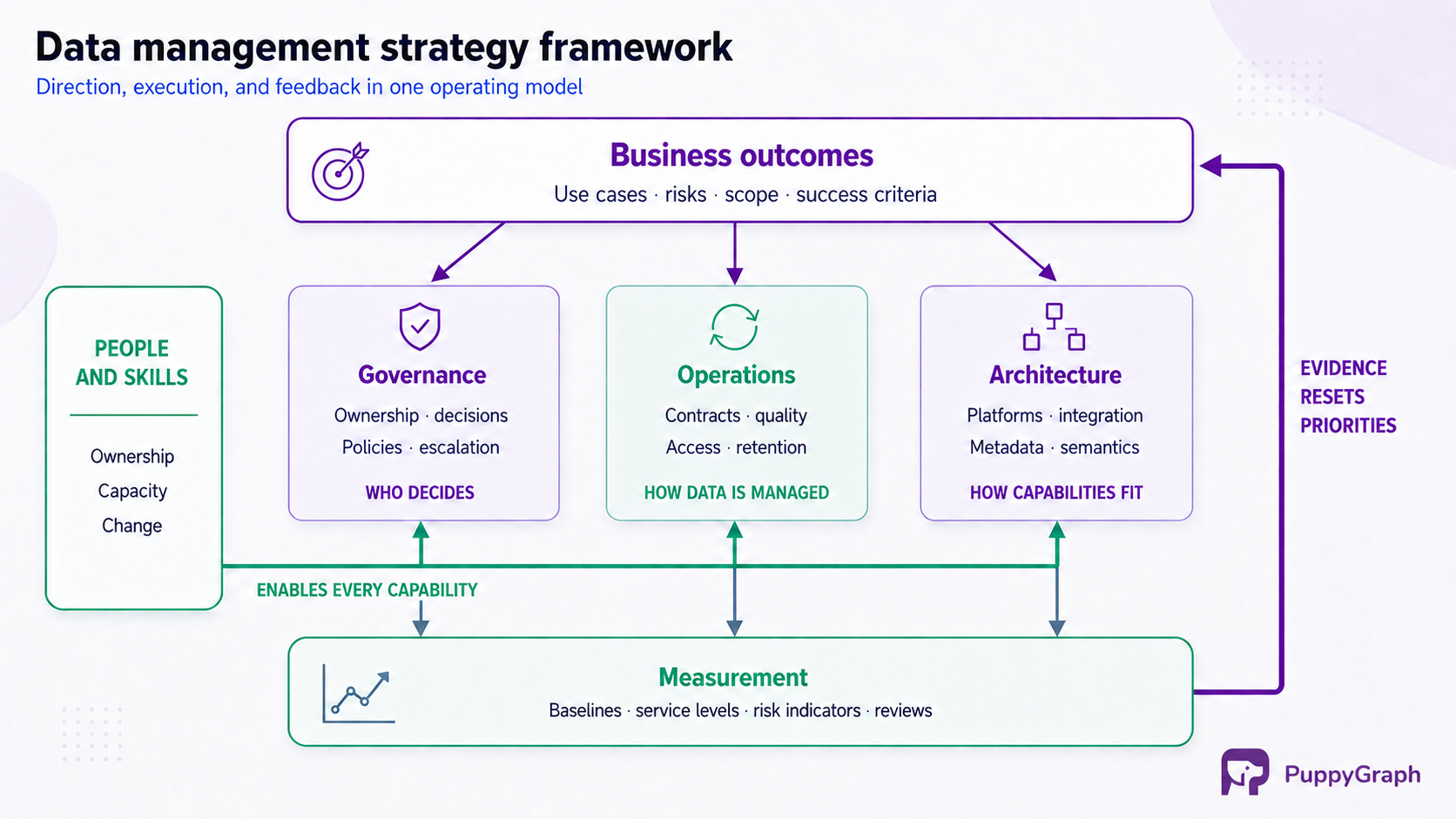
The layers are interdependent. Architecture implements governance decisions, operations supply evidence, and measurement tests outcomes. People and skills cut across the middle three layers.
This balance keeps the strategy from becoming either a technology wishlist or a policy catalog.
Frameworks supply a vocabulary. DAMA-DMBOK covers governance, architecture, modeling, security, integration, metadata, quality, data warehousing and business intelligence, and big data and data science. DCAM defines each sub-capability through objectives, challenge questions, evidence artifacts, and scoring criteria. Use them to check coverage and tailor priorities.
Data management strategy example
Consider a subscription software company that wants faster, more reliable expansion reporting. Sales, billing, product, and support systems use different account identifiers. Analysts reconcile them manually, finance disputes some dashboard totals, and machine-learning teams rebuild similar identity mappings for churn models.
The company defines one outcome: provide a traceable account view for finance, customer success, and churn modeling within twelve months. The scope covers account, subscription, product-usage, and support data, without replacing the warehouse.
The assessment finds that billing is authoritative for subscriptions, the CRM owns commercial hierarchies, and no team owns the cross-system account mapping. A business owner approves identity and hierarchy rules; the platform team implements matching, quality tests, lineage, and access controls.
The roadmap starts with one segment. It publishes an account data product with documented identifiers, survivorship rules, freshness, quality thresholds, and exception handling. Finance validates recurring-revenue aggregates, customer success tests hierarchy navigation, and the ML team checks historical coverage and leakage risks. Later releases add segments and automate more exception resolution.
Success is measured through reconciliation exceptions, time spent preparing the monthly report, percentage of model features traceable to governed sources, freshness compliance, and unresolved ownership decisions. The example is deliberately narrower than an enterprise transformation. Its value comes from proving a reusable operating pattern against a visible business result.
Data management strategy best practices
Tie work to outcomes and critical data. Catalog, quality, and architecture work should name the decision, service, or risk they improve. Apply deeper ownership and controls to data whose failure would materially affect customers, reporting, operations, compliance, or models.
Treat governance as a decision system. Policies should identify the decision, authority, evidence, and exception path. Automate repeatable enforcement, but keep accountable people responsible for semantic and risk judgments.
Manage metadata and the full lifecycle. Ownership, definitions, classifications, lineage, contracts, and quality status need maintenance and monitoring. Retention, archival, and deletion need explicit design wherever pipelines, extracts, features, indexes, or backups replicate data.
Deliver incrementally and expose trade-offs. Use one domain to establish the complete pattern, then standardize what worked. Record conflicts among freshness, completeness, cost, availability, and control, including who accepted each trade-off and for which use.
Fund operations, not only implementation. Stewardship, quality triage, access review, metadata upkeep, and platform reliability continue after launch.
These practices keep the strategy tied to business results while giving teams the capacity to operate it after launch.
Common data management strategy challenges
Scope expands faster than evidence. Enterprise-wide language can hide a collection of unrelated projects. Bound the first horizon by domains and outcomes, then expand through demonstrated patterns.
Ownership exists only on paper. An owner without authority, capacity, or an escalation route cannot settle definitions or accept risk. Test the model with real decisions during the pilot.
The roadmap is tool-led. Product categories become proxies for capabilities. Write requirements and operating changes before selecting technology.
Other challenges appear when shared standards meet local systems and measures.
Central standards conflict with domain context. A central team can establish interoperable controls and platforms, but domain teams usually understand meaning and fitness for purpose. Federate semantic decisions while keeping enterprise security, privacy, and interoperability requirements consistent.
Legacy dependencies remain hidden. Reports, exports, models, and manual workflows often sit outside formal inventories. Validate consumers before changing or retiring an asset.
Measures reward activity. Counts of catalog entries, policies, or completed training show effort, not value. Pair them with adoption, reliability, delivery-time, and risk outcomes.
These challenges are usually operating-model failures expressed through technology. Clear authority, evidence, and ongoing capacity make the technical work durable.
How to measure the success of a data management strategy
Use a balanced set of measures tied to the baseline and intended outcome.
Business outcome measures track the result: reporting cycle time, time to launch a data-dependent feature, cost of a recurring control, or incidents caused by incorrect data.
Reliability measures cover freshness, availability, contract failures, quality-rule pass rates, recovery performance, and time to resolve data incidents. Segment them by criticality.
Governance measures include ownership coverage for critical data, time to make or escalate a decision, access-review completion, policy exceptions, and retention execution. Measure whether owners act, not merely whether names appear in a catalog.
Adoption measures include active consumers, successful searches, reuse of governed products, support requests, and use of approved definitions.
Efficiency and cost measures cover duplication, unused assets, workload cost, manual reconciliation, and support burden.
Assign each measure a definition, source, owner, baseline, target, and decision rule. A metric matters when crossing its threshold changes funding, priority, control, or design.
Data management strategy for AI and machine learning
AI and ML extend the strategy because data shapes probabilistic behavior, not only reports. Cover training, evaluation, retrieval, prompt context, feedback, and generated outputs. For each dataset, record origin, purpose, transformations, usage constraints, population coverage, and known gaps.
Evaluate quality against the model task. A complete transaction table may still underrepresent a segment or contain inconsistently produced labels. Version datasets and features, test for leakage, separate evaluation sets from optimization, and monitor drift and outcomes.
Governance also needs model-specific decision rights. Name who approves a dataset, accepts limitations, authorizes deployment, and responds when monitoring crosses a threshold. The NIST AI Risk Management Framework organizes this work through Govern, Map, Measure, and Manage functions, while its Playbook provides voluntary actions that organizations can adapt rather than a universal checklist.
Generative AI adds a semantic access problem. An agent needs to know which entities and relationships exist, which definitions apply, and which data it may query. PuppyGraph lets teams define a graph schema over existing SQL databases, warehouses, and lakehouses, including direct reads of open table formats such as Iceberg and Delta Lake. That schema acts as an ontology of entities, relationships, and properties. Queries run as openCypher or Gremlin against data in place through the default direct-query path, so teams can add relationship-aware access without maintaining a separate graph copy.
For agents, PuppyGraph validates each query against the ontology before execution. Invalid entity or relationship references are rejected with structured feedback the agent can use to revise its query. This grounds queries in the organization's semantic model, but it does not prove that they match the user's intended task. It also does not establish source-value accuracy or replace broader AI risk controls.
Data management strategy vs data strategy
The terms overlap, and organizations use them differently. A useful distinction is that data strategy describes what value and outcomes the organization will pursue with data, while data management strategy describes how data will be governed and operated so those uses remain reliable and controlled.
In practice, the two should be developed together. A data strategy without a management plan accumulates risk and delivery friction. A data management strategy without business demand turns into a compliance exercise or platform program with unclear value.
Conclusion
An effective data management strategy begins with a bounded business outcome and ends with an operating model that can produce evidence. The seven steps connect current-state assessment, governance, target capabilities, architecture, roadmap, delivery, and measurement. The framework keeps outcomes, decisions, operations, and technology aligned while leaving room to adapt implementation as the organization learns.
Strong strategies apply deeper controls to critical data, deliver complete patterns in small slices, and measure whether decisions improve. AI adds new datasets, semantics, and monitoring needs, but reinforces the same foundation: known sources, explicit meaning, accountable use, and observable quality.
Try the forever-free PuppyGraph Developer Edition and book a demo with the team to see how openCypher and Gremlin queries add relationship-aware access to warehouse and lakehouse tables, with no graph-specific ETL, as part of a governed data management architecture.

Hao Wu is a Software Engineer with a strong foundation in computer science and algorithms. He earned his Bachelor’s degree in Computer Science from Fudan University and a Master’s degree from George Washington University, where he focused on graph databases.


