

Data Migration Process: 8 Steps & Strategy
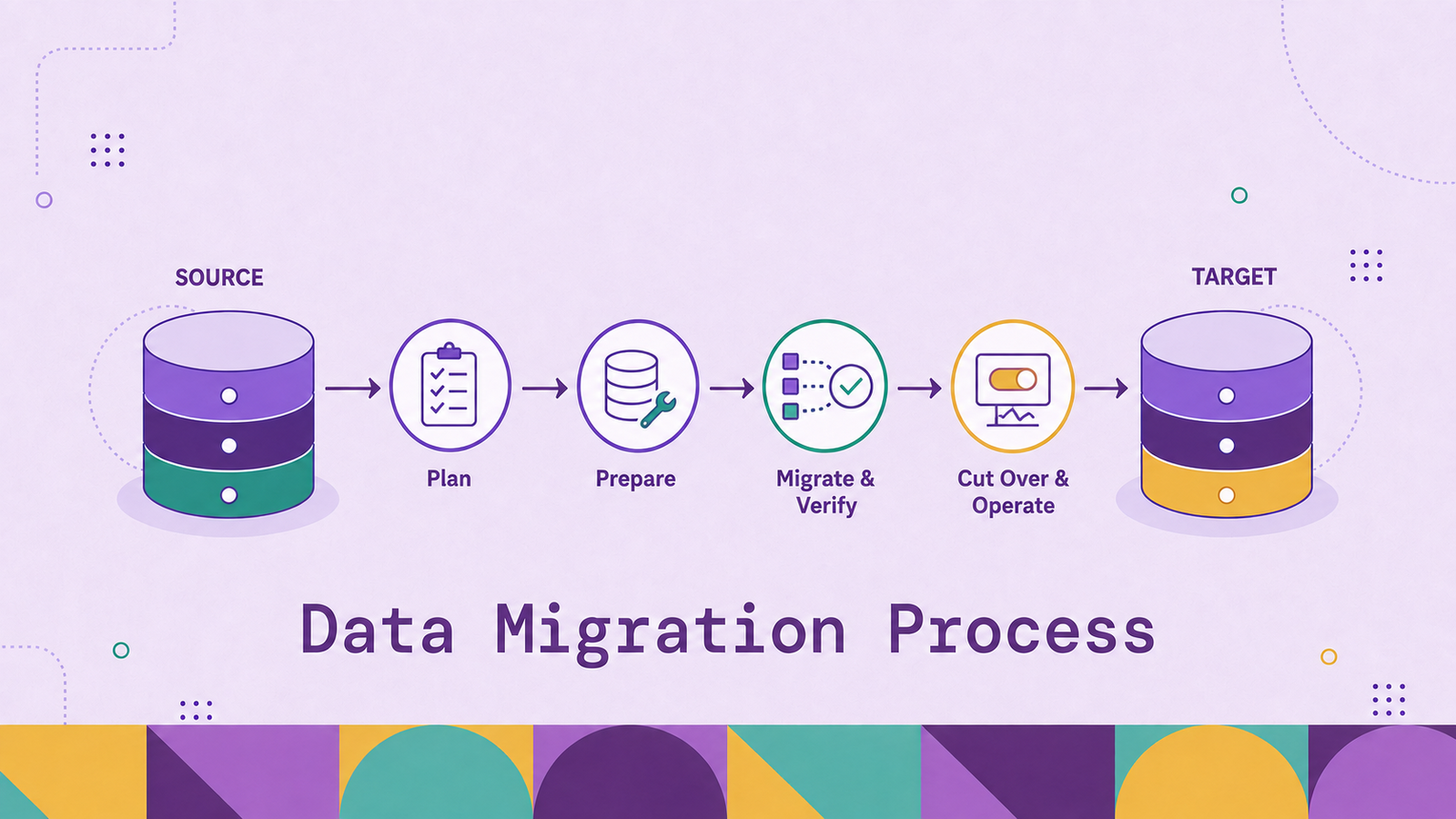
A data migration succeeds when the target system contains the right data, dependent applications behave correctly, and the business can switch over without losing control of either state. Copying bytes is only one part of that result. Teams also have to understand the source, translate schemas and semantics, reconcile the result, manage changes during the move, and decide when the old system can safely be retired.
This guide explains the main types and phases of migration, then turns the work into an eight-step process. The emphasis is on the decisions that make a migration testable: scope, ownership, acceptance criteria, cutover design, validation, and recovery.
What is the data migration process?
The data migration process is the controlled movement of data and its necessary context from one system, format, or storage environment to another. The context matters. A database migration may need to carry schemas, constraints, indexes, permissions, stored logic, lineage, and retention rules along with the rows. An application migration may also change identifiers, workflows, and the meaning of fields.
Most migrations combine discovery, preparation, movement, verification, and transition. Teams inventory the data and its dependencies, profile quality, establish the target design, move and transform the records, prove that the result meets its requirements, and direct consumers to the target. Source retirement comes only after the agreed recovery window.
Migration is therefore a program with technical and operational controls, not a single export-and-import job. The process should leave evidence that each dataset was authorized to move, transformed according to an approved rule, and accepted by its owner.
Why a structured data migration process matters
Migration defects are often discovered far from the copy job. A missing relationship produces an incomplete customer view. A timezone conversion changes a transaction date. A truncated value passes a row-count check but breaks an application. Structure moves these failures earlier, when they are safer to correct.
A defined process also makes trade-offs explicit. Near-zero downtime requires more replication and coordination than an offline move. Cleansing can improve the target while making direct reconciliation harder. Retaining history may help auditability while increasing cost and exposure. Each decision needs an owner and an acceptance criterion.
The practical benefit is control. Teams know which system is authoritative at every stage, which changes are allowed during the migration, how a failed batch will be replayed, and what condition triggers rollback. That shared operating model matters as much as the transfer technology.
Types of data migration
Migration types describe what is moving and why. One project may include several types at once.
Storage migration. Data moves between storage media or platforms while its logical model changes little. Examples include moving files from a network appliance to object storage or replacing an aging storage array. Integrity, permissions, paths, and application compatibility are the main concerns.
Database migration. Data moves between database instances or engines. A homogeneous migration keeps the same database technology, while a heterogeneous migration changes engines. Because source and target capabilities differ, a heterogeneous move may require schema, data-type, and database-code conversion. Google Cloud documents the distinction in its Database Migration Service overview and explains the conversion work in its heterogeneous migration guidance.
Application migration. An application moves to a new environment or product, and its data follows. User identities, workflow state, configuration, audit history, and integrations may each need different handling.
Cloud migration. Data moves from on-premises infrastructure to a cloud service, between providers, or into a new cloud architecture. Network throughput, residency, encryption, egress, and service quotas become design inputs.
Data warehouse or lakehouse migration. Analytical data, pipelines, models, catalogs, and downstream reports move to a new platform. A correct table copy is insufficient if metric definitions change or orchestration schedules no longer preserve dependency order.
Classifying the migration clarifies its dominant risks. It does not choose the execution method. An application migration, for example, may use either an offline cutover or continuous replication depending on its downtime requirement.
Key phases of the data migration process
The eight steps below fit into four broader phases:
- Plan: define goals, requirements, ownership, scope, and success measures.
- Prepare: assess the source, improve data quality, design the target, and specify mappings.
- Migrate and verify: execute repeatable loads, reconcile the target, and test dependent workloads.
- Cut over and operate: switch traffic, monitor the target, resolve exceptions, and retire the source deliberately.
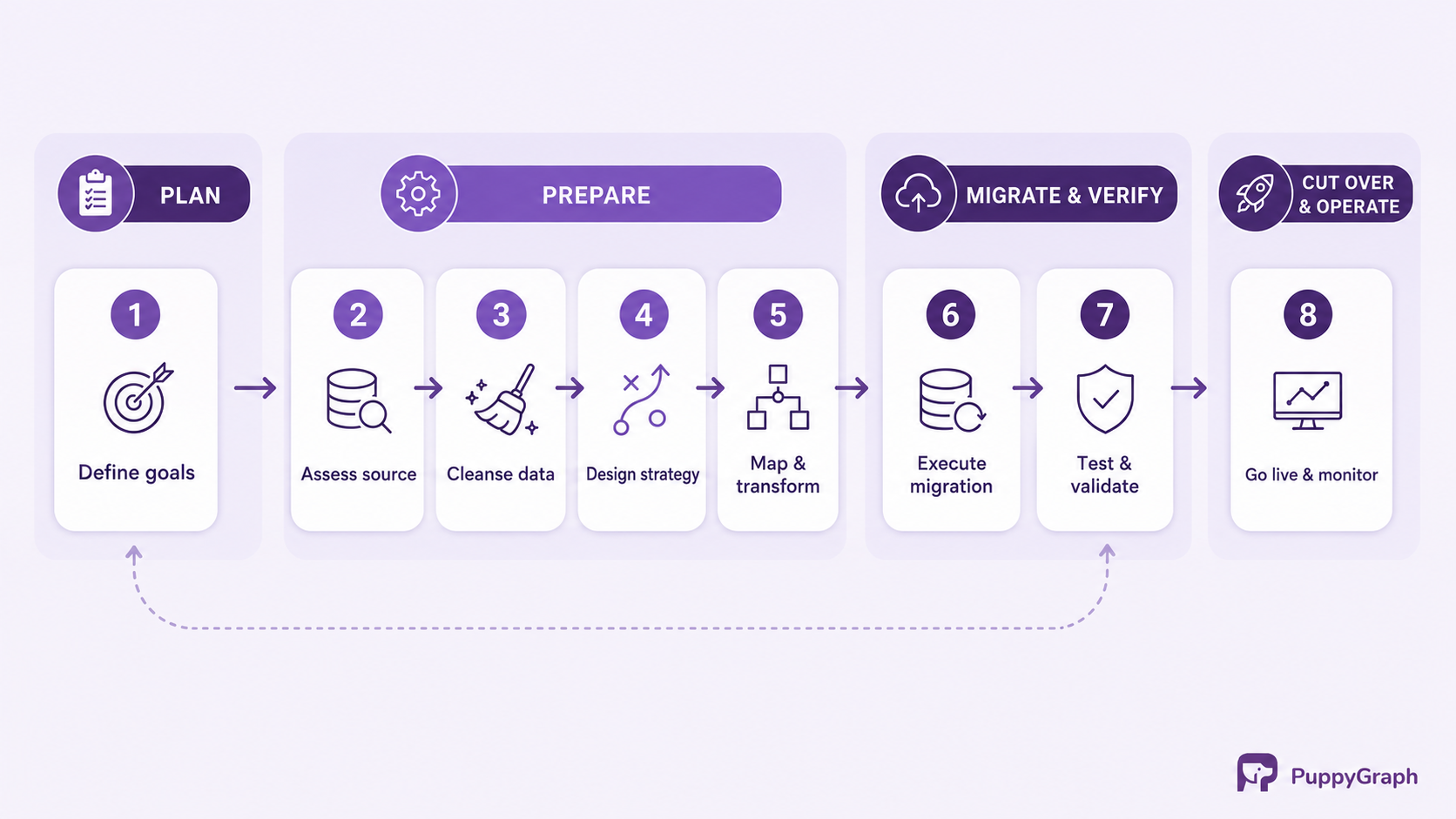
These phases overlap. Findings from profiling, rehearsals, and performance tests should update the plan while mappings, tests, and runbooks remain under version control.
Step 1: Define migration goals and requirements
Start with the outcome, not the tool. State why the migration exists and what will be different when it is complete. A useful goal is measurable, such as retiring a legacy database by a fixed date, supporting a defined workload on the target, consolidating duplicate customer records, or meeting a recovery objective the source cannot meet.
Turn that goal into a scope register. List datasets, historical periods, applications, reports, interfaces, users, and environments that will move. Record exclusions just as carefully. For every item, identify the business owner, technical owner, data classification, retention requirement, source of truth, and downstream consumers.
Then define acceptance criteria. These should cover:
- completeness and permitted exceptions;
- accuracy of critical fields and relationships;
- maximum outage and acceptable replication lag;
- application behavior and query results;
- performance and capacity targets;
- access controls, encryption, auditability, and residency;
- rollback triggers and the period for which rollback remains possible.
Assign approval clearly. Data owners approve semantic rules and reconciliation, security owners approve controls, and application owners sign off on behavior. Name the authority for the final go or no-go decision.
Step 2: Assess and profile source data
Build an inventory from the systems themselves rather than relying only on old diagrams. AWS recommends using programmatic data to validate institutional knowledge and static documentation, with discovery tooling specifically used to validate traffic patterns and dependencies, in its detailed application assessment guidance. The same guidance separately asks teams to document connection methods, schemas, custom data types, security details, and dependencies.
Profile each dataset at table, column, and relationship level. Measure row counts, distinct values, nulls, ranges, lengths, duplicates, orphaned references, and encodings. For large sources, cover representative partitions and every high-risk field rather than assuming one sample describes the history.
Trace dependencies in both directions. Identify what produces the data, what reads it, and which schedules or transactions establish ordering. Include files, APIs, dashboards, machine-learning features, exports, and manual processes. A table that appears unused may feed a quarterly regulatory report or a spreadsheet outside the formal catalog.
Preserve the profile results with timestamps and source snapshots where possible. This baseline distinguishes migration defects from known source defects and legitimate changes that arrived during the move.
Step 3: Cleanse and prepare data
Resolve quality issues according to explicit rules. Common tasks include standardizing dates and codes, normalizing units, correcting invalid values, deduplicating entities, repairing broken references, and separating records that should not be migrated. Assign every rule an owner, rationale, implementation, and exception path.
Decide where cleansing occurs. Fixing the source improves every consumer and simplifies comparison, but the source may be frozen or risky to change. Transforming during migration isolates the work but requires a documented bridge between old and new values. Questionable records can be quarantined when the business accepts and owns the exception.
Keep an immutable extract or reproducible snapshot for the migration window, subject to retention and privacy rules. Mask production data used in lower environments while preserving relationships required by the tests.
Cleansing should narrow ambiguity, not silently redefine the business. If two systems disagree about a customer's status, a deterministic string transform cannot decide which one is authoritative. Route semantic conflicts to the relevant data owner.
Step 4: Design the migration strategy
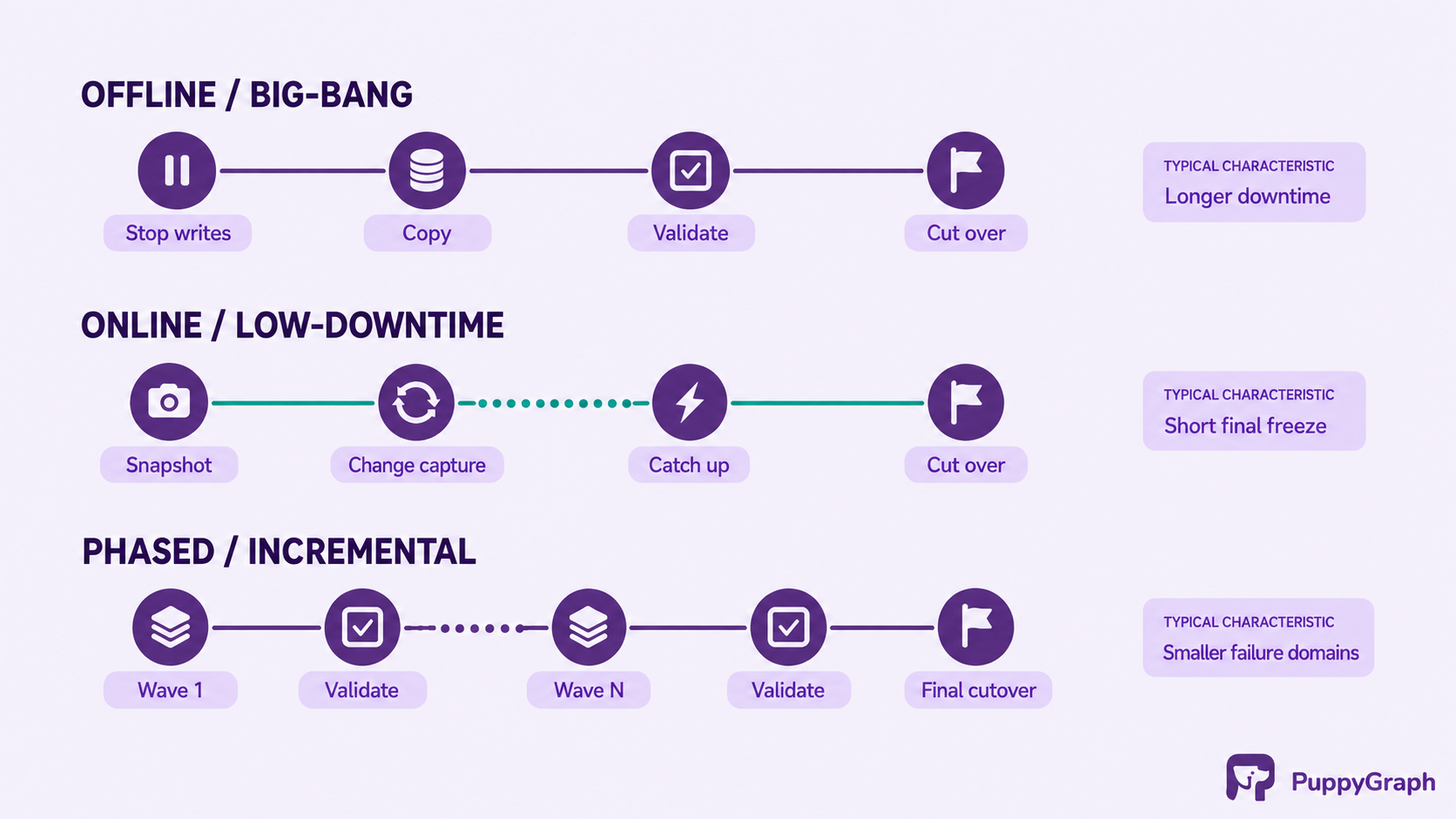
Choose the cutover method from the downtime limit, write rate, data volume, network capacity, target compatibility, and recovery requirement.
Offline or big-bang migration. Stop writes, migrate the data using an offline method, validate the target, then redirect applications. This is operationally simple and gives reconciliation a stable boundary, but the transfer and validation must fit inside the outage window. AWS's current database migration guidance documents this offline sequence alongside an online alternative.
Online or low-downtime migration. Load an initial snapshot, capture subsequent changes, and apply them to the target until replication lag is low enough to cut over. Google Cloud documents this snapshot-plus-change-data-capture pattern. It reduces outage time but adds ordering, delete handling, schema-drift, and replication-monitoring concerns.
Phased or incremental migration. Move datasets, tenants, regions, or application capabilities in waves. Smaller failure domains make learning and rollback easier, though coexistence requires routing rules and may temporarily create cross-system dependencies.
Write a runbook covering prerequisites, execution order, checkpoints, freeze windows, communications, validation gates, authority, rollback, and retirement. Rehearse it with production-like volume and measure each stage. An untested estimate is a weak basis for a cutover window.
Step 5: Map and transform data
A mapping specification connects every source field and relationship to the target. It should identify the source expression, target field, data type, null behavior, default, lookup, transformation, validation rule, and owner. Mark fields that are intentionally dropped and explain why. This prevents absence from being mistaken for oversight.
Test semantic equivalence, not just type compatibility. An integer identifier may fit in the target but lose leading zeros if it was treated as text elsewhere. A timestamp may need a timezone and daylight-saving policy. A monetary amount needs a currency and rounding rule. Enumerated values need an explicit translation for unknown and retired codes.
Relationships deserve their own mapping. Preserve primary and foreign keys where appropriate, maintain a crosswalk when identifiers change, and define how late-arriving parents and children are handled. For denormalized targets, document which source wins when two records contribute the same target attribute.
Implement transformations as versioned code. Make batches idempotent so retries cannot duplicate records or apply a conversion twice. Log identifiers, rule versions, and rejection reasons so validation failures remain traceable.
Step 6: Execute the data migration
Begin with a pilot covering hard cases such as large objects, old encodings, high-change tables, sensitive fields, and complex relationships. Use the extraction, transformation, loading, and logging path intended for production.
During execution, capture batch IDs, source boundaries, row counts, checksums, durations, throughput, errors, retries, and change-replication lag. Throttle work when migration traffic threatens source workloads. Avoid uncontrolled manual fixes in the target; route corrections through the migration code so the result can be reproduced.
Use explicit checkpoints. A failed batch should resume from a known boundary, and operators should know whether replay is safe. Keep schema changes coordinated with the migration team. Microsoft warns that source schema and data can drift during continuous synchronization, advises ensuring that every source change is captured and applied, and says to verify source-target parity before cutover in its SQL Server migration guidance.
For an online move, establish a short final freeze if the design requires one, let outstanding changes drain, record the final replication position, and only then begin the cutover validation. The source remains authoritative until the runbook's ownership transition point.
Step 7: Test and validate the migrated data
Validation needs several layers because each catches a different failure.
Structural validation checks that expected tables, columns, types, constraints, indexes, partitions, permissions, and metadata exist.
Data reconciliation compares counts, nulls, distinct keys, aggregates, checksums, and sampled or complete records. Segment comparisons by date, tenant, region, or another business dimension so offsetting errors do not hide inside one total. AWS DMS can compare corresponding source and target rows and report mismatches, but its documented key requirements and resource overhead also illustrate why tool-based validation needs to account for the specific schema and available capacity.
Relationship validation checks referential integrity, identifier crosswalks, hierarchy depth, and orphan rates. This is essential when the target changes the data model.
Functional testing runs application workflows, APIs, reports, and analytical queries against known cases. Compare business outcomes, not only query execution. A report that runs successfully can still apply a changed filter or calendar definition.
Nonfunctional testing covers performance, concurrency, recovery, security, auditing, backup, and restore under realistic volume and skew.
Classify every mismatch, assign an owner, and rerun the affected test after correction. The migration is ready only when the agreed thresholds are met and the relevant owners sign off. A dashboard full of green job statuses is operational evidence, not business acceptance.
Step 8: Monitor, optimize, and go live
Treat go-live as a controlled ownership change. Confirm the final backup or snapshot, replication position, validation results, support staffing, communication path, and rollback deadline. Redirect traffic according to the runbook, then test critical transactions from the user's point of view.
Monitor both technical and business signals. Technical measures include errors, latency, throughput, saturation, failed jobs, replication lag, and access denials. Business measures include order totals, account balances, active-user counts, document availability, and report freshness. Compare them with the pre-migration baseline and account for normal seasonality.
Expect controlled tuning after cutover as real traffic exposes changes needed in statistics, partitioning, indexes, caches, connection pools, or query plans. Do not decommission the source immediately. First pass the stabilization period, resolve exceptions, test target restore procedures, and obtain owner approval. Then revoke access, dispose of data according to policy, and update catalogs, lineage, and runbooks.
Common data migration challenges
Unknown source state. Hidden tables, forgotten exports, and undocumented integrations surface late. Duplicates, invalid values, missing keys, and inconsistent definitions then become target defects if extraction is treated as proof of correctness. Start with programmatic discovery and profiling, then have owners validate the inventory, exclusions, and data-quality exceptions.
Schema and source drift. Compatible-looking types may represent different units, timezones, identifiers, or business rules. Writes and schema changes during execution also make comparison boundaries unstable. Keep mappings testable, define freeze rules, capture changes, monitor lag, and record where authority transfers.
Unrealistic execution assumptions. A full load that exceeds the outage window forces a rushed decision, while a logically correct target can still fail under production concurrency or skew. Rehearse with realistic volume and workloads, use continuous replication where its complexity is justified, and reserve time for target tuning.
Weak verification and recovery. Row counts alone miss truncation, wrong values, broken relationships, and changed business logic. A rollback statement without a tested sequence, data-reconciliation plan, or decision deadline is equally weak. Combine structural, record-level, aggregate, relationship, functional, and security tests, then rehearse the reverse path and define how writes accepted by the target will be handled.
Governance gaps during transition. Temporary extracts, broad migration credentials, and copied logs can expand exposure. Premature source retirement removes an important recovery and comparison point. Apply least privilege, protect temporary data, and keep the source controlled but available until acceptance, backup, retention, and audit conditions are satisfied.
These challenges share a control problem rather than a transfer problem. Explicit ownership, measurable gates, reproducible execution, and a tested recovery path keep uncertainty visible until the target has earned acceptance.
Conclusion
A reliable data migration process is built around evidence. Goals define what success means. Profiling establishes the source baseline. Mapping makes transformations reviewable. Rehearsals expose timing and dependency problems. Layered validation proves that the target works, and a controlled cutover establishes when it becomes authoritative.
The eight steps are reusable across storage, database, application, cloud, and analytical migrations because they separate the migration's essential questions from any one vendor's tooling. Teams can change the transfer mechanism without giving up scope control, semantic ownership, reconciliation, or recovery.
Some analytical use cases can avoid creating another migration stream. When relational data already lives in supported SQL databases, warehouses, or lakehouses, PuppyGraph maps those tables to nodes and edges and runs openCypher or Gremlin queries over them. Its default external data source path reads rows from the source at query time. For graph analytics alone, this removes a derived graph copy and its separate cutover, validation, and synchronization work; migration remains necessary when the system of record itself must move.
Try the forever-free PuppyGraph Developer Edition and book a demo with the team to see how openCypher and Gremlin queries run over warehouse and lakehouse tables, with no graph-specific ETL, when graph analytics should not require another data migration.

Hao Wu is a Software Engineer with a strong foundation in computer science and algorithms. He earned his Bachelor’s degree in Computer Science from Fudan University and a Master’s degree from George Washington University, where he focused on graph databases.


