

What Is Data Provenance: Definition & Guide
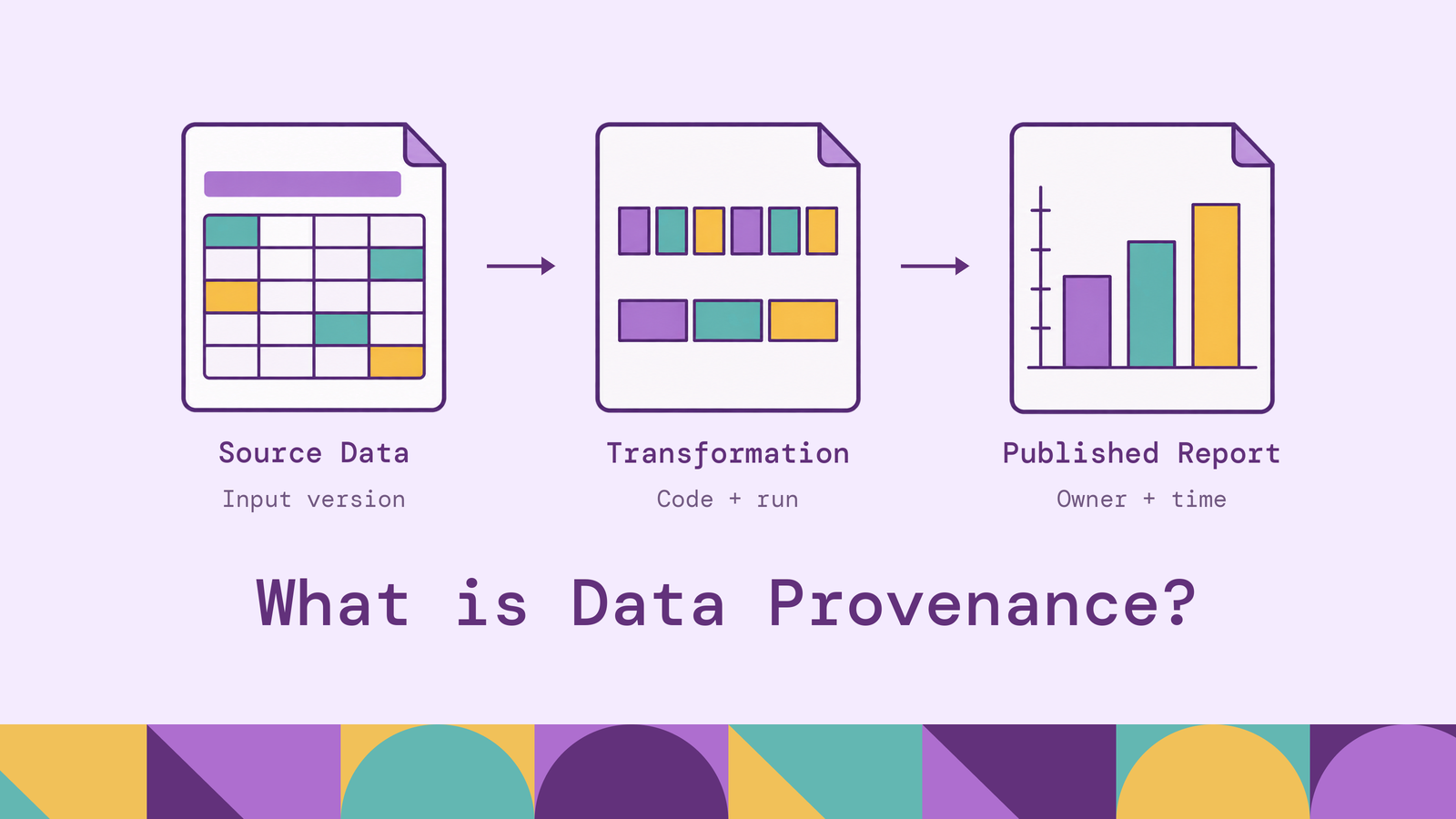
A report can be numerically plausible and still lack the evidence needed to defend it. Knowing which table supplied a metric helps, but investigating a disputed result also requires the input version, transformation logic, execution record, and responsible people or systems. Data provenance connects that evidence to the result it explains.
This guide covers how data provenance works, its relationship to data lineage, and the design choices that make it useful for governance, debugging, and reproducibility. A revenue-reporting example connects the concepts to implementation and solution selection.
What is data provenance?
Data provenance is information about a data artifact's origin and the processes and actors involved in producing it. The W3C PROV overview frames provenance as information that helps people assess quality, reliability, and trustworthiness. An artifact might be a file, table version, query result, report, or trained model.
Consider a monthly revenue report built from order records, refunds, and currency conversion rates. Its provenance could identify the specific inputs, the job that combined them, the code revision used, and the person who approved a manual adjustment. These records help explain why the published total differs from a later rerun.
The useful scope depends on the question. Dataset-level provenance may explain which files contributed to a report. Explaining an individual invoice adjustment may require record-level evidence. Neither level is universally sufficient, and capturing more detail introduces storage and maintenance costs.
Provenance provides evidence for evaluating a result; it does not guarantee that the result is correct. A fully documented transformation can contain a bug, and a well-identified source can supply inaccurate data. Quality checks establish additional evidence about validity. Provenance preserves the context needed to interpret those checks and investigate failures.
How does data provenance work?
A provenance implementation captures metadata as data is created and processed, links the records through identifiers, and exposes the resulting history for investigation. Separate the processing system, which performs the work, from the metadata system, which describes it.
In the revenue example, an ingestion process records the identities of the order and refund extracts. A transformation run records which extracts it consumed, which currency-rate version it used, and which report dataset it produced. Publishing the report creates another record connecting the published artifact to that output.
There are several ways to collect this evidence. Parsing transformation code can reveal declared dependencies. Execution events describe observed runs. Approval systems can supply records of human decisions. Each observation should retain its origin so investigators can distinguish what code could do from what a recorded run actually did.
OpenLineage's object model illustrates runtime capture: it distinguishes jobs, individual runs, and input and output datasets. Events can carry additional metadata through facets. Its source code location facet can identify a code revision, while its dataset version facet can identify a version supplied by the data store. Check which fields an integration actually emits.
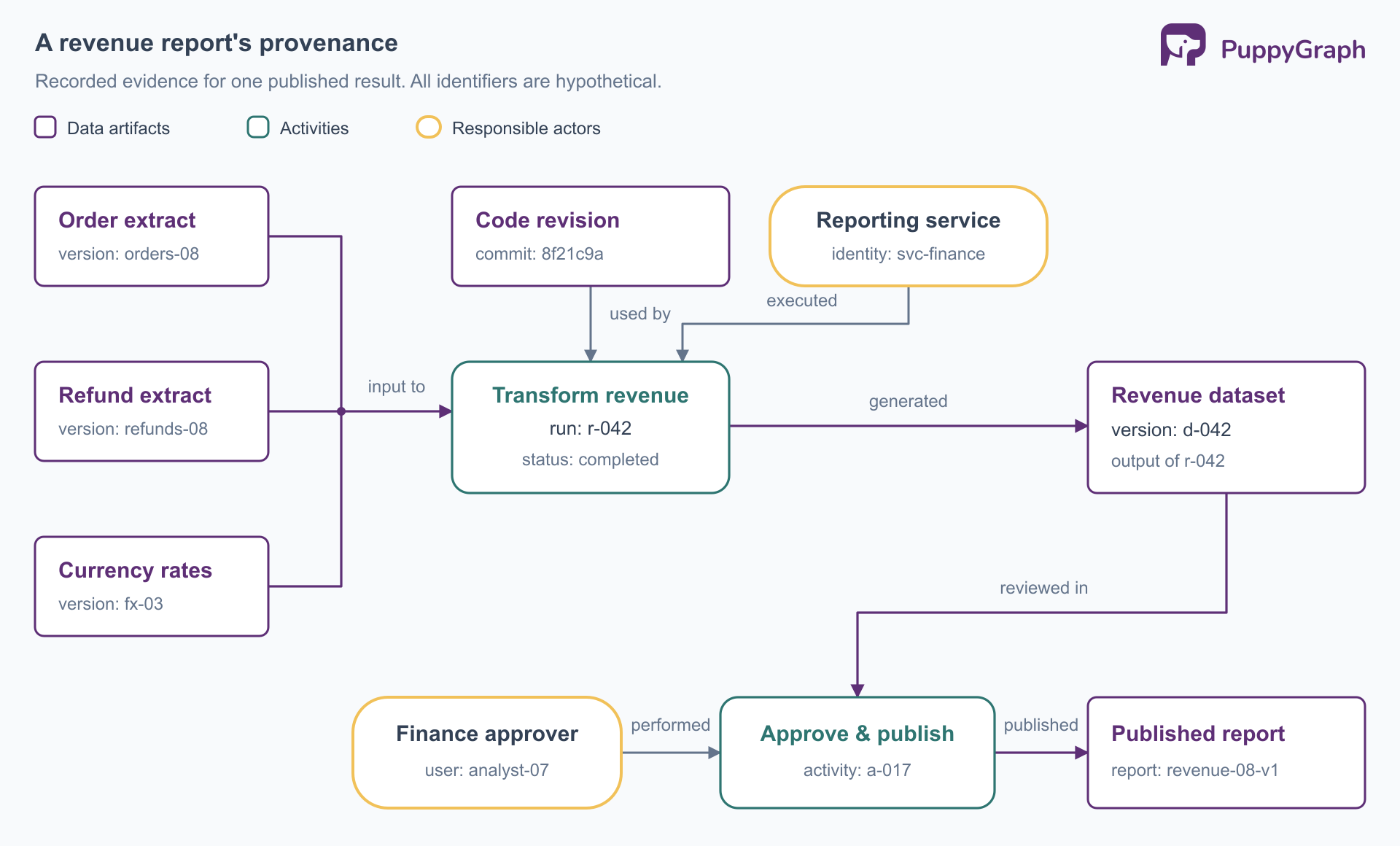
With those connections, investigators can work backward from a report to its inputs or forward from a faulty input to potentially affected outputs. The answer is bounded by what was captured: an unrecorded spreadsheet adjustment remains a gap even when the automated pipeline is fully documented.
Why is data provenance important?
Provenance makes a result inspectable after the people and systems that produced it have moved on. Its value becomes concrete when teams need to explain, correct, or reuse that result.
Debugging and correction. Suppose the revenue total changes after a rerun. Comparing input versions, code revisions, and run parameters gives the investigation specific candidates: a late refund, a corrected exchange rate, or changed aggregation logic. Once the cause is known, recorded dependencies help identify outputs that need review or regeneration.
Governance and accountability. A report owner needs to know who supplied an input, which team maintains the transformation, and who approved an exception. Connecting those responsibilities to particular artifacts and activities makes escalation more precise than a general ownership entry on a table. Ownership and execution identity should remain distinct.
Compliance evidence. Under GDPR Article 5(2), a controller must be able to demonstrate compliance with the principles in Article 5(1). Provenance can contribute evidence about data origins and processing history. It does not by itself establish a lawful basis, fulfill every documentation requirement, or prove compliance. Map the evidence collected to the specific obligation being assessed.
Reproducibility and reuse. An analyst evaluating an old report needs to know what inputs and logic produced it. A model-development team faces the same issue with training data and preprocessing. Provenance records can identify those dependencies, but rerunning the work also requires retaining the referenced data, code, configuration, and relevant environment.
These uses share a practical requirement: the explanation must survive independently of an engineer's memory. Provenance turns an investigation into a review of recorded evidence, with uncertainty visible where the record ends.
Key components of data provenance
The W3C PROV data model organizes provenance around entities, activities, and agents, connected through relationships such as usage, generation, and attribution. These concepts provide a useful foundation even when an implementation stores metadata in ordinary relational tables.
Entities identify the things being described. In the revenue example, entities include input extracts, a currency-rate dataset version, and a published report. Assign identities at the granularity needed for investigation. A table name identifies a continuing asset; a version identifier distinguishes the particular state used in a calculation.
Activities identify the work performed. A transformation run, validation run, or approval step can be modeled as an activity. Record start and end times where available, status, parameters, and relevant code references. Keep a recurring job's identity separate from the identity of each execution so yesterday's success cannot be confused with today's failed attempt.
Agents identify responsibility. In PROV terminology, agents can be people, organizations, or software agents. They need not be AI systems. A service may execute the reporting job while a finance analyst approves publication. Record their roles explicitly; an executing service account does not tell an investigator who owns the calculation's business definition.
Relationships identify how the pieces connect. Record which activity used an input, which activity generated an output, and which actor was responsible for an activity. Preserve relationship meaning. Knowing that a job read several tables does not establish that every output column derived from every input column; the PROV FAQ's derivation example illustrates this limitation.
Evidence metadata identifies the basis for the record. For each asserted relationship, retain its reporting system, collection time, and capture method. Where useful, link to an execution log or approval record. Label inferred dependencies separately from observed events and human declarations. That distinction lets an investigator judge the strength of a path through the history.
Together, these components describe both what happened and the evidence available to support that account. Consistent identifiers make the pieces joinable across systems.
Data provenance vs data lineage
Data lineage emphasizes how data depends on other data and moves through transformations. Provenance emphasizes the context of an artifact's creation, including those dependencies, activities, and responsible actors. This is a useful distinction in emphasis, not a strict boundary between standards or products. The W3C's dataset-exchange use cases explicitly discuss representing lineage with provenance vocabularies.
Both can support upstream and downstream investigation. Both can be recorded at different granularities. A lineage implementation can carry run history, ownership, and version information, as the OpenLineage model demonstrates. Provenance is not limited to an original source, and lineage is not limited to a diagram of table movement.
For implementation, start with the evidence your questions require. If your existing lineage system already preserves it, extend that system's model and access paths before introducing another metadata repository solely because the terminology differs.
How to implement data provenance
Begin with one important output whose history you can validate. For the revenue report, define success as identifying the inputs, execution, logic, and approval behind a selected published version. Then build the collection and retention needed to answer that question repeatedly.
- Define scope and granularity. Inventory the sources, transformations, manual interventions, and publication steps along that path. Decide whether dataset, partition, column, or record detail is necessary at each boundary. Write down what a successful investigation must return and which gaps are acceptable. Avoid making universal record-level tracking the starting requirement.
- Establish identifiers and a common model. Define how datasets, versions, runs, and actors are named across tools. Include environment and source-system context so two tables named
ordersdo not collapse into one identity. Maintain mappings where tools use different names for the same object. Specify relationship direction and meaning before merging records.
- Instrument the workflow. Collect supported execution events, transformation metadata, and approval records. OpenLineage can provide an event format for compatible integrations; custom emitters may be needed for uncovered steps. Give separate execution attempts distinguishable identities, and define how repeated delivery of the same event is handled. Preserve failed attempts without presenting their outputs as successfully published artifacts.
- Retain evidence and protect access. Store enough history to answer the agreed questions for the required period. Coordinate retention of provenance records with retention of source snapshots, code, and approvals. Restrict who can submit or alter evidence, and audit administrative changes. Keep sensitive values and credentials out of metadata where identifiers or protected references suffice.
- Validate with investigations. Select a historical report and reconstruct its production path. Introduce a controlled change to an input and check the downstream impact result. Test a retry, a renamed source, a delayed event, and a missing event. Measure coverage against the scoped inventory, along with event delay and unresolved identities. Assign an owner to every uncovered boundary.
Treat the first implementation as an operating process. New pipelines need instrumentation, changed identifiers need reconciliation, and expired evidence needs a visible retention boundary. A release check can require a sample output to have the expected provenance before a new pipeline enters routine use.
Once the first workflow passes these checks, expand to adjacent outputs. Reuse the identifier conventions and validation process, while adjusting detail to each use case. This creates evidence that teams can maintain and test as the estate grows.
Common data provenance challenges
The hardest gaps often appear between systems, where each tool records its own work but does not share the identities needed to connect it to the next step.
Incomplete capture. A notebook export, spreadsheet correction, or third-party feed can break an otherwise detailed history. Require those boundaries to record input references, output identities, and the responsible actor. When a supplier exposes no internal processing history, mark that boundary explicitly. An unknown origin should remain unknown rather than appearing as an original source by default.
Changing data and identifiers. Overwritten files, reused table names, and mutable reference datasets can make old records point at new content. Preserve version identities and rename mappings. For streams, define the offsets or windows covered by a recorded input. A timestamp alone may not identify the complete input state across several independently changing systems.
Volume and overhead. Recording every row-level contribution can create much more metadata than tracking dataset dependencies. Select detail according to the decisions it supports. Keep detailed evidence for workflows that require it and coarser records where they answer the question. Make that granularity visible so a dataset-level path is not mistaken for proof about one record.
Trust and exposure. Provenance metadata can reveal sensitive dataset names, user identities, query text, and organizational relationships. Apply access controls and deliberate retention. Integrity controls also have limits: protecting a record against later alteration does not establish that its original assertion was truthful. Preserve the producer's identity and check critical assertions against independent evidence where feasible.
These challenges belong in the data platform's operating responsibilities. Coverage, identity resolution, retention, and evidence quality need owners and measurable expectations, just as the pipelines themselves do.
How to choose a data provenance solution
Evaluate solutions against a representative investigation from your own environment. Ask the team or vendor to reconstruct a historical output that includes an automated transformation, a retry, and a manual approval. Require evidence tied to that output's version, including the inputs and approval records available at publication.
Capture coverage and precision. Verify the actual systems, languages, and execution paths covered by each connector. Inspect sample metadata for versions, run identities, actors, and column relationships where required. Ask how unsupported logic and missing events appear. Connector availability alone does not establish the depth or completeness of capture.
Historical evidence and interoperability. Confirm whether earlier states remain queryable and whether export preserves identities, relationship types, and timestamps. Test how schema changes affect older records. Standards support should be demonstrated with an exchange between the systems you plan to use, including any custom fields your investigation requires.
Investigation and operation. Test backward tracing, downstream impact analysis, and filtering by execution or time. Review APIs alongside the user interface. Include permissions, retention controls, recovery procedures, source-system load, and the effort required to maintain integrations in the evaluation. Judge query responsiveness using a realistic metadata graph and workload.
The architecture may combine several components. A catalog can organize metadata and ownership, collection integrations can emit evidence, and a query layer can connect records for investigation. Choose a packaged workflow where it meets the requirements; add components when a specific gap justifies their operating cost.
For teams that already store provenance metadata in supported SQL databases, warehouses, or lakehouses, PuppyGraph can make those relationships directly queryable as a graph. Its graph schema maps existing tables to nodes, edges, and properties. For this use case, a team could model dataset versions, runs, and actors, then connect them through the usage, generation, and responsibility records it already collects. That schema supplies a shared domain model for investigators.
The default direct-query path reads existing data in place, with no graph-specific ETL or persistent duplicate dataset required. Analysts can use openCypher and Gremlin to trace a report's recorded dependencies across multiple steps. Metadata collection, identity reconciliation, and historical retention remain responsibilities of the surrounding provenance implementation. This fits the division of work: collection systems preserve the evidence, and PuppyGraph provides graph queries over the mapped records.
Conclusion
Data provenance makes a result explainable through its inputs, transformations, execution history, and responsible actors. Useful implementations preserve identities and versions, distinguish observation from inference, and expose the gaps that limit an investigation. Start with a concrete output and prove that its history can be reconstructed before expanding coverage.
Try the forever-free PuppyGraph Developer Edition and book a demo with the team to see how openCypher and Gremlin queries connect provenance records in warehouse and lakehouse tables, with no graph-specific ETL, tracing the recorded relationships behind a report or dataset.

Hao Wu is a Software Engineer with a strong foundation in computer science and algorithms. He earned his Bachelor’s degree in Computer Science from Fudan University and a Master’s degree from George Washington University, where he focused on graph databases.


