

What Is Data Streaming ? Architecture, Tools, Use Cases
.png)
Data streaming becomes an architecture problem as soon as events must influence a decision before the next scheduled batch. The system has to stay correct while records arrive late, repeat, appear out of order, and pass through components that fail independently.
This model decouples producers and consumers through durable event transport, while computations maintain state across records. This article explains the mechanics, architecture, tools, trade-offs, and implementation path.
What is data streaming?
Data streaming is a model for continuously producing, transporting, and processing data records. Each record represents something that happened: a payment was authorized, a package changed location, a user opened a page, a database row was updated, or a server emitted a metric.
A stream is usually unbounded. Unlike a file or table snapshot, it has no known final record. That does not mean every computation runs one record at a time. A streaming engine may buffer events into short intervals or group them into time windows. The essential distinction is that the system accepts new input continuously and produces updates while the stream remains open.
Three terms are useful here:
Event. A fact about a state change or observation, normally carrying a timestamp, key, payload, and metadata.
Event stream. An ordered sequence of events stored under a logical name such as a topic. Ordering is commonly guaranteed only within a partition, not across an entire distributed stream. For example, Kafka guarantees order within a topic partition, so events that must stay ordered need a stable partition key such as an account ID.
Stream processing. Computation over events as they arrive. Stateless operations can parse or filter one event independently. Stateful operations remember prior events to calculate a running total, join two streams, detect a sequence, or maintain a live feature.
Data streaming is broader than real-time analytics. The output may feed an alert, application, database, model, API, or analytical table. Real time is a business-specific latency requirement with no universal threshold. A card authorization and an inventory dashboard can have very different latency budgets.
Why is data streaming important?
The value of streaming appears when the usefulness of data declines with age. A payment risk score matters before authorization, an infrastructure alert during the incident, and a recommendation during the current session. Scheduled processing may produce the same calculation too late to change the outcome.
Streaming also decouples systems. A producer publishes an event once, while independent consumers update search indexes, trigger notifications, calculate metrics, and archive history. The producer does not need direct integrations with every downstream service, and a new consumer can start without changing the producer. If the transport retains events, a consumer can recover after downtime or replay history into new logic.
The qualification matters. Streaming does not make every decision instantaneous or every dataset current. End-to-end freshness includes collection, broker delay, processing, sink writes, and serving latency. A team needs a measurable service-level objective for that whole path, not just a fast broker.
How does data streaming work?
A streaming flow has producers, durable transport, processors, and consumers.
1. Producers create events. Applications publish domain events such as OrderPlaced. Devices and services emit telemetry. Database connectors use change data capture (CDC) to turn inserts, updates, and deletes into event records. For example, the Debezium PostgreSQL connector reads committed changes through PostgreSQL logical decoding and sends row-level change events to topics.
2. A broker stores and distributes them. Platforms such as Apache Kafka, Amazon Kinesis Data Streams, Apache Pulsar, and Google Cloud Pub/Sub accept events and expose them to consumers. In a partitioned log such as Kafka, the producer chooses or derives a partition, the broker appends the event, and consumers track their position with offsets. Retention allows consumers to reread events rather than treating delivery as a one-time handoff.
3. Processors transform and correlate events. A processor may validate schemas, filter noise, enrich an event with reference data, join streams, or aggregate records into windows. Stateful stream processors commonly checkpoint managed state so they can recover consistently after a failure. In Apache Flink, a checkpoint records operator state together with source positions.
Time is one of the hardest parts. Processing time is when the system handles an event; event time is when the event occurred. Network delays, offline devices, and retries mean those values can differ. In Beam, a watermark estimates progress through event time. Allowed lateness determines how long delayed events remain eligible for processing, triggers determine when a window emits another pane, and accumulation mode determines whether that pane includes values emitted earlier. The Apache Beam programming guide explains how these controls interact in an unbounded dataset.
4. Sinks make results usable. Processed data may land in an operational database, search index, lakehouse table, feature store, or analytical database. Other consumers act directly by sending an alert or updating an application. The sink must tolerate retries, commonly through idempotent writes, deduplication keys, or transactions.
That last point limits delivery guarantees. In Flink, exactly once does not mean that each event is processed only once. It means that each event affects the state managed by Flink exactly once. End-to-end exactly-once behavior also requires a replayable source and a transactional or idempotent sink.
Data streaming architecture
A production architecture separates responsibilities so each layer can scale and fail independently.
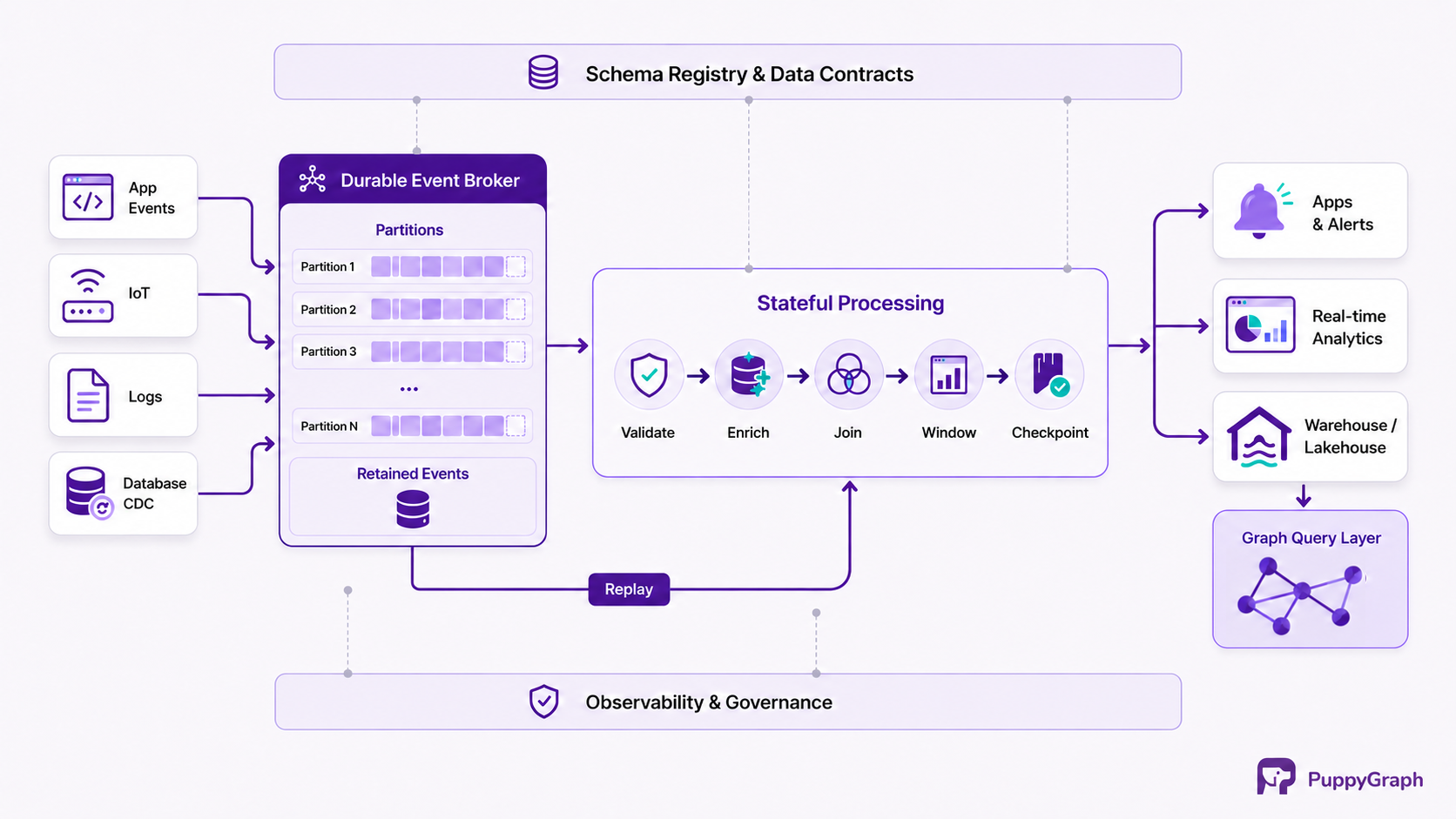
Sources and ingestion. Producers should emit stable event keys, event-time timestamps, unique identifiers, and enough context for consumers to interpret the record. CDC is useful when an existing database is the source of truth and changing application code is impractical. Application-native events are better when business meaning, such as why an order was canceled, cannot be reconstructed safely from row changes alone.
Event transport. The broker provides durable storage, partitioning, replication, and consumer coordination. For partitioned logs such as Kafka, partition count bounds partition-level consumer parallelism. The partitioning strategy affects load distribution, and routing related events to the same partition preserves their relative order. A poor strategy can overload one partition or scatter events that must be processed together. Retention should cover likely outages, replay needs, and audit requirements.
Stream processing. This layer applies transformations and maintains state. Apache Flink is designed for stateful event-time processing. Kafka Streams is a Java client library that runs processing inside an application and requires no separate processing cluster. Spark Structured Streaming treats a live stream as a continuously appended table. Apache Beam supplies a portable programming model that can run on engines including Flink, Spark, and Google Cloud Dataflow. These tools are not interchangeable with the broker that transports events.
Serving and storage. One stream often feeds multiple destinations. Key-value stores serve application state, search systems support retrieval, and analytical databases support live dashboards. Warehouses and lakehouses retain governed history for reporting, machine learning, and ad hoc analysis. Raw events or reproducible source tables allow derived views to be rebuilt after code changes.
Contracts and control plane. Schema compatibility rules prevent a producer change from silently breaking consumers. Access controls govern topics and destinations. Metrics should expose consumer lag, throughput, processing latency, watermark progress, checkpoint health, failed records, and sink freshness. Lineage connects an output back to its topics, processing job, and source fields.
Together, these layers decouple event production, processing, and serving so each can scale and recover independently under shared contracts.
Data streaming vs. batch processing
Batch processing typically runs a finite job over bounded input, such as yesterday’s files or all rows changed since the last run. Streaming commonly handles unbounded input incrementally, but streaming execution can also process bounded input. Windows, triggers, or micro-batches determine when results are emitted. Neither model is generally superior. The decision follows from latency, correctness, cost, and operational needs.
Streaming can reduce decision latency but introduces long-running state, out-of-order data, and continuous operations. Bounded batch inputs often make a replay range easy to identify, although retained streams can also be replayed from explicit offsets or timestamps. When results are needed only periodically, batch avoids a continuously running job; some engines also optimize bounded jobs to use fewer concurrent resources.
Many systems use both. A streaming path maintains a current view, while a batch job recomputes authoritative totals or backfills corrected logic. A shared event history or lakehouse lets both paths read the same underlying facts. The choice is whether continuous incremental work or periodic bounded work matches the decision being served.
How to implement data streaming
Start with one decision and its latency requirement. “Build a streaming platform” is too broad to guide architecture. “Block a suspicious payment before authorization” identifies the producer, output, maximum delay, failure policy, and correctness stakes.
Define the event and ownership. Give each event a unique ID, stable key, event timestamp, schema version, and clear business meaning. Assign an owning team. Prefer immutable facts and publish corrections as new facts. Decide how personally identifiable or regulated data will be minimized, encrypted, retained, and deleted.
Set an end-to-end freshness objective. Measure from event creation to the point where the result is usable. Break that budget across collection, transport, processing, sink, and serving. Define what happens when the objective is missed. A dashboard can display staleness; a payment service may need a conservative fallback.
Choose tools by layer. Select transport based on deployment environment, ordering, retention, throughput, and operational ownership. Select processing based on event-time needs, state size, APIs, and the delivery guarantees the sinks can support. Select each destination for its access pattern. A broker is not an analytical database, and a stream processor is not automatically a serving layer.
Next, make failure and replay behavior explicit.
Design for duplicates and disorder. Assume producers retry, consumers restart, and events arrive late. Use unique event or operation IDs, idempotent upserts, and deterministic processing where possible. Define a late-data policy for each output: update a prior result, route the event for review, or discard it after a stated boundary. Preserve the original event timestamp alongside ingestion and processing timestamps.
Plan replay before launch. Retain enough source history to recover from the longest plausible outage. Version processing logic and schemas. Replaying into a new destination is safer than overwriting a live result in place. Throttle replays so historical traffic does not starve current events, and verify whether downstream side effects such as emails or payments must be suppressed.
Then validate and operate the result.
Test failures, not only transformations. Unit tests can confirm that an event maps to the expected output. Integration tests should also kill a worker during a checkpoint, duplicate input, delay events across a window boundary, make a sink unavailable, and change a schema. Compare the recovered state with a clean run over the same input.
Operate the pipeline as a service. Alert on lag and freshness, not just job uptime. Establish runbooks for stuck partitions, failed checkpoints, schema incompatibility, poison records, and destination throttling. A dead-letter path needs ownership and a reprocessing process or it becomes permanent data loss with a queue attached.
Begin with one bounded use case and prove recovery under failure. Shared schemas, deployment templates, observability, and access policies can become a platform after the first pipeline exposes what the organization actually needs.
Data streaming use cases
Fraud and risk decisions. Payment, login, device, and account-change events can update risk features during an interaction. Stateful processing is important because a single transaction may look normal while a sequence across related accounts or devices reveals a pattern.
Observability and security. Metrics, logs, traces, authentication events, and network telemetry arrive continuously. Streaming pipelines normalize and enrich them, calculate rolling rates, and route alerts while also retaining the events for investigation. Event time matters when agents buffer data or reconnect after an outage.
Personalization and product analytics. Clicks, searches, purchases, and content views update session context and recommendation features. The same events can feed live product metrics and durable analytical tables, although the serving path for a recommendation has a tighter latency budget than a dashboard.
Other uses center on infrastructure and integration.
IoT and logistics. Sensors and vehicles produce location, temperature, vibration, and health readings. Processors can detect threshold breaches, missing signals, and changes over time. Using a device ID as a stable partition or ordering key can preserve broker delivery order per device when the transport’s ordering feature is configured. Uneven device rates can still create hot keys or shards.
CDC and operational data integration. Changes captured from database logs can refresh caches, search indexes, warehouses, and downstream services without polling whole tables. A CDC event carries database-level facts, so consumers still need clear rules for translating row changes into business meaning. Debezium’s event format, for example, can include operation type, source metadata, timestamps, and before-and-after row state.
Relationship analysis over fresh analytical data. Once streaming or CDC pipelines land current records in a SQL database, warehouse, or lakehouse, teams may need to follow relationships across accounts, devices, transactions, services, or assets. PuppyGraph defines a graph schema over those existing tables and queries them with openCypher or Gremlin. Its direct source connections let the default path read the governed data in place, including direct reads of Iceberg and Delta Lake tables, without a separate graph-specific ETL pipeline or persistent graph copy. The streaming system remains responsible for delivering fresh source data; PuppyGraph supplies the graph query layer over it.
These cases differ in latency and correctness. A live chart can tolerate a corrected count. An automated payment or control-system action may require stronger guarantees, conservative fallbacks, and a complete audit trail. The use case should set the architecture, not the other way around.
Benefits of data streaming
Faster action. Systems can respond while an event is still operationally relevant, which enables preventive decisions and current user experiences.
Incremental computation. A processor updates existing state as records arrive instead of repeatedly scanning the full history. This fits rolling aggregates, session state, and continuously maintained views.
Loose coupling. Durable transport separates producers from consumers. Teams can add new consumers, recover at different speeds, and deploy changes without coordinating every service in one release.
Replayability. Retained events provide reproducible input for recovery, backfills, debugging, and new derived products.
These benefits are architectural outcomes, not automatic product features. They depend on stable event contracts, adequate retention, correct partitioning, recoverable state, and consumers designed for retries.
Challenges of data streaming
Distributed correctness. Retries can duplicate events, failures can occur between a state update and a sink write, and no single transaction may span the entire system. Exactly-once claims must be evaluated at the actual source, processor, and sink boundary. Flink’s fault-tolerance guidance makes this scope explicit.
Ordering and late data. Distributed brokers typically provide ordering within a partition or ordering key rather than across an entire stream. Reducing the number of independent keys or partitions reduces parallel delivery. Events from multiple sources can still be delayed or assigned inconsistent timestamps. Window and correction policies encode business decisions, so they need review from the people who own the result.
State growth. Joins, deduplication, sessions, and pattern detection retain information across events. State can grow without bound when an unbounded stream keeps adding distinct keys, rows, or retained events and the operator does not expire, clear, or compact them. Large state can increase checkpoint and recovery work, although the impact depends on the state backend, checkpoint strategy, storage, and network.
Scaling and operational concerns follow.
Schema evolution. A field rename, type change, or altered meaning can break many independently deployed consumers. Compatibility checks catch structural changes, but semantic changes still require communication and versioning.
Backpressure and hot partitions. If a downstream stage cannot keep up, queues and latency grow. Scaling workers is bounded by partition-level parallelism and becomes less effective as key distribution skews. A single high-volume customer or device can become a hot key, capping that key’s processing rate and growing its backlog.
Operational visibility. A running job may still be producing stale or incomplete results. Teams need correlated measures of source rate, consumer lag, event-time delay, checkpoint duration, error routing, sink commits, and query-visible freshness.
Cost and complexity. Always-on compute, replicated retention, cross-region traffic, and multiple serving stores have continuing costs. A daily batch is often the better design when the business can wait. Streaming earns its operational burden only when fresher action or reusable event distribution creates commensurate value.
The hardest challenges sit at boundaries between components and teams. Clear ownership, testable contracts, and failure drills do more for reliability than adding another platform to the diagram.
Conclusion
Data streaming turns an ongoing sequence of events into continuously updated actions and data products. A sound architecture separates event production, durable transport, stateful processing, and serving. It treats time, replay, idempotency, schemas, and observability as core design concerns rather than cleanup work after the first pipeline runs.
Batch processing remains simpler when bounded inputs and scheduled results meet the need. Streaming fits when data loses value quickly, several consumers need the same events, or incremental state is central. Most mature systems use both.
Try the forever-free PuppyGraph Developer Edition and book a demo with the team to see how openCypher and Gremlin queries follow relationships across warehouse and lakehouse tables, with no graph-specific ETL, after streaming pipelines land fresh operational data.

Hao Wu is a Software Engineer with a strong foundation in computer science and algorithms. He earned his Bachelor’s degree in Computer Science from Fudan University and a Master’s degree from George Washington University, where he focused on graph databases.


