

Data Swamp: Definition, Causes, Examples & Prevention
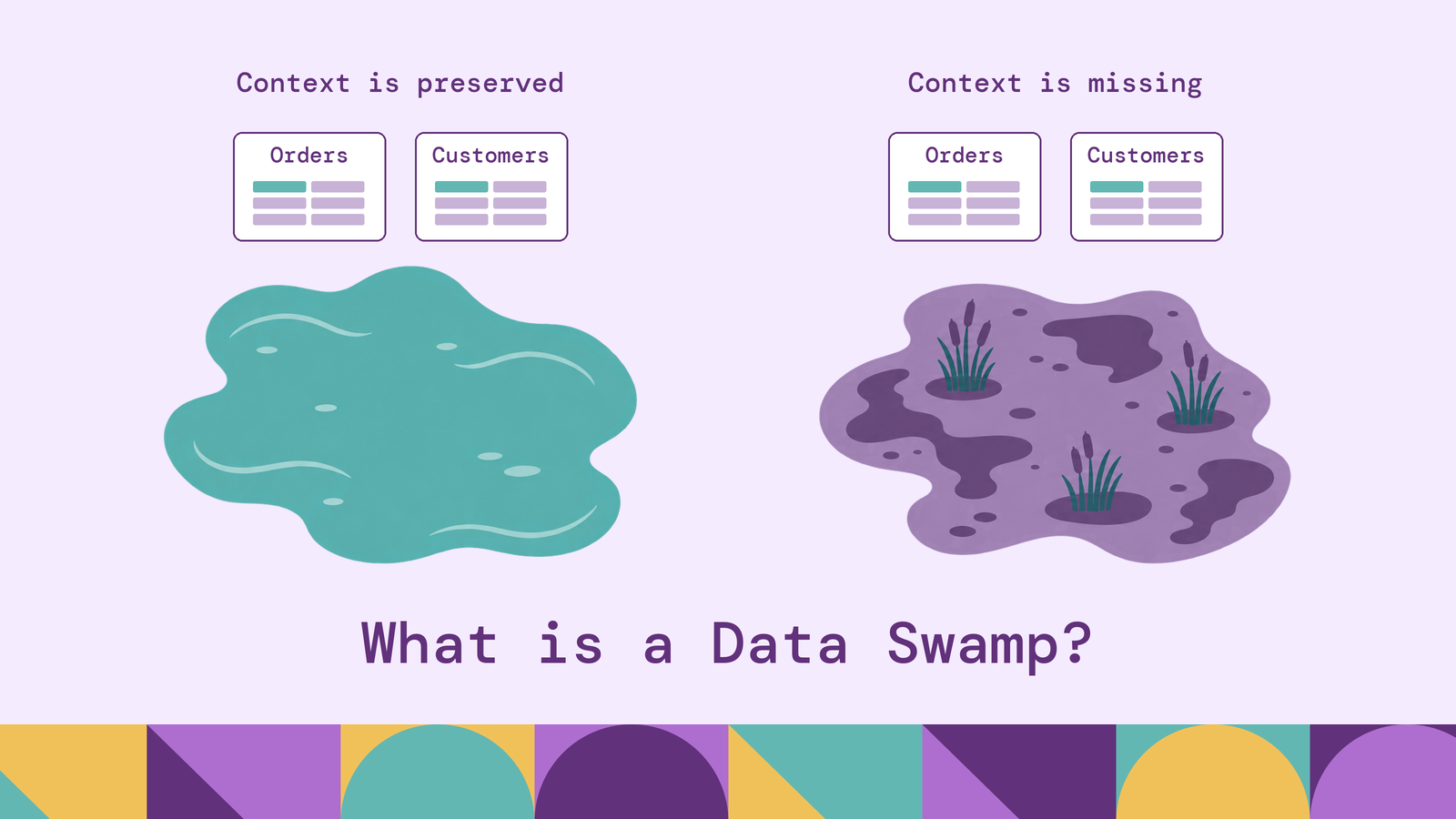
A data platform can keep ingesting records long after its users have lost confidence in the results. Files arrive, pipelines finish, and dashboards refresh, but nobody can establish which customer table is authoritative or whether a revenue calculation includes refunds. Preventing that outcome requires preserving the context needed to use data as carefully as the data itself.
This guide explains how data swamps develop, how they relate to lakes, warehouses, and lakehouses, and how to recognize and repair the conditions that make stored data difficult to trust.
What is a data swamp?
A data swamp is a data repository whose contents have become difficult to discover, interpret, or use reliably because metadata, quality controls, ownership, or governance are inadequate. The term usually describes a poorly managed data lake. AWS's data lake overview connects the swamp problem to missing mechanisms for cataloging and securing data, which leave users unable to find or trust it.
A swamp is a condition, not a storage architecture. It can contain structured tables, application logs, documents, or a mixture of formats. Its defining problem is that consumers cannot establish what data means, where it came from, or whether it is suitable for a particular task.
Raw data can be useful and well governed. An unprocessed event archive with documented schemas, source timestamps, an owner, and clear usage restrictions has a legitimate role. A polished table called customer_final can be harder to use if nobody knows which customers it includes.
How does a data swamp form?
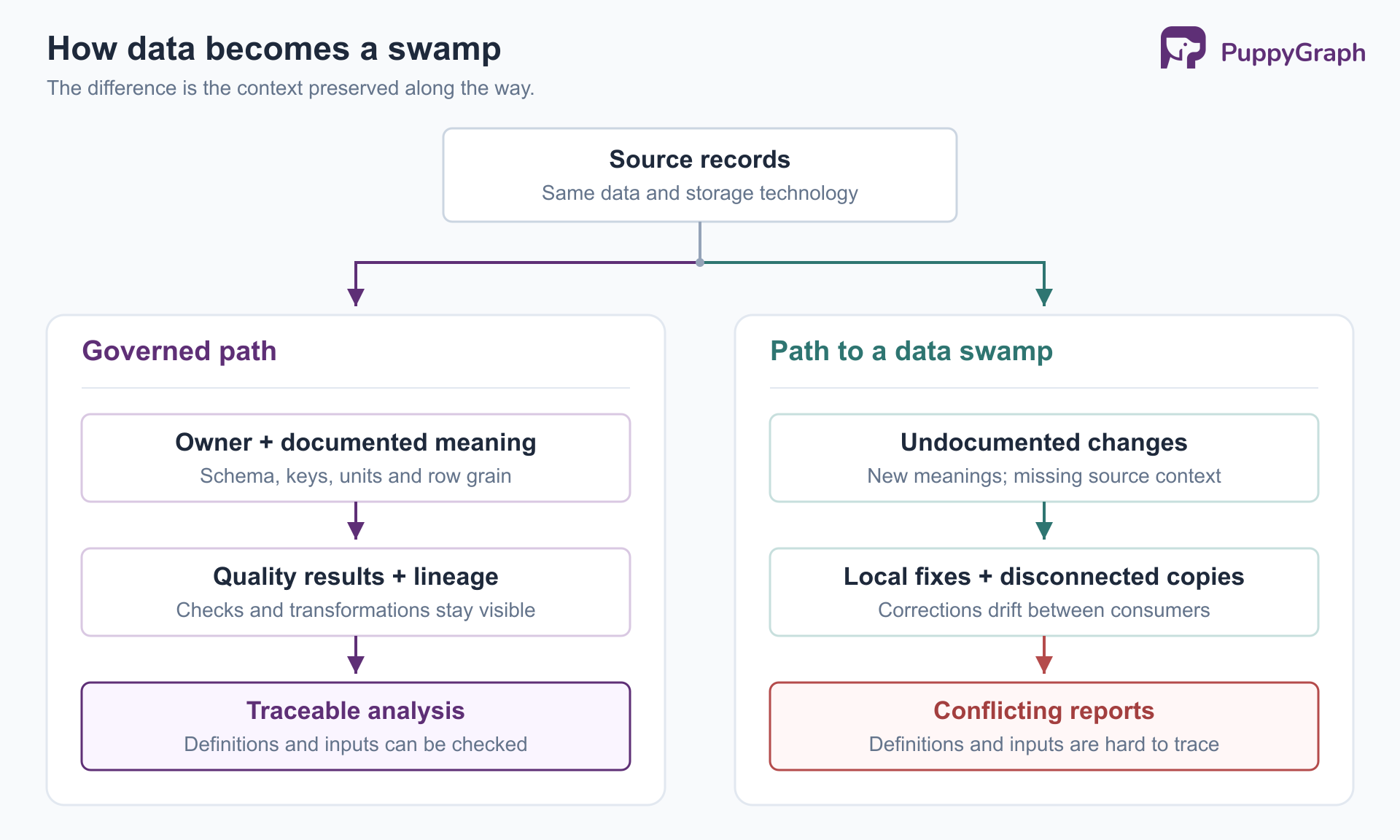
A swamp forms when ingestion continues while the work needed to interpret and maintain the data falls behind. Consider a team collecting order events for future analysis. Initially, the engineer who builds the pipeline knows the event schema, the retry behavior, and which timestamp represents the purchase. That knowledge may be enough for the first consumer.
As more sources arrive, assumptions diverge. One feed contains order headers; another contains individual order lines. A source starts replaying historical records after outages. An application changes a status code's meaning without changing its data type. The ingestion jobs still succeed, so none of these changes necessarily appears as a pipeline failure.
Consumers compensate locally. One analyst deduplicates events in a notebook; another filters a status value in a dashboard. Each creates a working answer, but the corrections remain separate from the shared dataset. Later consumers must rediscover the same rules, and copies of the corrected data acquire their own refresh schedules.
When the original maintainer leaves or the pipeline changes again, the undocumented assumptions become difficult to recover. The problem compounds because each new dataset or transformation depends on context that the platform no longer preserves.
Key characteristics of a data swamp
The characteristics concern the information available to consumers, not the size of the repository.
Missing context. Dataset names and column types exist, but descriptions omit the population covered, the meaning of identifiers, units, or the grain of a row. A field named amount does not tell an analyst whether it represents an order total, a line item, or a refund.
Uncertain quality and freshness. Consumers cannot see whether records are complete, duplicated, or current enough for their task. A recent file modification time may reflect a historical backfill rather than new business events.
Incomplete provenance. The relationship between a source, its transformations, and its downstream outputs is unclear. A result may be reproducible from today's tables while the inputs used for an earlier report are no longer identifiable.
Unclear accountability. A team owns the storage infrastructure, but nobody has authority to resolve conflicting definitions, approve schema changes, or repair a dataset's contents.
Unmanaged access and lifecycle. Consumers cannot determine who should have access, which copies are still needed, or how long data should remain available. Broad permissions and inaccessible datasets can coexist in the same environment.
The relevant standard is fitness for the intended use. The UK Government Data Quality Framework makes this distinction explicit: required quality varies with purpose. An archive need not meet a live operational dashboard's freshness requirement, but its limitations must be visible.
Data swamp vs. data lake
A data lake stores diverse data for later processing and analysis. It can retain original inputs while also providing validated and curated datasets, as illustrated in Microsoft's data lake architecture guidance. A data swamp describes what happens when consumers lose a dependable way to use those contents.
These states can coexist within one lake: a well maintained reporting domain may sit beside abandoned experimental data. Recovery can therefore begin with the datasets behind an important workflow. Moving every file to a different platform is not a prerequisite for restoring their usefulness.
Data swamp vs. data warehouse
A data warehouse organizes data for analytical queries, reporting, and business intelligence. AWS's warehouse overview describes a central analytical repository fed by transactional systems and other sources. Its curated models give teams a place to reconcile definitions before exposing them to reporting users.
Those properties require modeling and maintenance; a warehouse engine does not supply business agreement automatically. Raw staging tables, abandoned marts, and contradictory dashboards can develop the same usability problems. A table's valid schema establishes its technical shape, but does not establish that two departments mean the same thing by an active customer.
Data swamp vs. data lakehouse
A lakehouse adds table management and analytical capabilities over lake storage. The CIDR 2021 lakehouse paper, from Databricks, describes transactional metadata layers over open data files as a foundation for warehouse capabilities and broader analytical workloads.
This addresses important technical failure modes. Apache Iceberg's reliability documentation explains how atomic table updates and consistent snapshots let readers work with a coherent table state. Its schema evolution mechanism tracks fields through supported changes such as renames and additions.
A transaction can commit duplicate orders consistently. A numeric temperature column can retain its schema while a producer switches units. Lakehouse mechanisms improve the reliability of storing and reading tables; preventing a swamp also requires explicit business definitions and checks on the records themselves.
Common causes of data swamps
The formation process explains how context is lost. The underlying causes are decisions about delivery, responsibility, and maintenance.
Ingestion is treated as completion. A source is considered delivered when records arrive. Catalog entries, quality rules, and consumer documentation remain unassigned follow-up work. The project measures connectivity without establishing that anyone can use the result correctly.
Producer and consumer expectations are implicit. Teams have no agreed contract for keys, row grain, event time, freshness, or schema changes. Producers can change behavior without recognizing that a downstream calculation depends on it.
Ownership has no authority or capacity. Naming a contact does little if that person cannot change the pipeline, obtain a correction from the source team, or schedule maintenance. Shared datasets need an accountable team with time to support them.
Metadata maintenance is detached from delivery. Documentation lives in a separate process from code and schema changes. Automated discovery helps: AWS Glue crawlers can extract technical metadata into a catalog. Teams still need to supply the business meaning that a column's type and location cannot establish.
Copies and experiments have no retirement path. Temporary exports become dashboard dependencies, while old tables remain available beside replacements. Without recorded consumers and deprecation decisions, nobody can confidently retire either version.
These causes point to specific repairs. Adding a catalog will not resolve disputed ownership, and assigning owners will not expose defects unless they also have checks and a response process.
Signs of a data swamp
Start with a consequential report or analytical question and ask someone unfamiliar with its pipeline to reproduce the answer. Observe where they need private instructions, manual corrections, or assumptions that the platform does not record.
One symptom is not conclusive. Slow queries can result from an inefficient physical layout even when data is well governed. A stronger indication is repeated inability to establish meaning, suitability, and responsibility without reconstructing them from scratch.
Data swamp examples
The following are illustrative scenarios, not accounts of named organizations.
Retail events with inconsistent order totals. A retailer retains checkout events and payment records in a lake. Delivery retries produce repeated events, while payment records include authorizations, captures, and refunds. Analysts sum records without a shared definition of a completed sale, producing different revenue totals. The files are readable and the pipelines are healthy. Recovery requires defining each record type, establishing deduplication keys where the source supplies them, and publishing a reconciled sales dataset with explicit treatment of refunds.
Manufacturing telemetry with lost measurement context. A manufacturer combines sensor feeds from several plants. One producer reports pressure in bar and another in kilopascals, but both use a numeric pressure field. Historical maintenance files identify equipment using names that have since changed. A query can join the files and calculate averages, yet compare incompatible measurements or attach readings to the wrong asset. The repair is to preserve source units, standardize measurements in a curated layer, and maintain equipment identity mappings with effective dates. A schema check alone would miss the unit mismatch.
Customer records after an acquisition. Two businesses consolidate CRM exports, billing accounts, and support tickets. Customer IDs are unique only within each source, and the same organization appears under different legal and trading names. Joining on an unqualified ID creates false matches; joining on names leaves ambiguous results. A usable combined view needs source-qualified identifiers and reviewed mappings between records and business entities, with unresolved cases kept visible. Copying the exports into one repository does not establish those relationships.
In each scenario, the required repair concerns what a record represents and how it relates to other records. Storage consolidation supplies access to the inputs; the missing definitions determine whether combining them produces a defensible answer.
Challenges of data swamps
Reconstructing missing context. Engineers can profile values and inspect transformation code, but a dataset may no longer contain enough evidence to recover its intended meaning. If a producer changed units without recording when, some historical values may need to remain explicitly uncertain.
Determining the extent of an error. Fixing a source table does not identify every report or model that consumed the bad records. Lineage can help trace those dependencies. For example, the OpenLineage object model represents jobs, runs, and input and output datasets. Its usefulness depends on the systems actually emitting the relevant metadata; unobserved exports remain gaps.
Cleaning up without breaking consumers. An apparently redundant table may support a monthly process that recent query logs do not reveal. Retirement requires checking dependencies, identifying consumers, and providing a transition before removing a supported interface.
Keeping repairs from becoming new inconsistencies. If cleanup logic exists only in a one-off script, the next load can recreate the problem. A durable repair belongs in the source process or a maintained transformation, with a check that detects recurrence.
This makes remediation an operational change as well as a data cleanup exercise. Teams need a way to keep serving existing consumers while replacing unreliable inputs and documenting uncertainty that cannot be eliminated.
Impact of data swamps on business
Conflicting data can change decisions. In the retail example, duplicated events can overstate sales and distort campaign evaluation. In the manufacturing example, incompatible units can make a stable process appear abnormal. The consequences depend on where the affected data is used, which is why remediation priority should follow business dependencies.
Uncertainty also adds recurring work. Analysts reconcile reports, engineers investigate undocumented transformations, and teams build private extracts to avoid repeating the investigation. Those extracts introduce additional storage, processing, and maintenance obligations. A useful local measure is the time spent establishing whether an input is usable before the actual analysis begins.
Experiments and model development become harder to evaluate when teams cannot identify the data and transformations behind a result. An apparent improvement may come from a changed input population rather than a better model. Missing access and retention context also makes it harder to demonstrate that data handling follows the organization's own policies.
The business case for remediation should therefore identify the decisions delayed, calculations disputed, and recurring work created. Repository size alone says little about the cost of leaving the problem unresolved.
Data governance and data swamps
Data governance assigns responsibility for definitions, quality expectations, access, and lifecycle decisions. Prevention works when those decisions become part of publishing and maintaining datasets.
Set a minimum publication contract. Before a dataset becomes a supported input, record its accountable team, source, row grain, keys, business definitions, update expectations, sensitivity, and retention policy. Keep that information with the dataset's catalog entry and update it alongside changes. Raw ingestion can remain permissive while promotion into shared analytical use requires this context.
Make quality checks specific to use. Test the assumptions a consumer relies on: unique order IDs in an order-header table, valid customer references, expected currencies, and acceptable delays. dbt's data tests illustrate how assertions can identify nulls, duplicates, unexpected values, and missing relationships. Define the response as well as the test. A failed critical check might stop publication; a known late source might produce a visible freshness warning. Route failures to an owner who can act on them.
Preserve provenance and manage changes. Capture source-to-output dependencies from pipelines where possible, including the transformation version and input version or time range needed to reproduce consequential results. Review breaking changes with consumers. A catalog entry should make a replacement dataset and its deprecation schedule discoverable before the old interface disappears.
Control access and retention across the data's lifecycle. Classify sensitive data, assign access through maintained roles, and review permissions and copies when their purpose changes. Define retention by business and policy requirements. A raw archive can be worth keeping even when rarely queried; an undocumented export should not inherit indefinite retention simply because nobody remembers its purpose.
For an existing swamp, apply these controls through a bounded recovery sequence:
- Choose a critical use case. Identify a report, model, or operational decision whose inputs cause recurring problems. Inventory its datasets, transformations, owners, and known consumers.
- Establish a trusted path. Resolve definitions and identity mappings for those inputs, add quality checks, and publish documented outputs. Mark uncertain or unsuitable data so consumers can distinguish it from supported inputs.
- Move consumers deliberately. Reconcile old and new results, explain intentional differences, and update dependencies. Retire obsolete copies only after checking usage and retention obligations.
- Keep the repaired path healthy. Track freshness against its contract, unresolved quality incidents, ownership coverage, and the time a new consumer needs to obtain a usable answer. Extend the process to the next consequential workflow.
Once those foundations exist, a semantic model can make relationships across datasets easier to use. An account, its contracts, and the services covered by those contracts should have explicit identities and relationship definitions. Consumers can then ask which services belong to an account without repeatedly reconstructing the mapping from source tables.
PuppyGraph supports that relationship layer over existing data. Teams define a graph schema that maps tables to entities, relationships, and properties, then query the model with openCypher or Gremlin. It reads SQL databases, data warehouses, and data lakes or lakehouses, including direct reads of open table formats such as Iceberg and Delta Lake through its supported connections. The default direct-query path requires no ingestion into a separate graph store or persistent duplicate dataset; the tables stay in their existing storage.
That makes an agreed relationship model available for analysis without adding another dataset to synchronize. Source correction, identity resolution, and ownership remain prerequisites: the graph expresses the relationships the team defines over the records it supplies.
Try the forever-free PuppyGraph Developer Edition and book a demo with the team to see how openCypher and Gremlin queries connect entities across warehouse and lakehouse tables, with no graph-specific ETL, once the definitions and relationships behind your data are established.

Hao Wu is a Software Engineer with a strong foundation in computer science and algorithms. He earned his Bachelor’s degree in Computer Science from Fudan University and a Master’s degree from George Washington University, where he focused on graph databases.


