

Deep Learning vs. Machine Learning: Key Differences
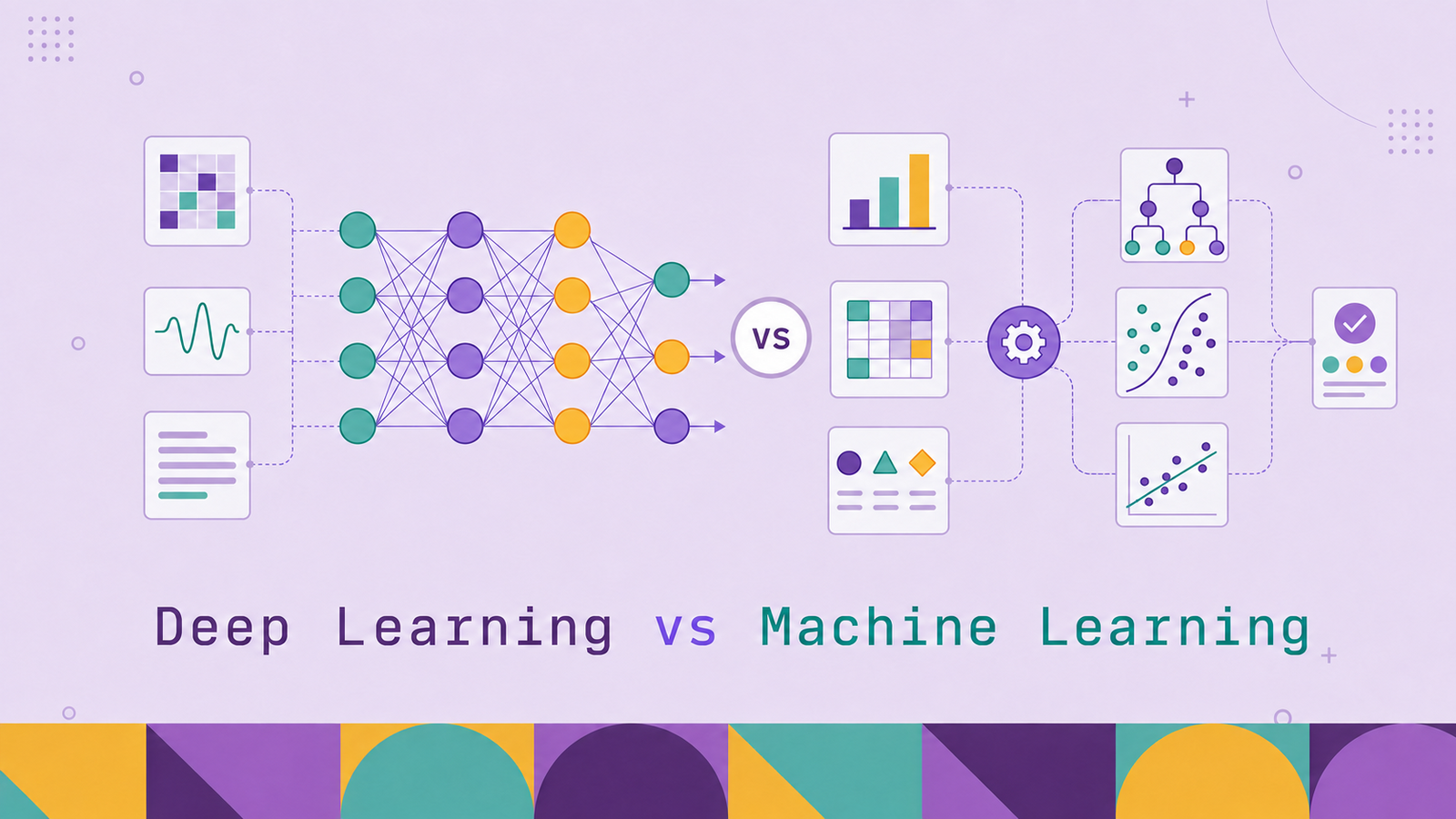
Deep learning is not a competitor to machine learning; it is a subfield of it. Every deep learning model is a machine learning model, built from multi-layer neural networks instead of the decision trees, linear models, or support vector machines that make up the rest of the field. The distinction that actually matters day to day is not the label but where the work goes: classical machine learning depends on a person engineering the right features from raw data, while a deep neural network learns its own features directly from raw input, at the cost of needing far more data and compute to do it well.
This post defines each approach on its own terms, sets their differences side by side, walks through how each one is actually trained, and closes with concrete guidance for choosing between them on a given project.
What is machine learning?
Machine learning is the branch of computer science in which a program improves its performance on a task from data rather than from explicit, hand-written rules for every case. Arthur Samuel, the IBM researcher who coined the term, defined it in 1959 as "the programming of a digital computer to behave in a way which, if done by human beings or animals, would be described as involving the process of learning," describing a checkers program that improved through self-play, adjusting the weights of its evaluation function after each move so a position's score converged toward the value its own search predicted for the position that followed it, an early form of temporal-difference learning. That framing, a program that adjusts internal parameters based on outcomes instead of following a fixed script, is still the core of the field today.
Most machine learning systems fall into three categories. Supervised learning trains a model on labeled examples, inputs paired with the correct output, so the model learns a function that maps one to the other; this covers regression tasks like predicting a price and classification tasks like flagging a fraudulent transaction. Unsupervised learning works on unlabeled data, finding structure the data itself contains: clustering similar customers together, or reducing a high-dimensional dataset to the handful of components that explain most of its variance. Reinforcement learning trains an agent to choose actions in an environment by rewarding good outcomes and penalizing bad ones, learning a policy through trial and error rather than from a fixed set of labeled examples.
What every category shares is a dependence on features: the variables a model actually sees. A credit risk model does not see a customer's raw transaction log; it sees engineered features an analyst built from that log, like average balance over 90 days or number of missed payments in the last year. Deciding which features to build, and building them correctly, is usually where most of the project's engineering effort goes, more than tuning the model that consumes them. Common algorithms in this category include linear and logistic regression, decision trees, random forests, gradient-boosted trees, support vector machines, and k-means clustering, each making different trade-offs between accuracy, training speed, and how easily a person can explain a given prediction.
What is deep learning?
Deep learning is the subfield of machine learning built on artificial neural networks with many stacked layers, deep referring to that layer count rather than to any qualitative leap in what the model is doing mathematically. Each layer takes the previous layer's output, applies a linear transformation followed by a nonlinear activation function, and passes the result forward; stacking enough of these layers lets the network represent increasingly abstract features of the input, from edges and textures in an early layer of an image model to entire object parts in a later one.
The architecture traces back to Frank Rosenblatt's perceptron, a single-layer network Rosenblatt developed at Cornell Aeronautical Laboratory and publicly unveiled in 1958, that could learn to classify simple patterns but, on its own, nothing more complex. Rumelhart, Hinton, and Williams' 1986 paper on backpropagation supplied the missing piece: an efficient way to compute how much each weight in a multi-layer network contributed to its error, which is what made training networks with hidden layers practical rather than purely theoretical. The field's modern inflection point came in 2012, when Krizhevsky, Sutskever, and Hinton's AlexNet, an eight-layer convolutional network trained on GPUs, won the ImageNet Large Scale Visual Recognition Challenge with a top-5 error rate of 15.3%, against 26.2% for the next-best entrant that year. That gap was large enough to redirect the field's research effort toward deep networks for most perception tasks.
What distinguishes deep learning operationally is that it removes the manual feature-engineering step. A convolutional neural network trained on raw pixels learns its own hierarchy of visual features; a transformer trained on raw text learns its own representation of syntax and meaning. This is why deep learning dominates domains where useful features are hard for a person to specify by hand, images, audio, and natural language, while classical machine learning remains competitive, and often preferred, on structured tabular data where a domain expert can already name the features that matter.
Deep learning vs machine learning: key differences
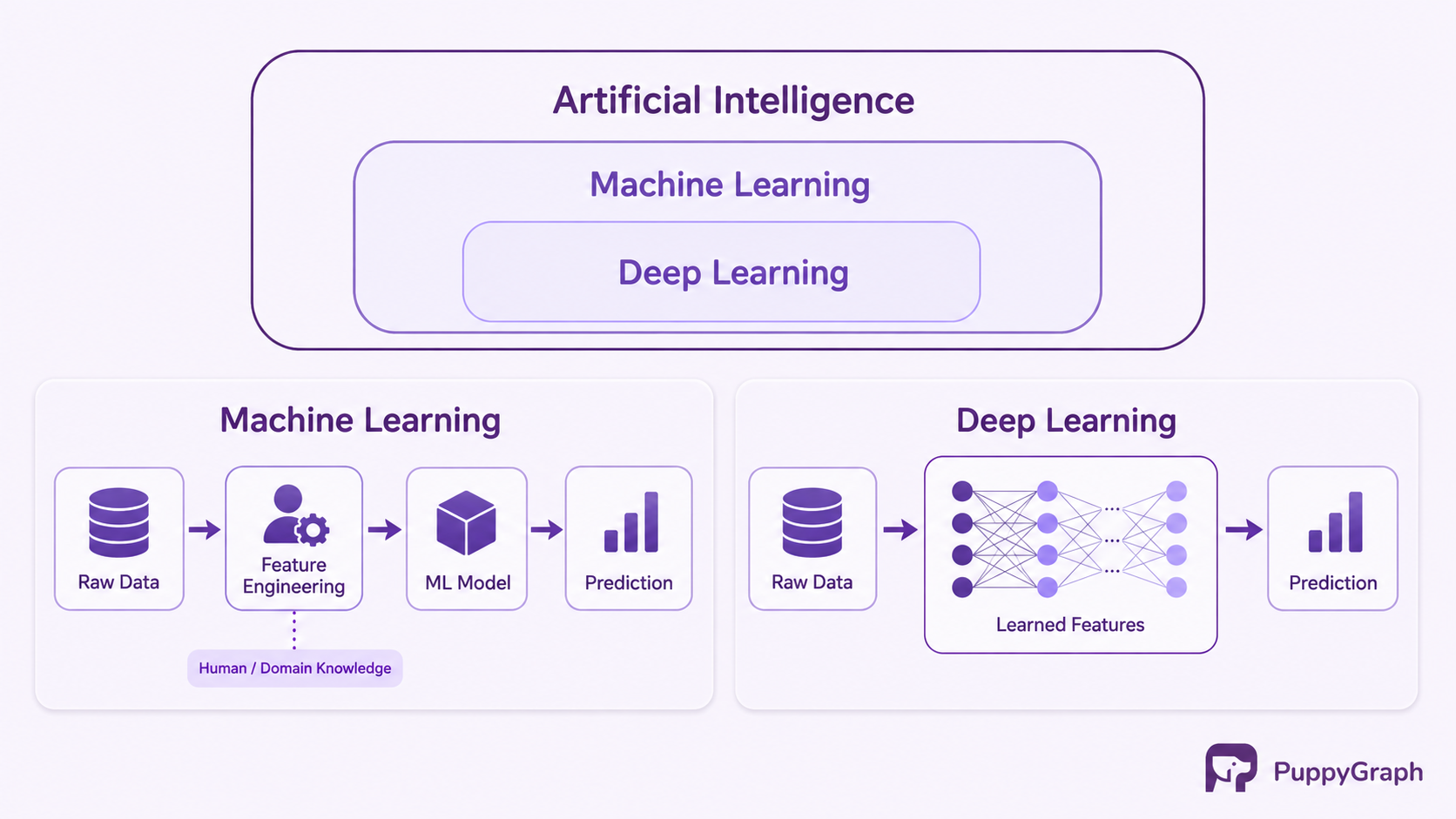
The differences below follow from the same root cause: a deep network trades a person's feature-engineering effort for the network's own capacity to learn representations, and that trade has costs that show up across data, hardware, and interpretability.
The interpretability and hardware rows are the ones that most often decide a real project. A gradient-boosted tree's feature importances can be handed to a regulator or a business stakeholder directly; a neural network's millions of weights cannot, and demonstrating why it produced a given output takes dedicated explainability tooling on top of the model itself, not a property of the model. That gap, more than raw accuracy, is why regulated domains like lending and insurance underwriting still lean on classical machine learning even where a deep model might edge out the metrics.
How machine learning and deep learning work
A classical machine learning pipeline runs through the same stages regardless of algorithm: collect and clean the data, engineer features from it, split the result into training, validation, and test sets, fit the chosen algorithm on the training set, and tune its hyperparameters against the validation set before a final check on the held-out test set. The feature engineering step is where domain knowledge enters the model; everything after it is comparatively mechanical. A random forest classifier in scikit-learn shows the shape of the last few stages:
from sklearn.ensemble import RandomForestClassifier
from sklearn.model_selection import train_test_split

X_train, X_test, y_train, y_test = train_test_split(X, y, test_size=0.2)
model = RandomForestClassifier(n_estimators=200, max_depth=8)
model.fit(X_train, y_train)
predictions = model.predict(X_test)
X here is already the engineered feature matrix; the library's job starts after that matrix exists, not before it.
A deep learning pipeline replaces the feature-engineering step with architecture design: choosing how many layers the network has, what each layer computes (convolutional, recurrent, attention-based), and how they connect. Training then runs the same loop repeatedly: a forward pass computes the network's output from the current weights, a loss function scores how far that output is from the target, backpropagation computes the gradient of the loss with respect to every weight in the network, and an optimizer nudges each weight a small step in the direction that reduces the loss. One pass through the full training set is an epoch, and a network typically needs many epochs before it converges. A minimal image classifier defined in PyTorch shows the architecture side of that loop:
import torch.nn as nn

class Classifier(nn.Module):
    def __init__(self):
        super().__init__()
        self.layers = nn.Sequential(
            nn.Linear(784, 256), nn.ReLU(),
            nn.Linear(256, 128), nn.ReLU(),
            nn.Linear(128, 10),
        )

    def forward(self, x):
        return self.layers(x)
Where a scikit-learn model call hides its internals behind fit(), this network's forward pass is written out layer by layer, because the layers themselves, not a downstream algorithm, are what the training loop is optimizing. Regularization techniques like dropout, randomly disabling a fraction of neurons during training, exist specifically to keep a network with millions of parameters from memorizing its training set instead of generalizing from it, a risk that grows with every added layer.
How to choose between machine learning and deep learning
The choice comes down to a handful of practical constraints, not a judgment about which approach is more advanced.
Data volume. A deep network's advantage over classical machine learning grows with the amount of labeled data available, and shrinks or reverses when data is scarce; a few thousand rows usually favors a gradient-boosted tree or a random forest over a network with millions of parameters to fit.
Data structure. Structured, tabular data with a manageable number of well-understood columns is classical machine learning's home ground, since a person can name the features that matter. Unstructured data, images, audio, free text, is where deep learning's automatic feature learning earns its cost, because hand-engineering equivalent features from raw pixels or waveforms is impractical at scale.
Interpretability and regulatory requirements. When a prediction has to be explained to a regulator, an auditor, or a customer, a model whose decision path can be inspected directly is worth more than a marginal accuracy gain from a black-box network.
Compute and latency budget. Training a deep model, and often serving it, requires GPU or TPU capacity that a classical model typically does not, and that infrastructure cost has to be justified by the task, not assumed as a given.
One consideration cuts across all four factors above: some of the most valuable engineered features, for either kind of model, describe relationships rather than individual rows: how many transactions link two accounts, how connected an entity is to others already flagged as fraudulent, which cluster of users share unusual overlap in devices or IP addresses. Computing features like these usually means traversing a chain of joins across several tables, and the chain gets slower and harder to maintain as the relationship goes deeper (a two-hop or three-hop connection instead of a single join). Graph query engines are built for exactly that traversal, and some ship graph algorithms, like PageRank, connected components, and Louvain, as callable operations rather than something a team has to implement from scratch. PuppyGraph runs those queries and algorithms directly against tables already sitting in a SQL database, warehouse, or lake, with no separate graph database or ETL pipeline to stand up first, so a relationship-based feature for either a classical model's feature matrix or a graph neural network's input can be computed against the data where it already lives.
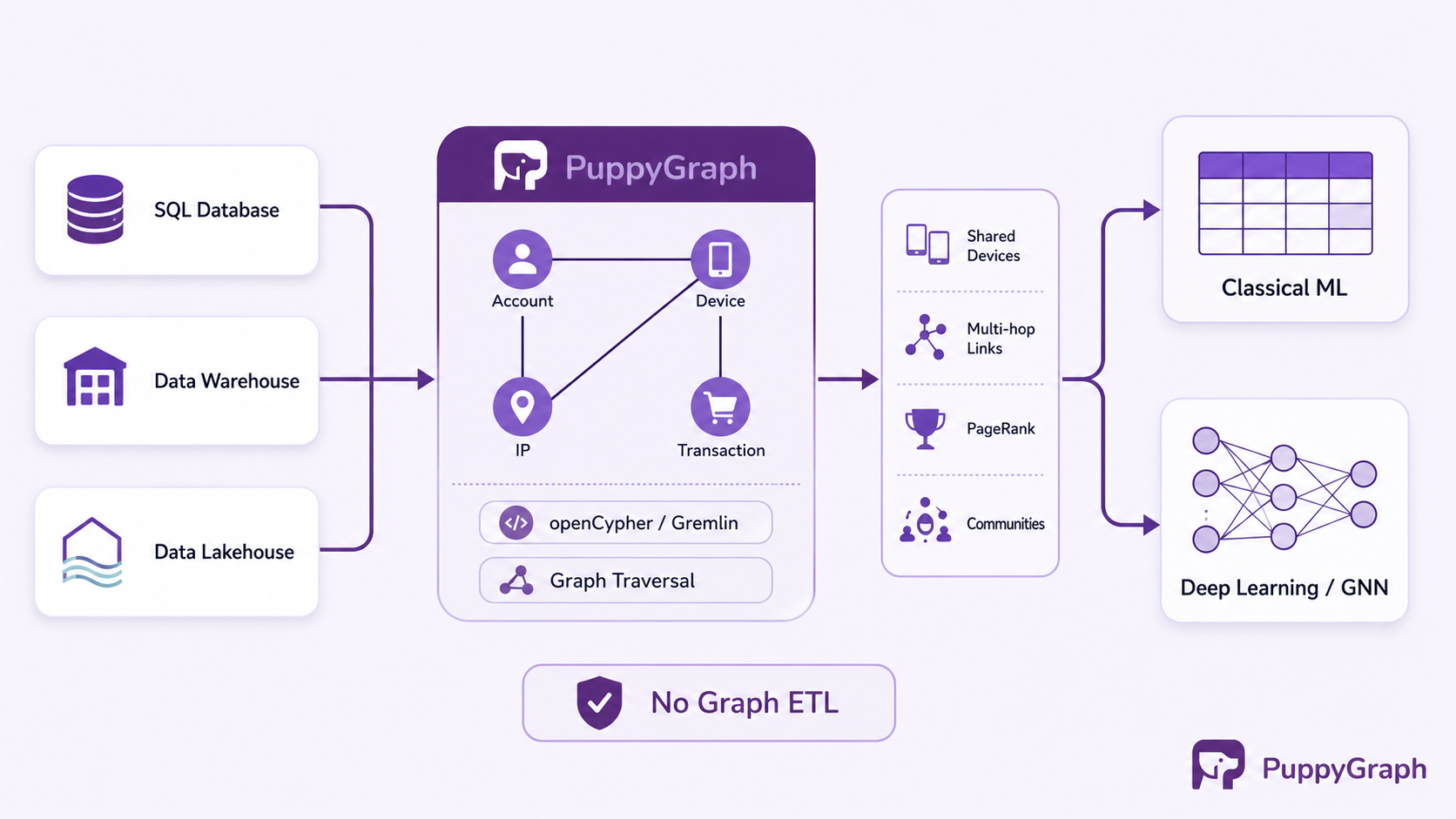
None of these factors are exclusive to one project. Many production systems combine both: a deep network embeds unstructured input like a product description or an image into a fixed-size vector, and a classical model like gradient boosting combines that embedding with structured features to produce the final prediction, each doing the part it is suited to.
Conclusion
Machine learning and deep learning are not two competing technologies, they are one field with a subfield inside it, and the practical question is where the feature-engineering work happens: by hand, guided by domain knowledge, or automatically, inside a network deep enough to learn its own representations. Classical machine learning wins on structured data, small datasets, and any project where a model's decisions need to be explained. Deep learning wins on unstructured data at scale, where hand-built features cannot capture what the raw input contains, provided the data and compute budget exist to train it. Most real systems end up using both, each where it fits.
Try the forever-free PuppyGraph Developer Edition and book a demo with the team to see how openCypher and Gremlin queries run over warehouse and lakehouse tables to compute relationship-based features, with no graph-specific ETL, before those features ever reach a training pipeline.

Hao Wu is a Software Engineer with a strong foundation in computer science and algorithms. He earned his Bachelor’s degree in Computer Science from Fudan University and a Master’s degree from George Washington University, where he focused on graph databases.


