

Oracle Graph vs Neo4j : Key Differences Explained
Oracle Graph and Neo4j answer the same question, how to model and query connected data, from opposite starting points. Oracle Graph is not a separate database; it is the graph capability built into Oracle Database (recently rebranded Oracle AI Database), where a graph is defined as a layer over relational tables and queried with SQL and PGQL inside the engine the tables already live in. Neo4j is a dedicated native graph database: data is imported into a store engineered specifically for traversal, and queried with Cypher. One treats the graph as a view of data you already manage; the other treats the graph as the primary home of the data.
That difference in starting point drives most of the practical differences: which query languages you write, how analytics runs, how each system scales, what the licensing looks like, and how much new infrastructure you take on. This post defines each system, lists what each does well, sets the key differences side by side, digs into the two architectures, and works through how to choose. It closes with a third option for the case where the data you want to traverse does not live in Oracle, and should not have to move into a graph database either.
What is Oracle Graph?
Oracle Graph is the collective name for the graph features that ship inside Oracle Database, covering two graph data models side by side: property graphs (nodes and edges with properties, the model Neo4j also uses) and RDF graphs (W3C-standard triples queried with SPARQL). Since December 5, 2019, the graph and spatial features have been included with all editions of Oracle Database at no additional license cost, so any supported Oracle Database can use them without a separate purchase.
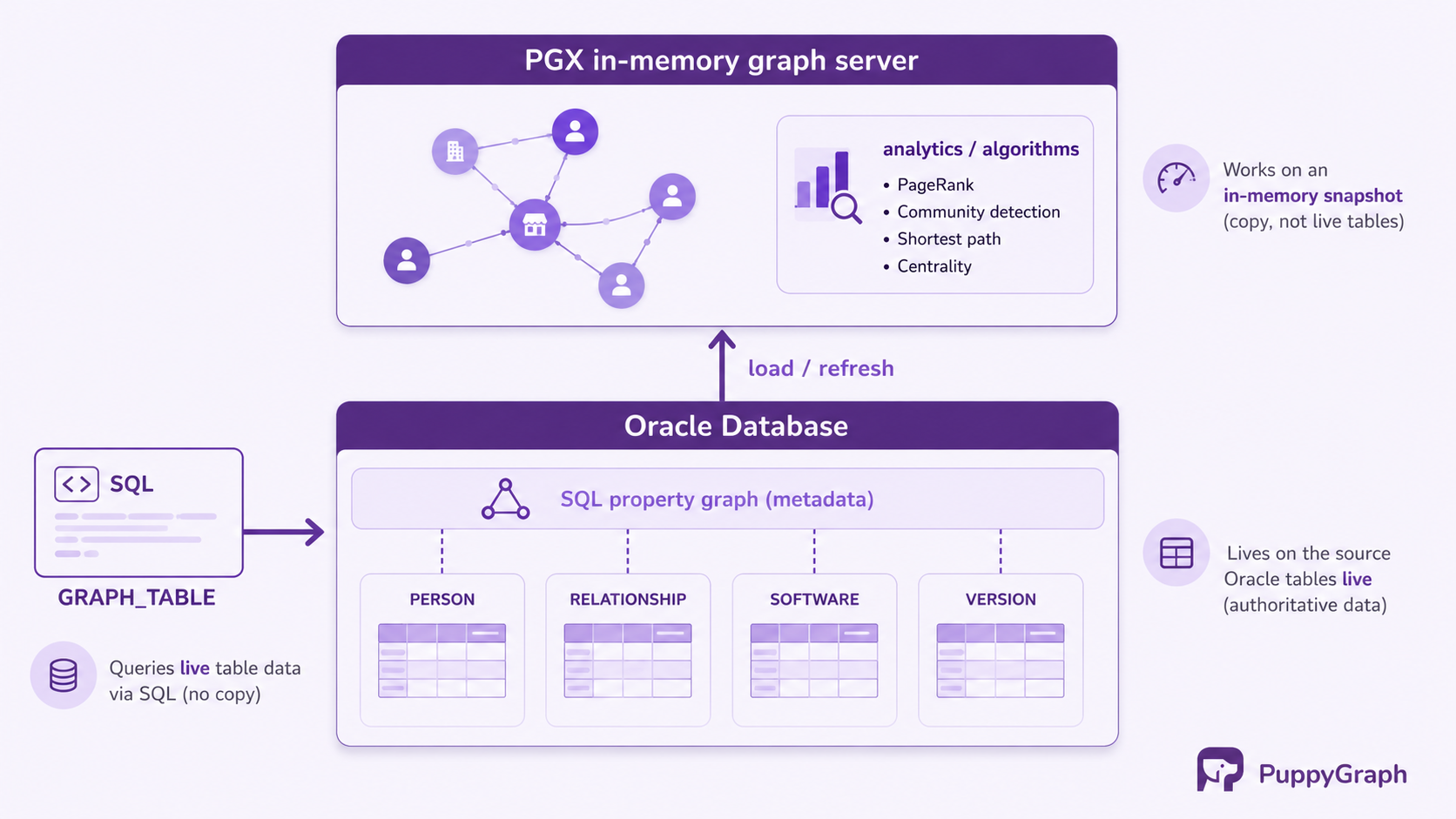
The property graph side took its biggest step in Oracle Database 23ai, which introduced SQL property graphs based on SQL/PGQ, the property graph extension published as part of the ISO SQL:2023 standard. A CREATE PROPERTY GRAPH statement defines vertex and edge tables over existing relational tables, and the GRAPH_TABLE operator matches graph patterns from inside a plain SQL query. The graph object itself is metadata only: per Oracle's documentation, no data is copied out of the underlying tables, so graph queries always run against the current data in the database. The capability carries forward into Oracle AI Database 26ai, the long-term release announced in October 2025 that succeeds 23ai.
Around that in-database core sits Oracle Graph Server and Client, a separately downloaded kit that adds an in-memory analytics tier. Its centerpiece is the graph server, PGX, which loads a snapshot of a graph from database tables into main memory in compressed sparse row form and runs parallel analytics on it. Oracle also ships Graph Studio, a browser-based modeling, notebook, and visualization environment included with Oracle Autonomous Database.
Key features
SQL property graphs (SQL/PGQ). Graphs are schema objects defined over existing tables and queried with the SQL:2023 GRAPH_TABLE operator. Pattern matching lands in the same statement as joins, aggregation, and everything else SQL does, and the results compose with ordinary SQL clauses.
PGQL. PGQL is Oracle's SQL-like property graph query language, which predates the SQL/PGQ standard and remains supported. It runs along two paths: directly against graph data stored in the database, or against an in-memory graph loaded into PGX.
In-memory analytics with PGX. The graph server ships a broad built-in algorithm library spanning ranking, community detection, pathfinding, and link prediction, plus machine-learning additions such as DeepWalk and GraphWise, and an API for writing custom algorithms.
RDF and SPARQL. The same database hosts RDF triple networks with SPARQL query support and a subset of OWL for inference, which matters for teams with semantic-web or ontology requirements alongside property graph work.
Included with the database. There is no separate graph license. Deployment follows the database: on premises, in OCI database services, or in Autonomous Database, where Graph Studio adds a managed, self-service environment with a graph modeler and notebooks.
Taken together, the feature set expresses Oracle's converged-database philosophy: the graph is one more model the database speaks, alongside relational, JSON, and spatial, rather than a separate system to stand up. Most of the strengths and constraints in the rest of this comparison follow from that single design choice.
What is Neo4j?
Neo4j is a native labeled property graph database: nodes and relationships are first-class stored structures carrying labels and typed properties, rather than a projection over rows. Its defining architectural property is index-free adjacency: each node holds direct references to its neighbors, so following a relationship is a pointer hop rather than an index lookup, and traversal cost tracks how much of the graph a query touches rather than how large the graph is overall.
Neo4j created Cypher, the pattern-matching query language that later seeded the openCypher project, and it participated in standardizing GQL, the graph query language published as ISO/IEC 39075 in April 2024. Current Cypher conforms to most mandatory GQL features, with full conformance still in progress. All queries run in fully ACID transactions, and the model is schema-flexible, with optional constraints and indexes rather than a required schema.
Neo4j ships in editions. The Community Edition is open source under GPLv3 and runs as a single instance. The Enterprise Edition is commercially licensed and adds clustering, role-based access control, online backup, and multiple databases. AuraDB is the fully managed cloud service, offered in Free, Professional, Business Critical, and Virtual Dedicated Cloud tiers on AWS, Azure, and Google Cloud. Server versioning moved to a calendar scheme in January 2025 (releases numbered YYYY.MM).
Key features
Native graph storage and traversal. Storage engineered around the graph is what makes Neo4j fast at deep traversals, variable-length paths, and pattern matching across many hops. The deeper a query reaches, the more this design pays off.
Cypher and the GQL standard. Cypher is widely known and well documented, its MATCH pattern syntax is the lingua franca of property graph querying, and its convergence on the ISO GQL standard lowers the long-term risk of betting on a vendor language.
Graph Data Science library. The GDS library runs a broad catalog of graph algorithms (centrality, community detection, similarity, pathfinding, embeddings, link prediction) over in-memory projections of the stored graph. The community edition runs with bounded concurrency, which the enterprise edition removes.
Ecosystem and tooling. Neo4j is reached over the Bolt protocol with official drivers for Java, Python, JavaScript, Go, and .NET. The APOC library adds hundreds of utility procedures, Browser and Bloom cover exploration and visualization, and recent releases added native vector indexes for embedding-based retrieval next to the graph.
Clustering and managed cloud. Autonomous clustering in the Enterprise Edition replicates each database across primary servers for fault tolerance and scales reads through secondary servers, and AuraDB removes the operational burden entirely.
Where Oracle's feature set expresses convergence, Neo4j's expresses specialization: the storage format, the query language, and the algorithm library all exist to serve graph workloads. That focus is why Neo4j defines this category, and it is also why adopting it means running, or subscribing to, a system dedicated to the graph.
Oracle Graph vs Neo4j: key differences
The shortest way to hold the comparison is that Oracle Graph adds a graph model to a general-purpose database you may already run, while Neo4j is a system whose entire design serves the graph workload. The table lines up the dimensions that tend to drive a decision.
The query language row deserves a concrete look, because it is the difference a developer feels first. The same question, who are Alice's direct connections, looks like this in each system:
-- Oracle: SQL/PGQ in Oracle Database 23ai and later
SELECT friend
FROM GRAPH_TABLE ( social_graph
  MATCH (a IS person) -[IS knows]-> (b IS person)
  WHERE a.name = 'Alice'
  COLUMNS ( b.name AS friend )
);
// Neo4j: Cypher
MATCH (a:Person {name: 'Alice'})-[:KNOWS]->(b:Person)
RETURN b.name AS friend
The patterns themselves are nearly identical, which is no accident: SQL/PGQ and GQL were developed together and share their pattern syntax. What differs is everything around the pattern. In Oracle the pattern is an operator inside a SQL statement, composable with joins and aggregations over the rest of the schema, written by someone who thinks in SQL. In Neo4j the pattern is the whole language, written against a store where the graph is the schema. Teams fluent in SQL tend to find the first form a smaller step; teams building graph-shaped applications tend to find the second form more direct.
Oracle Graph vs Neo4j architecture comparison
Oracle's architecture is a converged database with a graph layer on top and an analytics tier beside it. A SQL property graph stores no data of its own; it is a dictionary object that maps vertex and edge definitions onto existing tables, so a GRAPH_TABLE query is ordinary SQL execution over live tables, inside the same transaction and read-consistency model as every other query in the database. Analytics is a separate path: PGX loads a snapshot of the graph into memory in compressed sparse row form and runs its algorithm library there. That tier is fast and parallel, but it is a snapshot, not the live database; it must be refreshed to see new data, and the working graph has to fit in the memory PGX is provisioned with. Oracle's guidance is to provision at least twice the graph's in-memory size, in part because loading allocates temporary structures beyond the graph's resting footprint.
Neo4j's architecture starts from the opposite commitment: the graph is the storage format. Nodes and relationships are stored as linked record structures, which is what makes constant-cost relationship hops possible, and the write path, page cache, and query runtime are all built around that layout. Data gets in through import (LOAD CSV, the neo4j-admin bulk importer, or connectors for Spark and Kafka), after which the graph is the primary copy. Scale has two axes. Storage-wise, the aligned store format (the Community Edition default) has a bounded node-count ceiling, while the Enterprise-only block format raises that ceiling by orders of magnitude. Cluster-wise, autonomous clustering replicates a database across primaries with all writes routed through an elected leader, scales reads through secondaries, and federates across databases with composite databases; write throughput for a single database is bounded by that single leader.
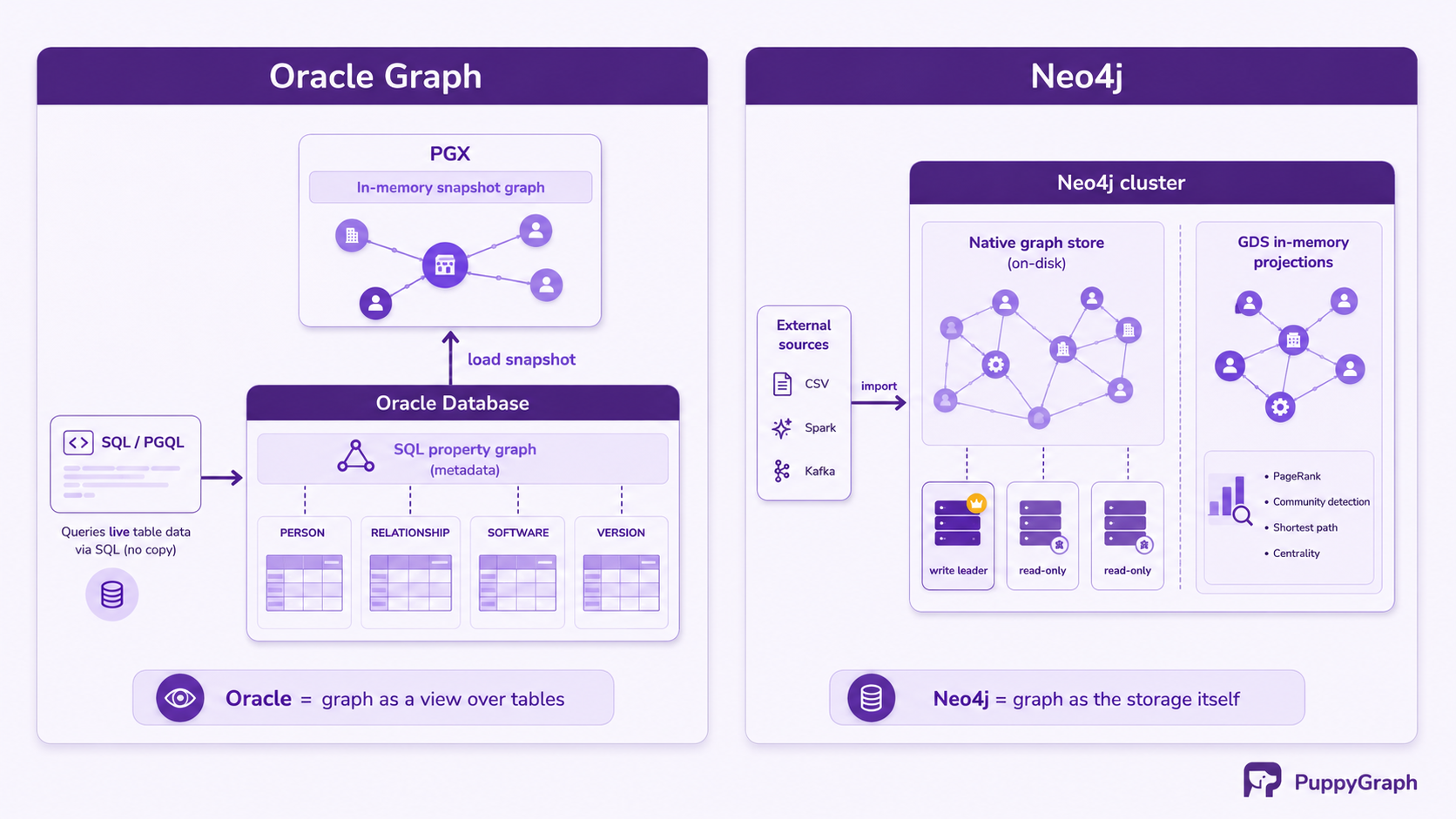
The symmetry between the two is worth noticing: both systems separate transactional graph queries from in-memory graph analytics. Oracle splits them between the database and PGX; Neo4j splits them between the database and GDS projections (and, since May 2025, an Aura Graph Analytics serverless offering that projects data from external sources into ephemeral in-memory graphs for algorithm runs). The asymmetry is where the primary copy of the data sits. In Oracle, the graph is a view over tables that other applications keep using as tables; adopting it does not move any data. In Neo4j, the graph store is the system of record for the graph, engineered for traversal depth that a SQL engine executing joins will not match, and paid for with an import pipeline and a second copy of the data to keep in sync when the source of truth lives elsewhere.
How to choose between Oracle Graph and Neo4j
Choose Oracle Graph when the data already lives in Oracle. If the tables you want to traverse are in Oracle Database, SQL property graphs add the graph model without moving anything, without a sync pipeline, and without a new license. Graph queries stay inside the transactional model the rest of the application relies on, DBAs keep one system to operate, and SQL-fluent teams pick up GRAPH_TABLE faster than a new database and language. The same argument extends to shops with RDF or ontology requirements, since the converged database covers both models.
Choose Neo4j when the graph is the product. Applications whose core workload is deep, variable-length traversal (recommendation engines, fraud rings, network topologies, knowledge graphs behind applications) benefit directly from native storage, and from an ecosystem built over more than a decade: Cypher and its GQL convergence, GDS for algorithm-heavy work, APOC, visualization tooling, drivers in five languages, and a large community. AuraDB also gives Neo4j a fully managed cloud story on all three major clouds, where Oracle's graph features live inside Oracle's own cloud and database deployments.
Weigh the operational surface honestly in both directions. Oracle Graph is only free if you are already paying for Oracle Database; adopting Oracle to get its graph features would be a far larger commitment than adopting Neo4j. In the other direction, Neo4j is a second data system: an import pipeline to build, a copy to keep consistent, and a cluster to operate (or an Aura subscription), which is a real cost when the graph questions target data whose home is a warehouse or lake rather than a graph-native application.
That last case, graph questions over data whose primary home is somewhere else, is common enough to deserve its own option, because both systems handle it with a copy: Neo4j by importing, and Oracle by holding the data in Oracle Database in the first place.
A graph layer that is not tied to one database
Oracle's SQL property graphs demonstrate something useful: a property graph can be a metadata layer over relational tables, queried in place with no second copy. The limitation is that it works only for tables inside Oracle Database. PuppyGraph generalizes that idea across the modern data stack. It is a distributed graph query engine that maps a graph schema onto existing tables in sources like PostgreSQL, MySQL, Snowflake, Databricks, and open table formats such as Apache Iceberg, then answers openCypher and Gremlin queries against those tables directly, with no ETL and no graph copy to keep in sync.
Architecturally it differs from both systems in the comparison. Unlike Neo4j, it does not own the storage: tables stay in the warehouse, lake, or database they already live in, and PuppyGraph acts as the compute layer over them. Unlike Oracle's in-database path, the traversal does not run on a relational SQL planner: PuppyGraph compiles a graph query into a plan of node and edge operators executed in its own engine, issuing only simple projection and filter queries to the source. Execution is columnar and vectorized, predicate pushdown and min/max statistics limit what gets scanned, and work is auto-sharded across executor nodes, so capacity scales horizontally. Standard graph algorithms (PageRank, Louvain, label propagation, connected components, and others) are built in and callable from Cypher and Gremlin, so algorithm work does not require a separate analytics tier.
For teams evaluating Neo4j specifically, there is a practical migration property: PuppyGraph speaks openCypher over the Bolt protocol, so existing Neo4j drivers, applications, and BI tools can be repointed without rewriting queries, and there is no export and import step because the data is read from the source directly. The fit is different rather than strictly better: Oracle Graph is the natural layer over data committed to Oracle Database, Neo4j is the dedicated engine for graph-first applications, and PuppyGraph is the graph layer for data that already lives across warehouses, lakehouses, and relational stores.
Conclusion
Oracle Graph and Neo4j are both mature, credible graph technologies separated mainly by where they put the graph. Oracle Graph makes the graph a feature of the converged database: property graph and RDF models over data that stays in relational tables, queried with standard SQL/PGQ and PGQL, with an in-memory PGX tier for algorithm-heavy analytics, all included with the database license. Neo4j makes the graph the database: native storage built for traversal depth, Cypher converging on the ISO GQL standard, the GDS algorithm library, and a managed cloud in AuraDB, paid for by importing data into its store and operating (or subscribing to) a dedicated system.
If your data is committed to Oracle Database and your team thinks in SQL, Oracle Graph is the shorter path. If the graph is the application and traversal performance and ecosystem depth are the point, Neo4j earns its place as a dedicated system. And if the data you want to traverse is spread across warehouses, lakehouses, and operational databases that are not moving, a graph query layer over that data in place is the option that avoids the copy altogether.
Try the forever-free PuppyGraph Developer Edition and book a demo with the team to see how openCypher and Gremlin queries run over warehouse and lakehouse tables, with no graph-specific ETL, when the tables you want to traverse live outside any single database.

Hao Wu is a Software Engineer with a strong foundation in computer science and algorithms. He earned his Bachelor’s degree in Computer Science from Fudan University and a Master’s degree from George Washington University, where he focused on graph databases.


