

Responsible AI Governance: Framework, Principles & Best Practices
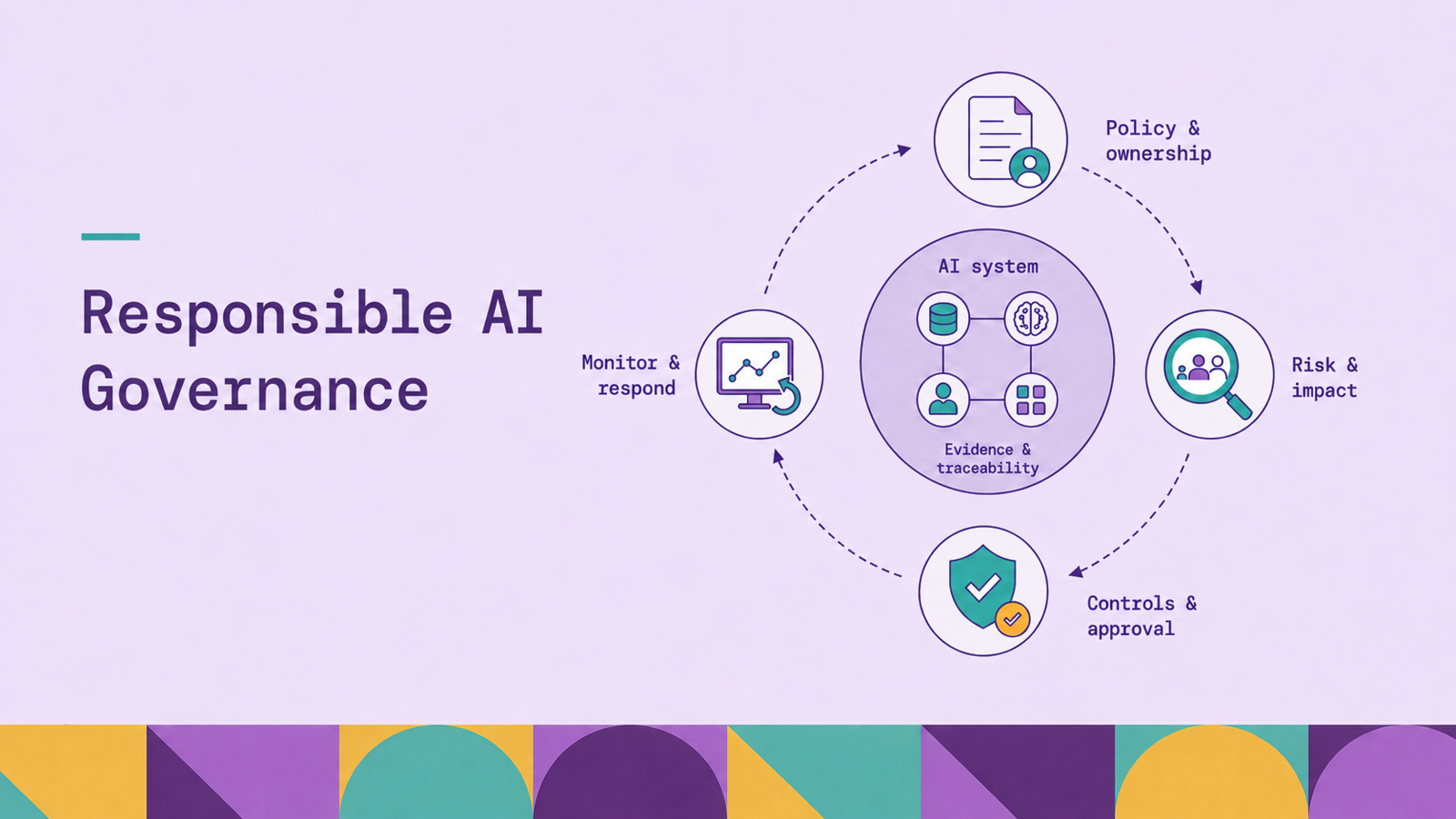
Ressible AI governance turns broad commitments about fairness, safety, and accountability into decisions that an organization can repeat and defend. It defines which AI uses are acceptable, who can approve them, what evidence approval requires, and what happens when a deployed system changes or fails.
The scope is wider than a model. Data, prompts, retrieval sources, business rules, interfaces, human reviewers, vendors, and downstream actions all affect the outcome. This guide explains how to govern that complete system through clear principles, a risk-based framework, defined responsibilities, and lifecycle controls.
What is responsible AI governance?
Responsible AI governance is the system of authority, policies, processes, and technical controls used to direct and oversee AI throughout its lifecycle. Its purpose is to keep AI development and use consistent with organizational values, risk appetite, legal duties, and the rights of affected people.
The word responsible describes the outcomes and conduct the program should support. The word governance describes how the organization makes that intent operational. Accountability becomes testable when policy requires an owner and workflows record approval.
Governance connects direction, decision rights, lifecycle processes, technical controls, and evidence. It defines approved and prohibited uses, assigns owners, establishes review and incident processes, and preserves system records and decisions. This is an operating model, not simply an ethics committee or a document library. It should cover AI built internally, models accessed through APIs, AI embedded in purchased software, and employee use of general-purpose tools.
Responsible AI governance also differs from compliance. Compliance addresses binding obligations in a particular jurisdiction, sector, and organizational role. Governance includes those obligations but also covers risks that a law may not describe in detail, such as whether a support assistant is useful enough to deploy or whether an agent has more tool access than its task requires.
Why is responsible AI governance important?
AI risk depends on use, not on the model name alone. The same language model can help rewrite an internal memo, summarize a medical record, rank job applicants, or operate tools that modify customer accounts. Accuracy on a general benchmark says little about whether those applications are acceptable.
Governance gives the organization a way to make that context visible. A system inventory identifies where AI is used. Risk classification directs stricter review toward applications that affect rights, safety, access to services, or consequential business operations. Named owners prevent a failure from becoming a dispute among the model vendor, development team, and business unit.
It also makes AI adoption easier to manage at scale. Reusable assessments, control patterns, and approval criteria let low-risk uses move quickly while preserving deeper review for higher-impact systems.
Continuous governance matters because release is not the end of the risk lifecycle. Models, prompts, retrieval collections, uses, and vendor services change. Production evidence may show drift, harmful disparities, security abuse, or poor human review. Defined thresholds should trigger investigation, rollback, restricted use, or renewed approval.
Finally, governance creates traceable evidence. Regulators, customers, auditors, and leaders may need the system version, test results, residual-risk owner, and challenge process.
Key principles of responsible AI governance
Major frameworks use different labels, but they converge on a related set of properties. The OECD AI Principles, updated in 2024, address human rights and fairness, transparency, robustness, security, safety, and accountability. NIST AI RMF 1.0 describes trustworthy AI as valid and reliable, safe, secure and resilient, accountable and transparent, explainable and interpretable, privacy-enhanced, and fair with harmful bias managed.
Responsibility toward people and information comes first.
Accountability and traceability. Every AI system needs business and technical owners with authority over its operation. Review boards can advise or approve, but collective review should not obscure who owns the outcome and who accepts residual risk. Traceable records connect that responsibility to system versions, evaluations, exceptions, incidents, and corrective actions.
Fairness and respect for rights. Teams should identify affected people, plausible harms, and relevant comparison groups before selecting fairness tests. Historical labels, proxy variables, uneven data quality, interface design, and the surrounding decision process can all create disparate effects. Metrics should be chosen for the use case, documented with their limitations, and paired with remediation and appeal paths.
Transparency, explainability, and contestability. People need context-appropriate information about when AI is involved, what it can and cannot do, and how to challenge an important result. Internal reviewers require more technical evidence about data, model versions, evaluations, and known failure modes. The OECD transparency principle calls for meaningful information appropriate to the context, not indiscriminate publication of source code or proprietary data.
Privacy and data governance. Responsible use starts with a legitimate purpose and proportionate data. Governance should cover provenance, permitted use, quality, access, retention, deletion, and data-subject rights. These controls extend beyond training data to prompts, retrieved documents, embeddings, feedback, outputs, and logs. Collecting additional sensitive data to test fairness can itself require a documented legal and privacy basis.
System behavior and intervention form the second group.
Safety, security, and robustness. An AI system should operate within defined bounds during normal use, foreseeable misuse, component failure, distribution shift, and adversarial activity. Threat modeling should cover the entire application, including data pipelines, model endpoints, retrieval, tools, credentials, dependencies, and outputs. Controls also need recovery paths. The OECD robustness principle calls for mechanisms to override, repair, or decommission systems that risk undue harm.
Validity and reliability. Tests must represent the intended task, users, languages, environments, and consequences. Aggregate scores can hide poor subgroup performance or rare but severe failures. Set acceptance thresholds before testing and repeat evaluation after material changes.
Human agency and oversight. Human review is effective only when the reviewer has adequate information, time, skill, and authority to intervene. A confirmation button placed after the system has already acted is not oversight. Consequential actions need approval before execution, while lower-risk outputs may be suitable for sampling and retrospective review.
These principles often create trade-offs. More logging can improve accountability while increasing privacy exposure. A detailed explanation can aid contestability while revealing information useful to an attacker. Governance makes the decision explicit, assigns an owner, and records when it must be revisited.
Responsible AI governance framework
A practical framework connects organization-wide authority to controls on individual systems. It should be broad enough to cover predictive models, generative AI, and agents, but flexible enough to scale requirements to the use case.
NIST AI RMF 1.0 organizes this work into Govern, Map, Measure, and Manage. Govern establishes culture, policy, responsibility, and oversight across the other functions. Map documents context, stakeholders, intended use, dependencies, and risks. Measure evaluates behavior and impact with quantitative, qualitative, or mixed methods. Manage prioritizes risks, applies treatments, monitors results, and responds over time. The functions are continuous rather than a one-way release checklist. NIST states that AI RMF 1.0 is being revised, so organizations should record which version informs their program.
ISO/IEC 42001:2023 approaches the same problem as an AI management system. It specifies requirements for establishing, implementing, maintaining, and continually improving organizational policies and processes for AI. ISO/IEC 42005:2025 adds guidance for AI system impact assessments across the lifecycle. Certification or adoption can provide structure, but neither replaces the legal analysis required for a specific system.
An organization can implement these sources through four levels:
1. Organizational governance. Leadership defines the mandate, principles, risk appetite, prohibited uses, escalation thresholds, and reporting expectations. The policy should state which systems are in scope, including acquired and embedded AI.
2. Portfolio governance. A central inventory records every use case, owner, status, vendor, model, data category, affected population, jurisdiction, and risk tier.
3. System governance. Each use case receives a proportionate impact assessment, controls, test plan, release criteria, monitoring plan, and accountable approval. The unit of review is the complete application and its decision process, not an isolated model artifact.
4. Runtime governance. Technical enforcement constrains what the deployed system can access and do. Monitoring and incident processes provide a reliable path to detect failures and restrict or stop operation.
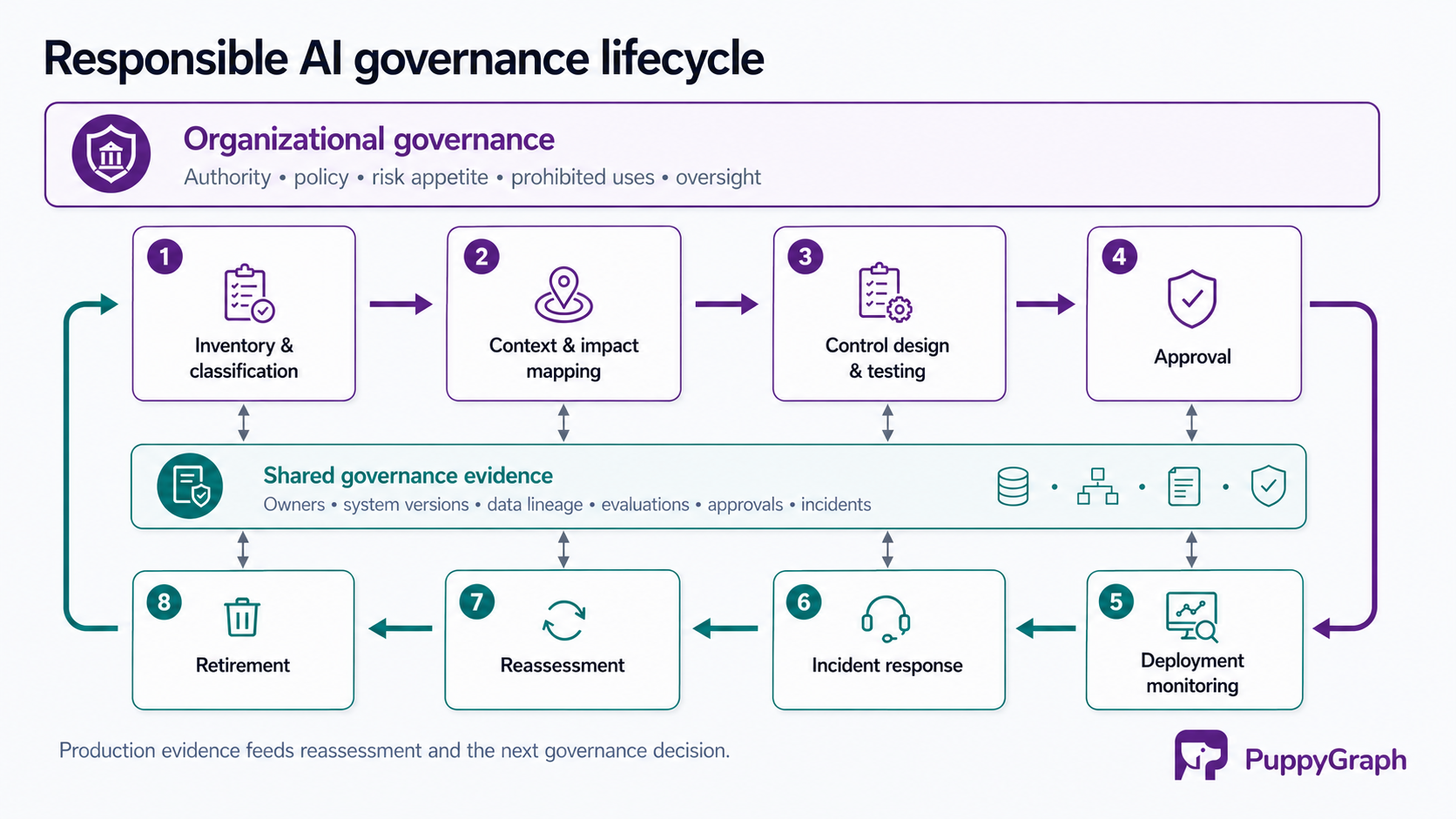
Risk tiers connect these levels. Classification should consider potential harm, affected population, decision significance, autonomy, reversibility, data sensitivity, scale, and legal category. Technical novelty can inform the assessment, but it is not a substitute for impact. A simple model used in a consequential decision may deserve more scrutiny than a complex model used for low-stakes drafting.
Evidence also needs relationship-aware traceability. A reviewer may need to traverse from an incident to the application, model version, prompt, dataset, vendor, control, owner, approval, and affected process. PuppyGraph lets teams define that graph over existing SQL databases, data warehouses, and data lakes or lakehouses, including direct reads of Iceberg and Delta Lake tables. On the default direct-query path, the records remain in their governed sources instead of being copied into a separate graph store. Teams can query the relationships with openCypher or Gremlin to investigate shared dependencies and control gaps.
For an AI agent that uses this graph as its data-access path, the schema functions as an enforced ontology. PuppyGraph validates each query before execution and rejects invalid entity or relationship references with structured feedback that the agent can use to revise its query. This grounds queries in the approved semantic model. Access control, prompt-injection defenses, tool permissions, and approval gates remain separate responsibilities in the governance framework.
AI compliance and regulatory requirements
AI compliance starts with applicability, not a generic checklist. Obligations depend on the jurisdiction, sector, use case, data, affected people, and the organization's role. A company that develops a model, a vendor that places an AI system on the market, and an employer that deploys a purchased screening tool may have different duties for the same technology.
The EU AI Act illustrates this role- and risk-based approach. It distinguishes prohibited practices, high-risk systems, certain systems subject to transparency duties, and other uses. As of August 2026, the Act is generally applicable, and the European Commission and national authorities have begun enforcement. Article 50 transparency requirements apply from August 2, 2026, including duties covering direct interaction with AI and certain generated or manipulated content. Systems already on the market have until December 2, 2026 to meet Article 50(2)'s marking and detection requirement.
The schedule is phased. Regulation (EU) 2026/1744 delayed Chapter III's high-risk-system requirements, except Article 6(5). Annex III requirements apply from December 2, 2027 and Annex I requirements from August 2, 2028. Use the current consolidated law.
Privacy law continues to apply when AI processes personal data. GDPR Article 22 addresses solely automated decisions with legal or similarly significant effects. For contract-necessity and explicit-consent exceptions, safeguards include human intervention, expressing a point of view, and contesting the decision. Laws authorizing such decisions must provide suitable safeguards.
Requirements also vary within a country. New York City's Local Law 144 and its rules require employers and employment agencies using covered hiring or promotion tools to rely on a bias audit no more than one year old, publish specified information, and notify covered residents at least 10 business days before use. Colorado's revised Automated Decision-Making Technology Act has operative requirements beginning January 1, 2027 and assigns duties to developers and deployers of covered automated decision-making technology. These examples make location and use case essential inventory fields.
A maintainable compliance process maps each obligation to a control, owner, evidence source, retention rule, and review trigger. One impact assessment or monitoring control may support several requirements, but the mapping should explain how. Record the authoritative text and version used for each interpretation. Legal counsel should determine applicability and sufficiency; a voluntary framework, completed questionnaire, or vendor certification does not by itself establish compliance.
Roles and responsibilities in AI governance
Responsible governance distributes work while preserving clear accountability. The exact titles vary, but the following responsibilities need named owners.
Governance roles set direction.
Board and executive leadership. Senior leaders approve the mandate and risk appetite, fund the program, and receive information about material exposure, incidents, exceptions, and control effectiveness. They should challenge whether incentives reward responsible operation as well as deployment speed.
AI governance committee or council. A cross-functional body maintains policy, resolves disputes, coordinates regulatory interpretation, and reviews high-impact or exceptional uses. Its charter should define authority, quorum, escalation, and which decisions remain with system owners.
Business or product owner. This owner defines the legitimate purpose, intended users, affected groups, expected benefit, and acceptable residual risk. The owner is responsible for keeping the system within approved use and for sponsoring remediation or retirement.
Implementation and assurance roles execute it.
Engineering, data, and machine learning teams. Technical teams document architecture and data, implement controls, run evaluations, manage versions, and provide production evidence. They should surface uncertainty and limitations instead of treating approval as a target to optimize around.
Legal, privacy, compliance, security, and risk teams. These specialists interpret obligations, assess data practices and threats, define control requirements, and review evidence. Independent model validation, safety, or red-team functions can reduce conflicts of interest for high-impact systems.
Operations, procurement, and vendor management. Operations monitor deployed behavior and handle incidents. Procurement and vendor managers obtain documentation, change notifications, audit terms, security commitments, data-use restrictions, and exit provisions for third-party AI.
Internal audit. Audit evaluates whether the governance system and selected controls operate as described. It should remain independent from the teams that own implementation and approval.
Users and affected people close the loop.
Users and affected people. Employees need training and a practical way to register tools, report failures, and escalate concerns. People affected by important decisions need usable notices, explanations where required, and a route to challenge outcomes. Feedback is evidence for governance, not a substitute for testing.
A responsibility matrix can clarify who proposes, reviews, approves, operates, and audits each system. It should name one accountable role for every decision. Shared responsibility without a final owner usually becomes unowned risk.
How to implement responsible AI governance
Implementation works best as a sequence of usable controls rather than a large policy released all at once.
Steps 1 through 4 establish scope and assess impact.
1. Define scope, authority, and prohibited uses. Start with a short policy that covers internally developed, third-party, embedded, and employee-operated AI. Name the executive sponsor, decision bodies, escalation path, and unacceptable uses. Define risk appetite in terms that can guide an approval decision.
2. Build a living inventory. Create a low-friction intake process and a stable identifier for each system. Record purpose, owners, status, model and vendor, data, integrations, autonomy, users, affected groups, jurisdictions, and downstream actions. Combine registration with procurement, security review, expense, API, and cloud signals to find unregistered use.
3. Classify risk and obligations. Use a small number of tiers with explicit consequences. Classification should determine the assessment depth, testing independence, approval level, monitoring frequency, and human intervention required. Screen for applicable laws and contractual requirements at intake, then repeat the analysis when context changes.
4. Map the complete system and its impact. Document data flows, models, retrieval sources, prompts, rules, user interfaces, tools, reviewers, vendors, and dependent processes. Identify intended use, foreseeable misuse, affected stakeholders, failure modes, and potential benefits. For higher-impact systems, conduct a structured impact assessment and consult relevant domain experts or affected groups.
Steps 5 through 8 implement controls and oversight.
5. Translate risk into testable controls. Give every material risk an owner, treatment, evidence requirement, and acceptance threshold. Tests may cover task validity, subgroup performance, privacy, data quality, adversarial behavior, security, explanation quality, and human-review effectiveness. Generative AI needs evaluations across realistic prompts and retrieval contexts. Agents also need least-privilege identities, tool allowlists, action budgets, and approval before consequential side effects. The NIST Generative AI Profile provides a useful source of risks and suggested actions for generative systems.
6. Make release a documented decision. Set pass criteria before testing. The approval record should identify the version and use case, summarize evidence, list unresolved limitations, record exceptions, and name the person accepting residual risk. A failed threshold should lead to remediation, narrower use, a compensating control, or no deployment.
7. Monitor behavior and prepare for incidents. Track indicators connected to the actual risks, such as material errors, subgroup outcomes, policy violations, security events, overrides, complaints, and tool failures. Establish severity levels, notification duties, rollback procedures, shutdown authority, evidence preservation, and post-incident review. Test that operators can stop the system before an emergency.
8. Govern change, vendors, and retirement. Define which changes trigger reassessment, including a new model, data source, prompt strategy, user group, tool, geography, or vendor term. Review third-party evidence critically and retain responsibility for the configured use. Retirement should revoke access, address retained data, notify dependent teams, and preserve required records.
Several practices keep the program workable. Reuse control libraries, connect evidence through stable identifiers, and automate reminders without automating judgment. Measure inventory coverage, overdue reviews, unresolved high risks, incident response, and repeated exceptions. Review policy after material incidents and regulatory changes. Give teams a route to ask for help early, before release makes problems expensive to correct.
Conclusion
Responsible AI governance makes AI decisions accountable. Principles set direction; ownership, risk classification, testing, enforcement, monitoring, and evidence make them operational.
Start with visibility and authority. Inventory the complete use case, assign owners, scale review to potential impact, and connect each material risk to a control and release decision. Revisit that decision as production, incidents, affected people, vendors, and regulations provide new evidence. The result is not risk-free AI. It makes risk visible, decisions traceable, and intervention possible.
Try the forever-free PuppyGraph Developer Edition and book a demo with the team to see how openCypher and Gremlin queries trace AI systems, owners, data, controls, and evidence across warehouse and lakehouse tables, with no graph-specific ETL, while an enforced ontology grounds agent queries in the approved semantic model.shi

Hao Wu is a Software Engineer with a strong foundation in computer science and algorithms. He earned his Bachelor’s degree in Computer Science from Fudan University and a Master’s degree from George Washington University, where he focused on graph databases.


