

Schema Evolution: Types & Strategies
A schema change succeeds when the applications and people using the data can still interpret it correctly. Adding a field to an event, renaming a warehouse column, or splitting an address into separate properties affects more than the system accepting the change. Readers may run older code, stored records may follow earlier definitions, and downstream calculations may depend on meanings that no type checker captures.
This guide explains how schema evolution works, the changes it covers, and the compatibility rules and rollout strategies that keep those changes manageable across databases, event streams, and analytical tables.
What is schema evolution?
Schema evolution is the process of changing a data structure over time while managing its effect on existing data and consumers. A schema describes fields, types, relationships, and constraints. Evolution governs how successive definitions coexist and how systems move between them.
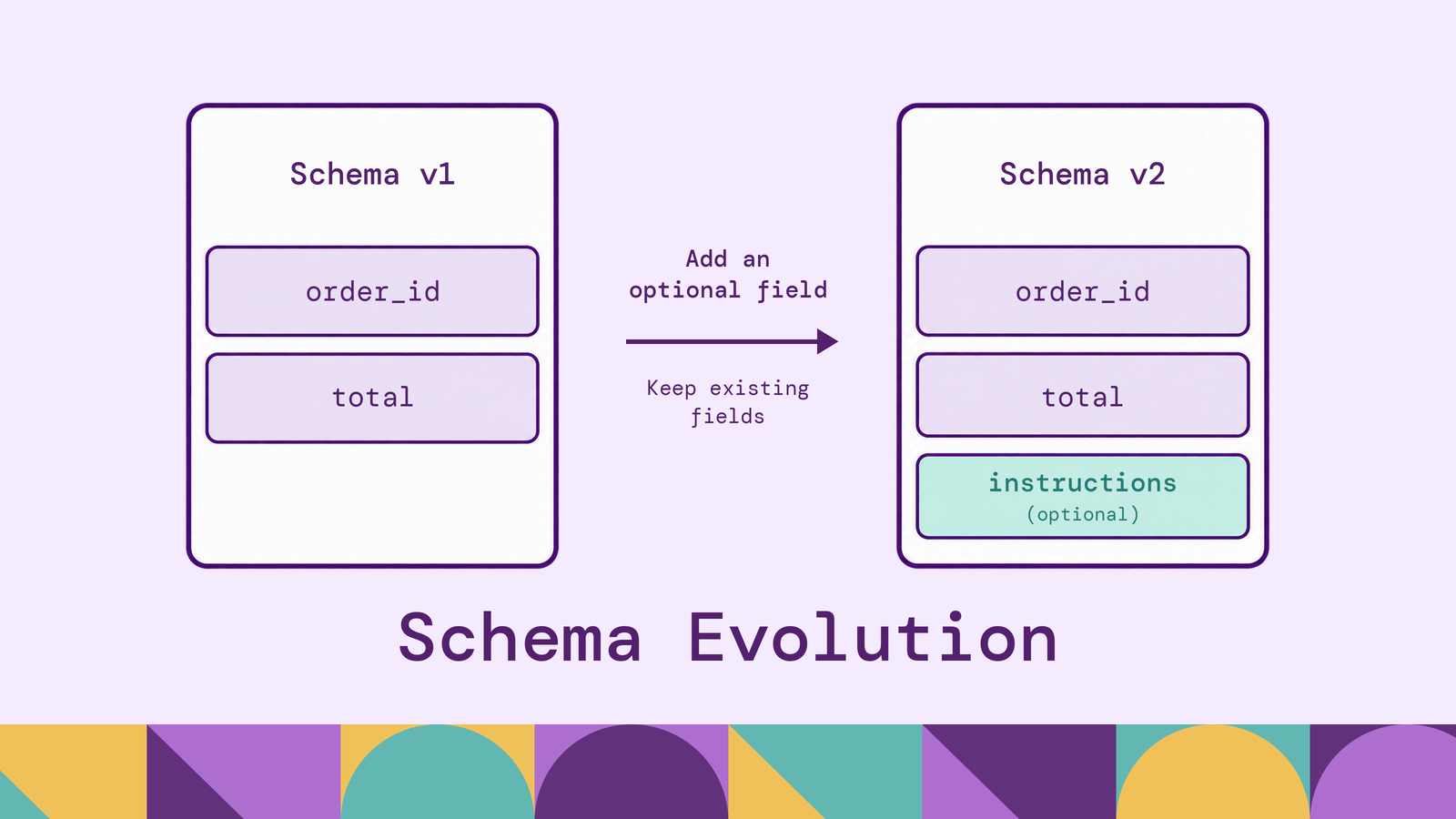
Consider an order event with order_id, customer_id, and total_minor_units. A later version adds delivery_instructions. New consumers need a defined way to handle historical orders without that field. Existing consumers need to continue processing new orders until they are upgraded. The change includes both the new definition and the rules for interpreting records across versions.
The mechanism depends on the system. A database alters table definitions; a serialization format resolves differences between written and expected records; an analytical table format tracks schema metadata alongside files. These mechanisms solve different parts of the problem.
Schema evolution also differs from schema drift. Drift describes a departure from an expected structure, such as an upstream feed unexpectedly changing a numeric field to a string. An evolution process evaluates that difference and decides whether to accept, transform, reject, or isolate the affected data.
Schema enforcement checks whether incoming data conforms to an accepted definition. Evolution changes that definition under an agreed policy. They work together: a system can reject unexpected input while still allowing a reviewed schema update. Permitting every observed structure is a policy choice, not a prerequisite for evolution.
Why is schema evolution important?
Data often outlives the application release that produced it. An order service can adopt a new event definition today while an analytics job still reads last year's records. A system must account for both timelines: software deployment and data retention.
Independent releases. Producers and consumers need room to upgrade separately. A fulfillment service should be able to add delivery details without requiring every reporting job to deploy at the same moment. Compatibility rules establish which version combinations can coexist.
Historical analysis. Reprocessing retained events or rebuilding an analytical table requires interpreting older records. A field introduced recently cannot be assumed to exist throughout the dataset. Defaults, explicit transformations, and version-aware readers make that gap visible.
Reliable decisions. A successful query can still produce incorrect results. If an order total changes from excluding tax to including it, dashboards may keep running while overstating comparable revenue. Reviewing meaning alongside structure protects the calculation itself.
The operational benefit is a smaller coordination burden, with explicit limits. Teams can approve routine changes quickly because they have already agreed on what must remain compatible and which changes require a broader rollout.
That agreement also clarifies ownership. The producing team owns the new definition and its meaning; consumer teams identify assumptions the change affects. For the order event, fulfillment may care about missing instructions while finance cares about amount semantics. A release review should make both dependencies visible before deployment.
How does schema evolution work?
A controlled change starts with the current contract, a proposed definition, and an inventory of affected readers and writers. The team checks the difference against the system's compatibility rules, tests representative data, and deploys in an order that supports the required version combinations.
For a concrete example, suppose version one of an Apache Avro event contains these two fields:
{
  "type": "record",
  "name": "OrderCreated",
  "namespace": "example.orders",
  "fields": [
    {"name": "order_id", "type": "string"},
    {"name": "total_minor_units", "type": "long"}
  ]
}
Version two keeps those fields and the record name, and appends this field to fields:
{
  "name": "delivery_instructions",
  "type": ["null", "string"],
  "default": null
}
Under Avro's schema-resolution rules, a version-two reader supplies null when reading version-one records. A version-one reader ignores the additional field in version-two records. This particular change supports both directions at the serialization layer. The writer's schema must still be available for decoding.
Nullability and a default serve different purposes. The union permits a null value; the default supplies a value when the writer's schema lacks the field. Avro specifies that a default does not make a field optional during encoding.
Tables can use a different mechanism. Apache Iceberg tracks columns by unique IDs and implements supported schema updates through metadata, without rewriting data files. A rename preserves column identity, but a query referencing the old name still needs attention.
In both cases, storage or serialization handles part of the transition. Application tests must establish whether the resulting values remain useful and correct.
Types of schema evolution
Schema changes can be grouped by what they alter. These categories describe the operation; compatibility describes its effect on a particular reader and writer.
Additive changes introduce fields, columns, or structures. Adding delivery instructions gives new consumers more information. The historical meaning of an absent value must still be defined, and readers that reject unfamiliar fields may need changes. Adding a required field is especially consequential when older records cannot supply it.
Subtractive changes remove fields or structures. Dropping a deprecated promotion code may be safe for the checkout service while breaking a finance export. Removal needs evidence that supported consumers have stopped depending on the field, including jobs that run infrequently.
Type and constraint changes alter the values a field accepts. Widening an integer can accommodate larger values, but every consuming layer must support that range. Narrowing a type can lose information. Making a nullable field mandatory requires both acceptable historical values and writers that populate it consistently.
Renames and structural changes change how data is addressed or organized. Renaming customer_id to buyer_id differs from changing its meaning to identify a household. Splitting one address field into components also requires a transformation policy for ambiguous historical values. Neither should be treated as a cosmetic edit merely because the migration is short.
For each category, record whether existing information is preserved, whether old code still recognizes the structure, and whether interpretation changes. That assessment determines the rollout more reliably than labeling every addition safe and every deletion unsafe.
Schema evolution strategies
Choose a strategy from the compatibility requirements and the cost of maintaining an overlap period. Several strategies can apply to one change.
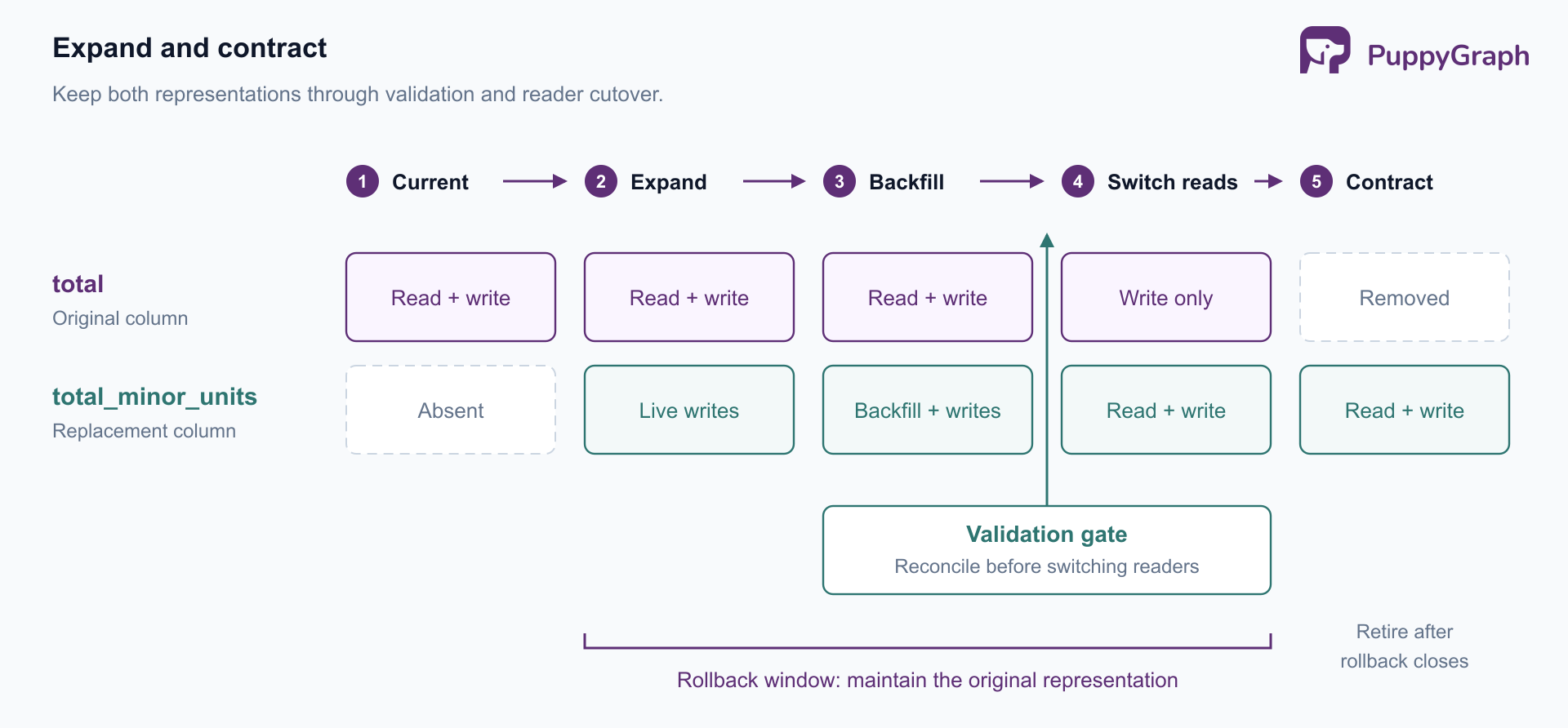
Expand, transition, and contract. Introduce the replacement structure while retaining the original, move writers and readers, then remove the original after validation. The expand-and-contract pattern supports incremental application changes around a shared database.
For example, replacing an ambiguous total column with total_minor_units could follow this sequence:
- Add the new column without invalidating existing writes.
- Update writers to maintain both representations under a documented conversion rule.
- Backfill historical rows, coordinating with live writes so the backfill cannot overwrite newer values.
- Compare results and switch readers to the new representation.
- Retire the old column after the rollback window closes and remaining dependencies are removed.
If both values live in one transactional database, update them together. Across separate systems, plan for partial failures and reconciliation. A dual-write period introduces consistency work of its own.
Version the contract explicitly. For an incompatible change, provide a separately versioned event contract, API, or table interface. Keep ownership, routing, and retirement dates explicit. This gives consumers time to move, but every supported version adds tests and operating cost. Define how duplicate representations of the same business event are identified so downstream jobs do not count both.
Adapt at the boundary. A view or transformation can preserve an established consumer interface while underlying structures change. Keep the translation in one reviewed place, document any information loss, and monitor its use. An adapter should have a clear support policy; otherwise temporary compatibility code becomes an undocumented permanent dependency.
Allow bounded automatic evolution. Automation fits predictable additions when the destination and its consumers tolerate them. Delta Lake supports automatic schema updates during writes, with controls that enable evolution for individual operations. Apply that capability alongside a policy for accepted fields and types. A misspelled field should not silently become a second business concept, and curated reporting tables warrant stricter review than a raw landing area.
Schema evolution and data compatibility
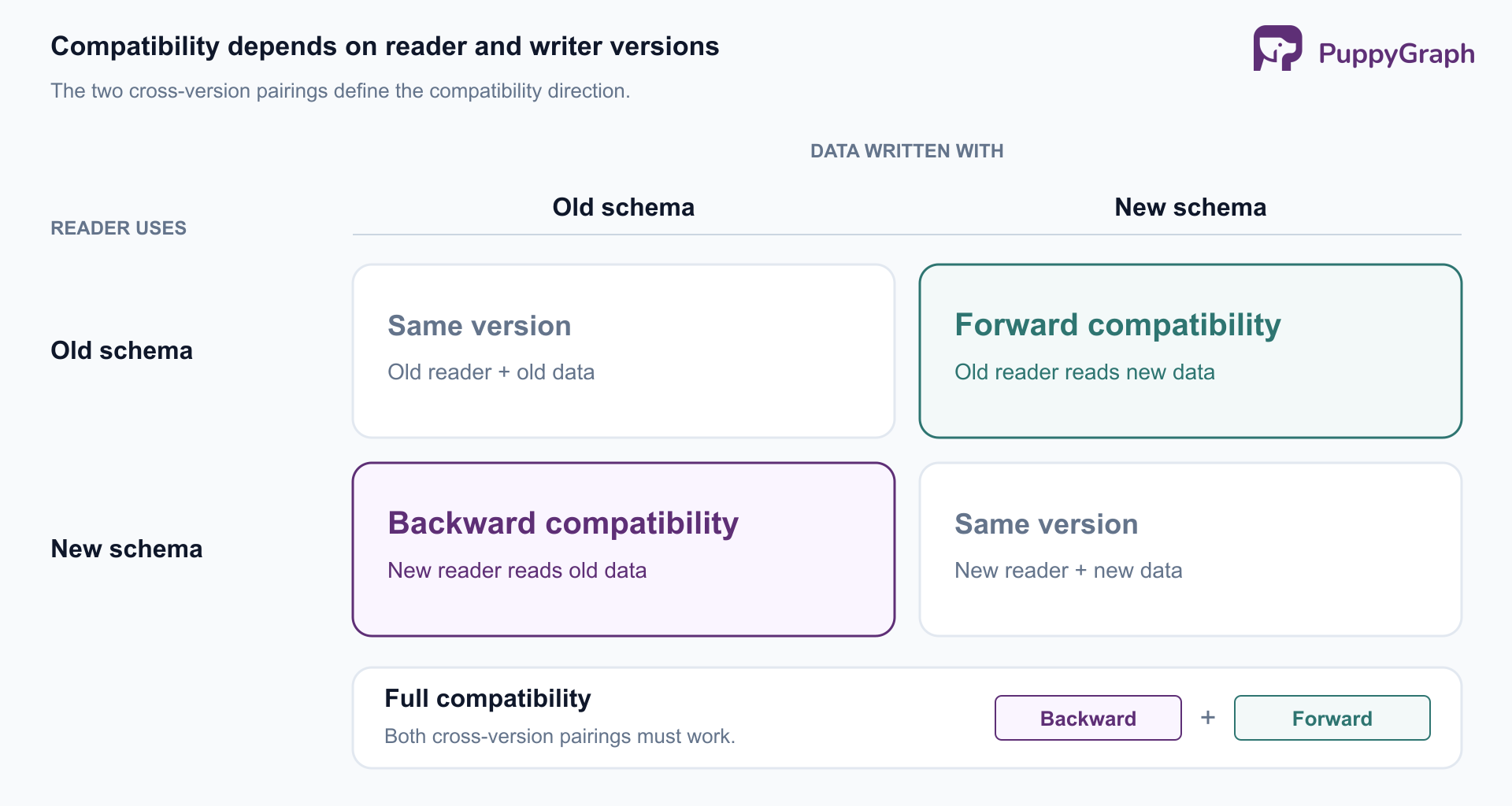
Compatibility is directional. It asks which reader can interpret data produced under which writer schema. In the terminology used by Confluent Schema Registry, the main guarantees are:
Forward compatibility alone does not establish that a new consumer can replay old data. Before upgrading that consumer, establish backward readability separately or ensure old records cannot reach it. Full compatibility also leaves business logic and deployment dependencies to test.
The history covered by the check matters too. Confluent's transitive compatibility checks compare a proposed schema with all previously registered versions, whereas non-transitive checks compare it with the latest. Choose the scope from the records and consumers the system must still support. Passing an adjacent-version check is insufficient evidence for a long historical replay.
Suppose live traffic uses version three, but an archive contains version-one orders. A replay test using only yesterday's traffic misses that archive entirely. Include the archived schema and representative records in the release gate, or provide a tested conversion step before those records reach the new reader. Retention policy therefore helps define the compatibility test matrix.
Compatibility also depends on representation. Protocol Buffers identifies fields by number in its binary format, and its documentation distinguishes binary evolution rules from ProtoJSON rules. A change that survives one encoding may fail through a gateway using another.
Finally, decoding successfully does not establish semantic compatibility. Changing total_minor_units from a pre-tax to a post-tax amount preserves its numeric type. It changes the business contract. Review units, time zones, identifier scope, and calculation definitions as explicitly as field names.
Schema evolution best practices
Turn compatibility requirements into repeatable release checks, with evidence for both machine readability and business meaning.
Keep a versioned contract with an owner. Store schema definitions alongside the application or data-product code that owns them. Document field meaning, accepted values, null behavior, compatibility policy, and deprecation expectations. Assign an owner who can answer whether a field is unused or merely absent from the main application.
Test real version combinations. Maintain representative records from the oldest supported schema as well as the current one. Test new readers against historical records and supported old readers against new records. Include nulls, boundary values, nested structures, and replay paths. Assert business results, such as unchanged order totals, in addition to successful parsing.
For the order example, write expectations before changing the schema: an archived order still contributes the same amount to revenue; missing delivery instructions do not prevent fulfillment; a newly populated instruction reaches the consumer that uses it. Test a mixed batch of old and new orders as well as isolated examples. This catches assumptions that only become visible when versions coexist.
Preserve meaning and identity. Introduce a new field when a value's meaning changes materially. Avoid inventing historical facts through convenient defaults: unknown delivery instructions are different from an assertion that no instructions were given. For Protobuf, follow its field-deletion guidance and reserve removed field numbers against reuse.
Review the entire dependency path. Include ingestion jobs, change data capture, transformation models, extracts, dashboards, and graph mappings in the impact assessment. Search for both direct references and derived calculations. An order identifier may connect several datasets even when its name appears in only one team's schema file.
Set measurable rollout and retirement gates. Define acceptable parsing errors, missing-value rates, unmatched identifiers, and old-versus-new result differences before release. Give backfills restartable checkpoints and reconciliation checks. Delay destructive cleanup until the team has evidence that the new path works and supported consumers have moved.
A practical release record should connect the schema diff to its tests, deployment order, backfill status, and rollback conditions. This makes the next change easier to assess and gives incident responders enough context to distinguish bad data from an incomplete rollout.
Schema evolution challenges
Hidden and delayed consumers. A monthly export may miss every check performed during a daily release cycle. Keep an inventory with business owners and execution schedules, then validate changes against a representative reporting period. Lack of recent reads is weak evidence that a field can be removed.
Operational cost and rollback limits. A compatible change can still require locks, scans, or data rewrites. PostgreSQL's ALTER TABLE documentation specifies different locking requirements for different operations. Evaluate the actual statement under representative load. Restoring an earlier application binary also cannot recover values discarded by a destructive transformation, so data recovery needs its own plan.
Set stop conditions for a backfill before it starts. Track progress separately from correctness: processing every row does not prove the conversion preserved values. Compare totals and sampled records, record exceptions, and decide who can pause the job. Keep sufficient original information to investigate discrepancies until the new representation has passed reconciliation.
Different rules across the stack. An event serializer, connector, table format, and query engine may accept different changes. Test the full path, including intermediate encodings and materialized outputs. A table's support for an operation establishes neither connector support nor unchanged application behavior.
Graph consumers add another dependency to manage: the mapping from source columns to entities, relationships, and properties. A source-column rename should not force users to rethink a business entity, but the mapping must be updated deliberately. Changing an identifier's scope needs deeper review because it changes which records are connected.
PuppyGraph lets teams define that semantic model over existing tables and query it with openCypher and Gremlin. Its default direct-query path keeps data in the source warehouse or lakehouse, without a graph-specific ingestion pipeline or persistent duplicate dataset. The graph schema maps tables and columns to nodes, edges, identifiers, and properties.
For schema evolution, this makes the mapping an explicit artifact to maintain alongside the source contract. PuppyGraph supports remapping source columns to graph fields. A team can use that separation to preserve graph vocabulary through a source rename, provided types and meaning remain compatible. Source changes still require mapping review and query tests; direct access removes the separate graph-loading step, while compatibility remains an engineering responsibility.
Schema evolution vs schema migration
The terms overlap, but they emphasize different work. Schema evolution is the ongoing management of changing structures and contracts. A schema migration is a concrete operation that moves a database definition from one state to another. Data transformation may accompany it, but is a separate concern.
For example, adding a PostgreSQL column is a schema migration. Deciding how old application instances behave while that column exists, whether historical rows need values, and when new readers can depend on it is schema-evolution work.
The distinction is not automatic versus manual, or online versus offline. Either approach can involve automation and coordinated deployment. A migration tool executes changes; an evolution policy establishes which changes are acceptable and how their effects are validated.
Conclusion
Schema evolution works when a structural change has a defined compatibility policy, a deployable transition, and tests for the meanings consumers rely on. Evaluate both reader directions, include retained data, and keep destructive cleanup separate from the initial rollout. Treat downstream mappings as versioned contracts too.
Try the forever-free PuppyGraph Developer Edition and book a demo with the team to see how openCypher and Gremlin queries connect entities across warehouse and lakehouse tables, with no graph-specific ETL, while you manage source-to-graph mappings as part of your schema evolution process.

Hao Wu is a Software Engineer with a strong foundation in computer science and algorithms. He earned his Bachelor’s degree in Computer Science from Fudan University and a Master’s degree from George Washington University, where he focused on graph databases.


