

SIEM vs Log Management: Key Differences
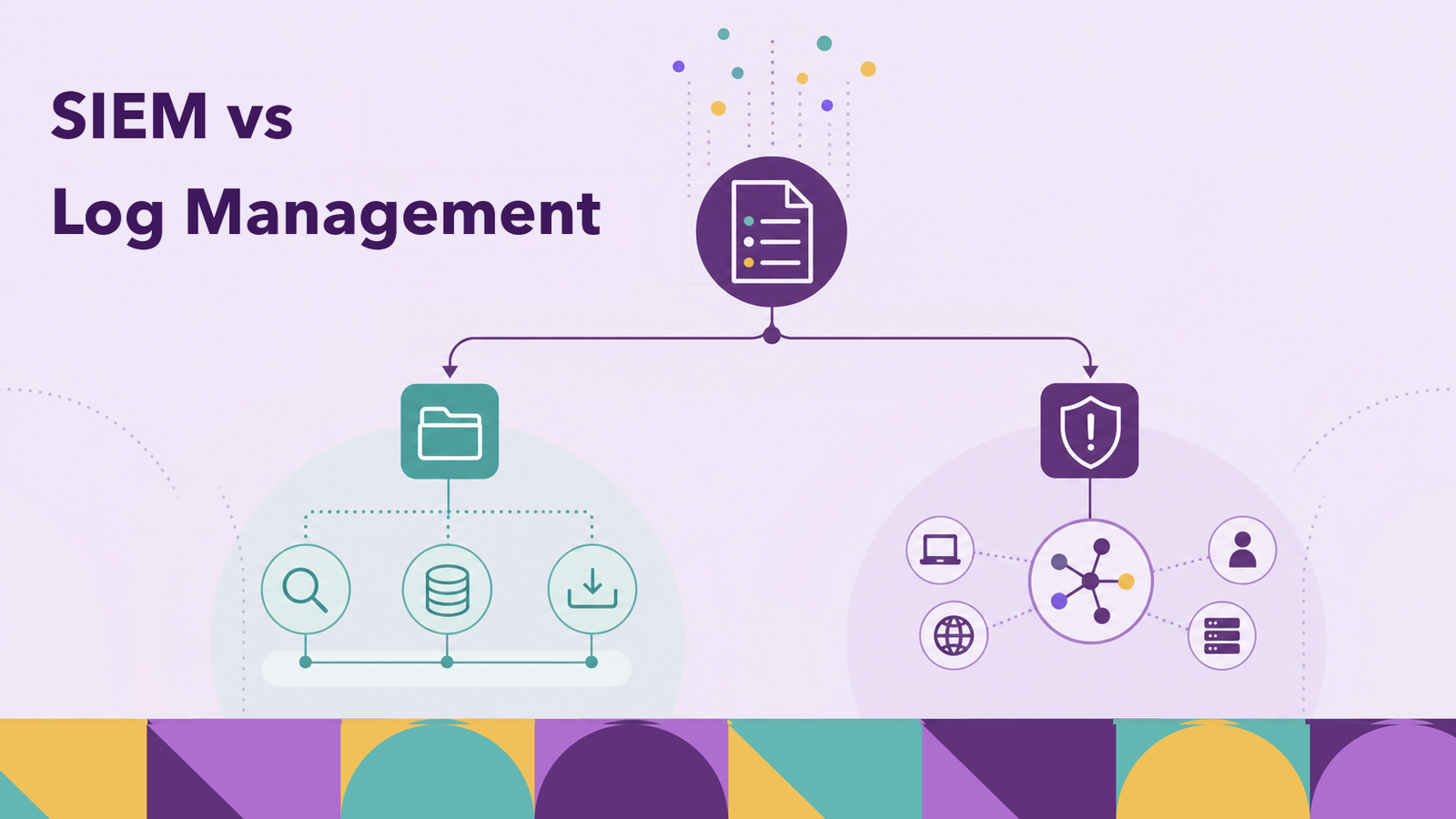
SIEM and log management get conflated because both centralize event data from across an environment. The difference is what each is built to do with it. Log management is a general-purpose pipeline that any team, security or otherwise, can share. SIEM is a security-specific layer that sits on top of such a pipeline and turns the events flowing through it into a detection, workflow, and compliance system for a SOC.
Because most SIEM platforms bundle a log store inside them, the choice is rarely one or the other. The useful question is how much of the detection, correlation, and workflow layer a team actually needs, and where the underlying event data is best kept for cost, retention, and reuse. This post defines each category on its own terms, compares them across the dimensions engineers care about, describes when each choice fits, and walks through the common architecture where they run together.
What is SIEM?
Security information and event management (SIEM) is the discipline of centralizing security-relevant events, normalizing them into a shared schema, correlating across sources to detect suspicious activity, and giving analysts the workflow they need to investigate and respond. The term merges two older categories: security information management (SIM), focused on long-term storage and reporting for compliance, and security event management (SEM), focused on real-time monitoring and alerting. A modern SIEM is both a detection system and a system of record for security events.
A SIEM platform typically covers a stack of capabilities. Ingestion and parsing pull logs and events from endpoints, identity providers, cloud control planes, network sensors, applications, and other security tools, then split each source’s native format into structured fields. Normalization maps those fields into a common schema (often based on frameworks like OCSF or ECS) so a rule can match a “failed login” the same way whether it originated in Windows, Okta, or a Linux sshd. Correlation and detection run rules, statistical baselines, and increasingly machine-learning models across normalized events to surface incidents that no single log would reveal. Alerting, case management, and dashboards turn detections into work items for a SOC analyst; many platforms also fold in SOAR (security orchestration, automation, and response) actions such as isolating a host or revoking a session. Reporting and retention produce the audit artifacts required by regimes like PCI DSS, HIPAA, or SOC 2, and keep the underlying events for the required window.
Splunk Enterprise Security, Microsoft Sentinel, Google Security Operations (Chronicle), Elastic Security, and IBM QRadar are examples of platforms that occupy this category, differing in their detection model, data architecture, and pricing.
What puts a platform in the SIEM category is not the log store underneath; every one of them has one. It is the security-specific layer above that log store: the normalized schema, the correlation and detection content, the case workflow, and the compliance packs. That layer is what the rest of this post means by SIEM.
What is log management?
Log management is the practice of collecting logs from applications, hosts, network devices, and services, then storing them somewhere they can be searched, visualized, retained, and archived. It is a general-purpose discipline: the same platform serves application observability, operations, product analytics, and security. A SIEM’s ingestion tier is one specific consumer of log management; developers debugging a slow request are another; a compliance team pulling a year of access logs is a third.
The core of a log management stack is straightforward. Collectors and forwarders (Fluent Bit, Vector, Filebeat, syslog, cloud-native agents) read logs at the source and ship them to a central pipeline. Ingestion and indexing parse the incoming stream into structured records, index the fields that will be searched, and place the data on storage tiered by access speed. Search and query let engineers filter, aggregate, and correlate events across sources through a query language, whether Lucene, LogQL, the Kibana Query Language (KQL), or SQL. Dashboards and alerts provide monitoring on top of that search layer. Retention and archival manage the trade-off between fast search and cost, usually by moving older data to cheaper tiers or object storage.
The Elastic Stack, OpenSearch, Grafana Loki, Graylog (Graylog Open, distinct from its Graylog Security SIEM), Splunk (in its log-store role, separate from Splunk ES), Datadog Logs, and cloud-native services like Amazon CloudWatch Logs and Google Cloud Logging all fit into this category. They differ in their storage architecture, query language, and how well they scale in ingest volume versus retention length, but none of them are, by themselves, security products.
The unifying property is that log management is content-agnostic on purpose. The same platform indifferently stores application traces, infrastructure events, and security logs, and what security value comes out of that store is a function of whatever queries and rules a team layers on top, not of the log platform itself.
SIEM vs log management: key differences
The two categories overlap in the mechanics of ingesting and storing events, but diverge in purpose, capability, and cost profile. The table below captures the differences an engineer or security architect actually needs to reason about.
The pattern in the table is that SIEM adds an opinionated security-detection and workflow layer above what a log management system already does. That layer costs more per gigabyte, both because the software is priced against a security value stream and because normalization, correlation, and long hot retention are genuinely expensive. Log management, in exchange for being cheaper and more general, leaves the security logic to whoever consumes its data. Choosing between them is less about capability and more about where in the stack a team wants the detection surface to live.
When to choose SIEM
A SIEM is the right center of gravity when the organization has an active detection and response practice and needs the workflow that goes with it.
A dedicated SOC or MDR partner drives detection. Analysts investigate alerts full-time, escalate incidents, and want the case management, timeline, and playbook features a SIEM ships with. Bolting that onto raw log search rarely gets the same outcome without significant custom work.
Compliance frameworks require security-specific reporting. Regimes such as PCI DSS, HIPAA, SOX, and various regional data-protection laws demand audit artifacts, retention windows, and access controls that a SIEM’s prebuilt content packs address directly. Building those from scratch on a general log store is possible but slow to change and hard to defend at audit.
Cross-source correlation is load-bearing. A brute-force login on an identity provider is noise on its own; the same account then downloading unusual volumes from cloud storage and disabling an MFA method is an incident. That correlation is what a SIEM’s rule engine, baselines, and increasingly UEBA models are designed to catch. Doing it by hand across separate log searches misses cases that fire once at 3 a.m. and never again.
A response workflow needs to close the loop. SOAR playbooks that isolate a host, revoke a session, quarantine an email, or open a ticket depend on the SIEM already knowing the entities involved and having integrations wired in. Detection without response leaves alerts sitting in a queue.
The trade-off in every case is cost and complexity. Enterprise SIEM licensing scales with ingest volume, and the platform demands ongoing content engineering to keep detections aligned with an environment that never stops changing.
When to choose log management
A log management platform is the right choice when the goal is centralizing logs for a mixed audience and the security-specific detection layer either does not exist yet, lives elsewhere, or is not the primary requirement.
Observability is the main use case. Application developers, SREs, and platform teams need to search logs to debug, correlate with traces and metrics, and monitor service health. A log management stack integrated with the observability pipeline serves that audience directly, and security logs can share the same pipeline without carrying a SIEM’s licensing overhead.
Retention and cost dominate the requirement. A compliance regime that requires seven years of retention over a large ingest volume is a very different economic problem from real-time correlation over the last ninety days. Log management platforms with cold-tier or object-storage backends let a team retain long histories cheaply, and query them when auditors or investigators actually need to.
The security detection layer runs somewhere else. An organization may already run EDR, cloud-native detection (GuardDuty, Defender for Cloud), identity threat detection, and network detection tools that produce their own alerts. In that setup, the log platform’s job is to be a searchable, retained record that supports investigation, not to duplicate detections.
Detection engineering is do-it-yourself. A small security team with strong data skills can build rule-based and query-based detections directly on the log store, especially when volumes are modest and the environment is well-scoped. That path skips the SIEM licensing model at the cost of building and maintaining the detection content in-house.
The trade-off in each case is that the security-specific layer has to come from somewhere; the log platform is content-agnostic by design. Teams choosing this direction accept that detection content, case workflow, and compliance reporting are theirs to build, integrate from other tools, or do without.
Can SIEM and log management work together?
Yes, and in practice most mature environments run them together. The common architecture is a tiered one: a general-purpose log management pipeline sits at the bottom, a SIEM (or a set of detection tools) sits above it, and the two exchange data in defined ways.
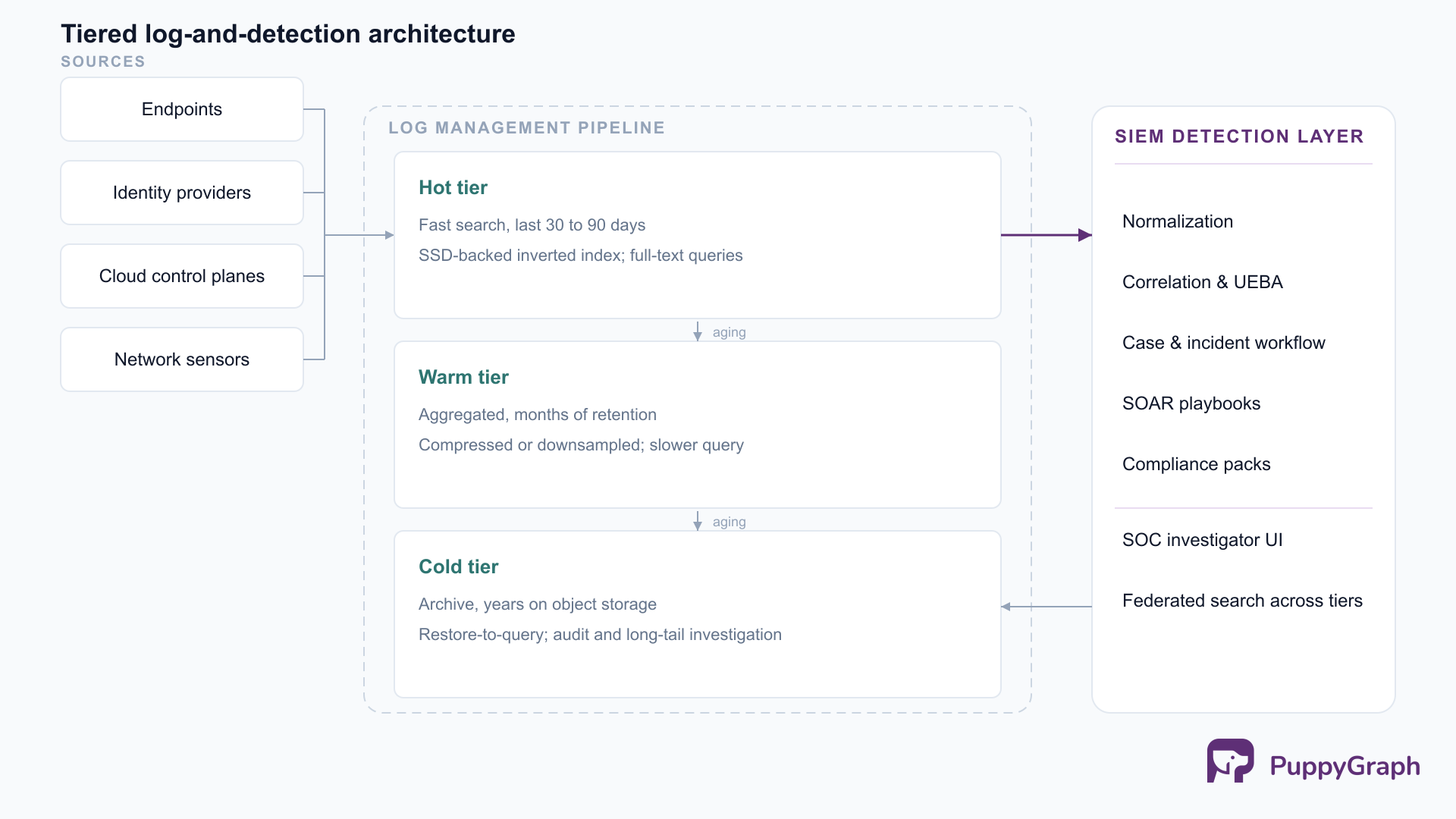
In this pattern, the log management platform absorbs the full firehose of application, infrastructure, and security logs and handles cost-efficient long-term retention. The SIEM subscribes to the subset of that stream that has security value, normalizes and correlates it, and drives the SOC workflow. When an investigation needs the long tail, an analyst reaches into the log tier directly, either through the SIEM’s federated search or through the log platform’s own query interface. This split lets each system do what it is designed for and keeps the SIEM’s ingest bill from scaling with every debug log an application emits.
A newer variant of this pattern replaces the SIEM’s proprietary hot store with a security data lake: security teams keep normalized events in an open-format lakehouse (often Iceberg or Delta Lake on object storage), and detection, investigation, and reporting run over that shared layer. That opens the door to querying the same data through more than one lens. Cross-source correlation is fundamentally a relationship problem: entities linked through shared identifiers across many logs. A graph layer over the same lake lets analysts ask multi-hop questions (“which identities touched this compromised host in the last 24 hours and then authenticated to production data stores”) directly against the underlying tables. PuppyGraph is one such layer: it defines a graph schema over the warehouse or lakehouse tables a log management pipeline already produces, and runs traversals in its own engine without exporting the data. That keeps the SIEM’s detection layer on the alerts and cases it does best, and adds a graph-shaped view of the underlying events for investigators. PuppyGraph names Palo Alto Networks, Datadog, Netskope, Trend Micro, Sola Security, and Blackpoint Cyber among its cybersecurity customers.
The point is not that one system replaces the others. It is that log management, SIEM, and a graph view over shared security data each address a different question, and running them over a common storage layer avoids paying for three separate copies of the same events.
Conclusion
SIEM and log management sit at different points in the same pipeline. Log management is the pipeline itself: it collects, indexes, stores, and retains events for anyone who needs them. SIEM is a security-specific layer on top: it normalizes, correlates, alerts, and drives the workflow a SOC depends on, and it produces the compliance evidence auditors expect. Teams pick a SIEM when detection and response are a live discipline with people, process, and compliance obligations behind them. They pick log management when the goal is centralization, retention, and general search across a broader audience than security. Most environments end up with both, arranged as tiers, with the SIEM subscribing to the subset of the log stream that carries security value.
Try the forever-free PuppyGraph Developer Edition and book a demo with the team to see how openCypher and Gremlin queries run over warehouse and lakehouse tables, with no graph-specific ETL, so identities, hosts, and events already sitting in your log platform can be traversed as a graph alongside the alerts your SIEM produces.

Hao Wu is a Software Engineer with a strong foundation in computer science and algorithms. He earned his Bachelor’s degree in Computer Science from Fudan University and a Master’s degree from George Washington University, where he focused on graph databases.


