

10 Best Unified Data Analytics Platforms & Key Features
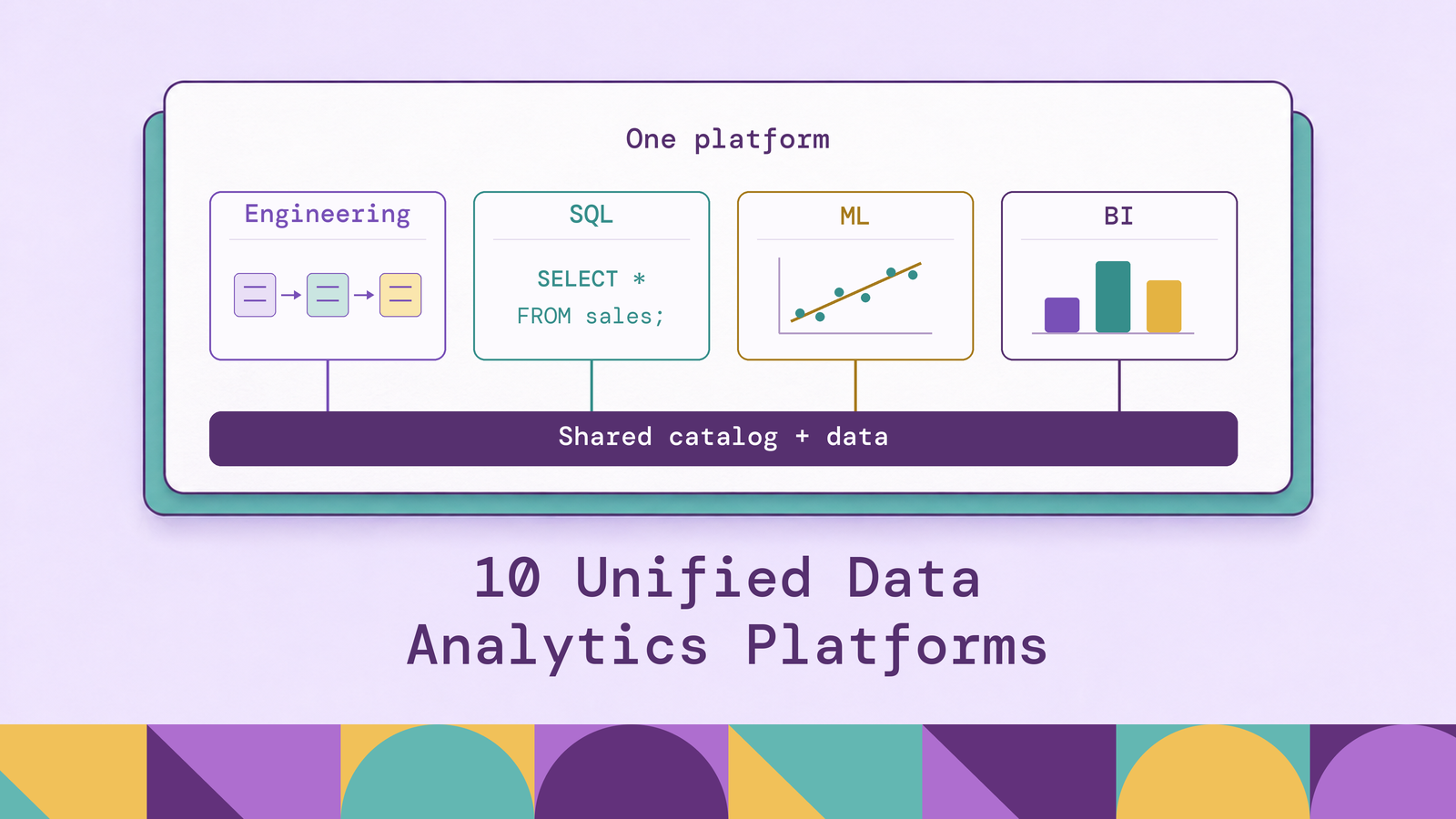
Every major data vendor now sells a platform that stores data once and runs data engineering, SQL analytics, machine learning, and BI against it. The ten platforms in this guide share that promise. They differ in the places that decide a multi-year commitment: whose storage holds the files, which table formats it uses, how far governance reaches when another engine reads the data, and how compute is billed.
This guide defines the category, explains the architecture most of theses platforms share, compares ten of them on storage, governance, deployment, and pricing, and closes with the criteria that separate a good fit from an expensive migration.
What is a unified data analytics platform?
A unified data analytics platform is a single environment in which data engineering, SQL analytics, data science, machine learning, and BI run against one governed copy of the data. Ingestion, storage, processing, cataloging, and consumption share one storage layer, one catalog, and one security model, rather than living in separate systems connected by copy jobs.
The phrase is most closely associated with Databricks, which described a "Unified Analytics Platform" in 2017 and was calling it the "Unified Data Analytics Platform" by 2019, before repositioning the platform around the lakehouse and, later, around AI. The architectural argument behind it was set out in the CIDR 2021 paper "Lakehouse: A New Generation of Open Platforms that Unify Data Warehousing and Advanced Analytics" by Databricks' Armbrust, Ghodsi, Xin, and Zaharia: the common two-tier design, a data lake for raw files plus a warehouse loaded from it, could be replaced by one system built on open, directly accessible file formats with warehouse-grade performance and first-class support for machine learning.
The problem the category addresses is fragmentation. In the two-tier design, every copy between lake, warehouse, feature store, and BI extract adds a pipeline to maintain, a delay before data is current, and a second place where permissions must be kept in sync. In Salesforce's State of Data and Analytics report (2025), data and analytics leaders estimated that 19% of their company's data is siloed, inaccessible, or otherwise unusable; Salesforce sells a data platform aimed at that problem, so read the figure as a survey of perception rather than a measurement.
How do unified data analytics platforms work?
Most platforms in this guide share the same layers, even when the vendor names them differently.
Columnar storage on cloud object storage. Data sits as columnar files, usually Parquet, organized into tables. Some platforms keep their primary tables in their own managed format (Snowflake, BigQuery, Teradata); others default to open table formats such as Delta Lake or Apache Iceberg, often in a bucket the customer owns. The table format adds transactions, schema evolution, and snapshots on top of plain files, which is what lets several engines write to the same table safely. Almost every platform now supports both modes.
A catalog that names and governs every table. The catalog holds the namespace (which tables exist and where their files are), access policies, and usually lineage and business metadata. Unity Catalog, Horizon Catalog, OneLake Catalog, Knowledge Catalog, and SageMaker Catalog all play this role. Catalogs that expose the Iceberg REST API let outside engines resolve the same tables, though whether row filters and column masks are enforced for those engines varies by catalog and engine.
Several engines on separate compute. SQL warehouses, Spark clusters, streaming jobs, and ML training run on compute that is provisioned independently of storage. That separation is what makes workloads unified without making them contend: a large training job runs on its own compute, so it does not slow the dashboards reading the same tables.
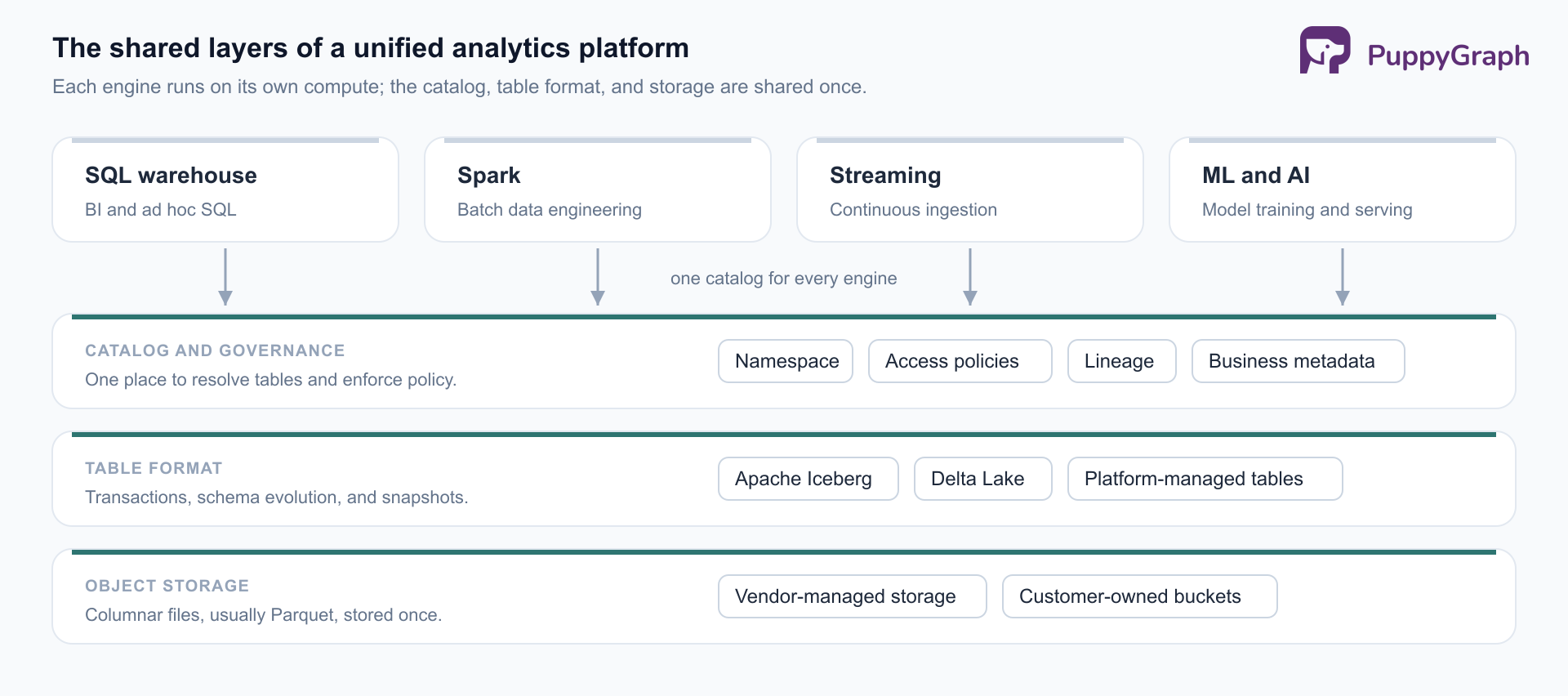
The differences between platforms come down to which of these layers the vendor owns. Storage-first platforms such as Snowflake and BigQuery keep the most control over files and offer open formats as an option; lakehouse-first platforms such as Databricks and Cloudera start from open tables in customer storage; suite platforms such as Microsoft Fabric, SAP Business Data Cloud, and Amazon SageMaker bundle several existing services behind one catalog and interface. The families are converging, but who controls the files and the catalog still determines how easily the data can be used outside the platform.
10 best unified data analytics platforms
The table summarizes how each platform handles the layers above. The sections that follow cover each platform's workloads, trade-offs, and best fit.
Read down the storage column and the field looks more alike than vendor positioning suggests: nearly every platform offers an open table format path, either as its default or as an option. The columns that still separate them are deployment and pricing. A platform that runs only as SaaS in one cloud rules itself out for data that must stay on premises, and a shared-capacity or credit model behaves very differently from per-service billing once workloads grow.
Databricks
Databricks, now branded the Databricks Data + AI Platform, is the vendor most closely associated with the category's name. Its lakehouse stores tables in Delta Lake by default, and Unity Catalog also manages Iceberg tables that external engines can read and write through the Iceberg REST Catalog API. On that storage it runs SQL warehouses, Spark and streaming pipelines, machine learning and AI agent development, and Lakebase, a managed Postgres database for operational workloads, with AI/BI dashboards on top. Unity Catalog, which Databricks calls "the unified governance layer for data and AI," governs tables, models, and files and also exists as an open-source project. The main design decision is the compute plane: classic compute runs in the customer's cloud account, serverless compute in Databricks' account, and the two differ in networking and operations. Databricks fits teams with data engineering capacity that want ETL, analytics, and ML on open-format tables in one place.
Snowflake
Snowflake, which markets itself as the AI Data Cloud, separates storage from compute through virtual warehouses: independent compute clusters that query the same tables without contending for resources. Native tables use Snowflake's compressed columnar format, and Iceberg tables can be stored either in Snowflake-managed storage or in an external volume the customer owns. Horizon Catalog covers governance policies, lineage, and semantic views, and exposes an Iceberg REST endpoint so engines such as Spark, Flink, and Trino can read and write Snowflake-managed Iceberg tables. Compute consumes credits billed per second; Snowflake's cost documentation notes that AI features and container services incur costs in their own ways, so forecasting takes more than counting warehouse hours. Snowflake fits SQL-centric organizations that want low administration and cross-cloud data sharing.
Microsoft Fabric
Microsoft Fabric is a SaaS platform that brings Data Factory, Spark-based data engineering, a data warehouse, data science, Real-Time Intelligence, SQL databases, and Power BI under one tenant. Every tenant gets one OneLake, a logical data lake built on Azure Data Lake Storage. Fabric stores tables natively in Delta Lake, and metadata virtualization lets the same tables be read as Iceberg, and Iceberg tables as Delta. Fabric is billed by capacity: all workloads assigned to a capacity draw on one pool of capacity units, and sustained overuse leads to throttling of new operations across that capacity. Fabric fits organizations already standardized on Power BI and Microsoft 365, where one tenant and one capacity model simplify administration.
Google BigQuery
BigQuery began as a serverless warehouse and is now positioned as Google Cloud's data-to-AI platform. Native tables use a managed columnar format, and Apache Iceberg managed tables keep their data in Cloud Storage buckets the customer owns; BigQuery can also query external Iceberg and Delta Lake tables. Workloads include SQL, BigQuery ML for training models in SQL, BigQuery DataFrames for Python, streaming ingestion, and Gemini assistance in queries and notebooks, with Spark available through Google's managed Spark service. Knowledge Catalog (formerly Dataplex Universal Catalog) handles metadata, data quality, and lineage across BigQuery and other sources. The trade-off sits in its pricing: on-demand rewards careful partitioning and clustering, and predictable spend at scale usually means planning slot capacity. BigQuery fits teams already on Google Cloud that want analytics without managing infrastructure.
Amazon SageMaker
The next generation of Amazon SageMaker, announced in late 2024, turned AWS's machine learning service into an umbrella for analytics and AI; the original ML service is now SageMaker AI. Its lakehouse architecture organizes data in Amazon S3, including S3 Tables, and Redshift managed storage into catalogs accessed as Apache Iceberg tables, built on the AWS Glue Data Catalog and Lake Formation. SageMaker Unified Studio gives one environment with a SQL editor, notebooks, and visual ETL over Athena, Redshift, EMR, Glue, SageMaker AI, and Amazon Bedrock. SageMaker Catalog, built on Amazon DataZone, adds a business catalog, glossary, lineage, and data quality, while Lake Formation enforces permissions underneath. Unified Studio's core features carry no charge, but each service used through it bills on its own terms, and SageMaker Catalog usage is metered separately. That is the main trade-off: the unified layer sits over separate AWS services, so cost, capacity, and tuning remain per service, and governance spans two layers. SageMaker fits AWS-centered organizations that already run Redshift, EMR, or Glue and want one entry point and catalog over them.
Cloudera
Cloudera, whose platform was formerly called Cloudera Data Platform, is the hybrid option on this list: the same services run in public clouds and in customer data centers. Its open data lakehouse is built on Apache Iceberg, with an Iceberg REST catalog that lets engines such as Spark, Trino, Snowflake, and Databricks read the tables without moving them. Governance comes from Shared Data Experience (SDX), which applies security policies through Apache Ranger and captures lineage through Apache Atlas, consistently across cloud and on-premises deployments. The trade-off is breadth and transition: the stack has many services to operate, and Cloudera has since announced Cloudera Anywhere Cloud, a new platform with a single control plane that can run standalone or complement existing data lakes, so buyers should confirm which architecture they are adopting. Cloudera fits regulated enterprises that need the same platform on premises and in the cloud.
Teradata
Teradata recently renamed its products: the platform formerly called Vantage is now the Teradata Autonomous Knowledge Platform, and its managed service is Teradata Cloud. Teradata Cloud runs always-on Active Compute alongside on-demand Elastic Compute in one managed system, and Elastic Compute works directly on Iceberg and Delta Lake tables in object storage. In-database analytics and machine learning ship under Teradata AI Studio (formerly ClearScape Analytics), so models run where the data sits. The trade-off is that the core engine and its storage are Teradata's own: open table formats are reached through Elastic Compute rather than serving as the primary storage layer, and much of Teradata's documentation still uses the older product names. Teradata fits organizations with existing Teradata warehouses that want to add lakehouse access and AI workloads without migrating their core analytics.
SAP Business Data Cloud
SAP Business Data Cloud, announced in February 2025, is built around the data that SAP applications produce. It combines SAP Datasphere for modeling and the semantic layer, SAP Analytics Cloud for BI and planning, SAP HANA Cloud, and SAP Databricks, a Databricks environment sold by SAP for data engineering, ML, and AI under Unity Catalog. SAP-managed data products are curated in an object-store data lake and keep their business semantics, so finance or supply chain data arrives with the meaning SAP's applications give it. Data products can be shared zero-copy with external Databricks, Snowflake, and BigQuery environments. The trade-off is its center of gravity: the platform is designed around SAP-managed data products, so an organization whose important data mostly lives outside SAP applications gets less from it than from a general-purpose platform. SAP Business Data Cloud fits enterprises whose most important analytical data originates in SAP applications.
Palantir Foundry
Palantir Foundry is built around its Ontology, which Palantir describes as an operational layer for the organization: existing datasources mapped into objects, properties, and links, plus action types that capture operators' decisions and connect them to existing systems. Datasets store tabular data as Parquet, SQL-created tables can use Iceberg, and virtual tables read data in Databricks, Snowflake, and BigQuery without copying it. Pipelines run on bundled engines including Spark and Flink; Workshop builds operational applications, and AIP builds AI workflows and agents on top of the Ontology. The trade-off is portability: data can leave in open formats, but the Ontology, applications, and AIP workflows are Foundry-specific. Foundry fits organizations that want analytics to drive operational applications and decisions, not only reports.
IBM watsonx.data
IBM watsonx.data, which IBM describes as an open, hybrid data foundation, is an Iceberg-centric lakehouse that also works with Delta Lake and Hive tables on object storage. Its engines include Presto for interactive SQL and BI and Spark for data engineering. The metadata service supports the Iceberg REST Catalog API, so other engines can share the same tables. Governance, cataloging, lineage, and data products live in a sibling product, watsonx.data intelligence (IBM's upgrade path from IBM Knowledge Catalog), and pipelines in watsonx.data integration. The trade-off is packaging: a complete platform means adopting more than one watsonx.data product, and engine capabilities differ, so it is worth checking which engine supports the operations a workload needs. watsonx.data fits hybrid deployments and IBM-centered estates that want an open Iceberg lakehouse they can run in their own environment.
How to choose a unified data analytics platform
A shortlist is easier to build from constraints than from feature lists.
Where the data already lives. Organizations whose core data comes from SAP applications, sits in an AWS account, or is already modeled in Power BI start with a strong default (SAP Business Data Cloud, Amazon SageMaker, or Microsoft Fabric), and moving away from it has to earn its migration cost.
Deployment and sovereignty. If data must stay on premises or in a specific jurisdiction, SaaS-only platforms drop out, and hybrid options (Cloudera, IBM watsonx.data, Teradata, Palantir Foundry) move up.
Governance across engines. Confirm that access policies, row filters, and column masks apply not only inside the platform's own engines but also when an external engine reads the same tables. Coverage varies by catalog, engine, and configuration, and the gaps are easiest to find before contracts are signed.
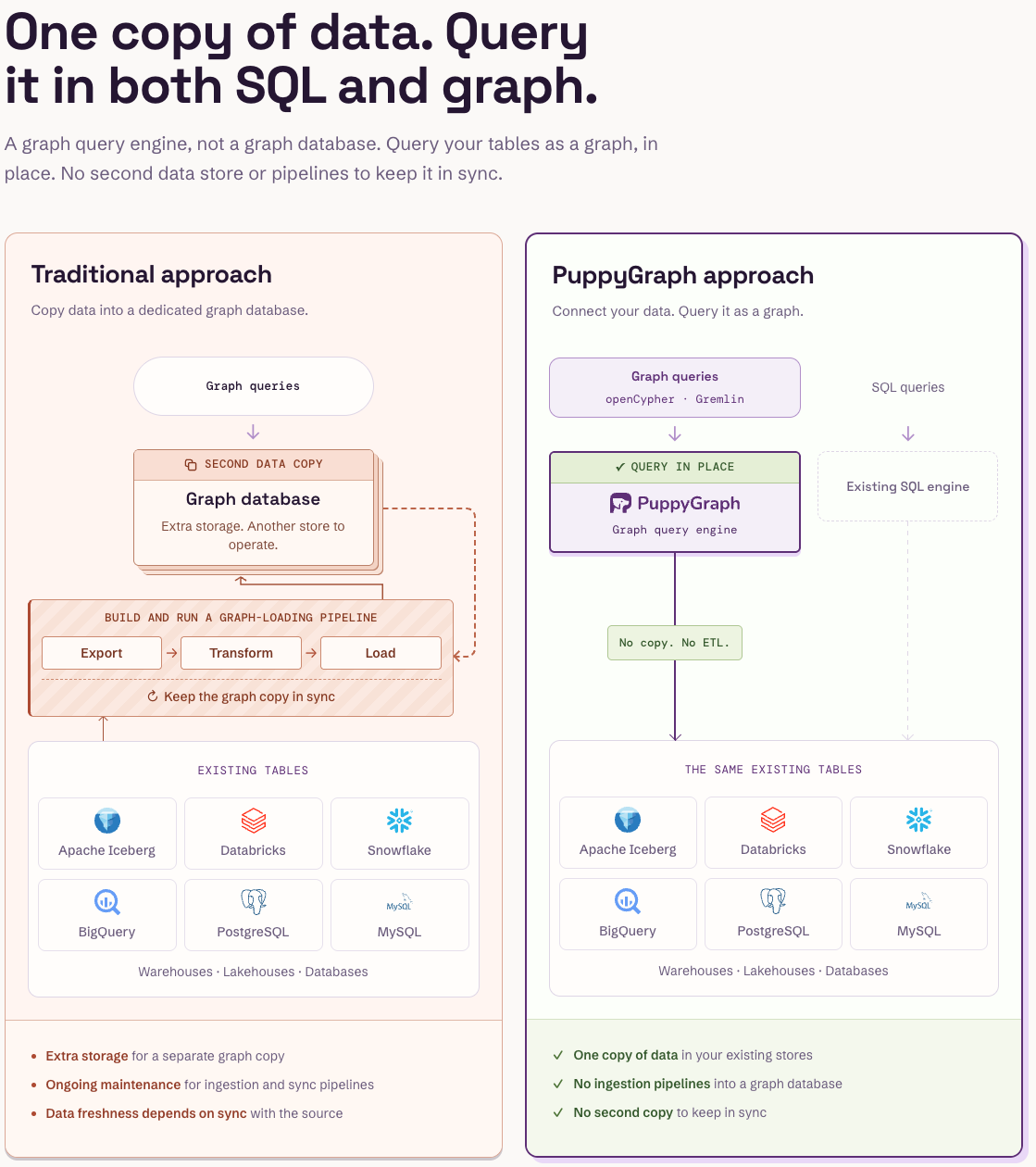
How open the platform is. Check whether the platform's primary tables are Iceberg or Delta Lake in storage you control, and whether its catalog lets other engines read and write them. Openness decides whether a future engine, a second platform, or an acquisition's stack can use the data without a copy, and whether you can add a layer the platform does not ship. A semantic model of the business is one such layer: the customers, accounts, devices, and suppliers in the tables and how they connect, so that a question such as which accounts share devices and payment methods with a flagged account is asked in those terms. In table vocabulary, each such question is a translation into joins, one more for every hop. On an open platform, PuppyGraph adds that model over the same tables in place and queries it as a graph, with no ETL into a separate graph database.
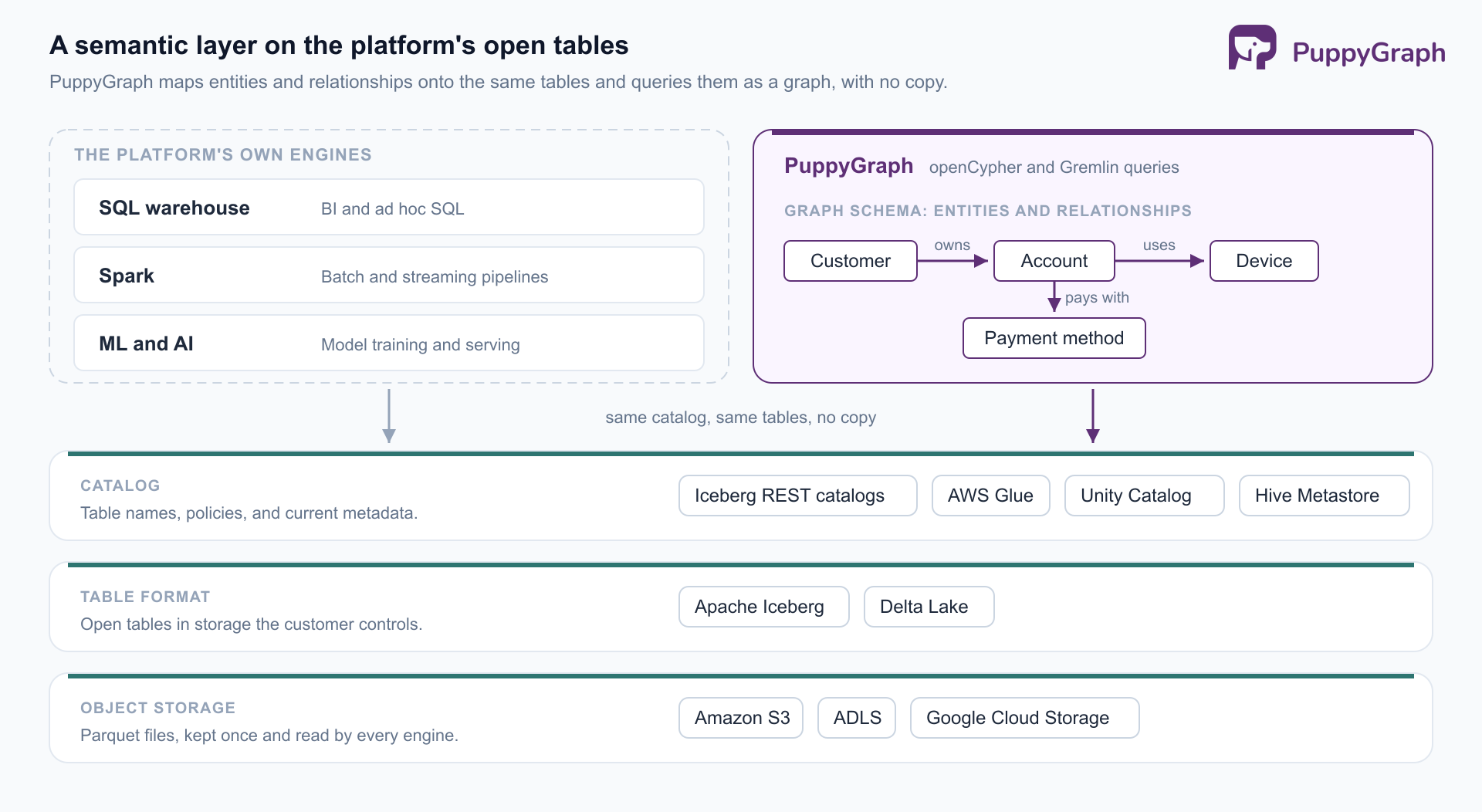
PuppyGraph is a distributed graph query engine that reads tables in SQL databases, data warehouses, and data lakes and lakehouses, including direct reads of open table formats like Iceberg and Delta Lake. Teams connect their existing sources, define a graph schema that maps tables to nodes and edges, and query with openCypher and Gremlin, while the same tables stay queryable with SQL in the platform.
Conclusion
Unified data analytics platforms put the lakehouse argument into product form: one governed copy of the data, several engines on separate compute, and one catalog in front of them. The ten platforms here implement that design from different starting points: a lakehouse, a warehouse, an application suite, an operational ontology, or a hybrid stack. That starting point still shows in their storage defaults, deployment options, and pricing.
Try the forever-free PuppyGraph Developer Edition and book a demo with the team to see how openCypher and Gremlin queries run over warehouse and lakehouse tables, with no graph-specific ETL, on the same governed data your unified analytics platform already holds.

Sa Wang is a Software Engineer with exceptional mathematical ability and strong coding skills. He holds a Bachelor's degree in Computer Science and a Master's degree in Philosophy from Fudan University, where he specialized in Mathematical Logic.


