

What Is a Digital Twin? Definition, Examples & Uses
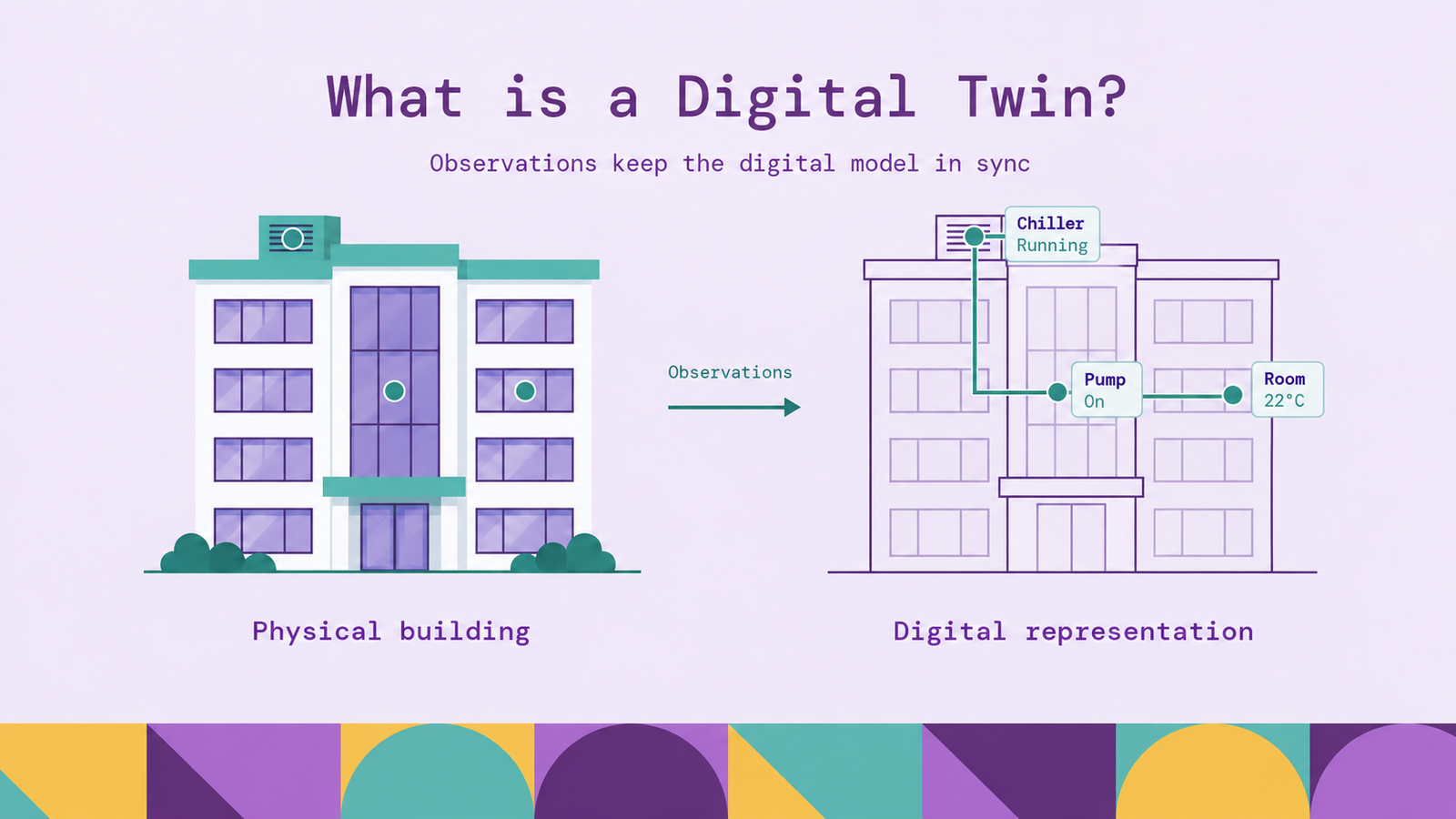
A digital twin's value depends on whether its data and assumptions are reliable enough for the decision at hand. Engineers use it to investigate an operating system, evaluate a proposed change, and compare the outcome with what actually happens.
This article explains how digital twins work, the different scopes they cover, and how they relate to simulations and digital shadows. It also examines where IoT, AI, and graph technology fit, with examples from equipment maintenance and manufacturing research.
What is a digital twin?
A digital twin is a digital representation of a real-world entity or process that stays synchronized with its counterpart at a frequency and level of detail suited to its purpose. The Digital Twin Consortium's definition makes synchronization and fidelity central. Fidelity means how faithfully the representation captures the characteristics that matter.
Consider a building's cooling system. A useful twin might represent chillers, pumps, pipes, and the rooms they serve, alongside temperature readings, equipment status, and maintenance history. An operator could use it to investigate a warm room or evaluate which areas would lose cooling during pump maintenance.
The required detail follows the question. Investigating energy consumption needs different measurements and models from analyzing pipe vibration. A three-dimensional view may help locate equipment, but the operational value comes from the relationship between the representation and the actual system.
How does a digital twin work?
A digital twin brings together a defined subject, a digital representation, incoming observations, and a way to use the resulting information. A practical implementation can be understood through five components.
The physical subject and its identity. Define what the twin represents and assign stable identifiers. The cooling-system twin needs to distinguish a pump's equipment identity from a sensor's identity. When someone replaces the sensor, its readings must still map to the correct pump.
The digital representation. Describe relevant properties, relationships, and behavior. Equipment specifications and connectivity describe structure; thermal equations or fitted models can describe behavior. Keep measured values distinct from estimates so that users know which information came from an instrument.
Data collection and synchronization. Internet of Things (IoT) sensors and gateways can supply observations such as pressure, temperature, and operating state. Maintenance systems contribute repairs and component changes. An ingestion pipeline checks timestamps, units, duplicates, and identifiers before updating the representation. Microsoft's Azure Digital Twins architecture illustrates this separation between device connectivity, event processing, the twin graph, and downstream analytics.
Analysis. Queries reveal the current recorded state; analytical models estimate conditions or evaluate alternatives. In the cooling example, an engineer might combine room temperatures with equipment relationships, then use a thermal model to estimate the effect of changing a setpoint.
Decisions and feedback. An operator can inspect a recommendation, schedule maintenance, or approve a change through an existing control system. Subsequent measurements show whether the action had the expected effect. Automatic actuation is a separate design choice with its own permissions and operating limits.
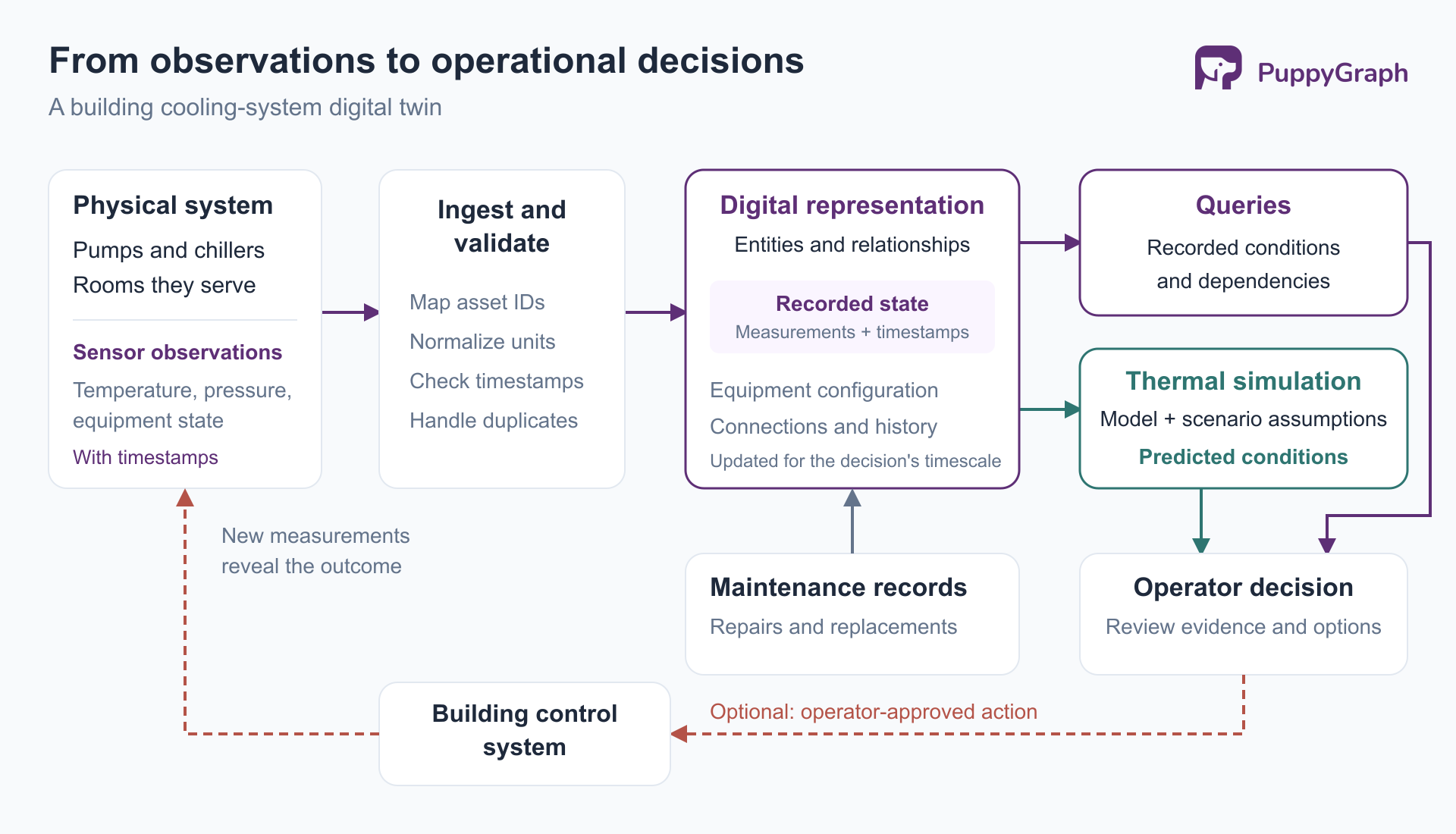
Freshness should be explicit for each use case. A maintenance-planning workflow may tolerate periodic updates; a fast operational response needs a tighter end-to-end delay budget. The Digital Twin Consortium glossary recognizes that synchronization frequency can vary within a twin. A fresh dashboard timestamp should never conceal stale sensor readings.
Types of digital twins
One useful classification groups twins by the scope they represent. IBM's digital twin overview describes component, asset, system, and process twins. Treat these as modeling boundaries, with the following illustrative examples, rather than a mandatory sequence of maturity levels.
Component twins focus on individual parts, such as a bearing. Their purpose might be to relate vibration and temperature to wear under particular operating conditions.
Asset twins represent a functional piece of equipment, such as a pump. They combine the behavior and condition of its components to support maintenance or performance analysis.
System twins represent interacting assets. A cooling-system twin includes pumps, chillers, valves, and the areas they serve, allowing questions about dependencies and overall service delivery.
Process twins represent an operational flow, such as fulfilling a manufacturing order. Equipment availability, work queues, and material movements contribute to analysis of delays or alternative schedules.
Choose the boundary around a decision. A bearing-maintenance question may need detailed component data; a production-rescheduling question needs dependencies across machines. Expanding scope is useful only when the additional relationships change the answer.
Benefits of digital twins
Digital twins can improve decisions when observations, models, and operational actions are connected. The benefits depend on how that connection is used.
Maintenance based on equipment condition. A twin can connect observed behavior with an asset's configuration and service history. Rolls-Royce describes using engine digital twins to support maintenance schedules based on individual engines' operating conditions. This is a concrete application of asset-specific information, without assuming identical wear across a fleet.
Testing changes before implementation. A synchronized model can provide the starting conditions for a what-if analysis. In the cooling example, an engineer could test a proposed operating schedule against expected demand before changing equipment settings. The result remains conditional on the model's accuracy and the scenario's assumptions.
Diagnosing problems in context. An abnormal room temperature becomes more actionable when connected to the equipment serving that room, recent maintenance, and neighboring measurements. Those relationships help an operator select what to inspect next.
Learning from outcomes. Recording predictions, decisions, and subsequent measurements lets a team evaluate whether its model remains useful. Repeated mismatches can reveal a need to investigate sensor calibration, revise assumptions, or account for equipment changes.
These benefits require ongoing investment in instrumentation, integration, and model maintenance. NIST's digital twins research program emphasizes validation and uncertainty alongside implementation. A twin earns trust through demonstrated accuracy for a defined task, and its operating costs should be assessed against the value of better decisions.
Digital twin vs simulation
A simulation executes a model to study behavior under specified conditions. A digital twin maintains a connection to the entity or process it represents. Simulation can therefore be one analytical capability within a twin.
The comparison below separates a standalone simulation study from a synchronized twin. Simulations can be dynamic, accept live inputs, and model complex systems; describing them all as static would obscure the actual distinction.
A cooling simulation can test a hypothetical building layout before construction. An operating building's twin can supply current equipment configuration and measurements to a simulation of tomorrow's cooling demand. The simulation computes a scenario; the twin provides continuity with the building that operators manage.
Digital twin vs digital model vs digital shadow
Another classification focuses specifically on automated data exchange. The manufacturing research paper MES-integrated digital twin frameworks uses the distinction introduced by Kritzinger and colleagues: a digital model has no automated exchange, a digital shadow receives automated updates, and a digital twin has automated exchange in both directions.
This is a stricter use of digital twin than the broader synchronization-based definition used earlier. The broader definition does not make automatic equipment control a universal requirement.
When evaluating a proposed twin, ask which updates are automated, what actions it can initiate, and who authorizes them. An advisory system may be the appropriate design for a maintenance workflow. Adding automatic control should follow a demonstrated operational need.
Role of AI in digital twins
AI can help interpret the observations associated with a digital twin. Its role should be tied to a specific task and evaluated against a simpler baseline, such as a threshold rule or an established engineering model.
Anomaly detection identifies departures from expected behavior. In a 2023 NIST and University of Michigan research demonstration, researchers combined a 3D printer's measurements with temperatures computed by its digital twin. Machine learning helped identify anomalies, and further models distinguished known disturbances from potential cyber threats. Human interpretation remained part of the framework. This was a laboratory demonstration, with further testing still needed.
Prediction estimates future conditions from observations and operating context. A maintenance application might forecast deterioration, provided it has suitable training data and a way to evaluate prediction errors. Rolls-Royce's engine example illustrates how asset-specific data can support such maintenance work.
Natural-language access gives users another way to query twin data. An assistant could translate a question about affected rooms into queries over equipment relationships, then summarize the results. Its answer should expose the underlying evidence and data timestamps so that an operator can inspect them.
AI is optional. A twin can support useful monitoring and engineering calculations without machine learning. Where AI is used, changing equipment or operating regimes can make previous training data less representative; continued evaluation belongs in the operating workflow.
Digital twin and graph technology
A system-level twin needs to represent how things connect. A pump supplies a cooling loop; the loop serves an air-handling unit; that unit serves rooms. A graph represents these entities as nodes and their relationships as edges. Microsoft's twin graph documentation uses this approach to connect individual twins into a representation of an environment.
Those relationships support dependency questions. If a pump becomes unavailable, which rooms depend on it? Which affected equipment has an open maintenance order? A graph query can follow several relationships without requiring the user to flatten the system into a single equipment list.
Connectivity alone does not calculate physical consequences. A path can identify potentially affected rooms, but estimating temperature changes requires a behavioral model and operating conditions. Redundant equipment and closed valves also change which dependencies matter. Relationship validity and state deserve the same attention as sensor freshness.
PuppyGraph lets teams define this entity-and-relationship model over existing tables. Its graph schema maps tabular data to nodes, edges, and properties, giving analysts a semantic model of equipment, locations, and maintenance relationships. Teams can query that model using openCypher and Gremlin.
By default, PuppyGraph queries existing data in place, without requiring ingestion into a separate graph dataset. Tables continue to live in the customer's warehouse or lakehouse. For a twin architecture, this supports relationship analysis over data already collected there; sensor ingestion, behavioral simulation, and control remain separate responsibilities. The available freshness still depends on when upstream systems make their observations available in those tables.
How to build a digital twin
Start with a decision you can evaluate, then assemble the data and models needed to support it. For the cooling example, a bounded first goal could be identifying rooms potentially affected by planned pump maintenance.
Define the decision and acceptance criteria. Identify the user, required output, and tolerated delay. Specify how you will check the result, such as comparing predicted dependencies with verified equipment records and a supervised maintenance exercise.
Establish identities and source ownership. Map equipment, sensors, spaces, and maintenance records to stable identifiers. Decide which system owns each property. Record units, observation times, and quality flags, including how missing measurements are represented.
Build the minimum useful representation. Model the assets and relationships required for the first question. Add behavioral models when the decision requires predictions, such as estimating temperature changes during an outage. Keep hypothetical scenario values separate from observed operating state.
Connect and test updates. Handle late events, duplicate messages, sensor outages, and equipment replacements. Test whether relationships update when technicians change the physical configuration. A correct initial model can become misleading after an undocumented repair.
Validate and operate the workflow. Compare results with independent observations across relevant operating conditions. Run recommendations in an advisory mode before allowing automated actions. Assign responsibility for reviewing errors, maintaining the model, and retiring obsolete entities.
Expand after the first use case proves useful. Adding assets should extend a model with understood limitations and accountable owners, so the team can tell whether each additional layer improves its decisions.
Conclusion
A digital twin links a representation to the changing state of its real-world counterpart. Its usefulness depends on matching model detail, synchronization, and validation to a concrete decision. IoT supplies observations, simulation evaluates behavior, AI can assist analysis, and graphs make dependencies explicit.
Try the forever-free PuppyGraph Developer Edition and book a demo with the team to see how openCypher and Gremlin queries connect equipment and maintenance relationships across warehouse and lakehouse tables, with no graph-specific ETL, to support dependency analysis for digital twins.

Hao Wu is a Software Engineer with a strong foundation in computer science and algorithms. He earned his Bachelor’s degree in Computer Science from Fudan University and a Master’s degree from George Washington University, where he focused on graph databases.


