

What Is Hive? Architecture, Features, and How It Works
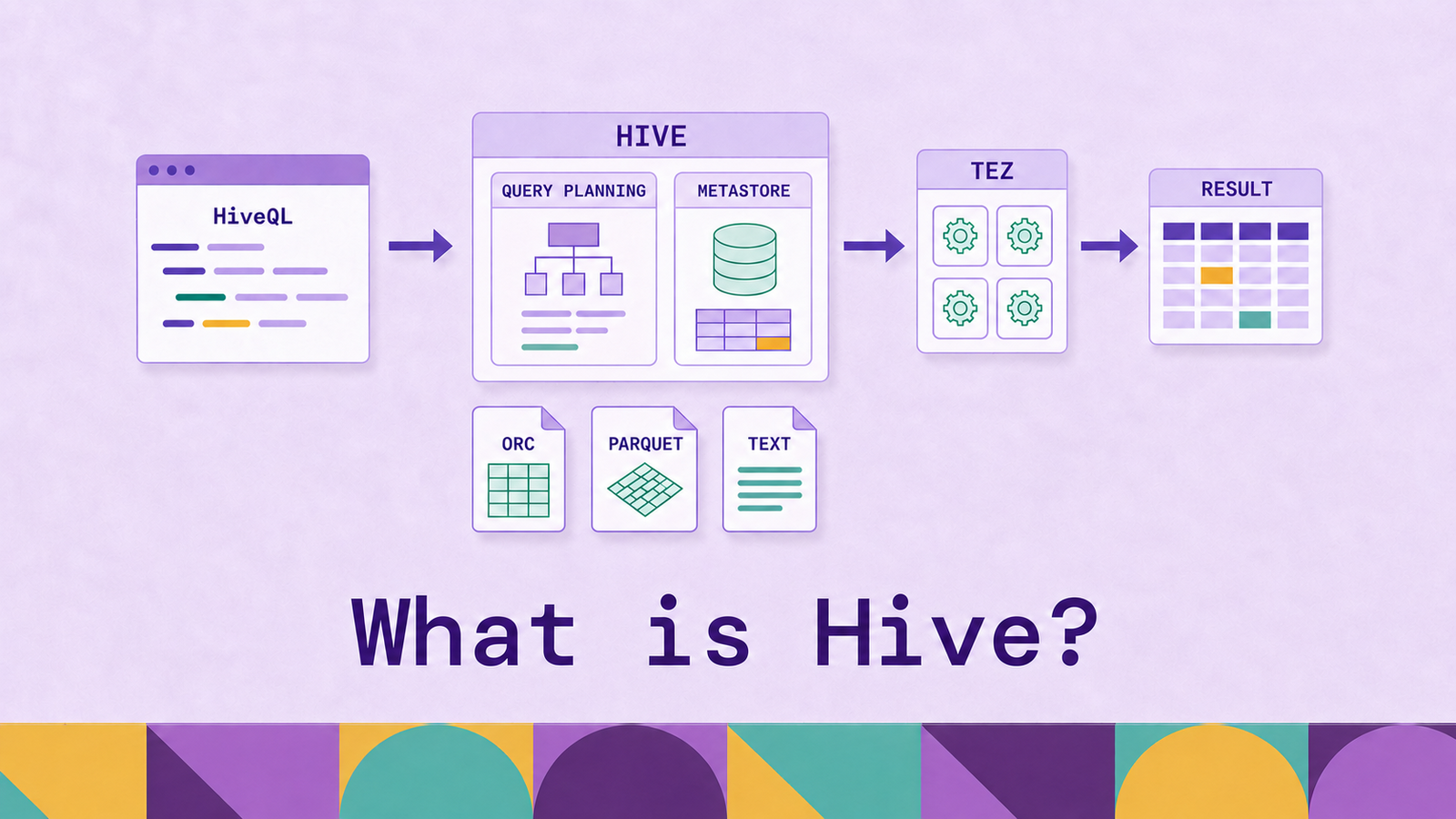
Apache Hive presents a SQL interface over separate metadata, stored files, query planning, and distributed execution. Those boundaries make Hive a fit for batch analytics, reporting, and data preparation rather than low-latency operational transactions.
This guide covers how Hive processes a query, the components in its architecture, the HiveQL language, its type and table systems, and the physical layout techniques that make large scans practical.
What is Hive?
Apache Hive is open source data warehouse software built on Apache Hadoop. It imposes table structure on data stored in distributed systems and lets users read, transform, summarize, and write that data with SQL syntax. A Hive table can describe text, ORC, Parquet, and other formats. There is no single file format called a Hive format.
That distinction matters. A relational database generally owns the records stored in its internal format. Hive can instead act as a metadata and query layer over files. A table definition records the columns, types, storage location, file format, and serialization rules required to interpret those files as rows. The raw data and the table definition can have different lifecycles, particularly for external tables.
The original Hive paper presented Hive as a way to query Hadoop data without writing a custom MapReduce program for every analysis. Its core use cases center on analytical work:
Batch reporting. Teams can aggregate event, transaction, or operational datasets into daily and monthly summaries.
Data transformation. HiveQL statements can clean, join, and reshape raw data into curated tables for downstream analytics.
Ad hoc analysis. Analysts can explore large historical datasets through a SQL interface such as Beeline or a JDBC client.
Hive is not intended for online transaction processing. Apache's documentation positions it for traditional data warehousing rather than workloads made up of frequent, low-latency row lookups and small updates. It is best understood as a distributed analytical system with a SQL interface.
How does Hive work?
A Hive query passes through several stages before the user receives a result. Consider this aggregation:
SELECT region, SUM(order_total) AS revenue
FROM sales
WHERE order_date >= DATE '2026-08-01'
GROUP BY region;
The process is broadly as follows:
- A client sends the HiveQL statement to HiveServer2. Clients commonly connect through Beeline, JDBC, or ODBC.
- Hive's query processor parses the statement and performs semantic checks. It resolves table and column names and confirms that operations are compatible with their data types.
- The compiler retrieves metadata about
salesfrom the Hive Metastore, including its schema, partitions, storage location, and file format. - The optimizer transforms the logical work into a more efficient plan. Available statistics can inform choices such as join order, while rules can push filters closer to scans and remove unnecessary work.
- Hive creates a physical plan made of stages and submits it to a distributed execution engine. In the Hive 4.x configuration, Tez is the default execution engine; MapReduce remains available but is deprecated.
- Tasks read the required files, apply filters and aggregations, exchange intermediate data where necessary, and produce the result.
- For a result-returning query, the client fetches rows through HiveServer2. For an
INSERTor directory-writing query, execution tasks write to the configured table or output path.
The order_date predicate can have a large effect on this flow. If sales is partitioned by date and the predicate matches the partition column, partition pruning can omit unrelated partitions before execution. If the files use a columnar format such as ORC or Parquet, readers can also avoid materializing columns that the query does not need. Physical layout therefore determines how much of the logical query becomes actual scan work.
Hive architecture
Hive's architecture separates client access, query coordination, metadata, execution, and storage. This separation lets each part serve a distinct role in the query lifecycle.
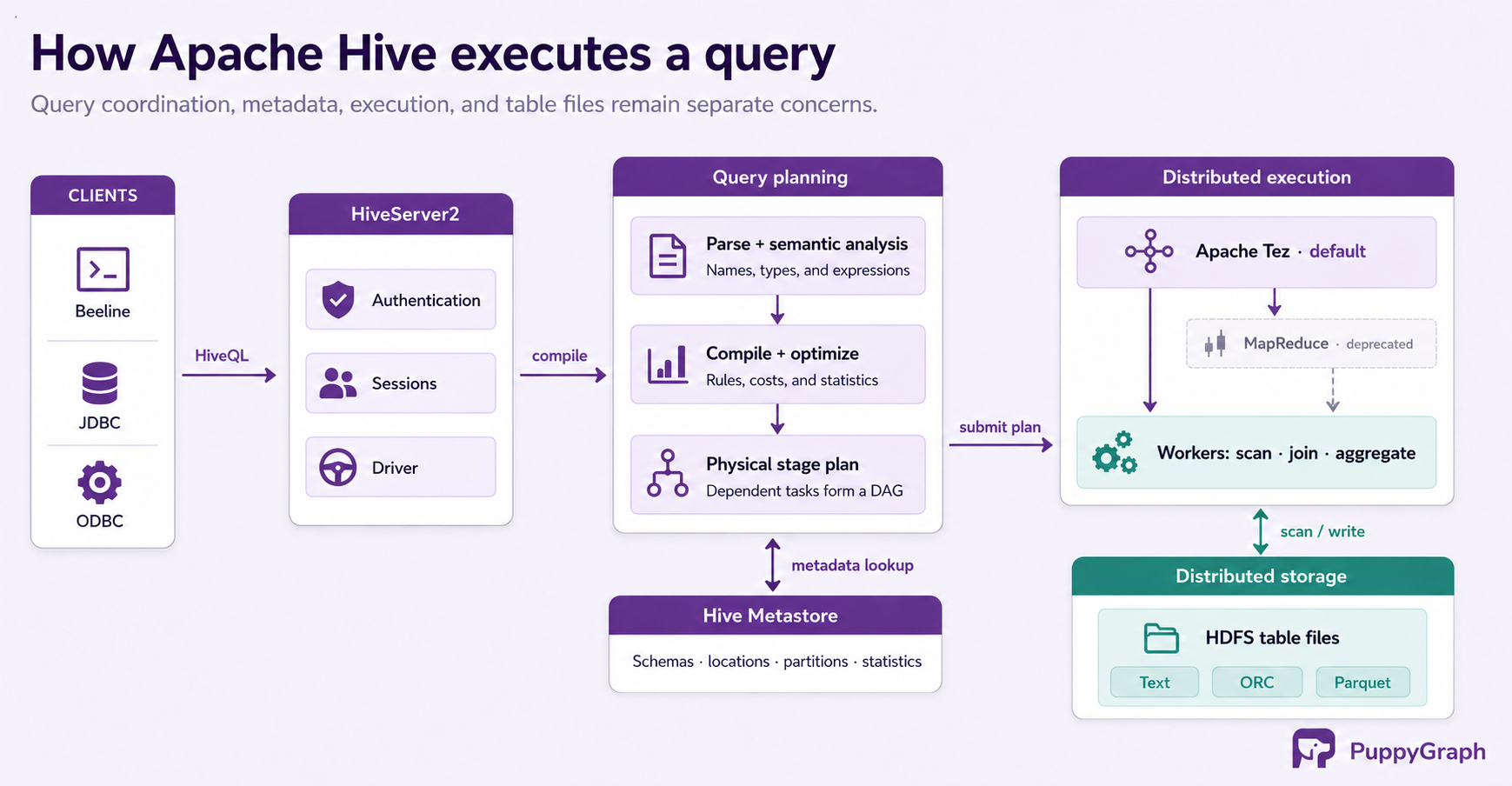
Clients and HiveServer2. Users and applications submit operations through clients. HiveServer2 provides a multi-client service with authentication and JDBC and ODBC access. It manages sessions and coordinates query execution rather than storing the table data itself.
Query coordination and compilation. The driver and query processor receive a query, maintain its session handle, and expose execution and fetch operations. The parser converts HiveQL into a parse tree. Semantic analysis resolves and validates the statement, then converts the tree into an internal query representation. The compiler uses metastore information to build a plan, while the optimizer rewrites that plan to reduce work. Hive's Calcite-based cost optimizer can use table and column statistics for decisions such as join reordering.
Hive Metastore. The metastore holds table and partition definitions, column types, storage locations, SerDe information, and statistics. It can run as a separate service or be embedded, and it persists object definitions to a relational database. It stores descriptions of data, not the analytical dataset itself.
Execution engine. Compilation produces a physical plan of dependent stages. As the HiveServer2 overview explains, HiveServer2 submits that plan to the configured cluster engine. Scans, joins, shuffles, and aggregations can therefore run in parallel.
Storage layer. Table data resides in distributed storage, commonly HDFS in a Hadoop deployment. Hive supports row-oriented text as well as analytical formats such as ORC and Parquet. A serializer/deserializer, or SerDe, converts stored records into the representation Hive expects and performs the reverse operation for writes.
Reliable Hive operations depend on keeping metadata, file layout, permissions, and statistics consistent. A healthy metastore does not guarantee that every referenced file exists or agrees with the catalog.
What is HiveQL?
HiveQL, often abbreviated HQL, is Hive's SQL dialect. It supports familiar constructs such as SELECT, WHERE, JOIN, GROUP BY, HAVING, window functions, subqueries, common table expressions, and data-definition statements. Apache documents support for many features from later SQL standards, but HiveQL is not identical to every relational database dialect.
A table can be declared and populated with standard-looking statements:
CREATE TABLE daily_revenue (
  order_date DATE,
  region STRING,
  revenue DECIMAL(18, 2)
)
STORED AS ORC;


INSERT INTO daily_revenue
SELECT order_date, region, SUM(order_total)
FROM sales
GROUP BY order_date, region;
The syntax hides distributed work. An INSERT ... SELECT may scan files, shuffle rows between workers, aggregate them, and create new output files. Cost therefore depends on layout, volume, cluster resources, statistics, and the execution engine.
HiveQL also exposes warehouse-specific operations. PARTITIONED BY and CLUSTERED BY describe physical organization. STORED AS chooses a file format. ROW FORMAT and SerDe clauses define how records are decoded. LOAD DATA places files in a table or partition location; the Hive DML manual notes that loading generally copies or moves files rather than transforming their contents.
Users can extend the language with user-defined scalar, aggregate, and table-generating functions. Custom code can express domain-specific transformations but adds deployment and maintenance responsibilities.
Hive data types
Hive's type system includes primitive values and nested structures. The Hive data type manual groups the main types as follows:
Complex types help represent semi-structured data. An event table might store tags as ARRAY<STRING> and request context as a STRUCT<ip:STRING,user_agent:STRING>.
Type choice affects correctness and interoperability. Monetary data belongs in DECIMAL rather than DOUBLE when exact decimal arithmetic is required. Timestamps require an explicit policy for time zones and source normalization. A permissive STRING column may simplify ingestion but move validation and casting into every downstream query. The file format and SerDe must also represent the declared type consistently.
Hive uses NULL for missing or unknown values. Test for it with IS NULL or IS NOT NULL, or use Hive's null-safe <=> operator when comparing two expressions. Ordinary = NULL evaluates to NULL, not TRUE. Teams moving between engines should test conversions, date functions, and complex-type behavior.
What are Hive tables?
A Hive table is a metadata definition that maps a name and schema to data in storage. The definition can include columns, partitions, bucket keys, a file format, a SerDe, a location, table properties, and statistics. Databases provide namespaces for organizing those tables.
Hive has two fundamental table ownership models:
Managed tables. Hive owns the table's data lifecycle. By default, it places managed-table data under the configured warehouse directory. Dropping a managed table removes its metadata and its data, subject to trash and purge configuration. Features such as Hive ACID transactions apply to managed tables.
External tables. Hive manages the metadata while another process or system can manage the files. Dropping an external table normally removes the catalog entry but leaves the files in place. External tables fit data that already exists, is shared with other engines, or must outlive one Hive definition. Table properties can alter deletion behavior, so operators should inspect a table's effective configuration before dropping it.
Directly changing managed-table files bypasses Hive's expectations and can produce undefined behavior. External tables instead require metadata reconciliation when partitions change outside Hive. The managed-versus-external table guide documents these lifecycle differences.
Tables can use formats such as text, ORC, or Parquet. Columnar formats fit analytical scans because they support column projection and compact encoding. Format selection should account for every engine that reads the data.
Hive partitioning and bucketing
Partitioning and bucketing both divide table data, but they solve different problems.
Partitioning creates directory-level subsets keyed by column values. A sales table partitioned by order_date can store each date separately:
CREATE TABLE sales (
  order_id BIGINT,
  customer_id BIGINT,
  order_total DECIMAL(18, 2)
)
PARTITIONED BY (order_date DATE)
STORED AS ORC;
A query constrained to one date can use partition pruning to skip other date directories. Good partition columns appear frequently in filters and have a manageable number of values. Partitioning by a near-unique identifier creates many small directories and excessive metastore entries, which can make planning and file management worse.
Partitions may be added explicitly, created during dynamic partition inserts, or discovered from an external layout. The metastore tracks them. If a process adds partition directories outside Hive, commands such as MSCK REPAIR TABLE can reconcile eligible filesystem partitions with the catalog, as described in the Hive DDL manual.
Bucketing distributes rows across a fixed number of logical buckets, represented by bucket files, using a hash of one or more columns. The following definition divides each partition into buckets based on customer_id:
CREATE TABLE sales_bucketed (
  order_id BIGINT,
  customer_id BIGINT,
  order_total DECIMAL(18, 2)
)
PARTITIONED BY (order_date DATE)
CLUSTERED BY (customer_id) INTO 32 BUCKETS
STORED AS ORC;
Bucketing can support efficient sampling and, under the right layout and configuration, bucket-aware joins. Unlike a partition key, a bucket key does not normally become a directory name visible to users. It controls which bucket file receives a row.
The physical writer must follow the advertised bucket layout. Apache's bucketed-table documentation warns that a mismatch between metadata and files defeats the intended behavior. Choose partition and bucket counts with file sizes, skew, and common predicates in mind.
Advantages of Hive
A familiar analytical interface. SQL lowers the barrier to working with distributed data compared with writing a custom distributed program for every report or transformation.
Separation of metadata and storage. Hive can impose structure on existing files and support external tables whose data remains available to other systems. Compatible tools can also reuse the Hive Metastore's schemas, locations, partitions, and statistics instead of separately describing the same files.
Scale-out execution. Queries are decomposed into stages and tasks that run across a cluster. Large scans and aggregations can use parallel compute rather than the resources of one database server.
Multiple formats and extensibility. Support for text and columnar formats covers many analytical datasets. SerDes and user-defined functions extend the defaults.
Physical data-pruning controls. Partition pruning, column projection, file-level statistics, and appropriate bucketing can reduce the amount of data read or exchanged. These controls reward deliberate table design without changing the logical SQL interface.
These advantages are strongest for large, read-heavy analytical workloads.
Limitations of Hive
It is not an OLTP database. Distributed job planning and execution introduce overhead that is poorly matched to point lookups, high rates of small writes, or interactive transactions with strict millisecond latency targets. Hive supports ACID operations for appropriately configured managed tables, but transaction support does not change its analytical design center.
Performance depends on layout and metadata quality. Missing statistics, ineffective partition keys, data skew, and large collections of small files can all increase planning time or execution work. SQL familiarity does not remove the need for storage and cluster engineering.
Schema enforcement has boundaries. A table definition can impose a schema when data is read, but external writers may still create malformed records, incompatible files, or unregistered partitions. Governance must cover the writers and storage locations as well as the Hive catalog.
Operational complexity spans several services. HiveServer2, the metastore, distributed storage, resource management, execution, and authentication all require operation. Drift across them can affect queries.
HiveQL is not a universal SQL dialect. Queries that rely on vendor-specific functions, procedural features, transaction semantics, or type conversions may need changes when moved between Hive and another database.
The limitations above follow from Hive's warehouse design center. The comparison below makes that workload boundary explicit:
Each design serves a different workload. A common architecture uses an operational database for application state and Hive for historical analysis after data has been landed in distributed storage.
Conclusion
Hive makes distributed, file-based data accessible through a warehouse abstraction and SQL. HiveServer2 accepts queries, the compiler and optimizer create a stage plan using metastore metadata, and a distributed engine executes that plan against stored files. HiveQL, complex types, managed and external tables, partitioning, and bucketing give teams control over both the logical model and the physical work.
That model is a strong fit for large analytical scans and batch transformations. It is a poor substitute for an operational database serving small, latency-sensitive transactions. The useful question is which model the workload needs: a distributed warehouse over files or an engine designed around operational records.
When analysis shifts from rows and aggregates to multi-hop relationships, PuppyGraph can connect to the Hive Metastore and HDFS, map Hive tables to nodes and edges, and execute graph traversals without first exporting those tables into a separate graph store. The table data remains in the existing storage layer while the graph schema supplies the relationship model.
Try the forever-free PuppyGraph Developer Edition and book a demo with the team to see how openCypher and Gremlin queries traverse warehouse and lakehouse tables, with no graph-specific ETL, including tables cataloged through Hive.

Hao Wu is a Software Engineer with a strong foundation in computer science and algorithms. He earned his Bachelor’s degree in Computer Science from Fudan University and a Master’s degree from George Washington University, where he focused on graph databases.


