

XDR vs SIEM: Key Differences
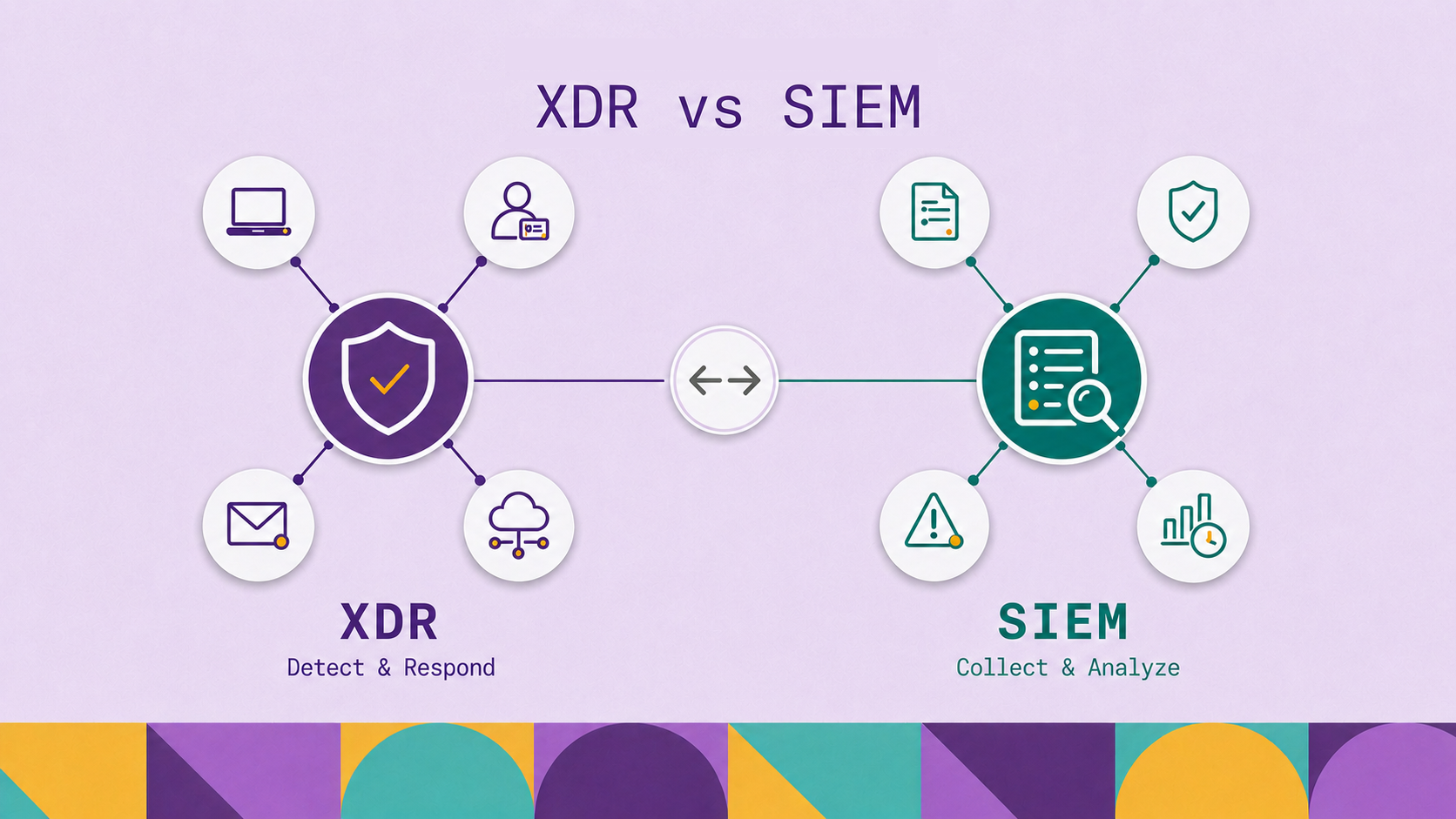
Extended detection and response (XDR) and security information and event management (SIEM) both help a security operations center find and investigate threats across more than one source. They differ in where that visibility comes from. XDR coordinates telemetry and response across a defined set of security controls, often endpoints, identities, email, cloud workloads, and network sensors. SIEM collects security-relevant events from across the organization, normalizes them, and provides a general platform for detection, search, investigation, retention, and reporting.
The categories now overlap. XDR platforms can ingest third-party data, SIEM platforms can automate response, and some vendors combine both in one operating experience. The useful comparison is architectural: which data each system holds, how tightly it connects to enforcement controls, and which workflows it owns.
What is XDR?
XDR is a security detection and response approach that correlates signals across multiple control domains. It extends the endpoint-centered model of endpoint detection and response (EDR) to identities, email, SaaS applications, cloud workloads, networks, and other parts of the attack surface. The exact coverage depends on the product and the controls connected to it.
The value comes from joining observations that are weak in isolation. A suspicious attachment reaches a mailbox, a process launches on the recipient's device, and the same identity authenticates from an unfamiliar source. XDR can group the related alerts and entities into one incident because its controls share telemetry and identity context.
XDR is also close to the systems that can act. Depending on the product and the organization's policy, response actions can isolate an endpoint, quarantine an email, disable an identity, block an indicator, or trigger a playbook. Microsoft's description of Defender XDR, for example, centers on coordinated detection, investigation, and response across endpoints, identities, email, and applications. That is one vendor implementation, not a universal XDR boundary, but it illustrates the category's control-oriented shape.
Products described as open XDR rely on third-party integrations to collect telemetry and execute response actions. The telemetry and actions available depend on each connector and its required data. Buyers therefore need to evaluate every connector as a detection and response path, not count integrations on a datasheet.
What is SIEM?
SIEM is the practice and platform for gathering security data from many systems and turning it into actionable information through a common interface. That broad definition matches the NIST glossary entry for a SIEM tool. In an operational deployment, the category includes collection, parsing, normalization, search, correlation, alerting, dashboards, investigation, and retention.
A SIEM is designed to ingest security-relevant records from across the organization: authentication and operating-system events, firewall and DNS logs, cloud audit trails, application logs, database activity, vulnerability findings, and alerts from security products. Normalization maps vendor-specific fields into a shared model so that analytics can operate across sources. For example, Microsoft Sentinel's ASIM documentation explains how normalized views support cross-source detections without requiring separate logic for every source schema.
Detection engineers use the resulting data for correlation rules, hunting queries, dashboards, and incidents. Analysts use it to reconstruct timelines and search historical evidence. Compliance teams also rely on SIEM retention and reports, although deploying a SIEM does not by itself make an organization compliant.
SIEM's breadth is its advantage and its operating cost. Connectors and normalization need maintenance, and detections need tuning as the environment changes. Storage economics matter because keeping every event at the same retention and performance tier is rarely sustainable. A mature SIEM program treats collection policy and detection content as engineering work.
XDR vs SIEM: key differences
The clearest distinction is the typical center of gravity. XDR begins with security controls and coordinates what they observe and can remediate. SIEM begins with security data and provides a broad analytical and operational layer over it.
Data scope. XDR concentrates on high-value telemetry and findings from its covered detection domains. SIEM accepts records from security controls and from systems that are not themselves security products, such as identity providers, business applications, cloud control planes, and databases.
Context depth. An XDR platform can expose detailed, product-native context about processes, mail messages, identities, and response state. A SIEM maps selected fields into a common schema so it can relate otherwise incompatible sources. Depending on the platform and ingestion path, analysts may also retain the original records and source-specific fields.
Response path. XDR is commonly integrated with controls capable of containment. SIEM coordinates response through cases, automation rules and SOAR playbooks, and product integrations. Both can automate actions, but the permissions, approval gates, and fidelity of each action depend on the deployment.
Retention, investigation, and compliance. SIEM commonly serves as the searchable record for investigations that span broad sources and long time windows, as well as the stronger fit for centralized evidence retention and security reporting. XDR is optimized around incidents and hunting across the telemetry its controls expose, while contributing incident and response records. Retention varies by platform and license, so it should be verified against the intended investigation and audit window rather than assumed from the category label.
Operational ownership. XDR can reduce the work of correlating alerts across a compatible control stack. SIEM gives detection teams more freedom to combine sources and author organization-specific analytics, but can add data-pipeline and content-maintenance work.
Neither category is automatically more advanced. An XDR incident can become an input to SIEM, while a SIEM detection can invoke an endpoint or identity response through supported integrations and automation. The right boundary follows the data and workflow, not the product name.
Features comparison: XDR vs SIEM
The table describes typical architecture, not a procurement shortcut. Modern platforms cross these lines. The SIEM failure modes are operational risks rather than fixed product properties: Microsoft documents volume-based ingestion costs and treats detection tuning as continuing work. A proof of concept should test whether an alert keeps its evidence, entities resolve across sources, response actions reach the right controls, and analysts can query the necessary time window.
When to choose XDR
Choose XDR when coordinated detection and containment across security controls is the immediate problem.
Your investigations begin with control alerts. If analysts pivot among endpoint, identity, email, and cloud consoles, XDR can assemble related signals and entities into a common incident.
Fast containment matters. An organization that has defined authority for automated or analyst-approved response benefits from a platform close to the controls. Isolating an endpoint or disabling an identity from the incident reduces handoffs, provided the action is governed and reversible.
The security stack has enough integration depth. XDR fits when the main controls share an ecosystem or verified third-party integrations expose the necessary telemetry and actions. This is a question of depth, not vendor count.
The team needs correlation without first building a broad data platform. A smaller SOC may prefer XDR's opinionated incidents and response workflows when it does not want to operate a general SIEM pipeline. It still needs to tune policy, validate automation, and cover sources outside the XDR boundary.
XDR is a weaker standalone choice when investigations depend on sources it cannot ingest deeply, or when it cannot satisfy long-retention and audit requirements. Those gaps favor pairing it with SIEM.
When to choose SIEM
Choose SIEM when broad data coverage, organization-specific analytics, and a durable security record are the primary requirements.
The environment is heterogeneous. Enterprises with several clouds, identity systems, security vendors, network zones, and custom applications need a source-agnostic place to relate events. SIEM connectors and normalization give detection engineers that common surface.
Custom detection engineering is central. A team writing correlation rules and hunting queries needs the underlying events, not only incidents a control vendor has formed. SIEM provides room to encode the organization's assets, trust boundaries, and expected behavior.
Historical search and evidence retention are load-bearing. Incident response, forensics, and audit work may require retention beyond what a particular XDR deployment provides. Depending on the platform, SIEM storage policies can place data in hot, warm, cold, or frozen storage according to its expected access pattern and required retention.
Several detection systems must feed one SOC workflow. Through supported connectors, SIEM can receive alerts from XDR, EDR, network detection and response (NDR), cloud security, and identity protection, then manage cases and automation across them. It gives the SOC a common queue and a place to correlate alerts with raw evidence.
The main caution is operational load. Collecting more data does not guarantee better detection. Teams need ownership for source onboarding, schema quality, access control, retention, detection testing, and rule retirement. Without that discipline, a SIEM becomes an expensive archive attached to a noisy alert queue.
Can XDR and SIEM work together?
Yes. In many environments, the combination is more coherent than asking either system to absorb every responsibility. XDR owns high-fidelity correlation and response across the controls it covers. SIEM supplies the wider event history, custom detections, cross-vendor evidence, and compliance record. Supported integrations can move incidents and context between the two systems.
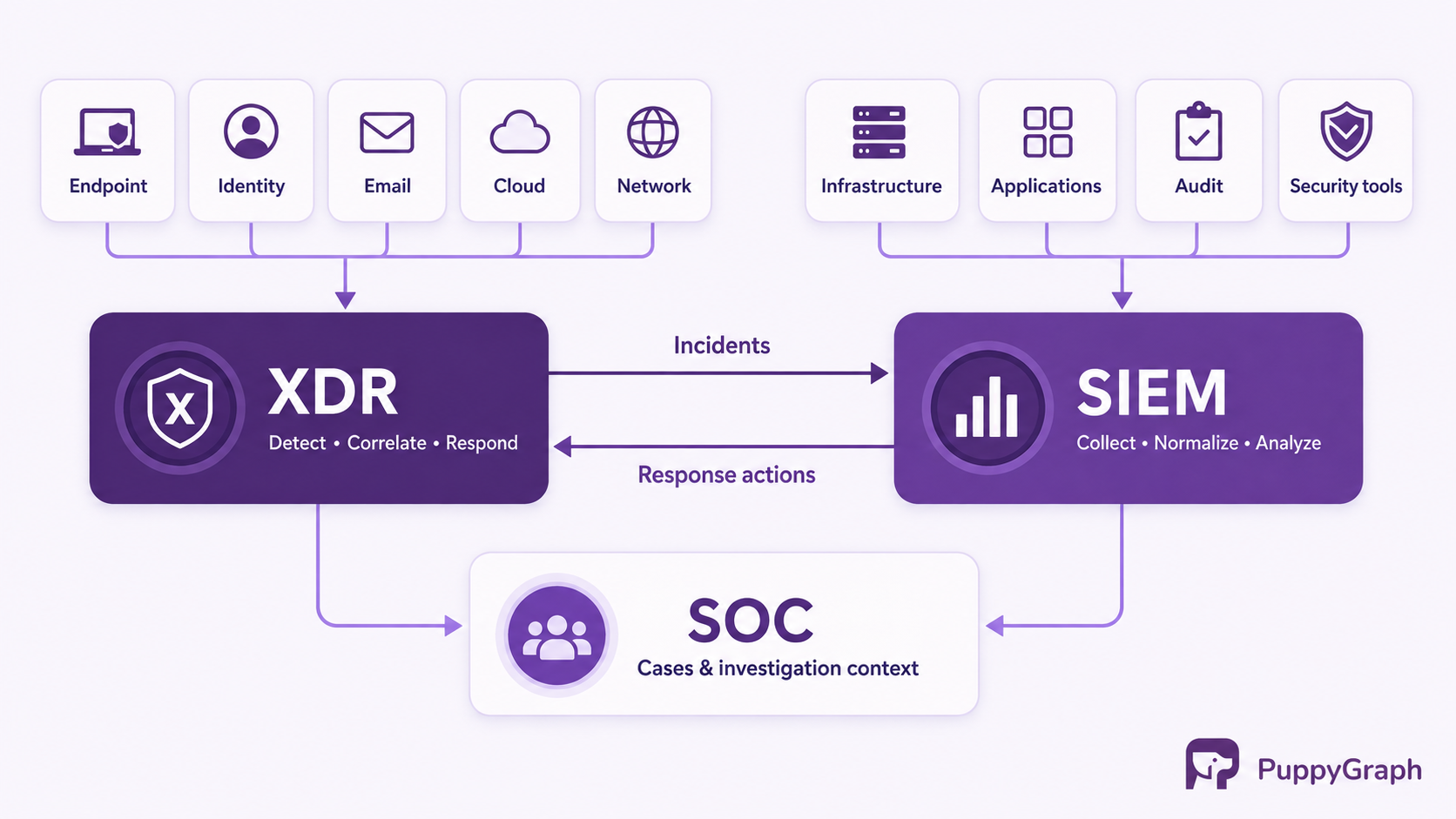
A concrete implementation of this pattern is the integration between Microsoft Defender XDR and Microsoft Sentinel. Microsoft's integration documentation says Defender XDR incidents and advanced hunting events can stream into Sentinel, with incidents synchronized and associated alerts and entities available for investigation. This shows that the categories can cooperate, not that every XDR and SIEM pair offers equivalent synchronization. Integration testing should cover identity mapping, duplicate incidents, status ownership, evidence retention, and failed response actions.
A shared security data lake can add another boundary. Security events land in a governed store using a common schema, while SIEM, XDR, and investigation tools consume the subsets they need. Amazon Security Lake's documentation, for example, describes central storage in Apache Parquet with the Open Cybersecurity Schema Framework (OCSF), plus subscriber access for incident response and analytics. Open storage does not remove normalization or governance work. That architecture can reduce dependence on a single analytics surface.
When an investigation combines an XDR incident with broader SIEM evidence, relationship-heavy questions can use a graph view over the same warehouse or lakehouse data. A user-defined schema in PuppyGraph maps existing tables for identities, assets, events, alerts, and vulnerabilities into nodes and edges, then PuppyGraph runs openCypher or Gremlin traversals in its own engine. With those entities and relationships defined in the schema, analysts can follow paths such as an identity to a device, to an alert, to a cloud resource without copying the tables into a separate graph database. PuppyGraph complements SIEM and XDR. It does not ingest event streams or run detection rules, and it does not replace the tools that produce the events or enforce response controls. The connection is at the storage layer when relevant security data already resides in a supported SQL database, data warehouse, or data lake.
The combined design works when ownership is explicit. One system should own incident status, every automated action needs an approval and audit model, and teams should decide which events warrant central retention. Otherwise, integration creates duplicate alerts and conflicting response state.
Conclusion
XDR and SIEM solve adjacent problems. XDR correlates across covered security controls and connects incidents to containment. SIEM collects a broader range of security events and supports custom detection, historical search, case workflows, retention, and reporting. Their overlap is real, but it does not erase the architectural distinction.
Choose XDR when the priority is coordinated detection and response across a compatible control stack. Choose SIEM when broad data coverage, custom analytics, and a durable security record matter most. Use them together when XDR can supply high-fidelity incidents and actions while SIEM provides the wider evidence and operating context.
Try the forever-free PuppyGraph Developer Edition and book a demo with the team to explore the identities, assets, events, and alerts already stored in warehouse and lakehouse tables as a graph, with no graph-specific ETL, alongside the XDR and SIEM workflows that detect and respond to threats.

Hao Wu is a Software Engineer with a strong foundation in computer science and algorithms. He earned his Bachelor’s degree in Computer Science from Fudan University and a Master’s degree from George Washington University, where he focused on graph databases.


