


Agent vs Agentless Security : Which is Best?
Every security tool that watches your environment has to make one architectural decision before it does anything else: does it run code inside the systems it protects, or does it observe them from the outside? That choice, agent or agentless, shapes everything downstream. It decides what the tool can see, how fast it sees it, what it costs to operate, how much of your fleet it can cover, and how it behaves when something breaks.
The debate is not academic. A modern security program runs endpoint detection and response (EDR), cloud security posture management (CSPM), vulnerability scanning, and workload protection across servers, containers, laptops, and cloud accounts, and each of those categories ships in agent-based, agentless, or hybrid form. Picking wrongly means either blind spots in coverage or a deployment that fights you on performance and maintenance. This post defines both models, lays out where they differ along the axes that matter (deployment, visibility, performance, scalability, compliance), walks through where each one earns its place, and closes on why the question is rarely “which one” and almost always “which one where.”
What is agent-based security?
Agent-based security installs a software component, the agent, directly on each protected system. The agent runs as a process or kernel module on the host, with local access to the things an outside observer cannot reach: live process trees, in-memory activity, system calls, file integrity, network connections as they open and close, and user sessions as they happen. It reports back to a central console and, in most modern tooling, can act locally to quarantine a file, kill a process, or isolate the host from the network.
This is the model behind EDR and extended detection and response (XDR), host-based intrusion detection, file integrity monitoring, and most runtime workload protection. Its defining property is presence: the agent is inside the trust boundary of the thing it watches, so it sees behavior rather than just state. An agentless scan can tell you a host has a vulnerable OpenSSL build installed. An agent can tell you that the vulnerable library was just loaded by a process that then spawned a shell and opened an outbound connection. That difference, state versus behavior, is the whole reason agents exist.
The cost of that presence is that someone has to deploy, update, and account for the agent on every system. The agent consumes CPU, memory, and disk on the host. It has to be compatible with the operating system and kernel version it runs on, and a bad agent update can degrade or crash the very systems it protects. Presence buys depth, and the bill for depth is operational weight.
What is agentless security?
Agentless security observes systems without installing anything on them. Instead of running code on the host, it collects data through interfaces that already exist: cloud provider APIs, snapshots of disk volumes, configuration metadata, network traffic, log streams, and read-only credentials into the platforms it inspects. A typical agentless CSPM tool authenticates to your AWS, Azure, or GCP account and reads the configuration of every resource through the provider’s API. A typical agentless vulnerability scanner takes a snapshot of a running volume and analyzes the package inventory offline, without ever touching the live workload.
The defining property here is reach without footprint. Because there is nothing to install, an agentless tool can cover an entire cloud estate, including resources nobody remembered to onboard, in the time it takes to grant it a role. It sees shadow IT, forgotten test accounts, and machines that no agent was ever deployed to. It does not consume host resources, it does not need kernel compatibility, and it cannot crash a workload with a bad update, because it is not in the workload.
What it gives up is the live, behavioral view. Agentless collection is mostly point-in-time: a snapshot or an API read reflects the state at the moment it ran, not the continuous stream of what the system is doing. It can find a misconfigured security group or an unpatched library, but it generally cannot watch a process inject into another process in real time. Reach without footprint comes at the cost of depth and immediacy.
Agent vs agentless security: key differences
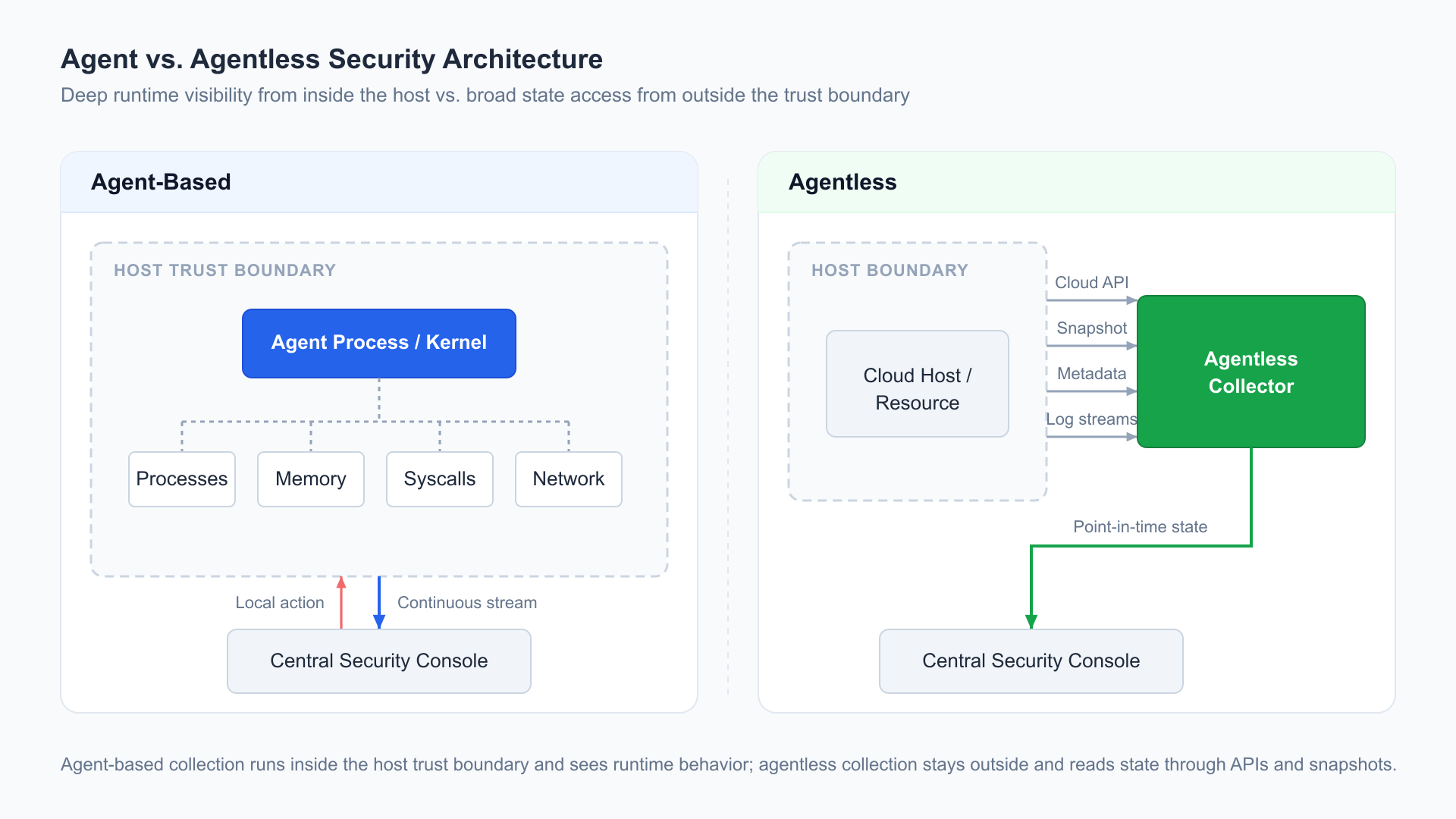
The two models trade off along a consistent set of axes. The table below lays them out, including the failure modes, which is where the choice often actually gets made.
The failure modes deserve emphasis because they are asymmetric. An agent that has stopped reporting looks identical to a host with nothing to report, so agent gaps tend to be silent until an incident exposes them. Agentless tools fail differently: the data is simply old, or an asset never appears because a permission was never granted. Neither failure announces itself, but they call for different operational hygiene. Agent fleets need health monitoring and version tracking; agentless deployments need permission audits and scan-freshness alerts. Choosing a model is also choosing which class of blind spot you are signing up to manage.
Advantages of agent-based security
Real-time detection and response. Because the agent is resident on the host, it sees activity as it happens and can act in the same moment. When a process exhibits ransomware-like behavior, an agent can kill it and isolate the machine before encryption spreads, rather than reporting the event after the next scan cycle. For runtime threats, lateral movement, and live intrusions, the continuous behavioral view is the difference between containment and forensics.
Depth of telemetry. Agents collect data that simply does not exist outside the host: in-memory injection, syscall sequences, parent-child process lineage, and local user activity. This is the raw material for behavioral detection and for mapping an attacker’s path through a single machine. Agentless collection can describe what is installed; only an agent can describe what is running and what it is doing.
Coverage of the gaps an API cannot reach. Air-gapped systems, on-premise servers with no cloud control plane, and workloads behind network boundaries that no central API enumerates are often reachable only by something running locally. Where there is no API to query, the agent is frequently the only option.
Enforcement, not just observation. An agent can hold a policy open on the host: block an action, require an integrity check, prevent an unsigned binary from executing. Agentless tooling observes and reports; in-line enforcement at the host generally requires presence on the host.
The through-line is that agents convert proximity into capability. By living inside the system, they get behavioral visibility and the ability to intervene, which is exactly what you want on the assets where a live attacker would do the most damage.
Advantages of agentless security
Speed and breadth of coverage. Granting a read-only role to a cloud account brings every resource in that account into view at once, with no per-host rollout. For a large or fast-changing estate, agentless coverage closes the gap between “we provisioned a new workload” and “security can see it” from weeks to minutes. It also surfaces the assets nobody onboarded, which is precisely where unmanaged risk accumulates.
No performance or stability cost on the workload. Because nothing runs on the protected system, there is no CPU or memory tax, no kernel compatibility matrix, and no risk that a security update destabilizes production. For latency-sensitive or tightly provisioned workloads, keeping the security tooling out of the host is a real operational benefit.
Lower operational overhead. There are no agents to deploy, patch, troubleshoot, or reconcile against an asset inventory. A small team can cover a large environment, because the maintenance burden scales with the number of integrations, not the number of hosts.
Comprehensive posture and compliance visibility. Agentless tools excel at the questions auditors and posture-management programs ask: which storage buckets are public, which databases lack encryption at rest, which identities have excess privilege, which hosts carry a known vulnerable package. These are state questions across the whole estate, and reading state across everything at once is exactly what the agentless model is built for.
The through-line here is that agentless tooling converts existing interfaces into coverage. By relying on APIs and snapshots that are already there, it achieves breadth and low friction, which is what you want for posture, inventory, and finding the assets that would otherwise go unwatched.
Compliance and scalability considerations
Compliance regimes care about both depth and completeness, and the two models satisfy those differently. Frameworks such as PCI DSS, HIPAA, and SOC 2 expect file integrity monitoring, audit logging of host-level activity, and evidence of runtime controls, all of which lean on agent-resident data. They equally expect complete asset inventory and configuration evidence across the environment, which is where agentless breadth carries the weight. Most mature programs end up drawing on both: agents for the runtime control evidence, agentless scans for the estate-wide posture evidence.
Scalability pulls in the same direction. Agent-based deployments scale with deployment and lifecycle automation, since every host is a unit of work to install, update, and monitor. Agentless deployments scale with API quotas, credential management, and scan scheduling, since the load moves to the collection pipeline rather than the fleet. In a cloud-native environment where workloads appear and disappear by the hour, agentless coverage keeps up with churn that agent rollout cannot match; in a fleet of long-lived, sensitive hosts, the per-host investment of an agent pays off. The scaling characteristics are not better or worse, they are shaped to different environments.
When the answer is both: unifying the data
In practice the choice is not binary, and the market has already converged on this. Cloud-native application protection platforms (CNAPP) deliberately combine agentless scanning for broad posture and inventory with optional agents for runtime protection on the workloads that need it. The agentless layer answers “what do we have and how is it configured,” and the agent layer answers “what is happening right now on the assets that matter most.” Used together, they cover each other’s blind spots: agentless reach finds the unmanaged asset, and the agent provides depth once it is brought under management.
Running both, though, leaves you with a data problem. Agents emit process and runtime telemetry. Agentless scanners emit configuration, vulnerability, and identity state. EDR, CSPM, and your asset inventory each hold a different slice of the same environment, in different schemas, in different stores. The question a responder actually needs to answer cuts across all of them: this host flagged by the agent for suspicious process activity, is it the same host the agentless scan found running a critical unpatched library, exposed to the internet through a misconfigured security group, and reachable from an identity with a path to production? Answering that means joining agent data to agentless data, and that join is where most programs stall, because the data lives in silos that were never designed to be queried together.
This is the natural place for a graph layer. Assets, identities, configurations, vulnerabilities, and runtime events are entities with relationships, and the questions security teams ask (attack paths, blast radius, lateral movement reachability) are graph traversals across those relationships. PuppyGraph adds a graph query layer over the tables where this data already lives, in your warehouse, lakehouse, or open table formats such as Iceberg, with no ETL and no separate graph database to load. Agent telemetry and agentless posture data that already land in those stores become nodes and edges you can traverse: a Host flagged by EDR, the Vulnerability an agentless scan found on it, the CloudResource it runs as, the Identity that can assume a role into it, the Network path that exposes it. A single openCypher query can then ask whether a runtime alert, a known vulnerability, and an exposed identity path all converge on the same asset, which is exactly the cross-source question neither an agent nor an agentless tool can answer on its own. PuppyGraph’s customers in cybersecurity include Palo Alto Networks, Datadog, Netskope, and Trend Micro. It complements the agent and agentless tools you already run; it does not replace any of them.
Conclusion
Agent and agentless security are not competitors so much as two ends of a trade-off between depth and reach. Agents give you behavioral visibility and the ability to act, at the cost of deployment weight and host footprint. Agentless tooling gives you broad, low-friction coverage and strong posture visibility, at the cost of the live, behavioral view. The right question is almost never “which is best in general,” but “which model fits this asset, this risk, and this operational constraint.” For most organizations the honest answer is both: agentless for breadth, inventory, and posture across the whole estate, and agents for runtime depth and enforcement on the assets where a live attacker would do the most harm.
What turns two partial views into one picture is being able to query them together. Try the forever-free PuppyGraph Developer Edition and book a demo with the team to see how openCypher and Gremlin queries run over warehouse and lakehouse tables, with no graph-specific ETL, joining agent and agentless security data into a single asset graph for attack-path and blast-radius analysis.

Sa Wang is a Software Engineer with exceptional mathematical ability and strong coding skills. He holds a Bachelor's degree in Computer Science and a Master's degree in Philosophy from Fudan University, where he specialized in Mathematical Logic.

Get started with PuppyGraph!


Developer Edition
- Forever free
- Single noded
- Designed for proving your ideas
- Available via Docker install
Enterprise Edition
- 30-day free trial with full features
- Everything in developer edition & enterprise features
- Designed for production
- Available via AWS AMI & Docker install