


AI Cybersecurity: How Artificial Intelligence Is Transforming
Artificial Intelligence (AI) is rapidly transforming the cybersecurity landscape as organizations face increasingly sophisticated and large-scale cyber threats. Traditional security approaches, which primarily rely on predefined rules and signature-based detection, often struggle to keep pace with modern attack techniques. At the same time, the expansion of cloud computing, remote work, IoT devices, and digital services has significantly increased the complexity of security operations.
To address these challenges, AI-powered cybersecurity solutions leverage machine learning, behavioral analytics, and automation to detect, analyze, and respond to threats more efficiently. By continuously learning from vast amounts of security data, AI can identify anomalous activities, improve threat detection accuracy, and support faster incident response. This article explores the fundamentals of AI cybersecurity, its underlying technologies, key applications, benefits, challenges, and its growing role in modern cyber defense.
What Is AI Cybersecurity?
AI cybersecurity refers to the application of artificial intelligence technologies to detect, prevent, analyze, and respond to cyber threats. Instead of relying solely on manually created rules or signature-based detection methods, AI systems learn from historical data and continuously adapt to new attack patterns.
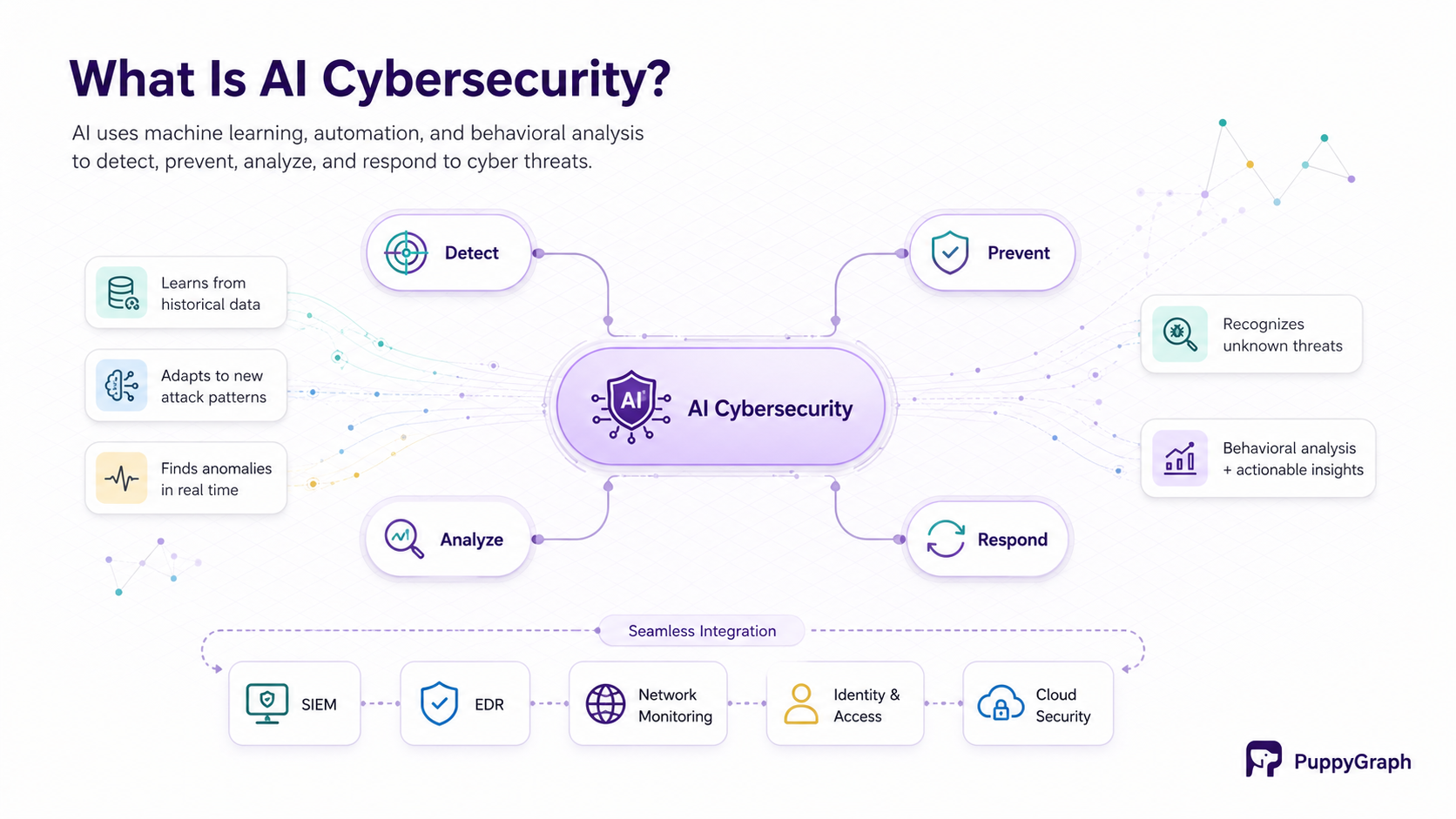
At its core, AI cybersecurity combines machine learning, data analytics, automation, and behavioral analysis to identify suspicious activities. These systems can process millions of security events in real time, uncover anomalies, and provide actionable insights to security teams.
Unlike traditional security software that typically identifies known threats, AI-powered platforms can recognize previously unseen attack techniques by examining deviations from normal behavior. This capability is particularly valuable as cybercriminals increasingly modify malware and exploit techniques to bypass signature-based defenses.
Modern AI cybersecurity solutions are commonly integrated into:
- Security Information and Event Management (SIEM) platforms
- Endpoint Detection and Response (EDR) tools
- Network monitoring systems
- Identity and access management platforms
- Cloud security solutions
As organizations expand their digital infrastructure, AI is becoming a foundational component of enterprise security architectures.
Why AI Is Becoming Essential for Modern Cybersecurity
The cybersecurity landscape has changed dramatically over the last decade. Organizations now operate across hybrid cloud environments, remote work infrastructures, mobile devices, IoT ecosystems, and third-party integrations. Each new technology introduces additional attack surfaces that security teams must monitor and protect.
The volume of security data generated daily has also grown exponentially. Large enterprises often produce billions of security events every day. Human analysts simply cannot review this amount of information manually. AI helps bridge this gap by processing data at machine speed and highlighting the events that require immediate attention.
Another significant factor is the cybersecurity talent shortage. Many organizations struggle to hire enough experienced security professionals. AI-powered automation can handle repetitive tasks such as log analysis, alert prioritization, and threat correlation, allowing analysts to focus on higher-value investigations and strategic security initiatives.
Attackers are also becoming more advanced. Sophisticated cybercriminal groups use automation, AI-assisted phishing campaigns, and rapidly evolving malware variants. To defend against these threats effectively, organizations increasingly rely on intelligent systems that can learn, adapt, and respond in real time.
How AI Cybersecurity Works
AI cybersecurity systems operate by collecting large volumes of security-related data and applying machine learning models to identify patterns, anomalies, and potential threats. These systems continuously analyze activity across networks, endpoints, applications, and user accounts.
A typical AI cybersecurity workflow looks like this:
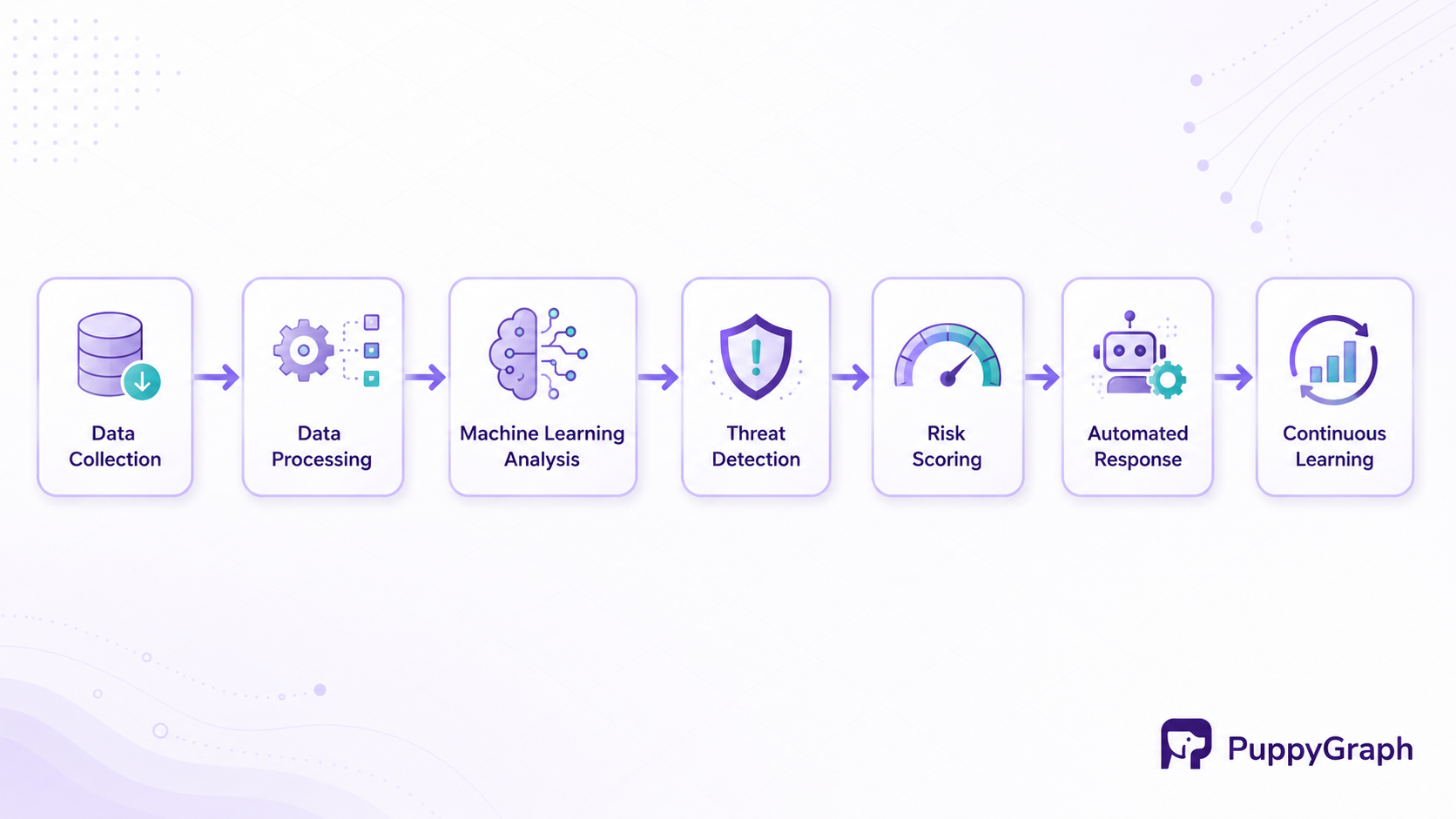
The process begins with data collection. Security logs, network traffic, endpoint telemetry, authentication records, and cloud activity are gathered from multiple sources. This information is then normalized and processed to create a consistent dataset.
Machine learning algorithms analyze the data to establish baseline behavior patterns. Once the baseline is established, the AI system identifies anomalies that may indicate malicious activity. For example, if an employee account suddenly accesses sensitive systems from an unusual geographic location at an abnormal time, the system may flag the activity for investigation.
Over time, the AI model continuously refines its understanding of normal behavior, improving detection accuracy and reducing false positives.
Key Technologies Behind AI-Powered Security
Machine Learning
Machine learning is the foundation of most AI cybersecurity platforms. These algorithms learn from historical data and improve performance without being explicitly programmed for every possible threat scenario.
Supervised learning models are trained using labeled datasets containing examples of malicious and legitimate activities. Unsupervised learning models identify anomalies by finding unusual patterns within large datasets, making them particularly effective for detecting unknown threats.
Deep Learning
Deep learning uses neural networks with multiple processing layers to analyze complex datasets. In cybersecurity, deep learning is often used for malware classification, threat intelligence analysis, and advanced behavioral detection.
Because deep learning models can identify subtle relationships within data, they are useful for detecting sophisticated attacks that may evade traditional security controls.
Natural Language Processing
Natural Language Processing (NLP) enables AI systems to understand and analyze human language. Cybersecurity platforms use NLP to process threat intelligence reports, vulnerability disclosures, phishing emails, and security documentation.
By extracting relevant information automatically, NLP helps organizations identify emerging threats more quickly and improve situational awareness.
Behavioral Analytics
Behavioral analytics focuses on understanding how users, devices, and applications typically behave within an environment. AI systems establish normal activity patterns and detect deviations that could indicate compromised accounts, insider threats, or malicious behavior.
This approach is especially effective because attackers often attempt to mimic legitimate users rather than exploit technical vulnerabilities directly.
AI vs Traditional Cybersecurity Approaches
Traditional cybersecurity solutions primarily rely on predefined rules, signatures, and manually configured policies. While these methods remain important, they often struggle to detect novel attacks that have not been previously documented.
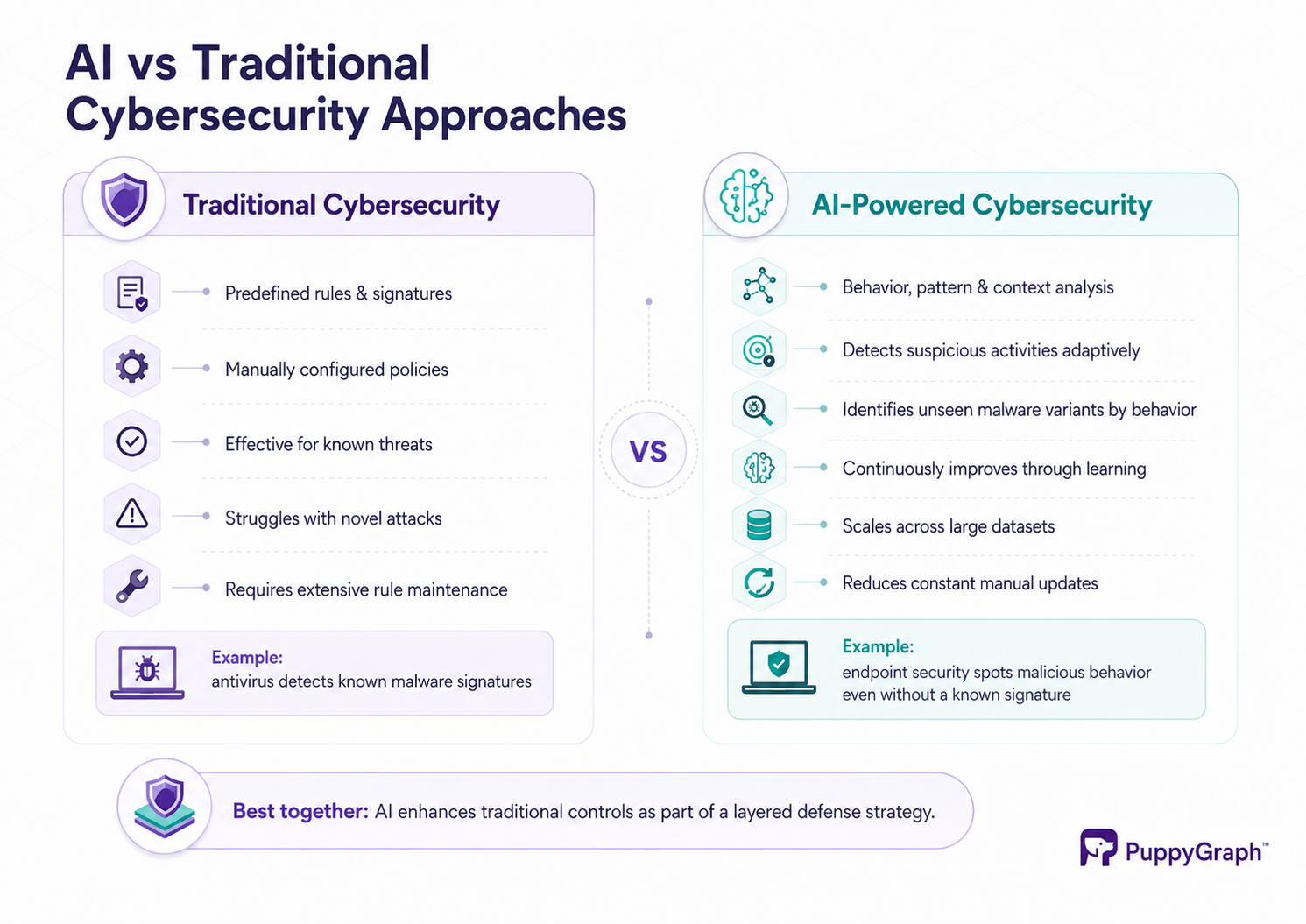
AI introduces a more adaptive approach. Rather than depending solely on known indicators of compromise, AI systems evaluate behaviors, patterns, and contextual information to identify suspicious activities.
For example, traditional antivirus software may detect malware only if it matches a known signature. An AI-powered endpoint security platform, however, can identify malicious behavior even when the malware variant has never been seen before.
Another major difference lies in scalability. Traditional approaches often require security teams to create and maintain extensive rule sets. AI systems automatically analyze large datasets and continuously improve through learning, reducing the need for constant manual updates.
While AI does not replace traditional security controls, it significantly enhances their effectiveness when used together as part of a layered defense strategy.
Major Benefits of AI in Cybersecurity
Faster Threat Detection
Speed is critical in cybersecurity. The longer a threat remains undetected, the greater the potential damage. AI can analyze enormous volumes of data in seconds, enabling organizations to identify suspicious activities far more quickly than manual processes.
Real-time threat detection reduces dwell time and helps security teams contain incidents before attackers achieve their objectives.
Improved Accuracy
One of the biggest challenges in cybersecurity operations is alert fatigue. Security analysts often receive thousands of alerts daily, many of which are false positives.
AI systems improve detection accuracy by correlating events, analyzing context, and prioritizing the most relevant threats. This allows analysts to focus on genuine security incidents rather than investigating large numbers of benign alerts.
Enhanced Incident Response
AI-powered automation can initiate predefined response actions immediately after detecting a threat. Examples include isolating infected endpoints, disabling compromised accounts, blocking malicious IP addresses, and escalating high-risk incidents.
These automated responses significantly reduce the time required to contain security breaches.
Better Threat Intelligence
AI can aggregate and analyze information from multiple threat intelligence sources, identifying trends and emerging attack techniques. This enables organizations to stay ahead of evolving threats and make more informed security decisions.
Scalability
As organizations grow, security operations become increasingly complex. AI provides the scalability needed to monitor large environments without requiring proportional increases in personnel or resources.
Common AI Cybersecurity Use Cases
Threat Detection and Monitoring
One of the most common applications of AI is continuous threat monitoring. AI systems analyze network traffic, endpoint activity, cloud workloads, and authentication events to identify potential security incidents.
Organizations use these capabilities to detect malware infections, unauthorized access attempts, suspicious lateral movement, and data exfiltration activities.
Phishing Detection
Phishing remains one of the most successful attack vectors. AI-powered email security solutions analyze message content, sender behavior, URLs, and communication patterns to identify phishing attempts.
Advanced systems can detect phishing campaigns that bypass traditional spam filters by examining subtle linguistic and behavioral indicators.
Fraud Detection
Financial institutions frequently use AI to detect fraudulent transactions. Machine learning models analyze transaction histories, user behavior, and contextual information to identify anomalies that may indicate fraud.
The same techniques are increasingly applied in broader cybersecurity contexts, including account takeover prevention and identity protection.
Endpoint Security
Modern endpoint detection and response platforms rely heavily on AI. These solutions continuously monitor device activity, identify malicious behaviors, and automate containment actions when threats are detected.
AI-driven endpoint protection is particularly effective against ransomware and fileless malware attacks.
Vulnerability Management
AI can help prioritize vulnerabilities by evaluating exploitability, asset criticality, and threat intelligence data. Rather than treating all vulnerabilities equally, organizations can focus remediation efforts on the issues that present the highest risk.
How Attackers Are Using AI
While defenders benefit from AI, cybercriminals are also leveraging the technology to enhance their capabilities. This growing trend is creating a new generation of AI-powered cyber threats.
AI enables attackers to generate highly convincing phishing emails that mimic human communication styles. Generative AI tools can create personalized messages tailored to specific targets, increasing the likelihood of successful social engineering attacks.
Attackers also use AI to automate reconnaissance activities. Machine learning systems can analyze publicly available information, identify potential vulnerabilities, and prioritize targets more efficiently than manual methods.
Deepfake technology represents another emerging threat. AI-generated audio and video can impersonate executives, employees, or trusted individuals, enabling sophisticated fraud and social engineering schemes.
Additionally, cybercriminals may use AI to modify malware dynamically, helping it evade traditional detection mechanisms. As AI capabilities continue to advance, defenders must adapt accordingly to counter increasingly intelligent threats.
Challenges and Risks of AI Cybersecurity
Despite its advantages, AI cybersecurity is not without limitations. Organizations must understand these challenges before relying heavily on AI-driven security systems.
One major concern is data quality. Machine learning models depend on accurate and representative training data. Poor-quality datasets can result in ineffective threat detection and increased false positives or false negatives.
Model bias is another challenge. If training data contains biases or gaps, AI systems may make incorrect decisions or fail to identify certain threat types effectively.
Adversarial attacks present an additional risk. Researchers have demonstrated that attackers can manipulate machine learning models by introducing specially crafted inputs designed to deceive AI systems. These techniques may cause models to misclassify malicious activities as legitimate.
Privacy and compliance concerns also arise when AI systems process sensitive user information. Organizations must ensure that data collection and analysis practices comply with applicable regulations such as GDPR, CCPA, and industry-specific requirements.
Finally, AI should not be viewed as a replacement for human expertise. Security analysts remain essential for interpreting complex incidents, validating AI findings, and making strategic decisions during security events.
Best Practices for Implementing AI in Cybersecurity
Organizations seeking to deploy AI cybersecurity solutions should approach implementation strategically rather than treating AI as a standalone solution.
The first step is establishing a strong security data foundation. AI systems require comprehensive, high-quality data from across the organization's infrastructure. Incomplete or inconsistent data can significantly reduce model effectiveness.
Security teams should also integrate AI with existing tools and workflows. AI performs best when combined with SIEM platforms, endpoint security solutions, threat intelligence feeds, and incident response processes.
Regular model evaluation is equally important. Threat landscapes evolve continuously, and machine learning models must be monitored, retrained, and updated to maintain effectiveness. Organizations should establish governance processes for AI performance assessment and validation.
Human oversight remains critical. Analysts should review AI-generated recommendations, investigate high-priority alerts, and continuously refine detection strategies based on operational experience.
Organizations should also prioritize transparency and explainability. Security teams need to understand why AI systems generate specific alerts or recommendations to build trust and improve decision-making.
A successful AI cybersecurity strategy combines intelligent automation with experienced human judgment, creating a balanced approach that maximizes both efficiency and effectiveness.
Beyond Detection: Giving AI Security Systems Semantic Context
As AI becomes more deeply embedded in cybersecurity workflows, organizations face a challenge that extends beyond threat detection itself. Modern security environments generate enormous volumes of data from endpoints, networks, cloud services, identity systems, vulnerability scanners, and threat intelligence feeds. While AI can analyze this information at scale, understanding how these data points relate to one another remains difficult.
Many cybersecurity platforms still operate on fragmented datasets stored across multiple systems. Security logs, asset inventories, user identities, vulnerabilities, and business applications often exist in separate repositories with different schemas and naming conventions. Although these systems contain valuable information individually, the relationships between them are frequently implicit rather than explicitly defined.
This creates a significant challenge for both human analysts and AI systems. A security alert may involve a user account, an endpoint, a cloud workload, and several network connections, but determining how these entities are related often requires manual investigation across multiple tools. As organizations increasingly deploy AI assistants, autonomous SOC workflows, and agentic security platforms, providing consistent semantic context becomes just as important as collecting security data itself.
A semantic layer helps bridge this gap by organizing security information around meaningful entities and relationships rather than isolated data records. Instead of treating logs, alerts, assets, and identities as disconnected objects, a semantic model enables AI systems to understand how they interact within the broader security environment.
The Role of a Semantic Layer
A semantic layer sits above existing security data sources and exposes meaningful security concepts directly, such as User, Device, Application, Vulnerability, Alert, or Threat Actor. Instead of forcing applications or AI systems to reason through disconnected logs and raw records, the semantic layer provides a higher-level logical model aligned with how security teams understand their environments.
This allows analysts, security tools, and AI agents to work with security data more naturally without requiring organizations to replace existing security infrastructure.
Ontology and Ontology Enforcement
At the core of many semantic layers is an ontology, a formal definition of entities, relationships, and rules across the security environment. An ontology defines:
- what entities exist,
- how they relate to one another,
- and what relationships are valid.
For example, a User may access a Device, a Device may host an Application, an Application may contain a Vulnerability, and a Threat Actor may exploit that vulnerability. These relationships provide the contextual foundation needed for accurate security analysis.
Ontology enforcement ensures that queries, correlations, and AI-generated actions respect these rules. Whether data originates from security tools, analysts, automated workflows, or AI agents, operations are validated against the semantic model to prevent inconsistent interpretations and incorrect conclusions.
Why It Matters: From Security Noise to Security Context
Without a semantic layer, much of the complexity of cybersecurity remains buried within individual tools and disconnected datasets. Security teams must manually correlate alerts, asset information, identity records, and threat intelligence to understand the full context of an incident.
For AI systems, this challenge is even greater. Large language models and autonomous security agents can become trapped in a form of semantic noise, where isolated events appear meaningful individually but lack the contextual relationships necessary for accurate reasoning. An AI system may successfully identify anomalous behavior yet fail to understand its true significance within the broader attack chain.
Ontology enforcement provides a semantic foundation that helps AI systems reason more accurately about security events. By defining valid relationships between users, assets, applications, vulnerabilities, and threats, the ontology acts as a guardrail that improves consistency and reduces the risk of incorrect conclusions.
It also creates opportunities for continuous improvement. Rather than returning only technical errors or disconnected alerts, ontology-aware systems can provide structured feedback about why a correlation, recommendation, or automated action conflicts with established security relationships. This feedback can help AI systems refine their behavior through iterative correction, improving decision-making in increasingly autonomous security operations. Over time, it can also serve as a valuable source of training signals for fine-tuning or reinforcement learning, helping models better align with security-specific reasoning and operational constraints.
Security Investigation with AI Assistants
Moving beyond detection and alerting, PuppyGraph provides a graph-based way to connect and query existing security data without requiring organizations to migrate everything into a native graph database. By transforming security data into connected knowledge, PuppyGraph enables analysts and AI systems to investigate relationships across users, devices, applications, vulnerabilities, and threats in a unified view.
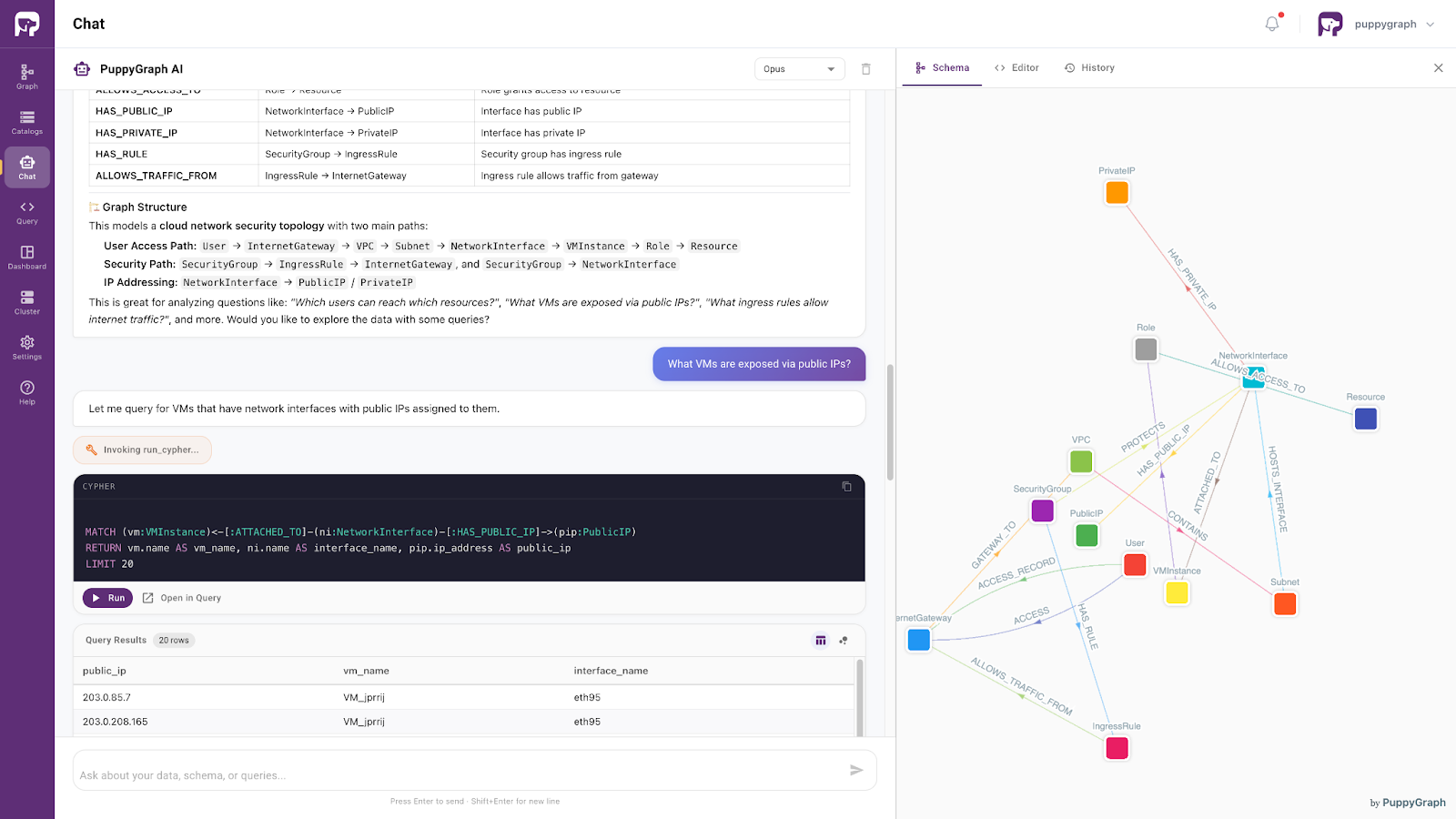
Figure: PuppyGraph AI assistant supporting security investigations through natural language interaction
Powered by the same ontology-enforced foundation, this approach allows AI assistants to interpret security questions within a well-defined semantic framework and retrieve relevant context accordingly. Analysts can move from isolated alerts to relationship-aware investigations, while AI agents gain a more complete understanding of the security environment.
As a result, security data evolves from a collection of disconnected records into an actionable knowledge layer that supports threat hunting, incident response, risk analysis, and next-generation AI-driven cybersecurity operations.
Conclusion
Artificial intelligence has become a critical component of modern cybersecurity, enabling organizations to detect threats faster, improve response times, and manage increasingly complex security environments. Through technologies such as machine learning, behavioral analytics, and automation, AI enhances traditional security approaches by identifying both known and previously unseen threats. As cyberattacks continue to evolve, AI-driven security solutions will play an increasingly important role in strengthening cyber resilience and supporting security teams at scale.
However, effective cybersecurity requires more than intelligent threat detection alone. As AI systems become more autonomous, they also need access to accurate contextual understanding of security data. Semantic layers and ontology-based approaches help provide this context by connecting disparate security information into a unified knowledge framework. By combining AI capabilities with structured security knowledge and human expertise, organizations can build more effective, explainable, and adaptive cyber defense strategies for the future.
Explore the forever-free PuppyGraph Developer Edition, or book a demo to see how ontology-enforced graph intelligence gives AI-powered security operations the context needed for faster investigations, more accurate threat analysis, and smarter decision-making.

Hao Wu is a Software Engineer with a strong foundation in computer science and algorithms. He earned his Bachelor’s degree in Computer Science from Fudan University and a Master’s degree from George Washington University, where he focused on graph databases.

Get started with PuppyGraph!


Developer Edition
- Forever free
- Single noded
- Designed for proving your ideas
- Available via Docker install
Enterprise Edition
- 30-day free trial with full features
- Everything in developer edition & enterprise features
- Designed for production
- Available via AWS AMI & Docker install