


The 7 Best AI Cybersecurity Tools in 2026
The interesting question in security tooling is no longer whether a product uses AI. Nearly every endpoint, network, and SOC platform now ships a model of some kind, so “AI-powered” on a data sheet tells you almost nothing. The question worth asking in 2026 is what the AI actually does: whether it detects by learning a baseline or by matching known patterns, whether it investigates an alert end to end or just ranks a queue, and whether it reasons over the relationships in your environment or only over the single event in front of it. Those differences decide whether a tool reduces analyst load or adds another noisy dashboard.
This post walks through seven AI cybersecurity tools that represent distinct answers to that question, spanning endpoint defense, network detection, malware analysis, and the agentic SOC. We start with what an AI-powered security tool is, the factors that actually separate one from another, then go tool by tool with an honest description and one limitation each. A comparison table and a short note on where AI in security is heading close out the post.
What are AI-powered cybersecurity tools?
An AI-powered cybersecurity tool is security software whose core detection, investigation, or response logic is driven by machine learning rather than by static rules and signatures alone. The distinction matters because the two approaches fail in opposite ways. A signature-based control catches what it has seen before and misses novel variants; a learning-based control reasons about what looks abnormal or malicious without an exact prior match, at the cost of producing probabilistic answers that need tuning and explanation.
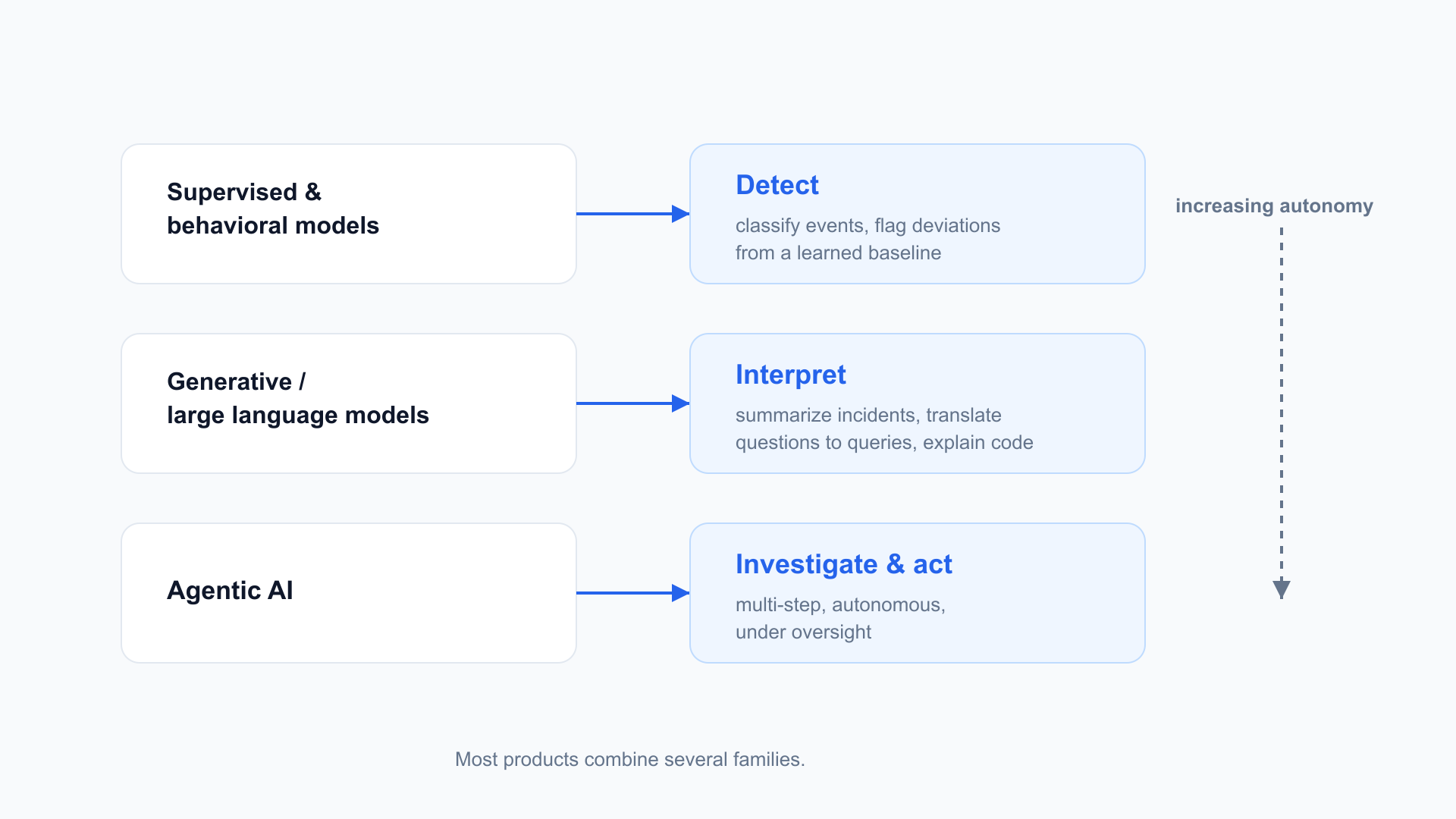
In practice the AI inside these tools falls into a few families, and most real products combine several.
Supervised and behavioral models classify events as malicious or benign from labeled training data, or flag deviations from a learned baseline of normal behavior. This is the engine under most modern endpoint detection, user and entity behavior analytics, and network anomaly detection. Its strength is catching attacks that have no signature; its weakness is that “abnormal” and “malicious” are not the same thing, which is where false positives come from.
Generative and large language models arrived in security operations more recently. Their job is usually not detection but interpretation: summarizing an incident, translating a natural-language question into a query, drafting a report, or explaining what a piece of code does. They compress the time an analyst spends reading and writing, which is a large fraction of SOC work.
Agentic AI is the 2026 frontier and the reason the category is shifting under everyone’s feet. An agent does not just answer a question; it decides which questions to ask, gathers the evidence, and carries an investigation through multiple steps the way a human analyst would. Most of the platforms below now market an agentic capability of some kind, and the quality of an agent is bounded by the context it can reach, a point we return to at the end.
Across these families, the tasks AI security tools take on are familiar SOC work: threat detection and prioritization, malware analysis and reverse engineering, alert triage and investigation, continuous monitoring across endpoints and networks, and the broader enterprise defense that ties them together. What changes is who or what does the first pass. The throughline of every tool below is moving the routine first pass from a human to a model, so that scarce analyst attention lands on the small fraction of events that genuinely warrant it.
Key factors to evaluate cybersecurity AI tools
Marketing language flattens these tools into a single “AI-driven” claim. The factors below are what actually separate them once you get past the data sheet, and they are the questions worth taking into a proof of value.
Detection approach. Ask what the model is trained on and what it is looking for. Self-learning anomaly detection builds a baseline from your own environment and flags deviations, which catches novel attacks but needs a learning period and careful tuning. Models trained on large external threat corpora generalize across customers but know less about what is normal for you specifically. Signature and rule layers still matter for known threats. Most strong products blend all three; the question is which one carries the weight for the threats you care about.
Data coverage and integration. An AI model is only as good as the telemetry it sees. A tool confined to endpoint data cannot reason about a network-borne lateral movement; a network tool is blind to what happens inside a process. Evaluate which domains a tool ingests (endpoint, network, identity, cloud, email, SaaS) and how cleanly it integrates with the sources you already run, because gaps in coverage become blind spots in detection.
Level of autonomy. There is a real spectrum from assistive to agentic. Some tools surface a prioritized queue and leave the investigation to you; some draft an investigation you approve; some run the investigation autonomously and act on it under human oversight. More autonomy saves more time but raises the stakes on accuracy and on how reversible the tool’s actions are. Match the autonomy level to your tolerance for an automated containment that occasionally fires on a false positive.
Explainability and false positive economics. A model that flags a threat without showing its reasoning forces analysts to redo the investigation to trust it, which erases the time savings. The tools that hold up in production explain why they reached a verdict in terms an analyst can verify, and they are honest about their escalation rate, the fraction of alerts they hand back to a human.
Deployment model and data cost. Cloud-native, self-hosted, or hybrid is partly a compliance and data-residency decision and partly an economic one. For platforms that ingest and retain large volumes of telemetry, the data pipeline (what you ingest, how long you keep it, how it is priced) is frequently the dominant line item, often larger than the detection capability itself.
Context and correlation across your environment. The hardest security questions are relational, not point lookups. “This alert fired on a host: who owns it, what identities can reach it, what is it connected to, and what is the blast radius if it is compromised?” is a multi-hop question that spans asset inventory, identity, and access data. Many tools detect the event well but cannot answer the relationship question because the relevant data lives in separate systems. The more your detection stack leans on AI, and especially on autonomous agents, the more this connective context determines whether the AI reaches a correct conclusion or a confident wrong one. We return to this factor at the end, because it is the one the tools in the list tend to address least.
No single tool scores highest on all six factors, and the weighting depends on your environment. A Microsoft-centric SOC weights integration differently than a malware-analysis team weights reverse-engineering depth. Treat the list below as a set of distinct strengths to map against these factors, not as a ranking.
Top 7 AI cybersecurity tools for 2026
The seven tools below are not interchangeable; they sit at different layers of the stack and optimize for different jobs. Several can coexist in the same SOC. Each entry describes what the tool is, the mechanism behind its AI, what it is best at, and one honest limitation.
1. CrowdStrike Falcon
CrowdStrike Falcon is a cloud-native endpoint and extended detection and response platform, and one of the most widely deployed enterprise security platforms in operation. Its AI story has two layers: the detection engine that powers endpoint protection, and Charlotte AI, the platform’s agentic analyst layer.
The detection side combines behavioral indicators of attack with machine learning to stop both known malware and novel, fileless techniques at the endpoint, with telemetry centralized in the cloud for cross-host correlation. Charlotte AI sits on top as an agentic layer: Charlotte AI Agentic Response runs the investigative questions a seasoned analyst would ask, reconstructs root cause, and maps lateral movement, while Charlotte Agentic SOAR orchestrates response actions under analyst command. CrowdStrike has also opened this up with AgentWorks, a no-code environment for building custom security agents on the platform.
Falcon is best for enterprises that want endpoint and XDR as the backbone of their defense and want the agentic tooling tied directly to that telemetry. The honest limitation is gravitational: Charlotte AI and the agentic features deliver the most value when the surrounding estate is already on Falcon, so the platform rewards consolidation onto CrowdStrike more than it rewards a best-of-breed mix.
2. SentinelOne Singularity
SentinelOne Singularity is an autonomous endpoint and XDR platform built around on-agent AI that detects and remediates without waiting on cloud lookups. Its analyst-facing AI is Purple AI, positioned as an AI security analyst over the Singularity Data Lake.
The endpoint engine models process behavior on the device and can autonomously kill, quarantine, and roll back malicious activity, which is the capability the product is best known for. Purple AI adds an agentic layer on top of the broader platform: it translates natural-language questions into threat-hunting queries across native and third-party data, runs autonomous hunts, and summarizes incident forensics, with human-in-the-loop checkpoints. SentinelOne has extended this toward the autonomous SOC with its AI SIEM and Auto Investigation, which run triage and investigation across ingested data rather than endpoint telemetry alone.
Singularity is best for teams that want strong autonomous endpoint response and natural-language-driven hunting in one platform. The limitation is that the platform is newer to the SIEM and broad-data-lake role than incumbents, so organizations adopting it as a full SOC backbone rather than as endpoint protection are betting on a still-maturing ecosystem.
3. Darktrace
Darktrace takes a distinct approach: rather than train on a corpus of known attacks, its Self-Learning AI builds a baseline of normal behavior for each organization from that organization’s own data, then flags activity that deviates from the learned norm. The design premise is that an attack does not need to match a prior signature to look anomalous against a well-modeled baseline.
The platform spans network, email, cloud, and identity, and layers two AI capabilities on the baseline. Cyber AI Analyst runs autonomous investigations, correlating activity across the environment and generating natural-language reports, which reduces the manual triage burden. Autonomous Response provides targeted containment, taking proportionate action (or integrating with firewalls and other controls) to neutralize a threat while letting normal business operations continue.
Darktrace is best for organizations that want to catch novel and insider threats that signature-based tools miss, and that value autonomous containment. The limitation is the flip side of unsupervised anomaly detection: a baseline derived from your environment can learn malicious activity as normal if it is present during the learning period, and anomaly does not always mean malicious, so tuning to suppress benign-but-unusual behavior is ongoing work.
4. Microsoft Security Copilot
Microsoft Security Copilot is a generative-AI layer that sits across the Microsoft security stack, including Defender, Sentinel, Entra, Intune, and Purview. It is less a detection engine than an interpretation and automation layer over the signals those products already generate.
Its 2026 form is increasingly agentic. Beyond answering natural-language questions and summarizing incidents, Security Copilot now ships purpose-built agents embedded in the flow of work: an alert triage agent that autonomously works through alert queues, a threat intelligence briefing agent, and a phishing triage agent in Defender, alongside partner-built agents. These agents take on the repetitive first-pass work of triage and enrichment, handing analysts a smaller, contextualized set of decisions.
Security Copilot is best for Microsoft-centric enterprises, where its access to first-party signals across identity, endpoint, email, and cloud is deepest and the integration is tightest. The limitation is the mirror image of that strength: its value drops outside the Microsoft ecosystem, and as a layer over Microsoft’s detection products rather than an independent detector, it inherits both the coverage and the blind spots of the underlying stack.
5. Vectra AI
Vectra AI is an AI-driven network detection and response platform that extends across network, identity, and cloud. Its core idea, branded Attack Signal Intelligence, is to model attacker behavior rather than known signatures, prioritizing the handful of behaviors that indicate an attack in progress out of the flood of raw alerts.
Mechanically, Vectra applies behavioral models to detect the techniques attackers use after they are inside (lateral movement, privilege misuse, command-and-control, and data exfiltration) and correlates them rather than reporting them in isolation. Notably, the platform exposes an attack graph: a unified, stitched view of attacker behavior across the network that maps an intrusion from initial access through lateral movement and privilege abuse. That graph framing is a useful illustration of a broader point this post returns to, that the most valuable security questions are about how entities and events connect, not about events in isolation.
Vectra is best for SOCs whose blind spot is east-west network and identity activity that endpoint tools cannot see, and that struggle with alert volume. The limitation is scope: Vectra is a detection-and-prioritization layer, strongest when paired with endpoint and response tooling that acts on the signals it surfaces, rather than a complete prevention-to-response stack on its own.
6. Palo Alto Cortex XSIAM
Palo Alto Cortex XSIAM (Extended Security Intelligence and Automation Management) is an AI-driven SOC platform that converges what used to be separate products: SIEM, SOAR, XDR, attack surface management, and identity threat detection in one architecture. The premise is that a SOC built from stitched-together point products spends too much human effort moving data and context between them, and that an integrated, ML-led platform can automate most of that.
The mechanism is data centralization plus analytics: XSIAM ingests broad security telemetry, applies a large library of machine-learning models to detect threats, and stitches related alerts into incidents for automated triage and, where appropriate, automated response. The goal is to compress the alert-to-incident-to-response pipeline so analysts handle exceptions rather than every alert.
Cortex XSIAM is best for organizations pursuing SOC consolidation, replacing a legacy SIEM and several adjacent tools with one automation-first platform. The limitation is that it is a converged platform rather than a point solution, so it delivers the most value as a committed SOC backbone, and like most consolidation plays it is strongest for teams willing to standardize on the Palo Alto ecosystem.
7. Intezer
Intezer occupies a narrower and deeper slot than the platforms above: autonomous alert investigation grounded in malware analysis. Its differentiator is Genetic Malware Analysis, a technique that dissects files and software at the binary level and identifies reused code, classifying a sample by its genetic similarity to previously seen malicious or trusted code rather than by behavior or signatures alone.
Built on that foundation, Intezer’s autonomous SOC platform automates the triage and investigation of alerts across endpoint, identity, cloud, phishing, and network sources. For each alert it performs the kind of deep analysis a reverse engineer would, including assessing suspicious files and code, then correlates findings and escalates only the small fraction that represent a real threat, with the rest resolved automatically. This positions it as an automated tier-1 analyst that is particularly strong on the malware-analysis questions other tools hand off to a specialist.
Intezer is best for teams drowning in alert volume that want every alert investigated rather than sampled, and for SOCs that lack in-house reverse-engineering depth. The limitation is focus: Intezer is an investigation and triage layer that sits on top of your existing detection sources, not a detection or prevention tool in its own right, so it amplifies a SOC’s analysis capacity rather than replacing the controls that generate the alerts.
Comparison at a glance
Read down the columns rather than across the rows. The “primary layer” column shows that these tools are not really competitors so much as occupants of different floors of the same building: endpoint, network, investigation, and the converged platform that tries to own several floors at once. The “watch out for” column is the one most comparison tables omit, and it is the one that separates a tool you would actually deploy from a feature list that reads well.
Benefits of AI in cybersecurity
Stepping back from individual products, the case for AI in security operations rests on a few benefits that the tools above all reach for in different ways.
Detection of threats that have no signature. Behavioral and self-learning models catch novel malware, fileless techniques, and insider misuse that signature-based controls miss by construction. This is the original and still the strongest argument for AI in security: the threat landscape produces variants faster than signatures can be written.
Compression of the alert-to-decision pipeline. The defining problem of the modern SOC is volume: more alerts than analysts can investigate, which produces fatigue and missed signal. AI triage, correlation, and investigation move the routine first pass off humans, so that scarce analyst attention concentrates on the small fraction of events that are genuinely ambiguous or serious. Stitching related alerts into incidents, as the converged platforms do, attacks the same problem from the correlation side.
Speed and consistency at machine scale. An autonomous investigation runs in seconds and applies the same rigor to the thousandth alert as to the first, which is something a tired analyst at hour seven of a shift cannot do. As response moves from assisted to agentic, that consistency extends from investigation into containment.
Accessibility of expert analysis. Generative interfaces let an analyst ask a question in plain language instead of writing a query, and genetic or forensic analysis brings reverse-engineering-grade insight to teams that have no reverse engineer. AI lowers the expertise floor required to get a good answer.
There is a constraint that runs underneath all four benefits, and it is the factor the tools in the list address least. Every one of these benefits depends on the AI reasoning over good context, and as the SOC shifts toward autonomous agents, the context an agent can reach becomes the ceiling on how reliable it is. An agent investigating an alert reaches a sound conclusion only if it can answer the relational questions around that alert: which asset is this, who owns it, what identities can reach it, what is it connected to, and what is reachable from it if it falls. That information is rarely in the alert. It lives across asset inventories, identity providers, CMDBs, and access logs, usually as separate tables in a warehouse, lake, or open table format. A model that cannot traverse those relationships will answer confidently from the single event in front of it, which is exactly how an autonomous agent produces a fluent wrong answer.
This is the gap a graph layer fills, and it is where PuppyGraph fits alongside the detection tools above rather than competing with them. PuppyGraph is a graph query engine that runs over your existing tables in a warehouse, lake, or open table format such as Iceberg, with no ETL and no separate graph database to load and maintain. You define a graph schema over the asset, identity, access, and alert tables you already have, and analysts and AI agents then traverse those relationships directly. The multi-hop question that no single detection tool can answer, what a breach actually exposes once you follow the connections, becomes a single query:
MATCH (sg:SecurityGroup)-[:PROTECTS]->(ni:NetworkInterface)-[:ATTACHED_TO]->(vm:VMInstance)
      -[:ASSIGNED_ROLE]->(r:Role)-[:ALLOWS_ACCESS_TO]->(res:Resource)
RETURN sg.name AS compromised_security_group,
       count(DISTINCT vm) AS affected_vms,
       count(DISTINCT r) AS affected_roles,
       count(DISTINCT res) AS accessible_resources
ORDER BY accessible_resources DESC
LIMIT 20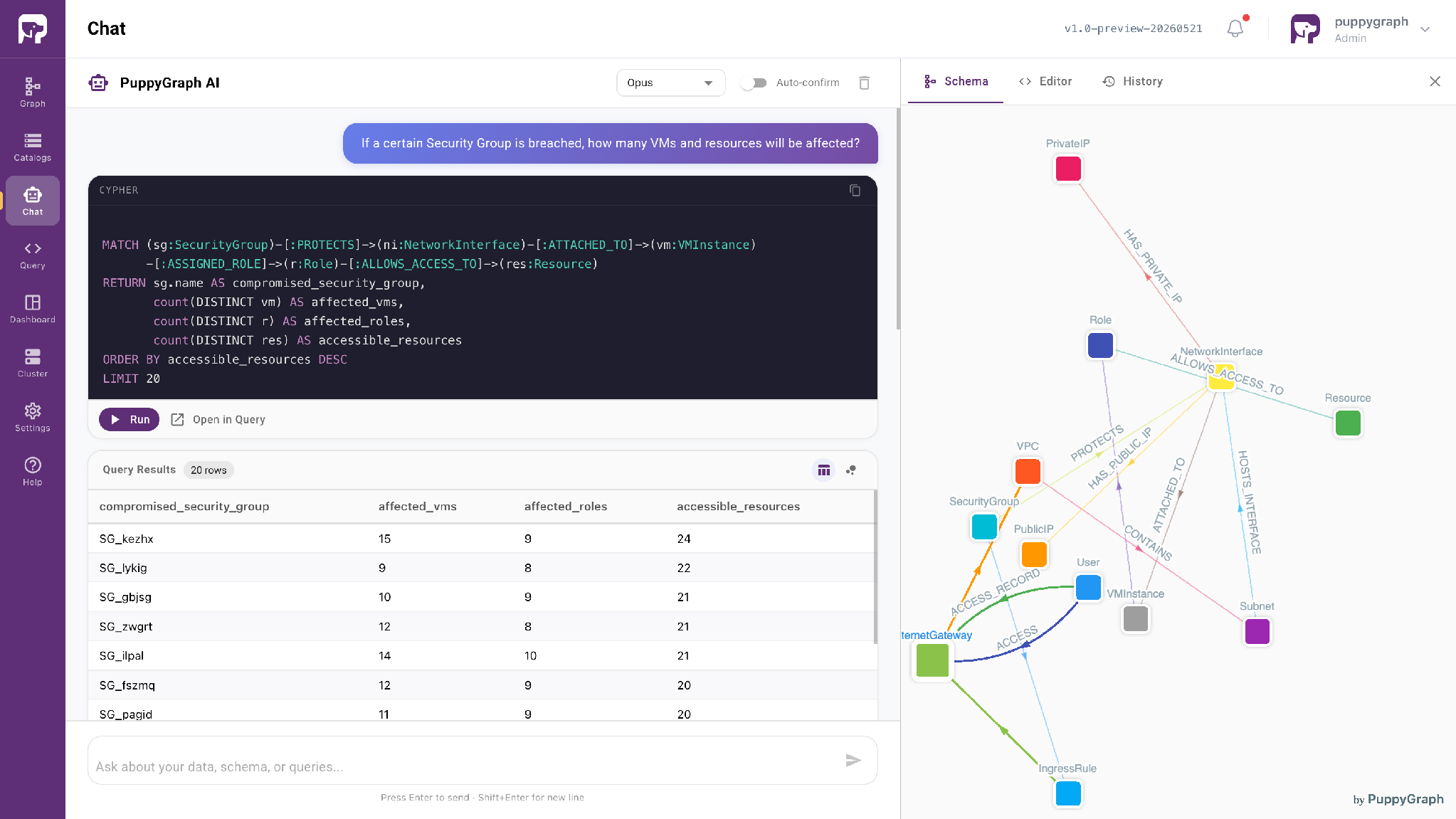
Two properties make this useful specifically for AI-driven security. First, because the graph is defined over the tables where the data already lives, the relationships an agent reasons about stay current with the source of record, with no copy to keep in sync. Second, the graph schema functions as an enforced ontology: queries are validated against it before they run, and an agent that references an entity or relationship that does not exist gets structured, machine-readable feedback explaining the violation in domain terms rather than a stack trace. That feedback lets an agent correct itself, which constrains the semantic hallucinations that occur when a model invents a plausible but nonexistent join across many tables and complex business logic. PuppyGraph speaks openCypher and Gremlin, so the same context layer serves a human analyst writing a query and an agent generating one. It does not detect threats, ingest logs, or replace any tool in the list above; it is the connective layer that gives those tools’ AI the relational context to reason well.
Conclusion
The most useful way to read a roundup like this is not as a ranking but as a map of distinct strengths. Falcon and Singularity anchor endpoint and XDR; Darktrace and Vectra cover the network and identity activity endpoints cannot see; Microsoft Security Copilot and Cortex XSIAM operate at the SOC layer, interpreting and automating; Intezer brings reverse-engineering depth to alert triage. Most mature security programs run several of these together, matched to the factors that matter for their environment: detection approach, data coverage, autonomy, explainability, deployment, and the connective context that determines whether all the AI above it reaches sound conclusions. The clearest signal of where the category is heading is that every one of these tools is racing toward autonomous agents, which makes the quality of the context those agents reason over the next thing worth getting right.
To see how a graph layer can give your AI security tools and agents that context, try the forever-free PuppyGraph Developer Edition and query your asset, identity, and access data as a connected graph in place. When you want to see it mapped to your own environment, book a demo with the team.

Sa Wang is a Software Engineer with exceptional mathematical ability and strong coding skills. He holds a Bachelor's degree in Computer Science and a Master's degree in Philosophy from Fudan University, where he specialized in Mathematical Logic.

Get started with PuppyGraph!


Developer Edition
- Forever free
- Single noded
- Designed for proving your ideas
- Available via Docker install
Enterprise Edition
- 30-day free trial with full features
- Everything in developer edition & enterprise features
- Designed for production
- Available via AWS AMI & Docker install