


AI Data Analytics: Benefits & Use Cases
Every enterprise now sits on more data than any team of analysts could manually review: transaction logs, customer records, sensor feeds, support tickets, and application telemetry, all accumulating faster than dashboards can keep up. AI data analytics is the response to that gap. Instead of relying solely on predefined reports and manual queries, organizations now apply machine learning, natural language processing, and increasingly autonomous agents directly to their data, so patterns surface on their own and questions can be asked in plain language. This article explains what AI data analytics means in practice, how it works under the hood, where it outperforms traditional analytics, and what still limits it today. Along the way, we look at the specific challenge of grounding AI systems in enterprise data reliably enough to trust their answers.
What Is AI Data Analytics?
AI data analytics is the use of machine learning and related AI techniques to collect, process, and interpret data with less manual effort than traditional analytics requires. Rather than analysts writing every query and building every model by hand, AI systems learn patterns from historical data, generate predictions, and, increasingly, answer questions posed in natural language. The scope spans structured data in relational databases, semi-structured logs, and unstructured text or images. What distinguishes AI data analytics from earlier automation is that the system adapts as new data arrives, rather than executing a fixed set of rules someone wrote in advance.
In practice, this ranges from a sales forecasting model that updates itself weekly to a chatbot that lets a marketing manager ask "which campaigns drove the most repeat purchases last quarter" and get a direct answer, pulled and computed from underlying data rather than a static report someone assembled in advance.
Why AI Is Transforming Data Analytics
Three shifts explain why AI has moved from a research topic to a standard part of the analytics stack. First, the volume and variety of enterprise data have outgrown what manual analysis can cover; a single organization may generate more log lines in a day than a human team could review in a year. Second, compute and storage costs have dropped enough that training and running models on large datasets is routine rather than exceptional. Third, large language models have made natural language a viable interface to data systems, so people who cannot write SQL or Cypher can still ask direct questions and get grounded answers.
Together, these shifts change who can use data, not just how fast. Analysts still build and validate models, but business users, support teams, and increasingly autonomous software agents now interact with data directly. That expansion of who is querying, and the pace at which they query, is the real transformation. It is also why the reliability of the answers, not just their speed, has become the central design problem for this generation of analytics tools.
This also changes what counts as a bottleneck. When only trained analysts could query data, the limiting factor was analyst time. When a natural-language interface or an autonomous agent can query data directly, the limiting factor shifts to whether the underlying data is well enough organized, and well enough governed, for that interface to answer correctly without a human checking every result. That is a data engineering and data modeling problem as much as an AI problem, and it is easy to underestimate until an AI system produces a wrong answer with the same confidence as a right one.
How AI Data Analytics Works
At a high level, AI data analytics follows a pipeline: data is collected from source systems, cleaned and integrated, fed into models, and the resulting predictions or insights are surfaced back to a person or an application. Data ingestion pulls from databases, files, APIs, and streaming sources. Processing standardizes formats, handles missing values, and engineers features that models can use. Model training and inference apply statistical or machine learning techniques to that processed data. The output then flows into a dashboard, an alert, or an automated action, and results are often fed back into the pipeline to improve future runs.
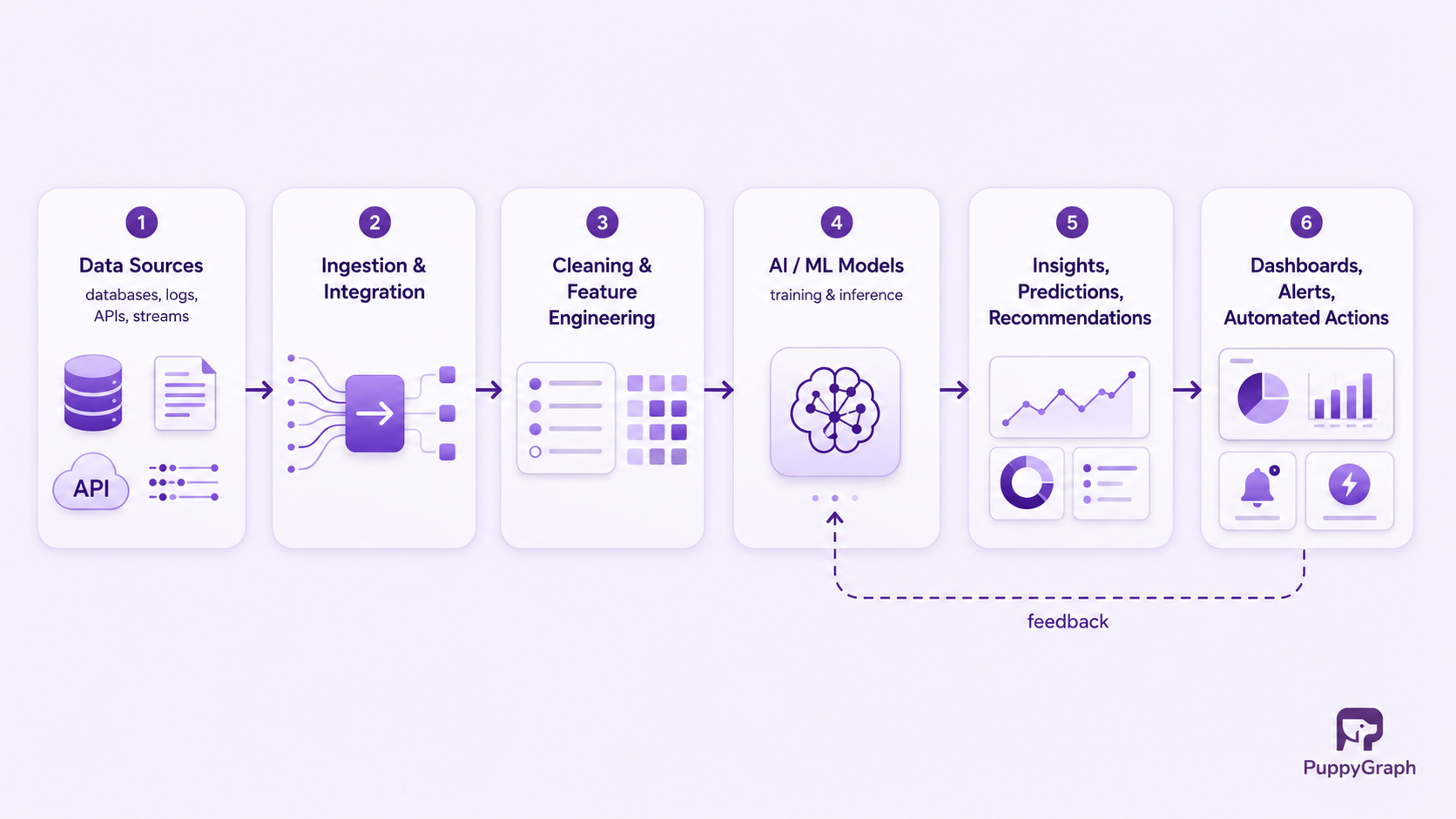
The pipeline looks simple in diagram form, but each stage carries real engineering work. Integration alone can involve dozens of source systems with inconsistent schemas, and feature engineering often requires domain expertise the model itself does not have. AI does not remove that work; it shifts part of it from manual query-writing to model training, validation, and monitoring, which brings its own discipline and its own failure modes, discussed later in this article.
Types of AI Used in Data Analytics
Several distinct AI techniques get grouped under the "AI data analytics" label, and it helps to separate them. Machine learning, particularly supervised and unsupervised learning, handles classification, regression, clustering, and anomaly detection on structured data. Natural language processing extracts structure from unstructured text, such as pulling entities and sentiment out of support tickets or contracts. Computer vision applies similar extraction to images and video, useful in manufacturing quality control or retail shelf monitoring. Generative AI, built on large language models, adds a newer capability: producing natural language summaries, generating queries from plain-language questions, and drafting narrative explanations of what the numbers mean.
These techniques are frequently combined rather than used in isolation. A single analytics workflow might use machine learning to forecast demand, natural language processing to summarize customer feedback driving that demand, and a generative AI interface to let a category manager ask follow-up questions about both. The trend across all of them is the same: less code written by hand per question asked, and more reliance on models and language interfaces that adapt to the data and the question rather than requiring a predefined report format.
AI Data Analytics vs Traditional Data Analytics
Traditional data analytics relies on analysts writing SQL queries, building dashboards against fixed schemas, and running statistical tests designed ahead of time. It is precise and auditable, but it scales with headcount: more questions require more analyst hours. AI data analytics changes that scaling relationship by having models generate predictions or natural-language interfaces answer questions directly, at the cost of requiring more upfront investment in data quality, model training, and validation.
Neither approach fully replaces the other. Most mature organizations run AI-driven forecasting and natural-language querying alongside traditional dashboards, using the traditional layer as a source of ground truth to validate what the AI layer produces. The practical question is rarely "AI or traditional," but where the line between them should sit for a given team and a given class of question.
Benefits of AI Data Analytics
The appeal of AI data analytics comes down to a handful of concrete advantages over manual analysis, though the exact gains depend heavily on data quality and how well the system is integrated into existing workflows.
- Faster time to insight, since models can process new data continuously rather than waiting for a scheduled report cycle.
- Detection of patterns and anomalies that are difficult for a human to spot manually across large, high-dimensional datasets.
- Natural language access to data for people who are not trained in SQL or query languages.
- Continuous adaptation as new data arrives, rather than analysis that goes stale between review cycles.
- Reduced repetitive query-writing for analysts, freeing time for higher-judgment work like interpreting results and deciding what to do about them.
These benefits compound when the underlying data infrastructure is well organized. A model or natural-language interface is only as reliable as the data and the semantic structure it operates on; strong AI on top of a poorly modeled dataset still produces confident but wrong answers, a theme this article returns to in the business intelligence and challenges sections below.
AI Data Analytics Across Industries
The specific application of AI data analytics varies by industry, but the underlying pattern is consistent: high-volume data, a need for faster answers, and a mix of structured and unstructured sources. In finance, AI models score credit risk and flag anomalous transactions for fraud review. In healthcare, analytics support diagnostic assistance and operational forecasting for staffing and supply needs. In retail, demand forecasting and personalization models drive inventory and marketing decisions. In manufacturing, sensor data feeds predictive maintenance models that flag equipment likely to fail before it does.
What these industries share is not the specific model but the shift in workflow: domain experts increasingly interact with AI-generated insights and natural-language interfaces rather than writing every query themselves. That shift raises the same question in every sector: how confident can a domain expert be in an answer generated by a model or an AI agent, when they were not the one who wrote the underlying query. That trust question becomes especially pointed once natural-language interfaces are handed to business users directly, which is the focus of the next section.
AI Data Analytics for Business Intelligence
Business intelligence has been the proving ground for AI's natural-language ambitions: instead of a business user requesting a report from an analyst, they type a question and expect a direct, correct answer computed against live enterprise data. The mechanism enabling this is typically an AI agent or assistant that translates natural language into a query, executes it, and returns results. This works well against a single clean table. It becomes considerably harder once the underlying data spans multiple systems with dozens of tables, ambiguous column names, and relationships that only make sense with domain context the language model was never given.
The specific failure mode is worth naming precisely: a generated query can be syntactically valid and still be semantically wrong, joining the wrong tables or referencing an entity that does not actually exist in the schema. This is sometimes called semantic hallucination, and it is distinct from the more familiar problem of a model inventing facts, because the query itself may run without error and simply return a confidently wrong answer. Catching that class of error requires something more structured than a well-written prompt: a layer that defines the entities, relationships, and properties in the underlying data, and validates every generated query against that model before execution.
This is the problem PuppyGraph addresses directly. Rather than positioning itself only as infrastructure for writing graph queries, PuppyGraph functions as an ontology layer between an organization's existing data and the humans or AI agents querying it. Teams use PuppyGraph's schema designer to map their existing tables into a graph model of entities and relationships, without moving or duplicating the underlying data; it connects directly to SQL databases, data warehouses, and data lakes, including open table formats like Apache Iceberg, reading them in place. Because the graph model sits at the compute layer only, the source data continues to live in the customer's existing warehouse or lake.
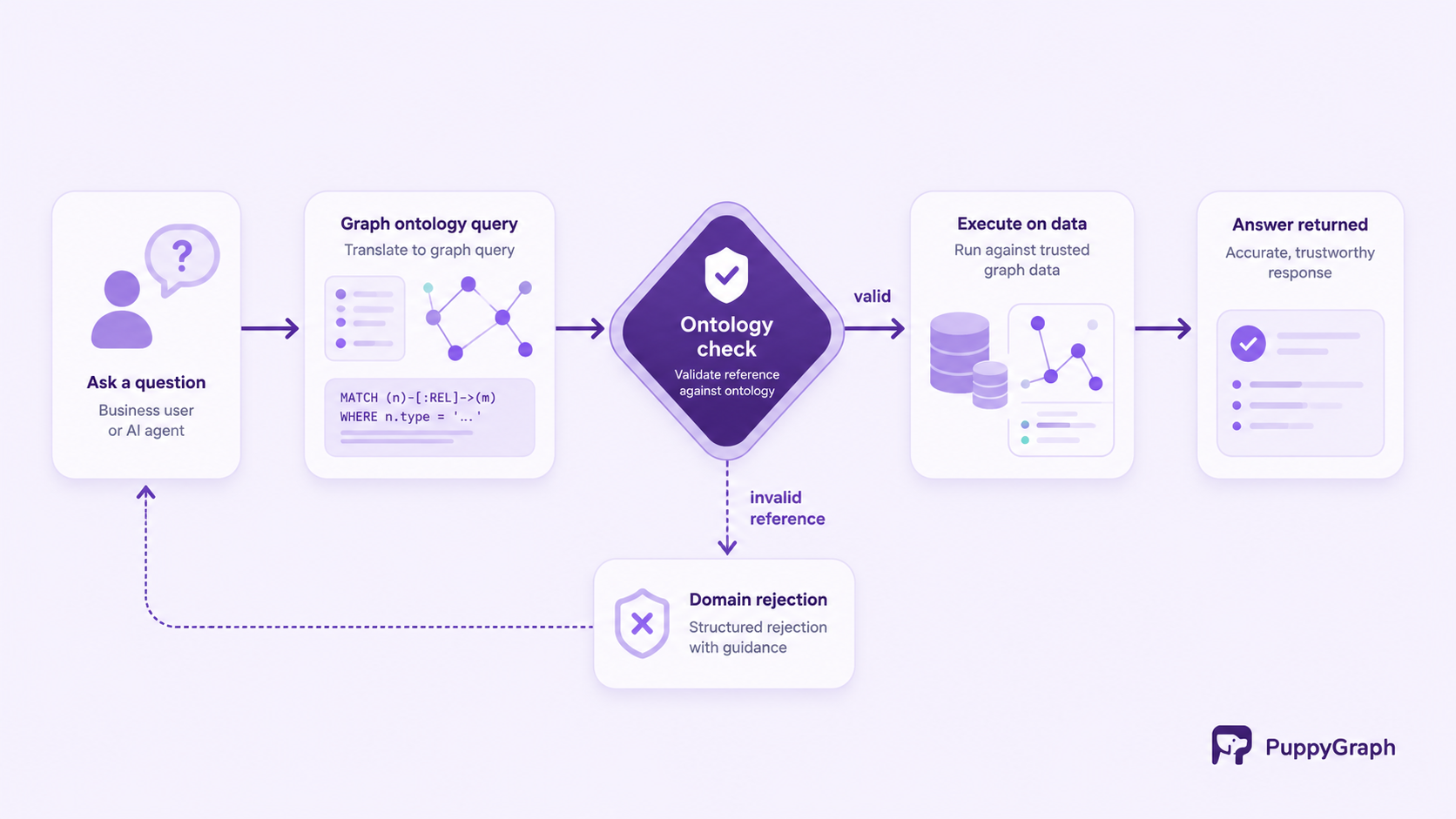
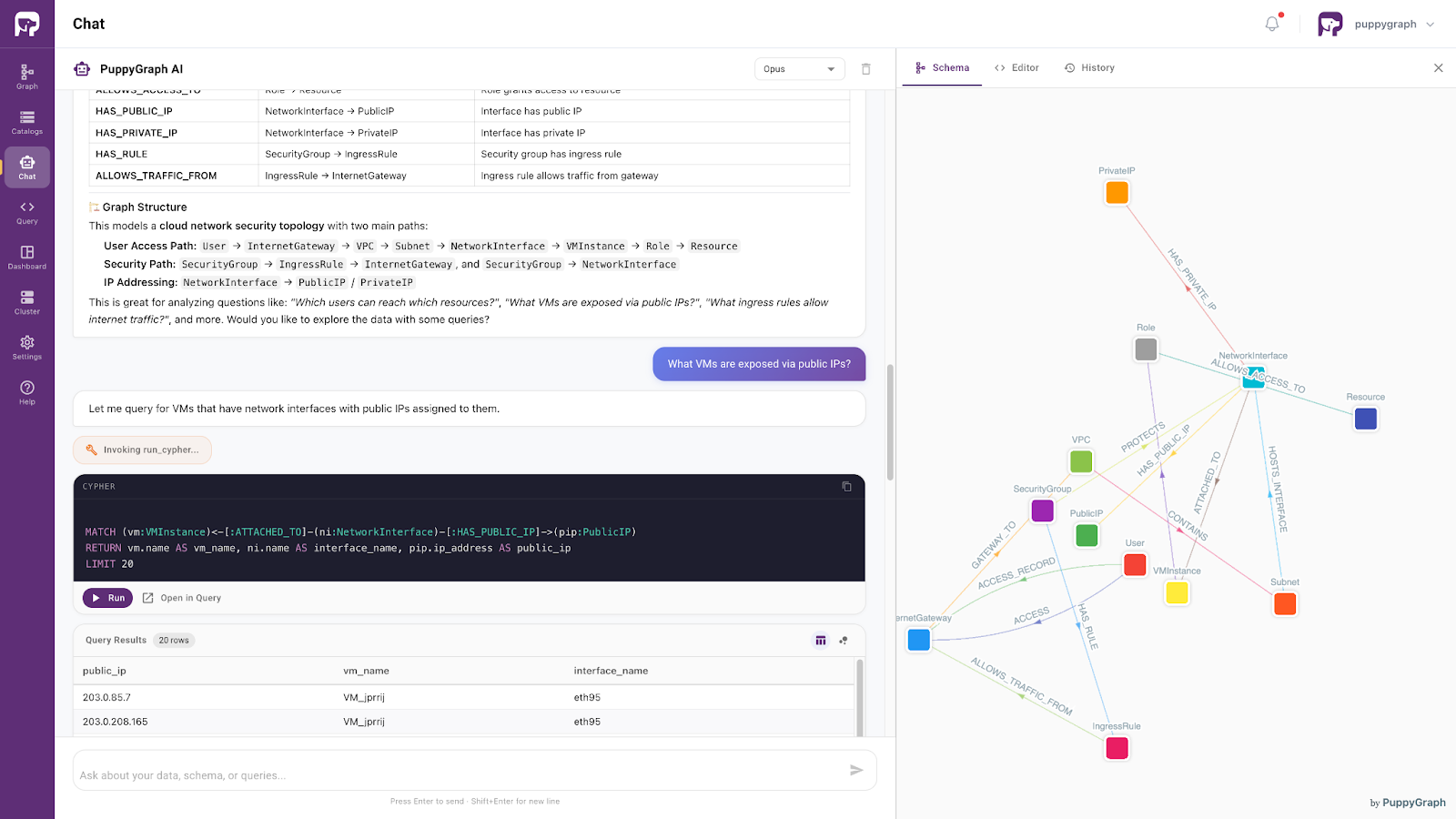
What makes this an enforcement layer rather than just a diagram of the data is that every query, whether written by a person or generated by an AI agent, is checked against the ontology before it runs. A reference to an entity or relationship that does not exist in the schema is rejected, and the system returns structured feedback explaining the violation in domain terms rather than a database stack trace. For a human analyst that catches mistakes early; for an AI agent it enables a self-correction loop, where the agent can revise its own query using the rejection feedback and try again, without a person in the loop for every iteration. PuppyGraph ships with a built-in AI assistant that uses exactly this loop: it accepts natural-language questions, generates queries against the enforced ontology, and iteratively explores related queries to build up a full answer.
This matters for business intelligence specifically because the whole appeal of natural-language BI is trusting an answer you did not personally verify. AMD, for example, has built a graph layer over Apache Iceberg with PuppyGraph spanning tickets, code, logs, and telemetry, giving a consistent structure across data that would otherwise sit in disconnected systems. Coinbase, eBay, Dawn Capital, and Prevalent AI are among the organizations applying the same underlying approach: model the data as a graph once, and let both people and AI agents query it through openCypher or Gremlin against a schema that rejects nonsense before it reaches a dashboard or a decision.
Challenges and Limitations of AI Data Analytics
None of this removes the real limitations of AI data analytics. Model quality depends entirely on training data quality, and biased or incomplete historical data produces biased predictions, regardless of how sophisticated the model is. Explainability remains difficult: a model that predicts high churn risk for a customer does not always make it easy to see why, which matters when the prediction drives a business decision someone has to justify. Integration is its own obstacle, since most enterprises have data spread across legacy systems that were never designed to be queried together, and connecting them well takes real engineering effort regardless of how capable the AI layer is.
Governance and trust compound these technical challenges. As natural-language interfaces and autonomous agents get closer to enterprise data, the cost of a confidently wrong answer rises, particularly when that answer informs a financial, medical, or security decision. Grounding mechanisms like ontology enforcement address one specific slice of this problem, semantic correctness of generated queries, but they do not substitute for data quality work, bias auditing, or the judgment of someone who understands what the numbers actually mean in context. AI data analytics reduces manual query-writing; it does not reduce the need for people who can interpret results critically.
Cost and skills are also worth naming plainly. Training and maintaining models, curating training data, and monitoring for drift all require specialized skills that are still scarce relative to demand, and the infrastructure to do this well is not free even when individual tools are. Organizations that treat AI data analytics as a one-time setup rather than an ongoing practice tend to see model quality degrade quietly as the underlying data and business context shift, which is one more reason the discipline around it matters as much as the technology itself.
Conclusion
AI data analytics has changed who can ask questions of enterprise data and how quickly they get answers, moving from analyst-written reports toward natural-language interfaces and models that adapt continuously as new data arrives. That shift brings real benefits: faster insight, pattern detection at a scale humans cannot match manually, and reduced repetitive query work for analysts. It also raises the stakes on correctness, since a wrong answer delivered instantly and confidently is more dangerous than a wrong answer that took a week to produce. Grounding AI systems in a clear, enforced model of the underlying data, rather than trusting a generated query on faith, is becoming a necessary part of that infrastructure rather than an optional add-on.
If your team is exploring how to ground AI agents or natural-language BI tools against your existing data without an ETL project, PuppyGraph's Developer Edition is forever-free to try. To talk through a specific use case with the team, you can book a demo.

Hao Wu is a Software Engineer with a strong foundation in computer science and algorithms. He earned his Bachelor’s degree in Computer Science from Fudan University and a Master’s degree from George Washington University, where he focused on graph databases.

Get started with PuppyGraph!


Developer Edition
- Forever free
- Single noded
- Designed for proving your ideas
- Available via Docker install
Enterprise Edition
- 30-day free trial with full features
- Everything in developer edition & enterprise features
- Designed for production
- Available via AWS AMI & Docker install