


AI in supply chain: benefits, use cases, and future trends
Supply chains have always run on forecasts that are wrong by some amount, inventories sized to hedge that error, and humans negotiating around the residual disruption. AI does not eliminate any of those layers, but it changes what each one costs. A planner who used to rebuild a weekly forecast in a spreadsheet now reviews exceptions a model surfaced. A dispatcher who used to call drivers about delays now adjusts routes against an ETA that updates every few minutes. The change is not that decisions are automated end-to-end; it is that the latency between a signal and a decision has collapsed, and the number of variables a single operator can hold in view has grown by an order of magnitude.
This post walks through what AI in supply chain management actually means today, the benefits operators are seeing in practice, the AI techniques behind those benefits, the use cases where adoption is furthest along, and the challenges that still slow rollouts down. The last sections cover an implementation path that has worked across industries and the role a semantic data layer plays when AI agents start participating directly in supply chain decisions.
What is AI in supply chain management?
AI in supply chain management refers to the use of machine learning, optimization, computer vision, and increasingly large language models to plan, execute, and monitor the flow of goods from suppliers through manufacturing, distribution, and delivery. It sits on top of the systems supply chains already run on (ERP for resource planning, WMS for warehouse operations, TMS for transportation, SRM for supplier relationships, and planning tools) and consumes the transactional and telemetry data those systems produce.
The category is broader than predictive analytics, which dominated the previous decade. Modern AI in supply chain includes prescriptive optimization (what to do given a forecast), anomaly detection (what is unusual in today’s flow), generative interfaces (asking questions of operational data in natural language), and agentic workflows (AI systems that can read inventory state, propose a reallocation, and execute it through the same APIs a human planner would use). What unifies these is that the AI sits between heterogeneous data sources and human decision-makers, reducing the cost of getting from data to a defensible decision.
How artificial intelligence is transforming modern supply chains
Three structural shifts are visible across companies that have moved AI past pilots.
Planning cycles compress. Where forecasts and replenishment plans used to refresh weekly or monthly, models retrained on a daily cadence make sub-day adjustments feasible. The bullwhip effect, the historical tendency for small demand variability at retail to amplify into large swings upstream, attenuates when each tier sees forecasts that incorporate downstream signals rather than reacting to its immediate customer’s orders.
Execution becomes continuous. Routing, slotting, and shift scheduling were periodic decisions made against a snapshot. Real-time location data, IoT sensor feeds, and event streams from order management let those decisions update during execution. A truck reroutes mid-trip; a wave plan reshuffles when a high-priority order arrives; a slotting policy adjusts overnight against the next day’s pick profile.
Visibility extends beyond tier one. Traditional supply chain systems are organized around the buyer’s direct trading partners. AI-driven graph and entity resolution techniques pull in data from logistics providers, customs records, news feeds, and supplier disclosures to surface tier-two and tier-three exposure. The 2020 to 2022 disruptions made this a board-level concern; the technical capability to answer “who else depends on this Taiwanese fab” without a months-long survey is what made the response operational rather than aspirational.
These shifts compound. A faster planning cycle is more valuable when execution can act on it, and execution that can act in minutes is more valuable when visibility extends past the next node. AI’s footprint in supply chains has grown less through any single breakthrough capability than through the three layers reinforcing each other.
Key benefits of AI in supply chain operations
The benefits show up in operating metrics that supply chain teams already track. The categories below are not exhaustive, but they cover where most documented ROI comes from.
Forecast accuracy improvement. Replacing classical time-series methods with gradient-boosted trees or transformer-based models, and feeding them exogenous variables (promotions, weather, macro signals, web traffic), typically moves MAPE (mean absolute percentage error, the standard forecast-accuracy metric) down by single-digit to low-double-digit percentage points at SKU-location granularity. The translation to dollars is downstream: better forecasts let safety stock be sized tighter without sacrificing service level, which releases working capital.
Inventory and working capital efficiency. Multi-echelon inventory optimization, fed by ML demand signals and lead-time distributions learned from supplier performance, sets target stocks per echelon jointly rather than locally. The result is fewer stockouts at the customer-facing tier and lower aggregate inventory across the network, which is the configuration finance teams have been asking planning teams for since enterprise resource planning was first sold.
Logistics cost reduction. Route optimization with real-time traffic and dynamic re-planning shaves miles and dwell time. Freight procurement informed by spot-rate prediction picks lanes and modes that beat default contracts. Both effects are small on a per-shipment basis and meaningful in aggregate; the case for AI here is volume-driven.
Throughput and labor productivity in warehouses. Pick-path optimization, slotting that adapts to demand mix, and computer-vision quality checks reduce the labor needed per unit moved. Where physical automation is in place (AS/RS, AMRs), AI is the layer that schedules and coordinates the equipment; without it, the equipment runs efficiently within its station and idles waiting for the next instruction.
Risk and resilience. Anomaly detection over transaction streams catches expediting patterns or order anomalies that signal an upstream problem before it shows up as a stockout. Supplier risk models that combine financial signals, news, and shipment behavior surface concentration exposure that aggregated procurement reporting does not.
The common thread is that AI is not replacing a system; it is improving the decisions that existing systems trigger. The benefit is measured in the same units (service level, working capital, cost-to-serve, on-time-in-full) the team was measured on before AI showed up.
Core AI technologies used in supply chain management
A handful of technique families do most of the work in production supply chain systems today.
Machine learning for forecasting and classification. Gradient-boosted trees (XGBoost, LightGBM) remain dominant for tabular demand forecasting because they are competitive on accuracy, cheap to train, and interpretable enough to debug. Deep sequence models (LSTMs, temporal fusion transformers) compete on long-horizon or multivariate problems where the cross-series signal matters.
Operations research and reinforcement learning for optimization. The classical vehicle routing problem, job shop scheduling, and multi-echelon inventory optimization remain operations-research problems at their core. ML often shows up as a faster heuristic, a learned policy, or a way to estimate parameters (lead times, travel times) that the optimizer then consumes.
Computer vision in physical operations. Vision models classify damage on inbound pallets, verify pick accuracy, monitor dock door utilization, and detect safety incidents. The deployment pattern is narrow models trained on operation-specific imagery rather than general-purpose foundation models, because the per-task accuracy bar is high and the visual variability inside a single warehouse is bounded.
Large language models and AI agents. The newest layer is conversational and agentic. LLMs let planners and analysts query operational data in natural language, draft supplier communications, summarize incident timelines, and propose actions. Agent harnesses extend this by letting the model invoke planning, ordering, or routing APIs under guardrails. The promise is significant; the implementation challenge is that supply chain data lives across ERP, WMS, TMS, SRM, and procurement systems, with overlapping but inconsistent identifiers for the same supplier, part, location, and order.
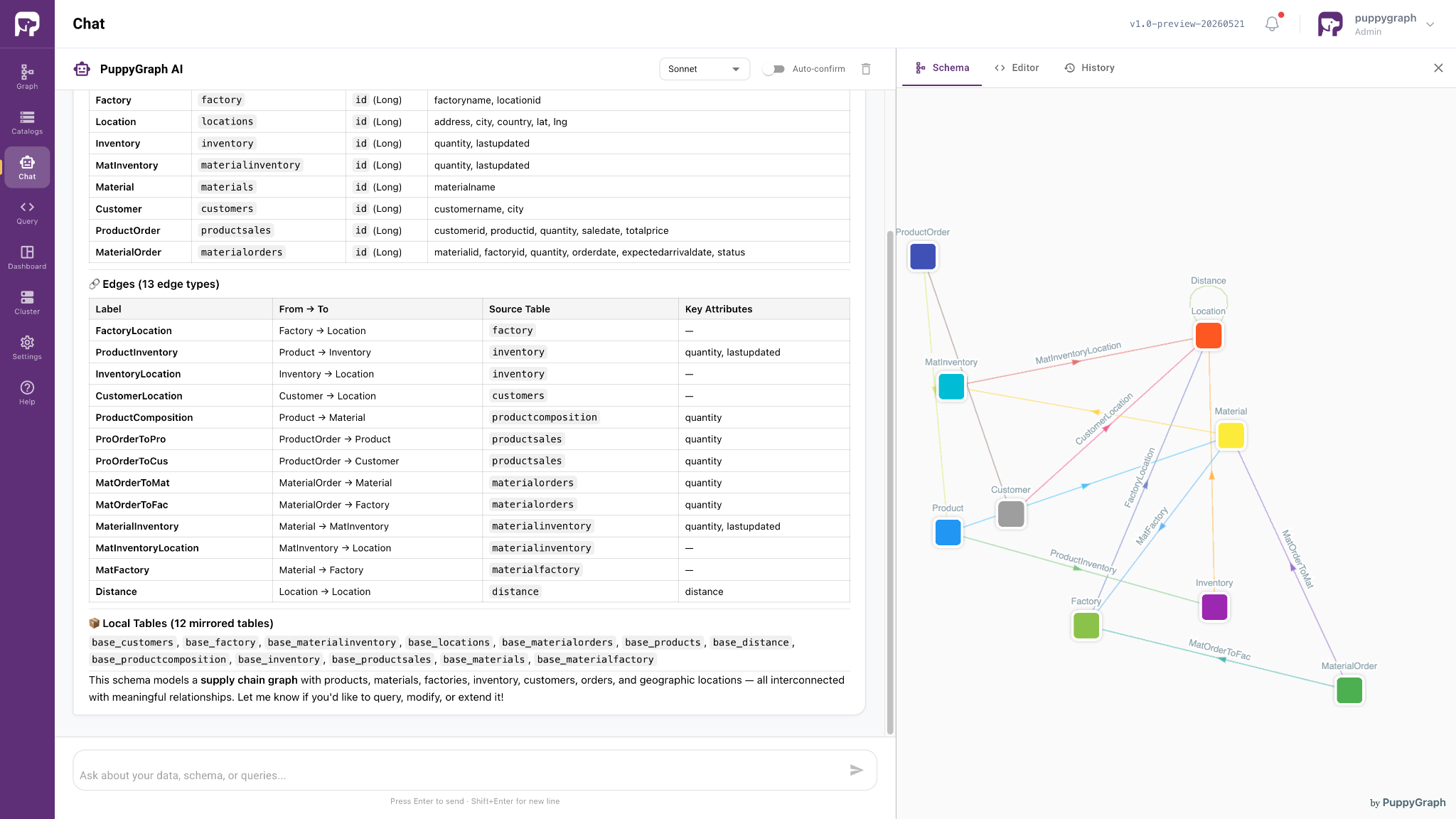
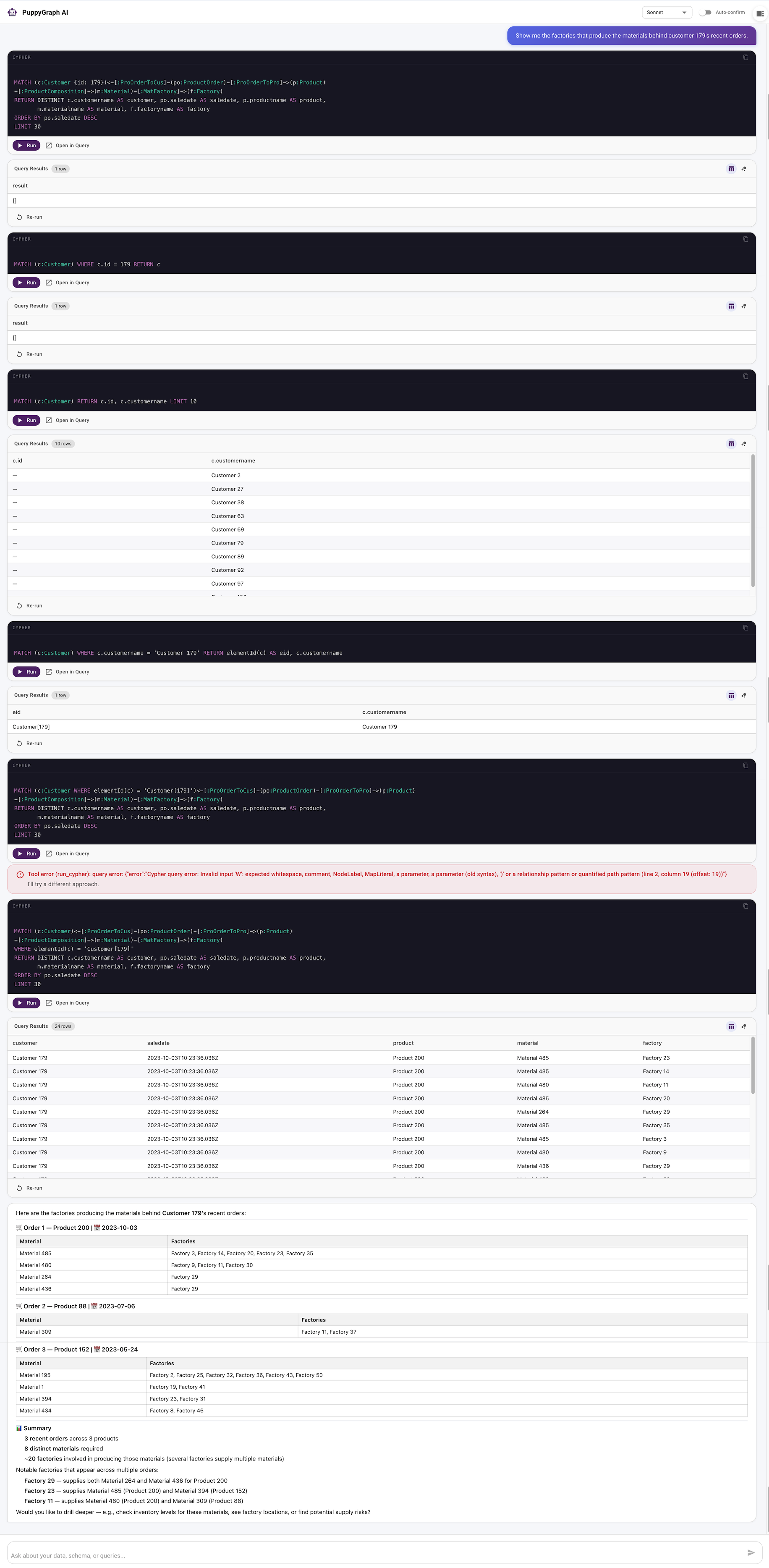
That last point is where the AI stack meets the data stack. For LLM-based planners and agents to be reliable in supply chain workflows, they need a unified semantic model of the network: what counts as a customer, how an order relates to a finished product, which materials compose that product, which factories produce those materials, and where every node in the network physically sits. PuppyGraph takes this role by exposing existing tables in a warehouse, lakehouse, or operational data store as a graph with an enforced ontology, so an agent asking “which factories ultimately produce the materials behind customer C’s recent orders” traverses a defined customer-order-product-material-factory path rather than reconstructing five-way joins on each call. That ontology is explicit and inspectable: the vertex types, the edge types, and the underlying tables each one maps to are all part of the model, which is what lets a team reason about the semantic surface rather than rediscover it on every query.
AI use cases in supply chain management
Use cases below are the areas where adoption is furthest along and where the gap between a slide deck and a production system is smallest. They are not the only places AI shows up, but they are where most operators see returns first.
AI for demand forecasting and inventory optimization
Demand forecasting is the entry point for most supply chain AI programs, because the data is centralized in planning systems, the success metric (MAPE or its sales-weighted variant WAPE, against actuals) is unambiguous, and the upside is directly traceable to inventory and service-level outcomes. Modern systems forecast at SKU-location-week or finer granularity, using gradient-boosted models that consume historical demand alongside promotional calendars, pricing, weather, web search trends, and competitor activity where available. New-product introductions and intermittent-demand SKUs, the historical weak points of statistical forecasting, are handled with hierarchical models that borrow strength from analogous items or with specialized intermittent-demand methods.
The forecast is rarely the end product. It feeds multi-echelon inventory optimization, which sets safety stock at each node jointly rather than locally, accounting for lead-time variability, service-level targets, and the cost of holding versus the cost of stocking out. The combined effect (better mean forecast plus tighter uncertainty estimates plus network-aware safety stock) is what releases working capital. Teams that adopt only the forecasting layer and leave inventory policies static typically see a fraction of the benefit.
AI in logistics and transportation management
Logistics absorbs the second-largest share of supply chain AI investment, distributed across route optimization, ETA prediction, freight procurement, and yard management. Route optimization in fleets with dozens to hundreds of vehicles uses metaheuristics (large neighborhood search, genetic algorithms) seeded with ML-predicted travel times that account for time of day, weather, and historical congestion. Dynamic re-routing during execution handles the cases the morning plan did not anticipate: a closure, a customer cancellation, a high-priority insertion.
ETA prediction is a quieter but pervasive use case. The downstream consumer is not always a human; warehouse labor scheduling, customer-facing delivery promises, and upstream planning all depend on accurate arrival predictions. Models combine GPS telemetry, historical lane performance, carrier behavior, and external congestion signals to produce predictions that update continuously rather than at scheduled checkpoints. Freight procurement applies ML to rate prediction and lane selection, picking between contract and spot capacity dynamically against forecasted volumes.
AI-powered warehouse automation and operations
Warehouse AI splits into the layer that schedules physical automation and the layer that improves human work. Automation scheduling coordinates AS/RS cranes, conveyor systems, and AMR fleets so the equipment runs as a system rather than as isolated stations. The optimization is real-time and multi-objective: throughput, energy, equipment wear, and order priority all compete. Reinforcement-learning policies have moved from research to production here in the past few years, often as a layer on top of rule-based dispatching that handles the long tail.
For human operations, slotting (deciding where each SKU lives in the warehouse) is re-optimized on a rolling basis against the next period’s expected pick profile, which keeps fast movers near the dock and minimizes travel. Pick-path optimization within a wave reduces walk distance per order. Computer vision verifies pick accuracy, catches damaged inbound product before it enters inventory, and audits putaway compliance. Predictive maintenance on conveyors, sorters, and lift trucks pulls vibration and current draw from controllers to flag components before they fail during a peak shift.
Challenges of implementing AI in supply chain systems
The challenges that slow AI programs down are rarely about the models themselves.
Data fragmentation and master data quality. Supply chain data is split across ERP, WMS, TMS, SRM, procurement, and a long tail of third-party platforms. The same supplier appears with different identifiers in different systems; the same part number is reused across plants with different meanings; locations are coded inconsistently. Without a master data foundation, a model trained on one system’s view will generate predictions that other systems cannot act on.
Process and change-management friction. Planners and dispatchers have decision habits built up over years and a justified skepticism toward systems that override their judgment without explanation. AI deployments that present recommendations without showing reasoning, that cannot be overridden cleanly, or that fail in ways the operator cannot diagnose tend to get worked around. The operating model around an AI system matters as much as the model’s accuracy.
ROI horizon and pilot fatigue. Demand forecasting pilots produce visible accuracy improvements in months; the inventory and service-level outcomes follow on a slower clock as policies and habits change. Programs that are evaluated only against the first-quarter metrics often get cut before they reach the metrics that justified them. Sponsors who understand this curve are the precondition for most successful programs.
Talent and operating costs. Supply chain ML platforms require data engineering, MLOps, and domain expertise simultaneously, and the market for people who span all three is thin. Cloud-first architectures and managed services have lowered the floor, but the running cost of feature pipelines, retraining infrastructure, and monitoring is a recurring line item that pilot budgets often understate.
Integration with execution systems. A forecast or a recommendation that cannot be acted on through the team’s existing systems is shelfware. Two-way integration with ERP, WMS, and TMS (reading state and writing back actions) is where many programs hit their longest delays, because it touches the systems operations cannot afford to disrupt.
How to successfully implement AI in supply chain operations
The pattern that works across industries is sequential, not parallel.
Start with a use case that has a clean success metric and a willing business owner. Demand forecasting is the most common entry point because the metric is unambiguous and the data is mostly in one system. Logistics route optimization is the second, when the fleet is owned and telemetry exists. Avoid starting with end-to-end planning rewrites; the integration scope is too large and the success criteria too diffuse.
Build a master data and integration foundation in parallel. Without harmonized supplier, part, location, and customer identifiers, every subsequent use case re-pays the same data-plumbing cost. This work does not need to finish before the first use case ships, but it should start in parallel and be funded as infrastructure rather than as part of any single use case’s budget.
Treat models as one component of the system. Forecasting models, optimizers, and anomaly detectors are commodities; the differentiation is in the data pipelines, the feature engineering, the operator interfaces, and the integration into execution. Teams that spend their budget on model selection and skimp on the rest underperform.
Plan for observability and governance from day one. Model drift in supply chain is common: demand patterns shift, suppliers change behavior, lanes get re-contracted. Without monitoring on input distributions, prediction distributions, and downstream business metrics, drift surfaces as a stockout or a missed shipment before it surfaces as a model alert. Governance, including approval workflows for actions taken by automated systems, is what makes scaling beyond the first use case politically possible.
One foundation deserves separate mention, because it tends to arrive last and be planned for least. As LLM-based planners and conversational interfaces move from pilots into production, the cost of not having a unified semantic model of the supply chain network shows up immediately. Agents asked to reason across ERP, WMS, and TMS will hallucinate joins between systems whose foreign keys do not actually align, and the failures are subtle: a syntactically valid query that returns plausible-looking but semantically wrong results. PuppyGraph’s role here is to define that semantic model once over existing warehouse, lakehouse, or relational data and enforce it at query time, so an agent’s traversal across customers, orders, products, materials, factories, and inventory locations runs against a defined ontology rather than against the agent’s reconstruction of one. When a query does reference something the model does not contain, it is rejected with structured feedback the agent can read and correct against, rather than returning a quietly wrong result. The same layer serves human analysts who want to query the network without learning each underlying system’s schema, so the semantic investment amortizes across both the agentic and the analytical roadmap.
Conclusion
AI in supply chain has moved past the demonstration phase. The capabilities that matter are not exotic: better forecasts, tighter inventory, smarter routing, automated warehouses, and a thinner layer between a question and an answer. What changes year over year is the share of decisions that can be made continuously rather than periodically, and the share of supply chain data that an analyst or agent can query without first learning where it lives. Programs that take both shifts seriously, and that build the data and semantic foundations to support them, are the ones whose pilots become operating systems.
Try the forever-free PuppyGraph Developer Edition to see how an ontology layer over your existing ERP, WMS, and TMS tables exposes the supplier-part-order-shipment network as a graph without ETL, and book a demo with the team to walk through how AI agents query that network with grounded, self-correcting traversals.

Sa Wang is a Software Engineer with exceptional mathematical ability and strong coding skills. He holds a Bachelor's degree in Computer Science and a Master's degree in Philosophy from Fudan University, where he specialized in Mathematical Logic.

Get started with PuppyGraph!


Developer Edition
- Forever free
- Single noded
- Designed for proving your ideas
- Available via Docker install
Enterprise Edition
- 30-day free trial with full features
- Everything in developer edition & enterprise features
- Designed for production
- Available via AWS AMI & Docker install