


AI Security Posture Management (AISPM): Complete Guide
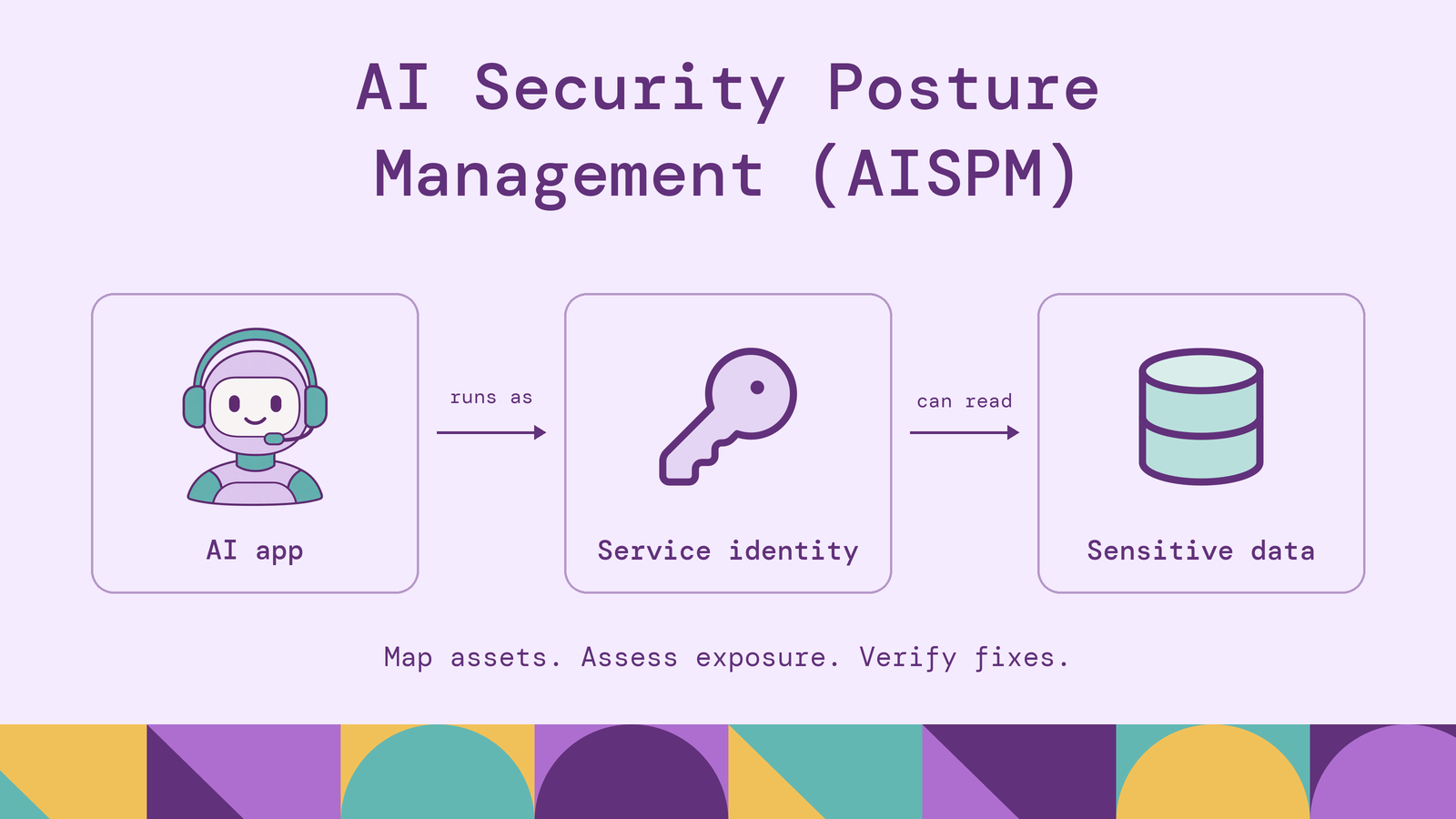
An AI application's security depends on the data it can retrieve, the identities it runs under, and the actions its tools can perform. A customer support assistant might use an approved model while holding credentials that expose unrelated customer records. Reviewing the model alone leaves that access path unexplained.
AI security posture management brings these dependencies into security review and keeps reassessing them as applications change. This guide explains how AISPM works, which risks it can address, and how to build an operational program around its findings.
What is AI security posture management (AISPM)?
AI security posture management is the ongoing process of discovering AI assets, assessing their security configuration and dependencies, prioritizing exposures, and tracking remediation. Its scope can include models, training pipelines, inference endpoints, retrieval systems, agents, and the infrastructure supporting them. Actual product coverage varies, so an AISPM label alone does not establish which of these are visible.
For example, Microsoft's AISPM documentation describes AI component discovery, security recommendations, and attack path analysis. These capabilities connect application context to familiar security concerns such as identity permissions and internet exposure.
AISPM overlaps with other security disciplines, but each starts with a different question:
These views work together. Microsoft likewise distinguishes posture management from AI threat protection. A configuration assessment provides context for runtime defenses; it does not establish that every interaction is safe.
How does AISPM work?
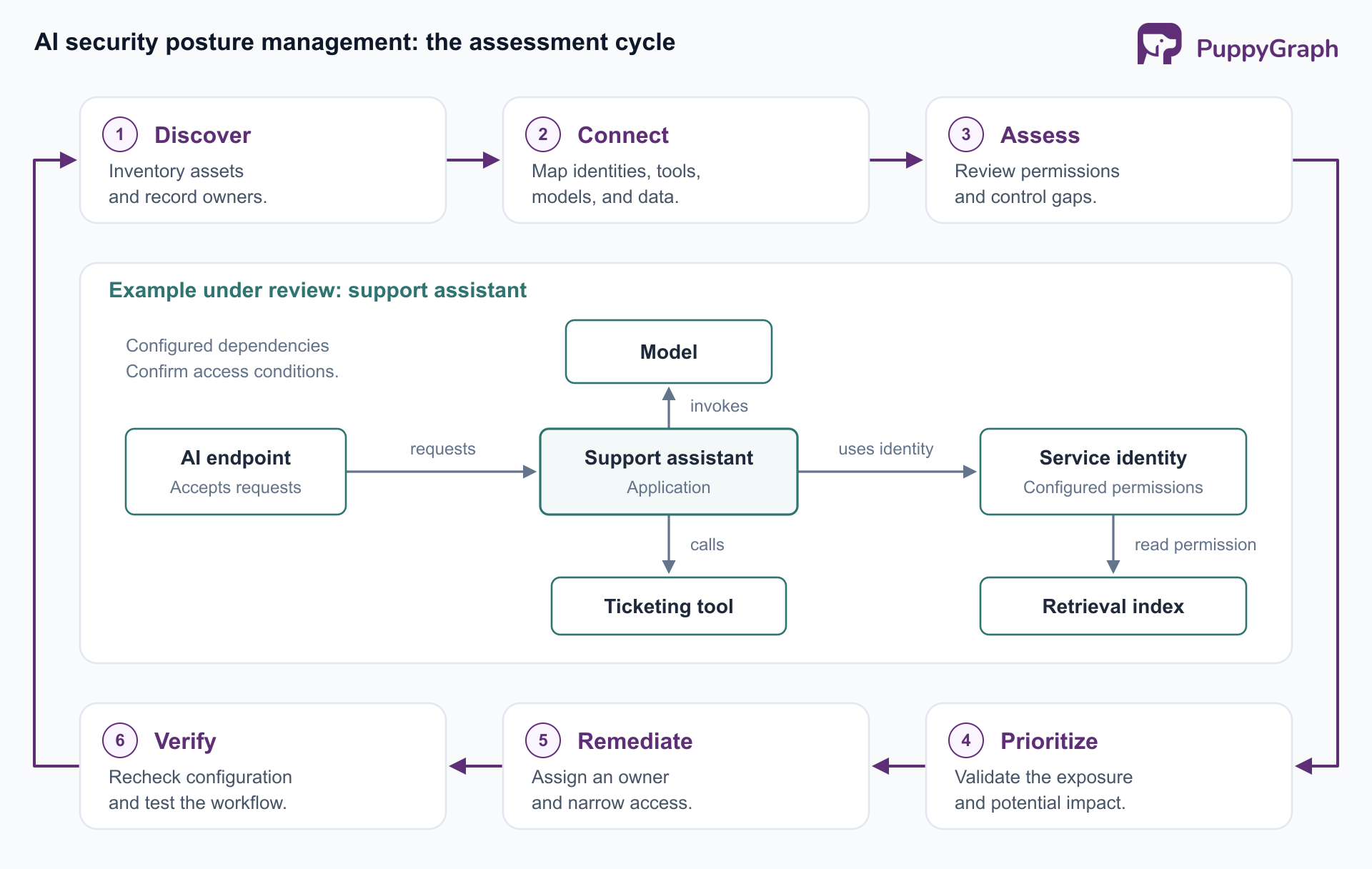
An effective AISPM workflow follows a repeating cycle: discover, connect, assess, prioritize, remediate, and verify.
Discovery can combine cloud resource inventories and code scans with usage telemetry, depending on available integrations. The inventory should identify each application's owner, environment, model dependencies, data sources, and service identities. Record collection failures alongside discovered assets so incomplete coverage remains visible.
Next, connect the assets. In the support assistant example, link the application to its inference endpoint, retrieval index, service account, and ticketing integration. Assess both individual settings and their combined effect. An unnecessary read permission matters more when it reaches confidential records through an externally accessible application.
Prioritization turns that context into a remediation decision. The finding should explain the affected resource, the relevant access path, the evidence supporting it, and the team responsible for changing it. A candidate attack path still needs validation of authentication, authorization, and application behavior before anyone calls it exploitable.
After the owner narrows permissions, reassess the configuration and test the affected workflow. Closing a ticket should mean the exposure was removed or explicitly accepted, with supporting evidence.
Key capabilities of AISPM solutions
Evaluate capabilities against the systems your team operates. Five areas provide a useful baseline.
Asset discovery and ownership. The inventory should cover the AI services and deployment patterns in scope, including experimental environments. An AI bill of materials can organize models, libraries, datasets, and other dependencies. Require owners and observation timestamps so teams can distinguish an abandoned experiment from a maintained service.
Configuration and identity assessment. Look for checks on endpoint authentication, network exposure, credentials, workload permissions, encryption, and logging. Findings should explain which setting violates policy and how the application uses the affected resource.
Data and dependency context. Require links between applications and their retrieval collections, training datasets, model artifacts, and tool integrations. For a retrieval-augmented generation (RAG) application, knowing that an index exists is less useful than knowing which users can retrieve which documents through it.
Risk prioritization. Findings should account for reachable data, available actions, exposure, and compensating controls. Ask whether the platform can explain a risk score using inspectable evidence and distinguish observed activity from configured access.
Remediation and reassessment. Integrations should route findings to existing engineering workflows, preserve exceptions, and verify changes. Runtime testing or blocking may be available separately; confirm those capabilities explicitly when they are part of the requirement.
Common AI security risks addressed by AISPM
AISPM can expose conditions that make attacks possible or more damaging. Its contribution depends on which evidence it collects and which controls it can assess.
Exposed services and excessive permissions. Weak authentication, leaked credentials, and broad service roles can expose inference services or connected data. Agents add actions to that exposure. OWASP's excessive agency guidance identifies excessive functionality, permissions, and autonomy as underlying causes. A support assistant that only reads tickets should not inherit account administration privileges.
Sensitive data disclosure. Retrieval can cross an authorization boundary when an application's shared identity accesses documents the requesting user cannot read. OWASP's vector and embedding guidance highlights access-control failures and leakage across user contexts. AISPM can help identify connected stores and permissive configurations; application tests must verify that retrieval respects the caller's permissions.
Prompt injection and unsafe tool use. Malicious instructions can arrive in user input or retrieved content. OWASP's prompt injection guidance explains why retrieval-augmented generation and fine-tuning do not eliminate this risk. As part of posture assessment, review tool permissions, outbound network restrictions, and approval requirements. Assessing these conditions complements adversarial testing and runtime enforcement.
Compromised dependencies and poisoned data. Models, packages, and datasets introduce supply-chain dependencies. OWASP recommends component inventories and verification of model sources. Its data and model poisoning guidance also emphasizes provenance and dataset version control. Inventory and vulnerability checks help locate affected systems, but proving a model or dataset free of malicious behavior requires more than a clean configuration scan.
Resource abuse. Unrestricted inference requests can consume capacity and generate substantial charges. OWASP describes this as unbounded consumption. Where configuration is visible, posture checks can flag missing quotas or rate limits. Runtime controls must enforce those limits and detect abusive usage.
Benefits of AI security posture management
The practical benefit of AISPM is a shorter path from identifying a weakness to deciding what to change.
More focused remediation. Connecting exposure to sensitive data and powerful actions helps teams prioritize consequential findings. Several alerts may trace back to one shared service role, making permission reduction a more useful intervention than treating each alert independently.
Repeatable deployment reviews. A maintained inventory and documented baseline let engineers review changes against established expectations. Adding a retrieval source becomes a specific access review with an owner and test criteria.
Better investigation context. When an incident occurs, responders can identify affected applications, connected datasets, and responsible teams. This benefit depends on retaining relevant historical evidence rather than keeping only the latest inventory.
Measure results through ownership coverage, time to remediate validated exposures, recurring configuration failures, and successful reassessments. Finding counts alone can rise when discovery improves, so they are a poor standalone measure of security progress.
AISPM architecture and core components
A practical AISPM architecture separates evidence collection, relationship analysis, and response. Collection adapters obtain resource configuration, identity policies, artifact metadata, and selected telemetry. A normalization layer reconciles identifiers across sources while retaining provenance and observation times.
The asset model then represents applications, models, identities, datasets, and tools, along with relationships such as deployment, invocation, and access. Keep configured permissions separate from observed activity: an audit event records an action or attempt, while effective permissions describe what is allowed under specified conditions. Check the event's outcome before treating it as evidence of successful execution. Missing telemetry proves neither safety nor inactivity.
Assessment services evaluate policy and exposure. Findings flow into ticketing, security operations, and governance records, while control changes occur through authorized deployment or administration workflows. Protect the assessment platform itself with scoped collection credentials and access controls, because its inventory reveals sensitive infrastructure relationships.
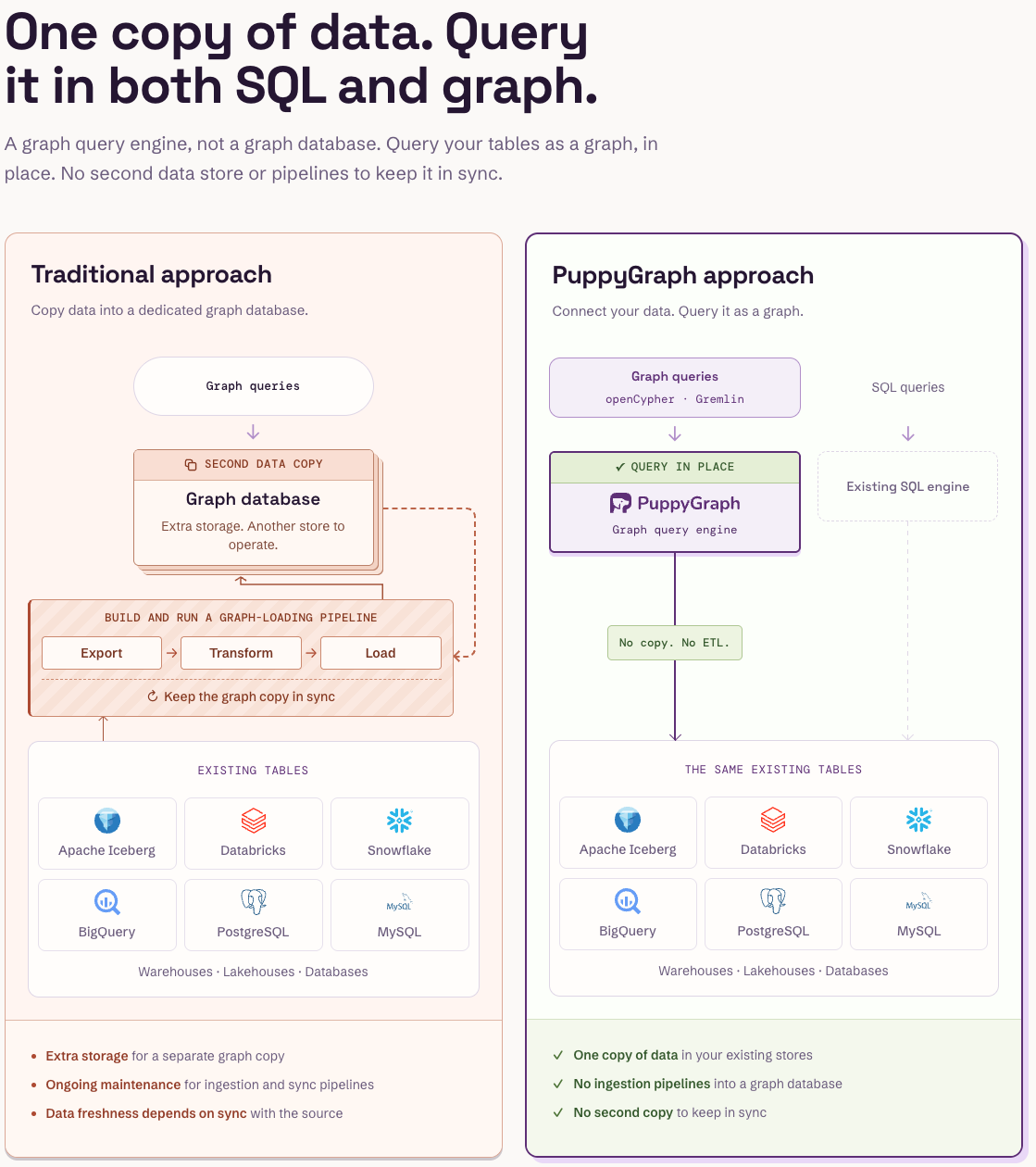
PuppyGraph is the first and only zero-ETL graph query engine that lets teams query existing relational data as a graph without loading it into a separate graph database. For AISPM, teams can define a graph schema over AI asset inventories, identity records, effective permissions, and dataset classifications already stored in supported SQL databases, data warehouses, or data lakes and lakehouses. This creates a shared model of the entities and relationships needed for exposure analysis while keeping the source records in existing storage.
With openCypher and Gremlin, analysts can follow a path from an externally reachable AI application through its service identity to sensitive datasets. They can also investigate which applications depend on a flagged model artifact or share an overprivileged identity. These are graph queries over relationships the team defines; their accuracy depends on supplied evidence, reliable identity mappings, and correctly modeled authorization conditions. The resulting paths help analysts identify where a permission change could reduce exposure across applications.
PuppyGraph supplies the relationship analysis layer alongside an AISPM platform's discovery and assessment workflows. Existing collectors continue gathering and normalizing evidence, and runtime controls continue enforcing access and action policies. The zero-ETL approach removes the need for an additional graph ingestion pipeline on the default direct-query path, making the relationships already recorded in security tables available for repeated investigation.
AI security posture management use cases
The most useful starting points involve a concrete application and a decision that security evidence can change.
Customer support assistants. Map the assistant's retrieval collections and ticketing permissions before deployment. Check whether one customer's request can retrieve another customer's records, and whether the integration can perform unnecessary write operations. Use configuration findings to direct application-level authorization tests.
Internal knowledge assistants. Review which repositories feed the retrieval layer and how document permissions survive indexing. A department-restricted file should retain its access restrictions when it becomes retrievable through a shared assistant. Reassess when new collections or user groups are added.
Model development environments. Track training jobs, notebooks, artifact stores, and the identities connecting them. A review can identify developers with unnecessary write access to deployment artifacts or experiments that retain access to sensitive training data after completion.
AI applications acquired from vendors. Record the service owner, exchanged data, approved integrations, and available security evidence. SaaS visibility may stop at tenant configuration and contractual commitments. Document that boundary, then evaluate accessible controls and supplier evidence rather than assuming visibility into the provider's internal model infrastructure.
How AISPM supports AI governance and compliance
AISPM provides technical evidence for governance decisions: what exists, who owns it, how it is configured, which risks remain open, and what changed after remediation.
The NIST AI Risk Management Framework is voluntary. Its Govern, Map, Measure, and Manage functions provide a useful way to organize this evidence. For example, ownership records can support Govern; application and dependency inventories can support Map; assessments can inform Measure; and tracked remediation can support Manage. This is a practical mapping, not a NIST certification or a prescribed AISPM checklist.
ISO/IEC 42001 specifies requirements for an AI management system. AISPM findings can contribute to that broader management process, but tool-generated reports alone do not demonstrate that an organization meets the standard.
For each relevant obligation or internal control, record the evidence source, assessment date, responsible owner, and unresolved exceptions. Keep the legal and governance teams responsible for interpreting applicability and adequacy. Security posture evidence addresses only part of AI governance; privacy, fairness, intended use, and human oversight also require context-specific review.
How to implement AI security posture management
Start with a bounded application portfolio and prove that the assessment-to-remediation workflow works before expanding coverage.
- Define scope and ownership. Select an application, its environments, and its dependencies. Assign a service owner, a security reviewer, and the teams authorized to change permissions or deployments. Record the data and actions that would make a failure consequential.
- Establish discovery coverage. Connect the necessary cloud accounts, registries, repositories, and data catalogs with scoped credentials. Compare discovered assets against deployment records and owner interviews. Treat missing systems and failed collections as coverage gaps.
- Set an actionable baseline. Define requirements for authentication, permissions, approved data sources, model provenance, logging, and usage limits. Give each requirement a test and an exception process. Avoid controls whose pass condition nobody can explain.
- Validate a realistic exposure. For the support assistant, test whether an ordinary user can retrieve a restricted test document or request an unauthorized tool action. Use synthetic data in a controlled environment. Compare observed behavior with the platform's findings.
- Remediate and reassess. Narrow the relevant permission or correct the retrieval policy, then repeat the assessment and application test. Preserve the evidence, expand coverage gradually, and repeat relevant checks when dependencies change.
The NCSC's secure operation guidance treats changes to models, data, and prompts as changes that can affect system behavior. Build reassessment into those change workflows so posture management continues after the initial rollout.
Challenges of implementing AISPM
Incomplete visibility. Cloud resource inventories may reveal a managed model endpoint while missing AI calls embedded in application code or employee use of external services. Network-based discovery can add visibility into service usage. Combine appropriate discovery sources and report the boundaries of each assessment.
Changing relationships. A model alias, retrieval index, or identity policy can change independently of an application release. Retain version identifiers where available and record when relationships were observed. Reproducing a past access decision requires the relevant policy version and context from that evaluation; today's configuration alone cannot establish the state involved in an incident.
Ambiguous ownership. Collections, identities, and application behavior may have different owners. A useful finding must identify the control that needs changing and the team that can change it, with escalation when responsibility is disputed.
Telemetry sensitivity and noise. Prompts, responses, and retrieved documents can contain confidential information. Collect what the assessment requires, restrict access, and define retention. Group duplicate findings by cause while preserving their evidence; suppressing alerts without understanding coverage can conceal a real exposure.
How to choose an AISPM solution
Use a proof of concept built around your applications and known test conditions. Evaluate the platform on questions it can answer with evidence.
Include a deliberately restricted retrieval document, an unnecessary tool permission, and a failed collection connection. The platform should explain what it found and what it could not assess. After remediation, require it to demonstrate the changed state.
If runtime protection is part of the proposal, test blocking, false positives, and failure behavior separately. A convincing posture demonstration does not establish the effectiveness of an inline control.
The future of AI security posture management
As AI applications gain more tools and delegated authority, posture assessments will need to describe what an application can do across systems. Model inventories remain useful, but an operational review also needs identities, authorization conditions, retrieval boundaries, and action permissions.
A useful direction for AISPM is tighter feedback between configuration evidence, adversarial tests, and observed behavior. A test that exposes an unauthorized action should point back to the permission or application control responsible. A configuration change should identify which tests need to run again.
For teams evaluating that direction, the practical requirement is evidence portability: stable asset identifiers, exportable relationships, versioned assessments, and findings that other systems can inspect. Those capabilities make it easier to adapt the security program as applications and tools change.
Conclusion
AI security posture management makes AI assets and their dependencies part of a continuous security process. Its value comes from connecting discovery to a specific exposure, assigning a change, and verifying that the change worked. Start with an important application, establish coverage, and test the permissions and data paths that determine its potential impact.
Try the forever-free PuppyGraph Developer Edition and book a demo with the team to see how openCypher and Gremlin queries connect AI assets, identities, and datasets across warehouse and lakehouse tables, with no graph-specific ETL, for investigating AI security exposure paths.

Hao Wu is a Software Engineer with a strong foundation in computer science and algorithms. He earned his Bachelor’s degree in Computer Science from Fudan University and a Master’s degree from George Washington University, where he focused on graph databases.

Get started with PuppyGraph!


Developer Edition
- Forever free
- Single noded
- Designed for proving your ideas
- Available via Docker install
Enterprise Edition
- 30-day free trial with full features
- Everything in developer edition & enterprise features
- Designed for production
- Available via AWS AMI & Docker install