


5 Best Ontology Software & Tools in 2026
The best ontology software depends on what your team needs to deliver: a formal domain model, a governed vocabulary, or an application that queries data through shared business concepts. Those requirements overlap, but they demand different capabilities. An editor can help define a relationship without providing the infrastructure to query it across enterprise systems.
This guide compares five tools across modeling, governance, and operational use. It explains where each fits, what to test before adopting it, and how to choose an ontology tool that supports both the people maintaining the model and the applications consuming it.
What is ontology software?
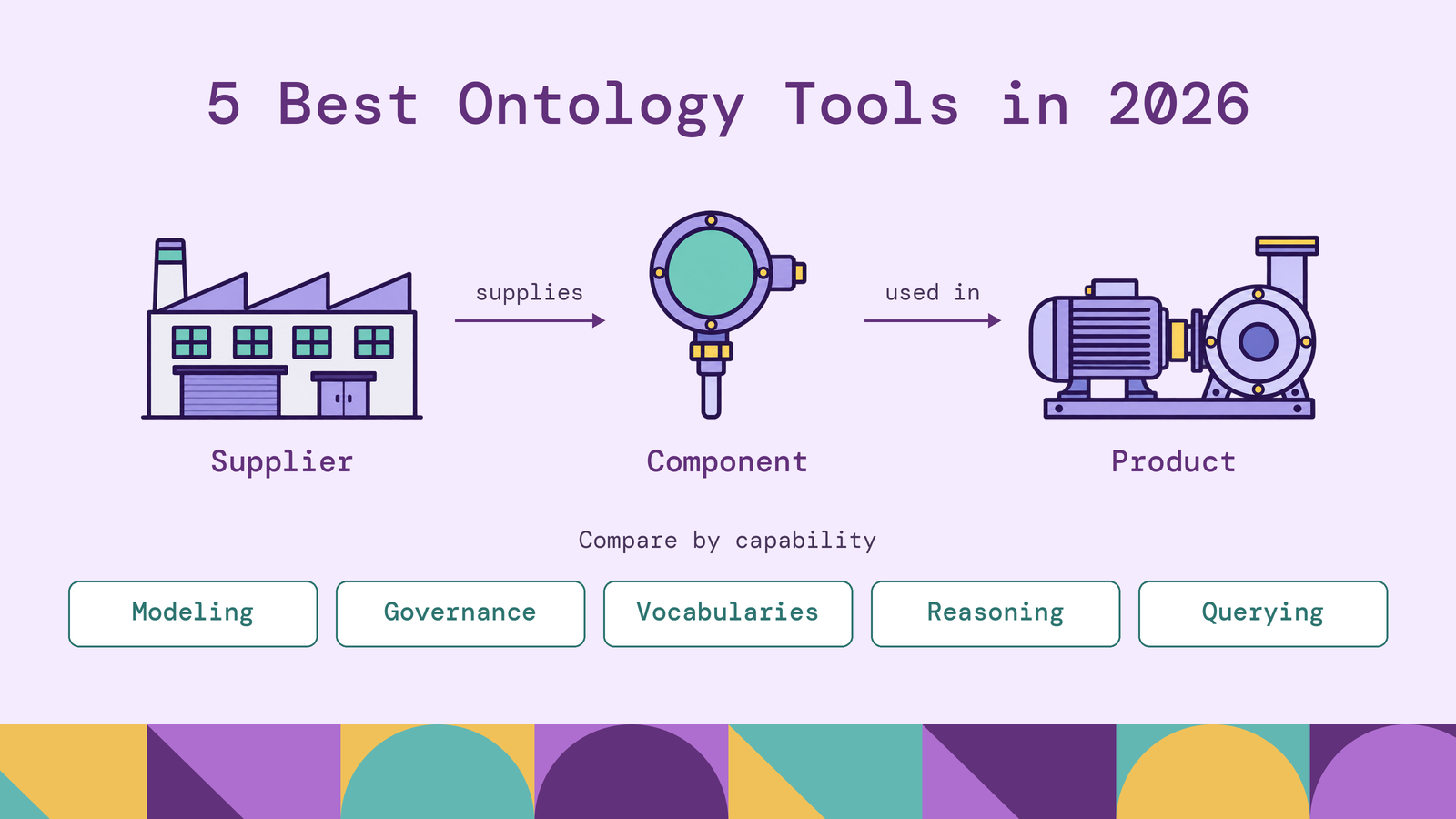
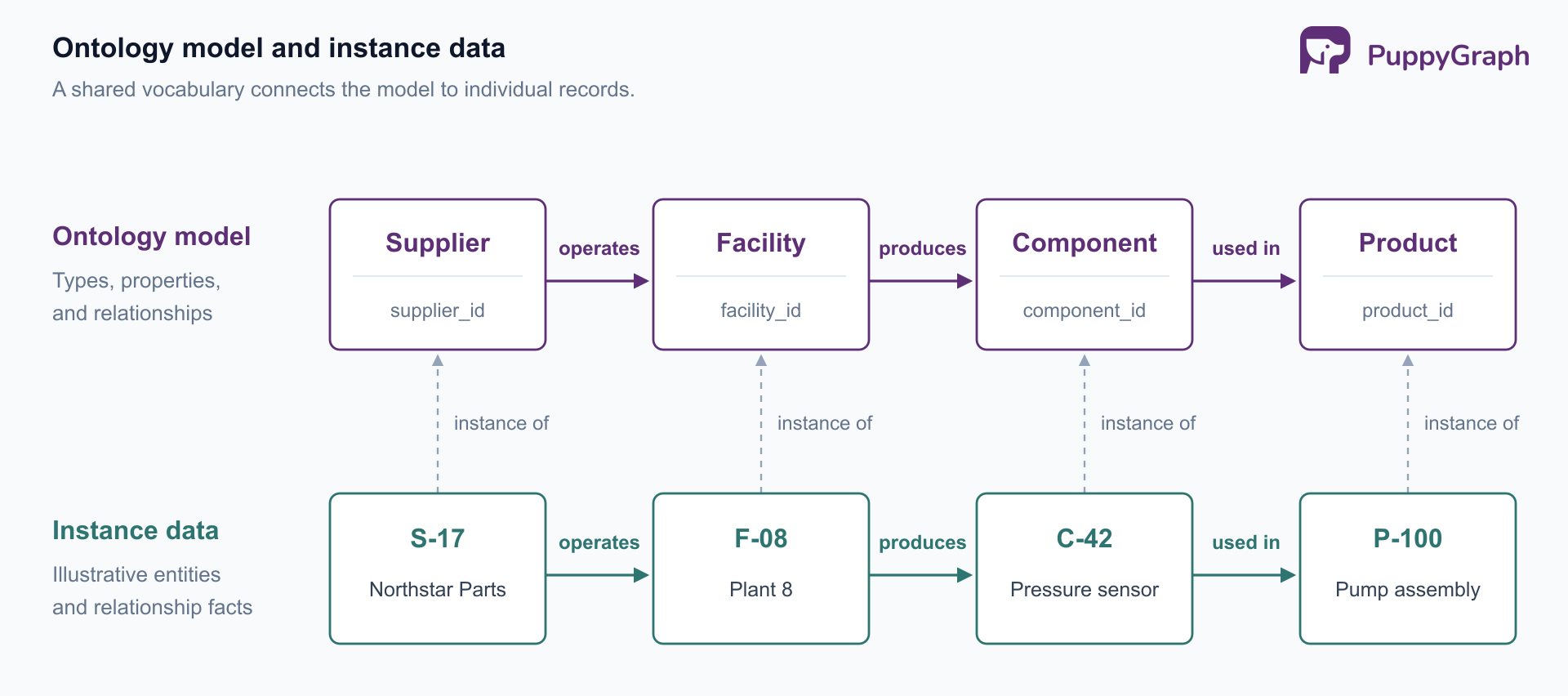
Ontology software helps teams create, maintain, or apply an explicit model of a domain. That model defines concepts, their properties, and relationships, and may include formal axioms that support inference. An ontology for manufacturing might distinguish Supplier, Facility, Component, and Product, with relationships describing who operates a facility and which components go into a product.
The ontology describes the domain; instance data records particular suppliers, facilities, and products. A knowledge graph connects those records using the model's vocabulary. Keeping the distinction clear prevents a common purchasing mistake: selecting an ontology editor when the project also needs data integration and query execution.
Different representations serve different needs. OWL supports formally defined classes, properties, and axioms. SKOS represents controlled vocabularies, including labels and broader, narrower, and related concepts. A property-graph schema can express a domain model through typed entities and relationships, but sharing concept names with an OWL ontology does not give it the same inference semantics.
Ontology management software adds ways to maintain the model over time, such as collaborative editing, review, release management, and integration interfaces. Some products concentrate on authoring; others combine governance with knowledge-graph services. Evaluate the particular responsibilities your project needs rather than treating every product in the category as interchangeable.
What to look for in ontology management software
Start with an example model, representative data, and questions the system must answer. Feature lists become more useful when you can test them against a specific relationship or change request.
Modeling expressiveness and interoperability. Determine whether the project needs OWL axioms, SKOS vocabularies, SHACL constraints, or a property-graph schema. Check which constructs the tool can edit, export, and execute. Importing an ontology file does not establish that every axiom affects query results. For an existing ontology, test a round trip through export and reimport, including identifiers, annotations, and dependencies.
Reasoning, validation, and query checks. These capabilities answer different questions. Reasoning derives consequences from definitions and facts. SHACL validates RDF data against declared conditions. Query-schema checks detect references that do not match the exposed model. Under OWL's open-world semantics, missing information is not automatically false, so logical consistency alone cannot establish that a record contains every required field. Test each required behavior separately.
Collaboration and change control. Domain experts need to review definitions, while engineers need to inspect mappings and consumer impact. Look for appropriate permissions, change history, discussion, and approval mechanisms. Exercise a meaningful change, such as separating a supplier organization from its physical sites. Check how reviewers see the difference and how applications adopt the revised model without silently changing their interpretation of existing data.
Data access and application integration. Establish where instance data lives, how it becomes queryable, and who maintains its mappings. A platform may load data into an RDF store, query external sources through virtual mappings, or expose source tables as a property graph. Test freshness, source-system load, identifiers, and the query interface your application uses. If an AI assistant consumes the model, examine its generated queries and supporting records as well as its final answer.
Operating cost and ownership. Include licenses, hosting, support, mapping maintenance, and the staff time needed to review model changes. Free software can still require substantial ontology expertise. A commercial suite can reduce integration work while introducing configuration and administration responsibilities. Ask who will maintain the system after the pilot and whether that person can reproduce a release and diagnose a failed query.
The strongest evaluation follows a complete change from proposal to application behavior. That reveals whether the tool supports your operating process, beyond whether it can draw the initial model.
5 best ontology software & tools
These five tools cover complementary parts of ontology work. The recommendations below reflect their documented capabilities and the workflows those capabilities support, rather than a benchmark ranking. Each entry identifies a useful starting point and the main issue to validate during a pilot.
Protégé
Protégé is a strong starting point for teams whose main deliverable is a formal OWL ontology. It is free and open source, with a desktop editor and a browser-based collaboration environment, WebProtégé. Its focus makes it useful for ontology engineers who need to inspect definitions and understand their logical consequences.
Protégé Desktop supports OWL 2 editing and connects to description-logic reasoners. Its tools help users inspect inferred relationships, understand explanations, and refactor ontologies. For example, a modeler could define classes for manufacturers and suppliers, then investigate whether the axioms classify organizations as intended. This is valuable when correctness depends on the model's formal meaning rather than only its labels.
WebProtégé adds shared editing, permissions, discussions, and revision history. That gives domain experts a way to review terminology without coordinating local copies of the ontology. Treat the desktop and web environments as related tools with different workflows; evaluate the features your contributors need in the interface they will actually use.
The practical trade-off is the surrounding application work. Plan separately for source-data integration, production query services, and deployment of approved ontology releases. Protégé earns a place when careful ontology authoring is the central task, and the team is prepared to assemble the services that consume its output.
TQ Data Foundation
TQ Data Foundation is TopQuadrant's ontology and governance platform, described by the company as the next iteration of TopBraid EDG. It is a strong candidate when several teams must maintain shared definitions through an explicit governance process.
The platform manages ontologies as asset collections. Its ontology tooling emphasizes SHACL-based modeling and also supports RDFS and OWL. Classes and property shapes define the structure of managed assets, including constraints on their values. This connects the model to the forms and checks people use while maintaining the data.
Its workflow system isolates proposed changes from production collections and provides review, approval, and commit steps. Permissions or governance roles can determine who moves a change between states. A procurement team, for example, could propose a revised supplier definition while designated reviewers examine it before publication.
Choose it when governance is a recurring operational requirement, with identified owners and consumers across domains. Budget for configuring the collections, permissions, and workflows around that process. During evaluation, test how a model change affects existing assets and downstream applications. If the project requires particular OWL inferences, demonstrate those behaviors explicitly; support for OWL models and SHACL-based editing should not be treated as equivalent capabilities.
Graphwise Graph Modeling (formerly PoolParty)
Graphwise Graph Modeling, formerly PoolParty, is well suited to teams building ontologies from established taxonomies and controlled vocabularies. Its modeling tools emphasize SKOS-based knowledge organization, multilingual vocabularies, and connections between taxonomies and richer domain relationships.
The ontology management documentation describes creating or importing ontologies, defining classes, relations, and attributes, and selecting them into custom schemes. Those schemes provide views of the model that extend thesauri or support other applications. This is a useful progression for a content team that already manages product categories and now needs relationships connecting products to technologies, standards, or subjects.
The wider platform also connects knowledge models to text processing. Graphwise's Semantic Analytics component extracts concepts and entities from text and uses vocabulary-based annotation to enrich content. That makes the toolset relevant to semantic search, document classification, and retrieval systems where consistent terminology helps connect documents written by different teams.
Evaluate the authoring and content-processing components together if both are required. A successful ontology demo does not establish that tagging quality meets your needs: test ambiguous terms, unfamiliar abbreviations, and documents with overlapping subjects. For a project centered on formal inference, verify the required axioms and reasoning behavior separately. Graphwise's toolset fits teams connecting maintained terminology and richer models to the content applications that use them.
Stardog
Stardog is a strong candidate when the ontology must participate in querying enterprise data through RDF and SPARQL. Its Designer provides a visual environment for data models and mappings, using OWL and RDFS for model definitions. Teams can publish modeled concepts and their source mappings into the query environment.
Stardog's inference engine performs reasoning at query time. With reasoning enabled, results can include consequences of supported schema axioms and rules without storing every inferred statement in advance. If a model declares Manufacturer a subclass of Supplier, a supplier query can include manufacturers even where source records only state the narrower classification.
Its virtual graphs map external data into the graph and allow queries against that data in place. Stardog rewrites relevant parts of SPARQL into source-native queries, such as SQL, and combines the results. It can also query local and virtual data together, so a separate copied dataset is not required for every source.
The evaluation should focus on mappings, supported inference behavior, and representative queries across actual sources. Test what happens when a source is unavailable or a mapping changes, and measure source load alongside response time. Stardog fits teams that want semantic modeling, reasoning, and data access in one platform and can invest in maintaining that integrated environment.
PuppyGraph
PuppyGraph is the first and only zero-ETL graph query engine that lets teams query existing relational data as a graph without building a separate graph ingestion pipeline. Its fit in an ontology toolset is applying a domain model to data already held in SQL databases, data warehouses, and data lakes or lakehouses. Teams define a graph schema that maps source tables into entities, relationships, and properties. The default direct-query path requires no persistent duplicate dataset, keeping the modeled relationships connected to the existing data platform.
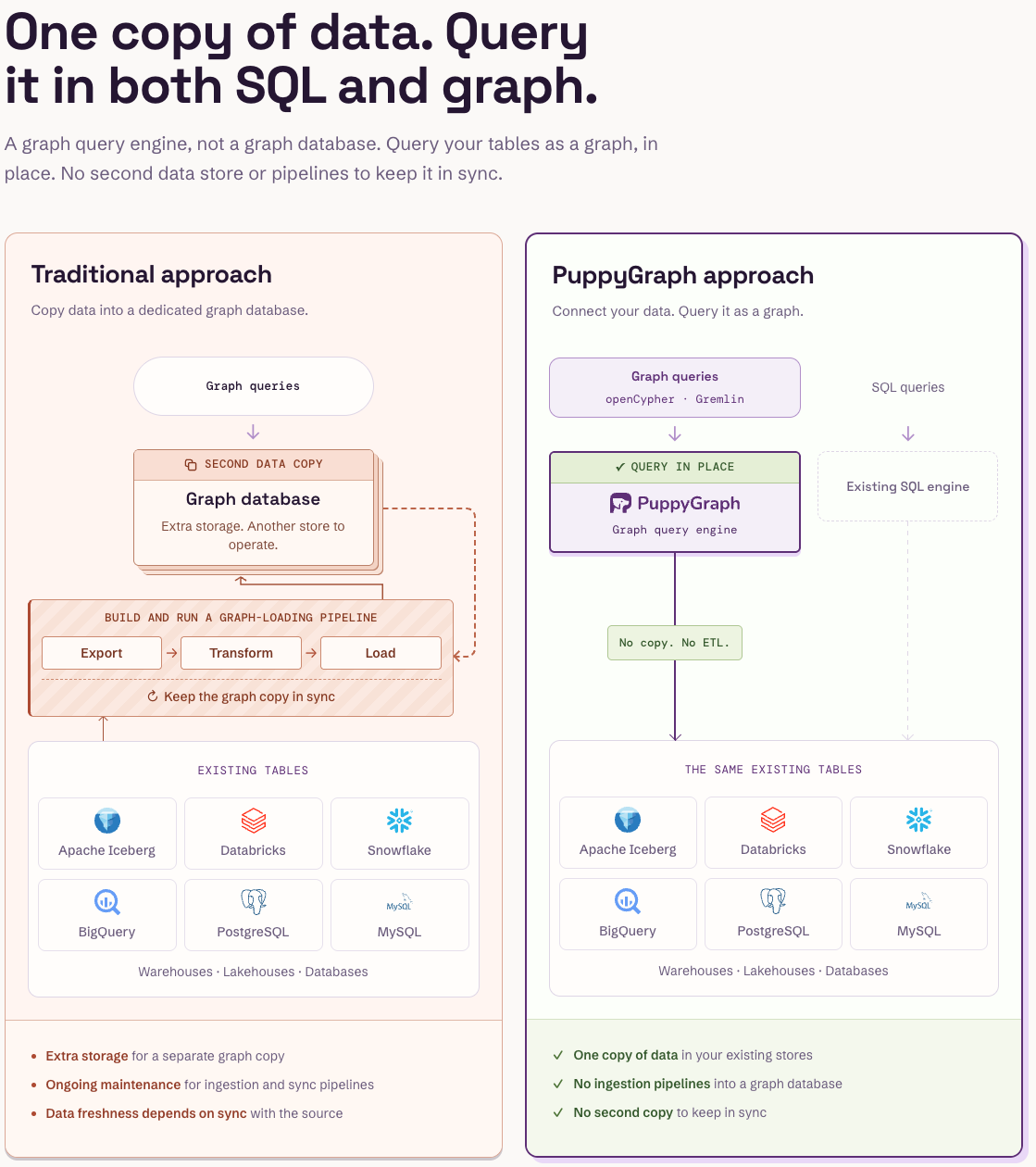
For the manufacturing example, that model could connect suppliers, facilities, components, and products so analysts can investigate which products depend on a disrupted supplier. Applications query these relationships through openCypher and Gremlin, using domain entities instead of reconstructing their table mappings in every investigation. PuppyGraph also supports exporting and importing the schema as JSON, allowing teams to version the mappings alongside their definitions and query tests. This makes it a useful choice when the immediate requirement is putting an agreed semantic model to work across existing data.
For AI-generated queries, PuppyGraph's openCypher schema validation can identify unknown labels, undefined properties, and relationship patterns absent from the model. It produces warnings by default; an opt-in strict mode can fail a query on a mismatch. An application can use that feedback to request a corrected query, while continuing to test whether the result answers the user's question. Its role here is querying and checking references against a mapped property-graph model. Projects requiring OWL reasoning or ontology approval workflows should evaluate those requirements separately rather than assuming the graph schema supplies them.
How to choose the right ontology tool
Shortlist by the work that must succeed first. The table summarizes the fit described above and a practical test for each option.
These requirements can coexist. A team may author an ontology in one environment and implement a narrower operational model in another. When combining tools, test which meanings survive the handoff. Exported labels and identifiers are useful, but they do not establish equivalent reasoning or constraint behavior.
Run the pilot with a domain expert and an application owner. Include an incorrect mapping, a changed definition, and a record with missing information. Check whether each problem becomes visible to the person responsible for resolving it. For enterprise AI, add a question that cannot be answered from the available relationships and inspect how the application handles that limit.
Finally, review the full operating cost and exit path. Confirm how to retrieve models, mappings, and history, and whether another team can reproduce the deployment. A successful pilot should demonstrate both a correct answer and a maintainable process for keeping that answer correct as the data changes.
Conclusion
Ontology tools support different responsibilities: defining meaning, governing changes, organizing content, inferring relationships, and querying enterprise data. Choose around the responsibility your project must fulfill, then test the handoffs to the rest of the stack. A useful model has clear definitions, tested mappings, and consumers that behave as expected when it changes.
Try the forever-free PuppyGraph Developer Edition and book a demo with the team to see how openCypher and Gremlin queries connect domain entities across warehouse and lakehouse tables, with no graph-specific ETL, putting your ontology's relationships to work against existing data.

Hao Wu is a Software Engineer with a strong foundation in computer science and algorithms. He earned his Bachelor’s degree in Computer Science from Fudan University and a Master’s degree from George Washington University, where he focused on graph databases.

Get started with PuppyGraph!


Developer Edition
- Forever free
- Single noded
- Designed for proving your ideas
- Available via Docker install
Enterprise Edition
- 30-day free trial with full features
- Everything in developer edition & enterprise features
- Designed for production
- Available via AWS AMI & Docker install