


7 Best Data Intelligence Platforms in (2026)
Enterprise data is scattered across warehouses, lakes, applications, and spreadsheets, and most organizations no longer know exactly what data they have, where it lives, or who is allowed to use it. Data intelligence platforms exist to close that gap: they catalog metadata, trace lineage, enforce governance policy, and increasingly prepare data for AI agents rather than only human analysts. This article explains what a data intelligence platform actually does, how we approached evaluating the category, and walks through seven platforms worth knowing, from established governance suites to newer graph-based approaches. It closes with practical guidance on matching a platform to your organization's data landscape, compliance requirements, and AI ambitions, rather than picking by name recognition alone.
What Is a Data Intelligence Platform?
A data intelligence platform is software that helps an organization understand and govern its own data: what data exists, where it lives, how it moves between systems, who owns it, and whether it can be trusted for a given use. This typically combines a searchable catalog of metadata, lineage tracking that shows how data flows and transforms across pipelines, governance controls that enforce access and quality policy, and, in newer platforms, structures that make data legible to AI agents rather than only to human analysts through a dashboard.
The category grew out of two older, narrower disciplines: data catalogs, which focused on search and discovery, and data governance suites, which focused on policy and compliance. Data intelligence platforms merge both, then add lineage and increasingly AI readiness as a third and fourth pillar. That expansion matters because an AI agent answering a business question needs the same grounding a human analyst needs, arguably more, since the agent has no institutional memory of which tables are stale or which column names are misleading.
The practical trigger for adopting one of these platforms is usually a specific pain point rather than an abstract desire for "better data management." A compliance team facing an audit needs documented lineage for a regulated data element. A data team onboarding new analysts needs a searchable catalog so people stop asking in chat which table is the source of truth. A platform team standing up an AI assistant needs a model of the data that assistant can be grounded against, so it stops generating confident but wrong queries. Each of these triggers points toward a different weighting of the four capabilities, which is why no single platform dominates every use case in this category.
How We Evaluated the Best Data Intelligence Platforms
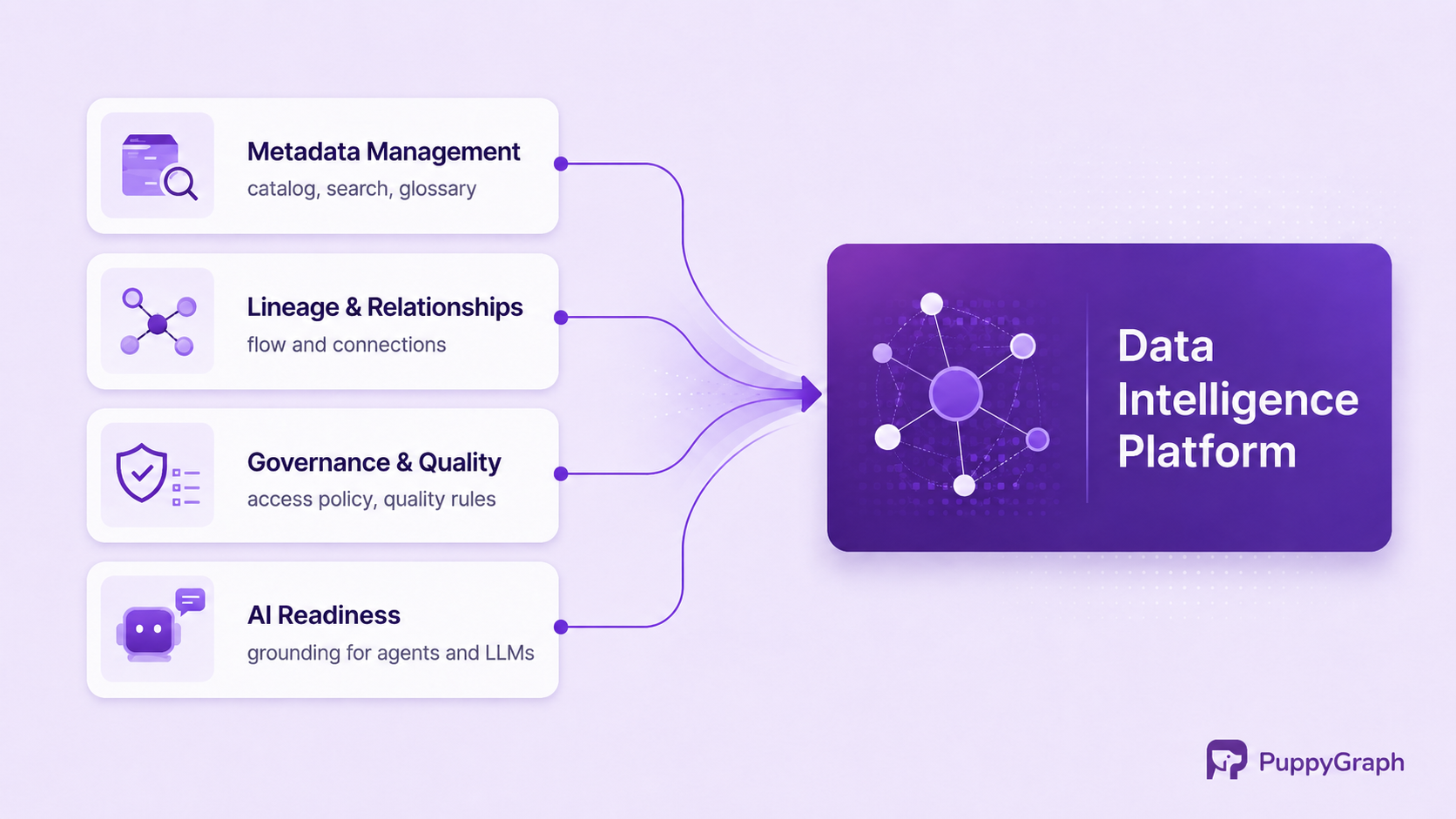
We assessed each platform against the four capabilities that define the category today, drawn directly from what the term "data intelligence" is now expected to cover. Metadata management asks whether the platform can catalog and make searchable the data across an organization's actual sources, not just a subset. Governance and quality asks whether the platform enforces access policy and data quality rules rather than just documenting them. Lineage and relationship visibility asks whether a user can trace how data moves and connects across systems, not just view it table by table. AI readiness asks whether the platform's model of the data is something an AI agent can query and be grounded by, not only something a person reads on a dashboard.
These four criteria are not equally weighted for every organization. A heavily regulated bank will weight governance and lineage more than a startup building AI agents on top of a small warehouse, which will weight AI readiness more heavily. The platforms below are grouped by these capabilities so the comparison reflects that reality, rather than forcing every product into a single ranked list as though one criterion mattered more than the buyer's actual constraints.
We also looked at how each platform reaches an organization's actual data, since a catalog or governance layer is only as useful as the sources it can see. Some platforms connect primarily to a single cloud ecosystem, others integrate broadly across warehouses, lakes, and databases regardless of vendor, and one takes the more structural approach of modeling data directly on top of existing storage rather than describing it from the outside. That distinction matters more as organizations spread data across more systems and expect a single intelligence layer to reason across all of them coherently, rather than maintaining separate documentation per source.
7 Best Data Intelligence Platforms
The seven platforms below span the category's established governance suites, modern catalog products built for cloud-native data teams, and one graph-based approach to metadata and AI grounding. None of the descriptions below include claims we could not source from each vendor's own public positioning; treat this as a starting map for evaluation, not a substitute for a hands-on trial against your own data.
Collibra
Collibra is one of the longest-established enterprise data governance platforms, built around a business glossary, policy workflows, and a catalog that connects technical metadata to business definitions. It is commonly adopted by large, regulated organizations that need documented approval workflows for data access and clear ownership records for audit purposes. Its strength is governance process: getting stewards, data owners, and compliance teams working from a shared vocabulary and a repeatable approval workflow. Teams evaluating Collibra should expect a platform-wide governance rollout rather than a quick point solution, since its value depends on organizational adoption of its workflows as much as on the software itself.
That same thoroughness is also the main adoption cost. Configuring glossaries, ownership hierarchies, and approval chains for a large enterprise takes real implementation time, and the platform generally rewards organizations that already have a data governance function in place to drive that rollout, rather than one just starting to formalize the practice. Organizations without dedicated governance staff often underuse the workflow features and end up treating Collibra primarily as a catalog, which understates what the platform is built to do and leaves much of its governance value on the table.
Best for: large, regulated organizations that need documented, auditable governance workflows more than lightweight discovery.
Alation
Alation positions itself around active metadata and data catalog search, with a strong emphasis on helping analysts find trustworthy data quickly through search, popularity signals, and stewardship annotations. It has built out governance and data quality features alongside its catalog core over time. Organizations that adopt Alation are typically trying to solve a discovery problem first: analysts spending too much time asking colleagues which table is authoritative. Its catalog-first origin means the search and browse experience tends to be a central strength, with governance and lineage features layered on around that core rather than being the platform's original design center.
Because search and stewardship annotations are central to the product, Alation deployments tend to succeed or fail based on whether analysts actually adopt the habit of documenting and endorsing datasets as they use them. A catalog populated automatically but never annotated by the people who understand the data reverts to a technical inventory rather than the trusted, socially validated resource the product is designed to become. Organizations considering Alation should weigh how much cultural buy-in they can realistically get from analysts to keep annotations current, since that ongoing participation is where most of the platform's value comes from.
Best for: data teams whose main problem is discovery friction, where trustworthy search matters more than governance workflow.
Atlan
Atlan is a newer entrant built for cloud-native data teams, emphasizing integration with the modern data stack and a collaborative, developer-friendly interface over the more workflow-heavy governance model of older suites. It markets itself around active metadata that updates as pipelines run, rather than metadata that goes stale between manual catalog refreshes. Teams already standardized on modern data stack tooling, such as cloud warehouses and transformation frameworks, tend to find Atlan's integrations and interface a more natural fit than legacy governance suites designed before that stack became common. Its governance capabilities are generally considered less mature than Collibra's for organizations with heavy regulatory obligations.
Atlan's design center is the working data team rather than the compliance office, which shows up in details like collaborative annotations that resemble a project management tool more than a formal glossary review process. This makes it easier to get lightweight, ongoing engagement from data engineers and analysts, but organizations with strict, auditable approval requirements for data access may still need to layer a more formal governance process on top rather than relying on Atlan's collaboration features alone to satisfy an audit.
Best for: cloud-native data teams that want active, collaborative metadata without a heavyweight governance rollout.
Informatica
Informatica offers metadata management and governance as part of a much broader enterprise data management portfolio that also includes data integration, master data management, and data quality tooling built over several decades. Its data governance and catalog products benefit from deep integration with its own data integration pipelines, which is a natural fit for organizations already running Informatica for ETL or MDM. The tradeoff is that adopting its governance layer often means buying into a broader Informatica ecosystem, which suits enterprises already standardized on the vendor but is a heavier commitment for teams that only need cataloging and lineage on top of a different existing stack.
Its longevity is also a genuine advantage for large, complex environments: Informatica has had years to build connectors and mappings for the kind of legacy systems, mainframes, and heterogeneous databases that still run core operations at many large enterprises, coverage that newer, cloud-native catalog products have not always had reason to build. Organizations with a genuinely mixed estate spanning decades of accumulated systems, not just a modern cloud warehouse, are more likely to find that breadth valuable than teams running a comparatively clean, recent data stack.
Best for: large enterprises already standardized on Informatica for integration or master data management.
Microsoft Purview
Microsoft Purview is a unified data governance and compliance service built natively into the Azure ecosystem, covering data mapping, cataloging, lineage, and information protection across Microsoft's own data services and, to a growing degree, external sources. Its clearest advantage is for organizations already committed to Azure and Microsoft 365, where Purview's compliance and classification features integrate directly with existing identity and security tooling. Organizations with a multi-cloud or heavily non-Microsoft data estate typically find its coverage less complete outside the Azure ecosystem than a vendor-neutral catalog product would offer.
The pricing and packaging also follow the Azure consumption model rather than a traditional enterprise software license, which can make Purview easier to start with for a team already paying for Azure services, since there is less separate procurement friction. That same integration depth is a lock-in consideration in the other direction: organizations that later diversify their cloud footprint may find that governance policies and classifications built around Purview's Azure-centric model do not transfer cleanly to a vendor-neutral platform, which is worth weighing before committing broadly.
Best for: organizations already standardized on Azure and Microsoft 365 that want governance native to that ecosystem.
Ataccama
Ataccama ONE combines data cataloging with automated data quality management, positioning data quality rules and cataloging as a single integrated workflow rather than separate tools. This is a meaningful differentiator for organizations whose primary data intelligence problem is trust in the data itself: duplicate records, inconsistent formats, and unvalidated fields, rather than discovery or policy documentation. Teams for whom data quality remediation is the immediate priority, ahead of governance workflow or AI readiness, are the clearest fit for Ataccama's combined approach, since its cataloging features are built around surfacing and fixing quality issues rather than serving as a standalone discovery layer.
Its automation-first approach to quality rules also reduces some of the manual rule-writing burden that older data quality tools required, since profiling and rule suggestion are built into the same workflow as cataloging rather than handled by a separate team with a separate tool. Organizations evaluating Ataccama should still expect to invest time tuning those automated rules to their own data's specific quirks; automated suggestions reduce the starting effort but do not eliminate the need for domain review before quality rules are trusted to run unattended in production.
Best for: teams whose immediate data intelligence problem is data quality, not just discovery or governance documentation.
PuppyGraph
PuppyGraph takes a structurally different approach to data intelligence: instead of building a separate catalog application that documents your data, it models your existing data as a graph, directly on top of your SQL databases, data warehouses, and data lakes, including open table formats like Apache Iceberg, without ETL or a duplicate copy of the data. That graph model functions as an ontology: a queryable structure of entities, relationships, and properties defined once in PuppyGraph's schema designer. Because relationships are first-class in a graph model rather than reconstructed through joins, tracing how a customer record connects to transactions, support tickets, and account changes is a direct traversal rather than a chain of table lookups documented separately in a catalog.
Where PuppyGraph diverges most clearly from the other platforms here is AI readiness. Every query against that graph, whether written by a person or generated by an AI agent, is checked against the ontology before it runs; a reference to an entity or relationship that does not exist in the schema is rejected, with structured feedback explaining the violation in domain terms. That enables a self-correction loop for AI agents, which PuppyGraph's own built-in AI assistant uses to turn natural-language questions into valid graph queries. Organizations like AMD have used this approach to build a graph layer over Apache Iceberg spanning tickets, code, logs, and telemetry; Coinbase, eBay, Dawn Capital, and Prevalent AI apply the same underlying model to their own data. For teams whose data intelligence priority is grounding AI agents against real relationships in enterprise data, rather than maintaining a documentation layer for humans, this is a fundamentally different starting point than a traditional catalog.
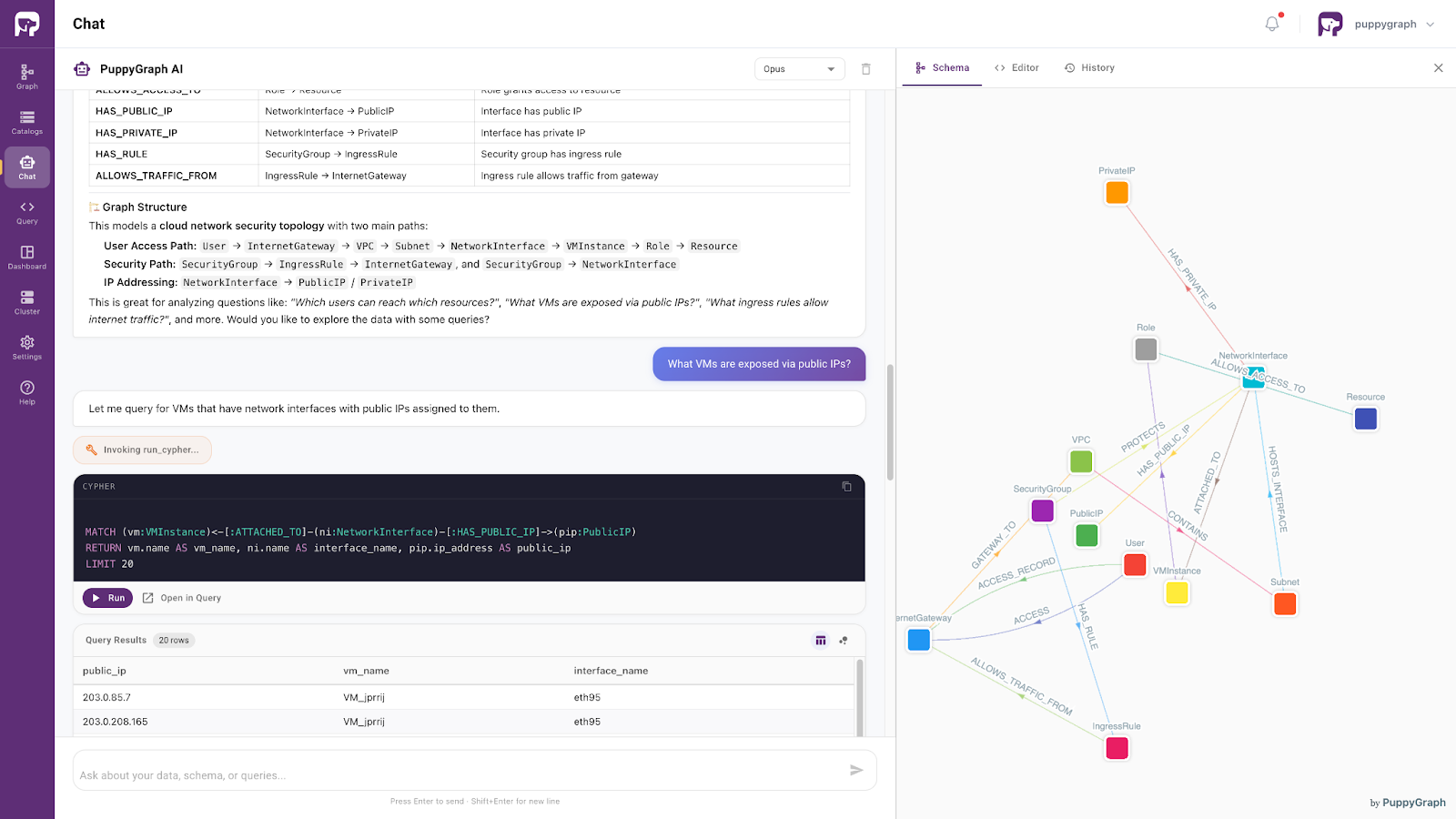
Figure: PuppyGraph AI assistant using graph-based semantic context to answer natural language questions
This also changes what "metadata management" means in practice. In a traditional catalog, metadata is a description that sits beside the data and can drift out of date as the underlying tables change. In PuppyGraph, the graph model is the access path itself: because PuppyGraph is a query engine that compiles graph queries into its own execution plan rather than a documentation layer describing tables from the outside, the ontology and the live data cannot silently diverge the way a catalog entry and its underlying table can. That is a narrower claim than full governance coverage, PuppyGraph does not replace policy workflow or compliance reporting, but it is a meaningfully different answer to the question of how an organization keeps its model of its own data accurate over time.
Best for: teams whose priority is grounding AI agents and human analysts in real, enforced relationships across existing data, without a separate ETL or documentation project.
How to Choose the Right Data Intelligence Platform
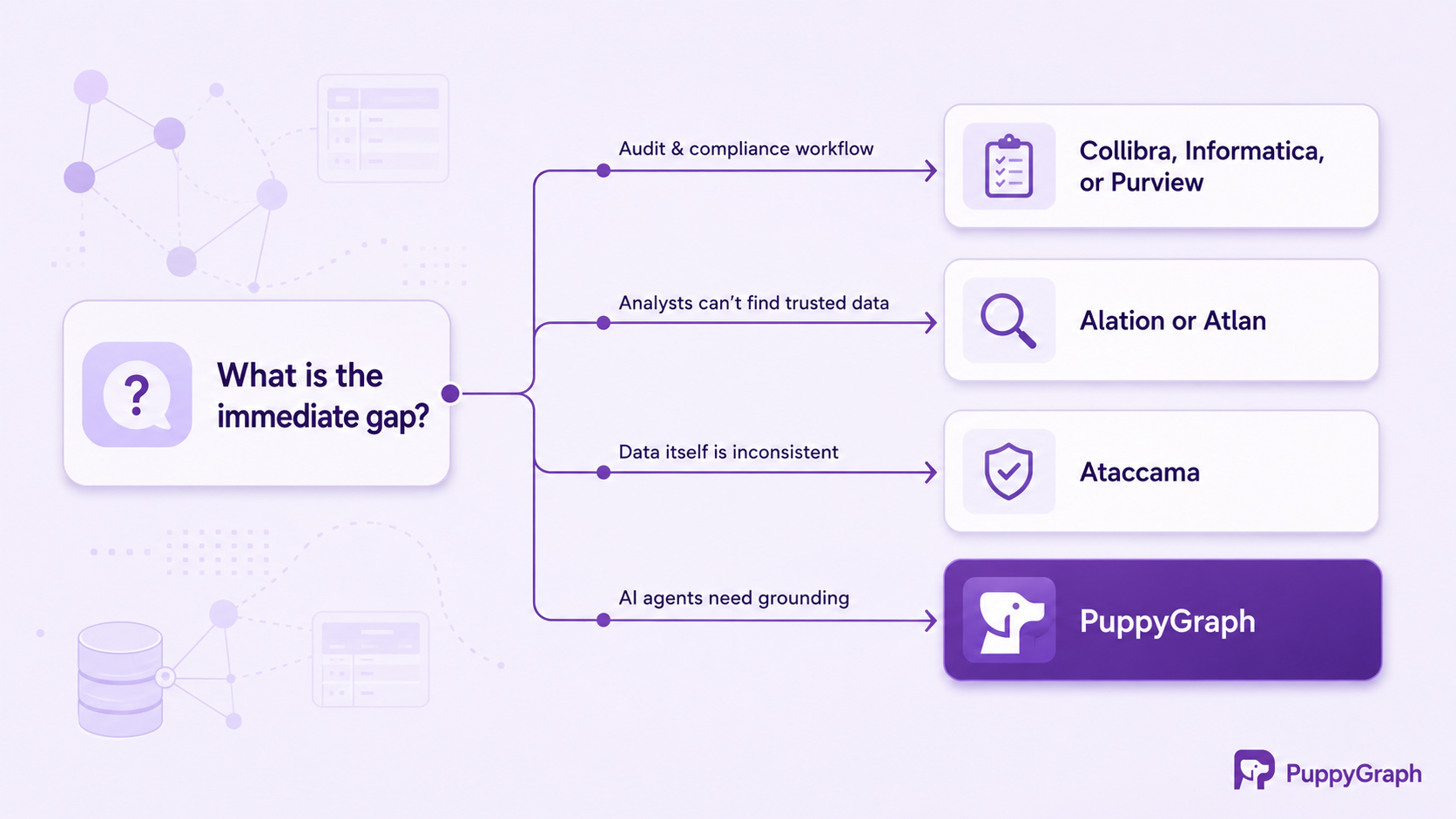
The right platform depends more on which of the four capabilities matters most to your organization right now than on overall market reputation. A regulated enterprise with active audit obligations should weight governance workflow and documented lineage heavily, which points toward Collibra, Informatica, or Purview depending on existing vendor commitments. A data team frustrated by discovery friction, where analysts cannot find or trust the right table, is better served by a catalog-first product like Alation or Atlan. A team whose most pressing problem is dirty, inconsistent data should look closely at Ataccama's combined quality and cataloging workflow before adding a separate catalog on top.
Existing infrastructure commitments narrow the list further. Heavy Azure and Microsoft 365 usage makes Purview's native integration hard to ignore; a stack already running Informatica for integration or MDM gets more value from its governance layer than a standalone tool would provide. Teams building or planning AI agents against enterprise data, where the risk is not missing documentation but an agent generating a plausible, wrong query against real systems, should evaluate PuppyGraph's ontology approach directly, since grounding and self-correction address a failure mode the documentation-first platforms were not built to catch. In practice, most organizations end up combining a governance or catalog platform for compliance and discovery with a graph-based layer for AI grounding, rather than expecting one product to cover every capability equally well.
It is also worth being honest about the limits of any single evaluation, including this one. Vendor capabilities change faster than any comparison article can track, packaging and pricing models shift, and the right answer for a five-person data team is rarely the right answer for a regulated bank with a dedicated governance function. Treat the groupings above as a starting shortlist for a proof of concept against your own data and your own queries, not as a final decision. The platforms that look strongest on a vendor's website are not always the ones that hold up once real users, real edge cases, and real data quality problems show up in a trial environment.
Conclusion
Data intelligence platforms solve overlapping but distinct problems: cataloging what data exists, governing who can use it, tracing how it moves, and, increasingly, grounding the AI agents now querying it directly. Collibra, Alation, Atlan, Informatica, Microsoft Purview, and Ataccama each anchor on a different combination of governance, discovery, and quality, built up over years of enterprise adoption in those areas. PuppyGraph approaches the same category from a different starting point, modeling data as a graph and enforcing that model against every query, which makes it the clearest fit when AI readiness, not documentation, is the priority. No single platform wins on every axis, so the right choice depends on which capability your organization is actually missing today.
If AI readiness and ontology grounding are the gap in your current stack, PuppyGraph's Developer Edition is forever-free to try. To walk through how it would model your specific data, you can book a demo with the team.

Hao Wu is a Software Engineer with a strong foundation in computer science and algorithms. He earned his Bachelor’s degree in Computer Science from Fudan University and a Master’s degree from George Washington University, where he focused on graph databases.

Get started with PuppyGraph!


Developer Edition
- Forever free
- Single noded
- Designed for proving your ideas
- Available via Docker install
Enterprise Edition
- 30-day free trial with full features
- Everything in developer edition & enterprise features
- Designed for production
- Available via AWS AMI & Docker install