


Data Mesh vs Data Lake: Key Differences & Use Cases
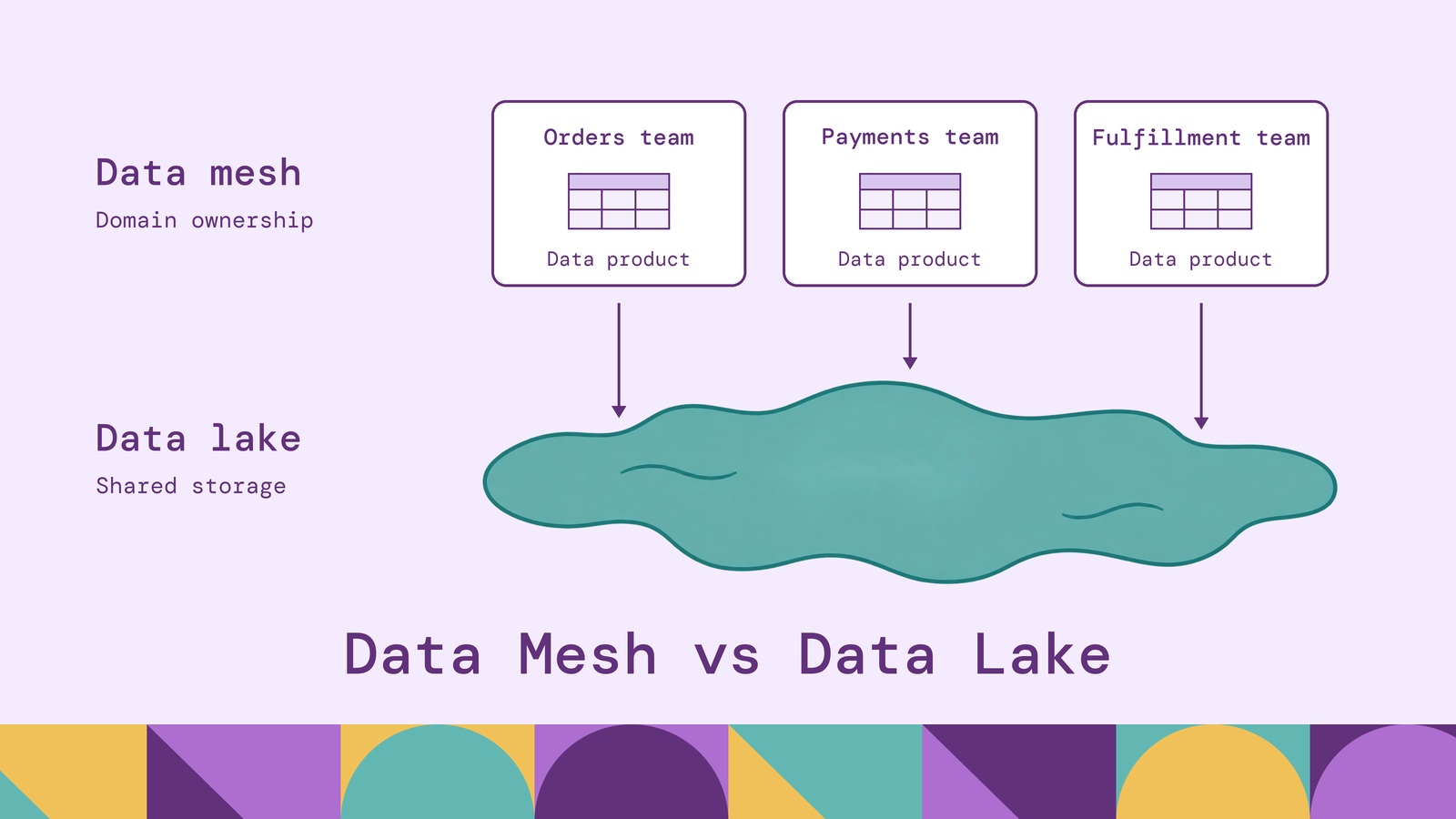
The data mesh vs data lake decision involves two different problems: organizing responsibility for analytical data and providing infrastructure to store and process it. A company can have ample storage capacity while every new dataset waits on an overloaded central team. It can also distribute responsibility across teams while still needing a shared place to retain data.
These problems call for different investments, and many organizations need both. This guide compares the architectures, ownership models, performance considerations, and use cases, then explains how to combine them without confusing decentralization with physical separation.
What is a data mesh?
A data mesh is an approach to analytical data management that gives business domains responsibility for delivering usable data to other teams. It combines an organizational model with an architecture for publishing, discovering, and consuming data products.
Zhamak Dehghani's Data Mesh Principles and Logical Architecture defines four principles that work together:
Domain ownership. Teams responsible for business areas, such as payments or fulfillment, also own the analytical data those areas produce. Ownership includes maintaining meaning and quality as source systems change.
Data as a product. A dataset has consumers with expectations. Its owner provides documentation, an access interface, quality expectations, and support so other teams can use it reliably.
A self-service data platform. Shared infrastructure handles recurring work such as provisioning, deployment, discovery, and monitoring. Domain teams build products without independently recreating the entire platform.
Federated computational governance. Domain representatives and platform stakeholders agree on common rules, with enforcement automated where practical. Local ownership operates within organization-wide interoperability and governance requirements.
Consider a retailer's payments team. Its analytical product might distinguish payment authorization, capture, and refund events, document their timing, and publish stable transaction identifiers. Finance can then consume those events with a clear route for resolving discrepancies. The benefit comes from assigning responsibility to a team that understands the payment lifecycle and can maintain that interface.
What is a data lake?
A data lake is a repository for structured, semi-structured, and unstructured data. It can retain tables, logs, documents, and other files before every downstream use is known. AWS's data lake overview describes this combination of flexible storage and access through different analytical tools.
A typical cloud implementation combines object storage, ingestion pipelines, catalogs, and processing engines. Raw data can coexist with cleaned and curated datasets. Schema-on-read allows consumers to interpret stored data for particular uses; it does not prevent teams from also publishing tables with explicit schemas.
For example, a manufacturer might retain equipment readings and maintenance records in a lake. Engineers can revisit historical readings when investigating a newly identified failure pattern, while analysts use curated tables for routine reporting.
The lake provides a reusable storage foundation. Teams still need to define what the data means, who maintains it, and which consumers can access it. Those responsibilities can sit with a central team, business domains, or a combination of both.
Data mesh vs data lake: key differences
The comparison is clearest when each row separates the responsibility model from the storage architecture. A lake does not inherently require centralized ownership, and a mesh does not prescribe a particular storage engine.
This distinction changes the purchasing decision. Adding lake capacity cannot assign accountability for a broken payments dataset. Giving the payments team ownership cannot by itself provide durable storage or efficient query execution. Evaluate each investment against the problem it can actually solve.
Data mesh vs data lake: architecture comparison
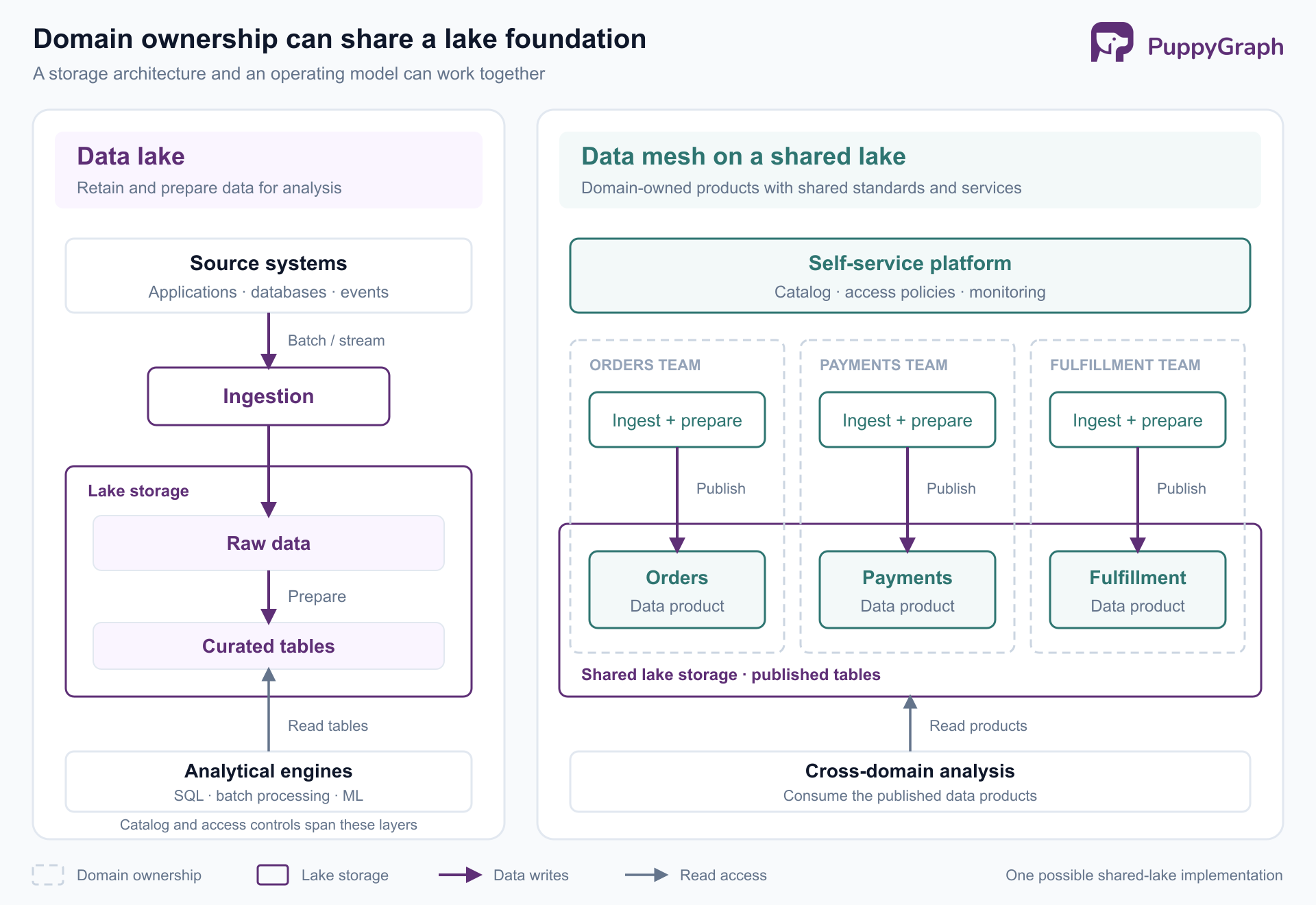
A lake organizes the data processing path. Sources feed ingestion pipelines, which write to storage. Preparation jobs validate and transform records into usable datasets, and analytical engines read them. Catalogs and access controls make those datasets discoverable and govern their use. AWS's lake foundation guidance describes raw, transformed, and curated storage areas as one implementation pattern.
Open table formats add table-management capabilities over files. For example, Apache Iceberg's snapshot and atomic commit model gives readers a consistent table state while writers update it. These capabilities help operate lake tables reliably; they do not determine which team owns their business definitions.
A mesh organizes product boundaries and interfaces. Each domain controls the pipelines and transformations behind its published products. Consumers access those products through agreed interfaces, supported by shared discovery and platform services. An interface might expose a table, a view, or an event stream, depending on the use case.
In the retailer example, orders, payments, and fulfillment can publish separate products on shared infrastructure. A returns-analysis team consumes their published interfaces. Its dependency is on the documented order identifier and event meanings, rather than every internal table used by the source applications.
Data mesh vs data lake: data ownership and governance
Ownership becomes concrete when something breaks. If a refund total changes unexpectedly, someone must explain the business rule, correct the dataset, and communicate the effect to consumers.
In a centrally managed lake, a platform or analytics team may coordinate that work with the source-system owners. In a mesh, the payments data product owner is accountable for the published payment data. AWS's data mesh guidance places this responsibility with domain teams while retaining organization-wide standards.
Federated governance requires an explicit division of decisions. Shared rules might cover identity, access auditing, required metadata, and how products announce breaking changes. Domains define their own business semantics within those rules. Finance and fulfillment can use different definitions of completion, provided each product states what its status means.
For the retailer, an illustrative publication contract could specify that order_id remains stable, timestamps use a documented time zone, refund events distinguish partial from full refunds, and the owner publishes a freshness target. Automated checks can catch missing identifiers or unexpected schema changes. Business review is still needed to decide whether the definitions are useful.
The governance question is therefore practical: who decides, who enforces, and who responds when a contract fails? Buying a catalog helps expose those answers, but the organization must establish the responsibilities behind its entries.
Data mesh vs data lake: scalability and performance
Storage and compute scaling. Cloud lakes commonly separate object storage from processing resources. Retaining more history does not require proportionally increasing always-running compute. AWS's guidance on decoupling storage and compute explains how this allows capacity and costs to be managed separately.
Query performance. Athena, for example, treats service configuration, query design, and data layout as separate performance concerns. Its data optimization guidance highlights partitioning, columnar formats, and file organization. A monthly orders query can avoid unrelated dates when its filters align with the storage layout. Changing the dataset's owner does not change that physical work.
Organizational scaling. Mesh distributes delivery work so multiple domains can maintain products in parallel. Dehghani's original data mesh proposal identifies centralized teams and coupled pipelines as obstacles when sources and use cases proliferate. The intended improvement is responsiveness as organizational complexity grows.
Measure these outcomes separately. For the retailer, track query latency and compute cost alongside the time required to publish a new payments field or resolve a quality incident. A mesh can shorten the delivery queue while an inefficient cross-domain query still needs tuning. Neither architecture label establishes a performance advantage on its own.
Data mesh vs data lake: challenges and limitations
A lake can accumulate data faster than teams maintain it. Missing descriptions, inconsistent schemas, and unclear ownership make stored records difficult to reuse. Microsoft's data lake guidance identifies discoverability, integrity, governance, and processing bottlenecks as recurring challenges. Retaining a file successfully says little about whether an analyst can interpret it correctly.
Mesh requires sustained staffing and incentives. AWS's Data Analytics Lens treats mesh as a design with added architectural complexity and emphasizes organizational readiness. Plan for domain teams to support analytical consumers alongside their operational responsibilities, and fund the shared platform services they depend on. Assigning an owner without funding maintenance leaves consumers with a name but no dependable service.
Cross-domain compatibility needs active work. Payments may identify a transaction, fulfillment a shipment, and customer service a case. Combining them requires documented relationships, compatible identifiers, and clear handling of missing or late events. Independent release schedules make compatibility and communication part of routine product maintenance.
Costs extend beyond storage. A lake budget includes ingestion, transformation, cataloging, and query execution. A mesh budget also includes product ownership, support, and shared platform development. A useful evaluation should account for those costs alongside the time consumers spend interpreting or repairing data.
Both approaches need maintenance. The relevant trade-off is whether the proposed arrangement gives teams enough capacity and authority to keep shared data useful.
Can data mesh and data lake work together?
Yes. A lake can provide the storage foundation for domain-owned data products. Microsoft's domain-oriented mesh pattern on a shared platform explicitly combines domain ownership with shared storage and governance capabilities. Decentralizing accountability does not require a separate storage platform for every team.
For the retailer, orders, payments, and fulfillment could own curated tables in the same lake. The platform team maintains shared infrastructure, while each domain manages its definitions, pipelines, and consumer commitments. An analysis of delayed refunds combines those published products using documented order and transaction identifiers.
Some questions also require following relationships across several products: which returned items belong to orders with split shipments, and which payments still lack matching refunds? A reusable model of those entities and relationships gives consumers a common way to express that analysis across domain boundaries.
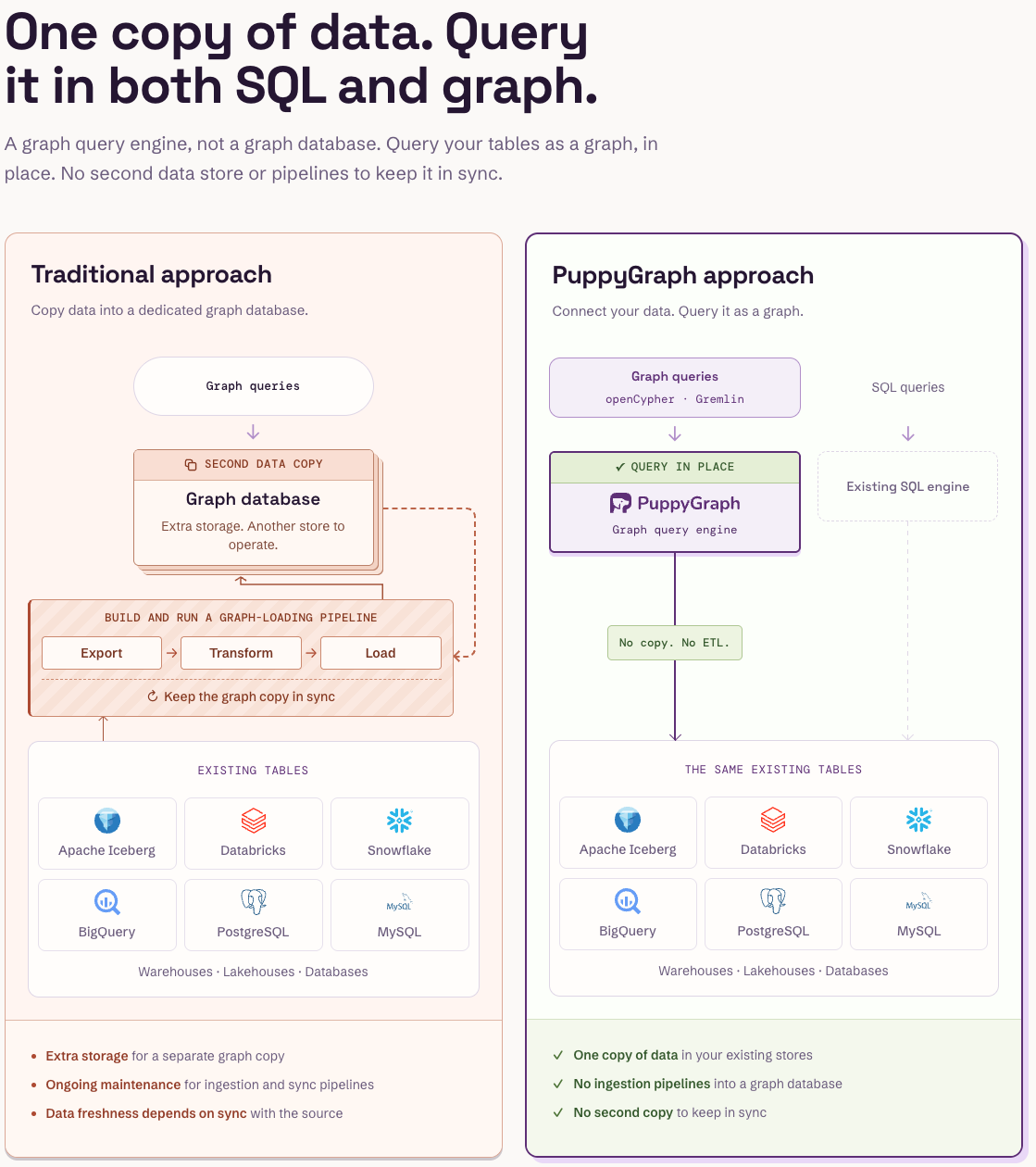
PuppyGraph is the first and only zero-ETL graph query engine that lets teams query existing relational data as a graph without loading it into a separate graph database. It connects to SQL databases, data warehouses, and data lakes or lakehouses, including direct reads of Apache Iceberg and Delta Lake tables. Its direct-query path keeps source tables in place without requiring graph-specific ETL or a persistent duplicate dataset.
Teams define a graph schema that maps source tables and identifiers to entities, relationships, and properties. For this retailer, that model could connect orders to payments, refunds, shipments, and returned items. Analysts query it with openCypher or Gremlin, expressing paths through the business entities. The schema provides a shared semantic layer over products whose maintenance remains with their domain owners.
This fits both a centrally managed lake and a mesh built across supported stores. Domain teams continue to maintain their published interfaces, while the graph model makes their relationships reusable for analysis. Teams must still agree on identifiers, maintain the mappings when contracts change, and configure access appropriately. The benefit is adding relationship queries over existing data without another graph ingestion pipeline to operate.
Data mesh vs data lake: which is best?
Choose the investment that addresses your current constraint. AWS's adoption guidance recommends evaluating mesh against business requirements and alternative architectures before implementation.
Prioritize a lake when retention and analytical reuse are the immediate needs. Examples include preserving equipment telemetry for failure analysis, collecting application events for exploration, or retaining source records for model development. A smaller organization with a manageable delivery workload may operate this effectively through a central team.
Prioritize mesh practices when coordination is limiting delivery. They become relevant when multiple established domains have distinct semantics, frequent changes, and consumers waiting on one central queue. Order-to-cash reporting across commerce, payments, and finance is a candidate when each domain can commit to maintaining its contribution.
Combine them when shared infrastructure already works but accountability does not. Start with a bounded use case that crosses a few domains. Name the product owners, document interfaces, agree on quality expectations, and measure whether consumers can complete the analysis with fewer clarification and repair cycles.
The pilot should test both responsibilities and execution. Confirm who handles a late payments feed, how a schema change reaches consumers, and whether the resulting query meets its latency and cost requirements. Those observations provide a stronger basis for expansion than adopting mesh across the organization at once.
Conclusion
A data lake provides reusable storage and a foundation for analytical processing. A data mesh assigns domain responsibility for delivering dependable data products. They address different constraints and can work together on the same infrastructure. Choose storage and engines around workload requirements, then establish ownership and interfaces that let other teams use the results reliably.
Try the forever-free PuppyGraph Developer Edition and book a demo with the team to see how openCypher and Gremlin queries connect business entities across warehouse and lakehouse tables, with no graph-specific ETL, while domain teams retain ownership of their published data products.

Hao Wu is a Software Engineer with a strong foundation in computer science and algorithms. He earned his Bachelor’s degree in Computer Science from Fudan University and a Master’s degree from George Washington University, where he focused on graph databases.

Get started with PuppyGraph!


Developer Edition
- Forever free
- Single noded
- Designed for proving your ideas
- Available via Docker install
Enterprise Edition
- 30-day free trial with full features
- Everything in developer edition & enterprise features
- Designed for production
- Available via AWS AMI & Docker install