


Delta Lake vs Snowflake: Key Differences & Comparison
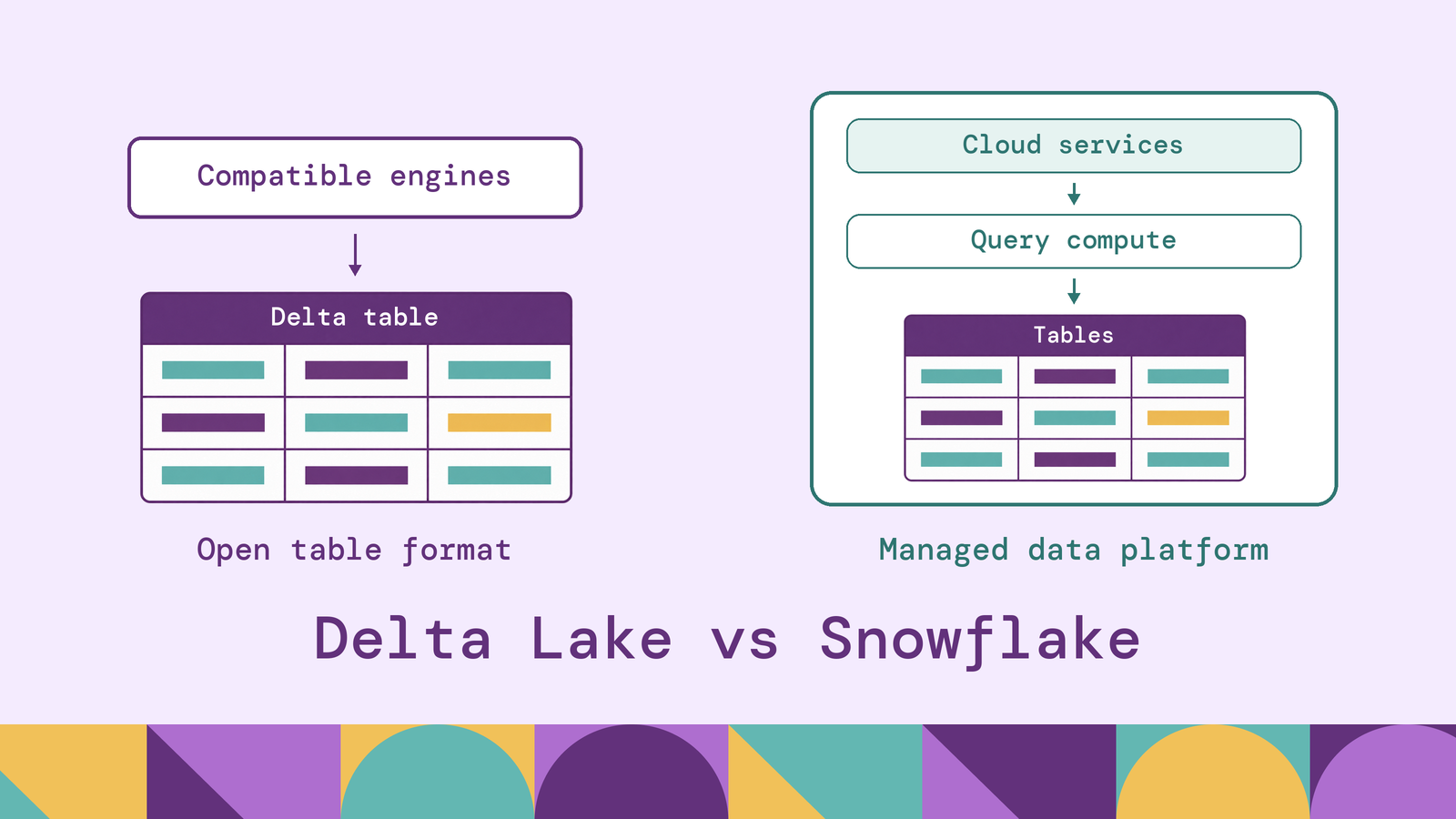
Choosing between Delta Lake and Snowflake means deciding how much of your data platform you want to assemble and operate. Delta Lake supplies an open table format and storage framework for a lakehouse. Snowflake supplies a managed platform with its own query engine, compute services, and administrative controls. Comparing them requires looking at the complete environment around your data.
This guide compares architecture, performance, scalability, cost, and operational trade-offs. It also explains how the two can work together, so the decision can accommodate existing pipelines and analytical workloads.
What is Delta Lake?
Delta Lake is an open-source storage framework that adds transactions and table management to a data lake. Its table format combines Parquet data files with a transaction log that records the table's state. Compatible engines use that metadata to read a consistent table snapshot while other jobs write changes.
Delta Lake supports ACID transactions, schema enforcement, schema evolution, and time travel. Through its Spark integration, a table can serve batch workloads and act as a streaming source or sink. Its update and merge operations support pipelines that apply corrections and changes to existing records, such as updating an order when its status changes.
The project is Apache 2.0 licensed. You choose the surrounding compute, catalog, orchestration, and access controls, either independently or through a managed platform. Delta Lake and Databricks are therefore distinct choices: adopting the table format does not mean every capability of a Databricks deployment comes with it.
What is Snowflake?
Snowflake is a managed cloud data platform that combines storage, query processing, and services for administering data. Snowflake operates the underlying infrastructure and software. Users configure databases, permissions, workloads, and compute resources called virtual warehouses.
Snowflake accounts run on supported regions of AWS, Microsoft Azure, or Google Cloud. SQL analytics is a central use case, but the platform also supports data engineering and machine learning. Snowpark provides libraries and execution environments for working with languages including Python, Java, and Scala.
Snowflake also supports Apache Iceberg tables, including configurations that access data in customer-managed cloud storage. The storage and management model depends on the table type you select.
Delta Lake vs Snowflake: key differences
The practical comparison is a stack built around Delta Lake versus a Snowflake deployment. The table below separates what the format provides from the responsibilities of the surrounding platform.
Two distinctions matter when reading feature comparisons. First, Delta protocol compatibility determines whether a particular reader or writer can use a table. Open storage does not guarantee every engine supports every table feature. Second, Snowflake includes role-based access control within its service, while a Delta deployment's governance depends on the stack around it.
Evaluate those boundaries against your requirements. A team maintaining several analytical engines faces different integration work from a team consolidating reporting in one managed service.
Delta Lake vs Snowflake: architecture comparison
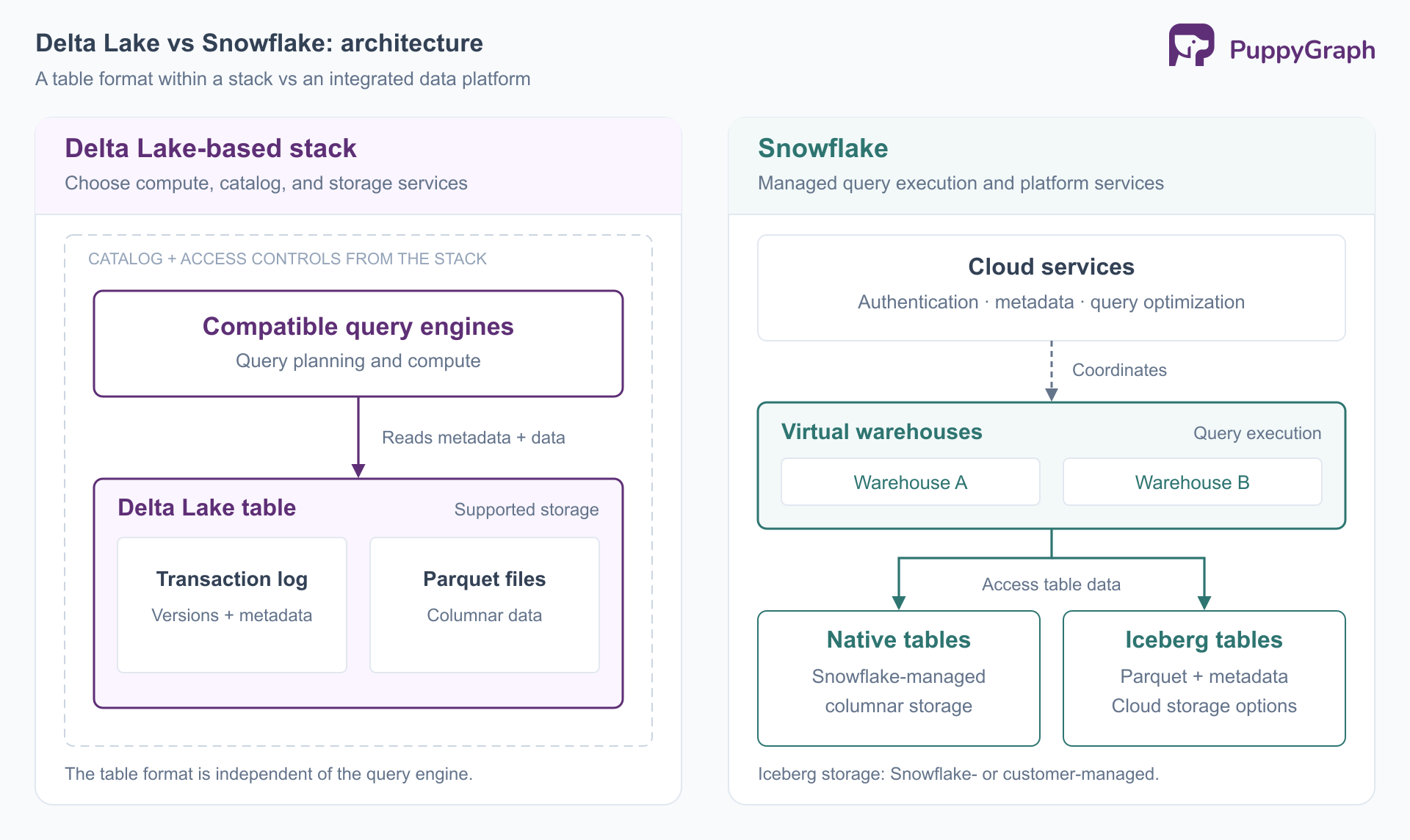
Delta Lake separates the table from the engine. Its transaction log identifies the files and metadata that make up a table version. A compatible engine reads that state and executes the query. With optimistic concurrency control, writers validate proposed changes before committing; conflicting operations can fail and require a retry. The log supplies transactional coordination, while the engine supplies query planning and compute.
Snowflake integrates storage, compute, and cloud services. For standard native tables, Snowflake manages the columnar storage layout. Virtual warehouses execute queries, while cloud services handle coordination such as authentication, metadata management, and query optimization. Separate warehouses provide distinct compute resources for workloads that need isolation. Iceberg configurations add a different storage path, so native-table internals should not be generalized to every Snowflake table.
Performance depends on data layout and execution. Delta Lake's compaction and data skipping reduce small-file overhead and unnecessary reads. The chosen engine and compute environment determine join execution, memory use, and resource allocation. Snowflake uses micro-partition metadata to avoid scanning irrelevant native-table data. Clustering keys can improve pruning for suitable workloads, but maintaining that layout consumes resources.
Scalability has several dimensions. More stored data, a larger individual query, and more simultaneous users create different demands. In a Delta stack, the selected compute service governs resource scaling. Snowflake distinguishes warehouse resizing from multi-cluster scaling: additional clusters primarily address concurrency, while a larger warehouse may help a resource-intensive query. Multi-cluster warehouses require an eligible edition.
A useful evaluation includes selective dashboard queries, large joins, incremental updates, and concurrent ingestion. Measure cold and warm execution, queueing, and total compute consumption. A fast cached report alone says little about how either deployment handles a backfill while analysts are querying.
Delta Lake vs Snowflake: pricing and cost
Delta Lake has no open-source software license fee, but a working lakehouse has operating costs. Budget for storage, object requests, compute, catalog services, orchestration, monitoring, and engineering time. A managed Delta platform adds its own charges. Compaction and backfills consume compute, while retaining historical data consumes storage.
Retention deserves explicit planning. Delta's VACUUM removes obsolete data files according to retention settings. Historical queries require the relevant files and transaction history to remain available. Keeping more history supports recovery and reproducibility, but expands the data footprint; deleting files too aggressively can undermine those requirements.
Snowflake's cost model combines compute, storage, and applicable data transfer charges. Compute uses credits, including virtual warehouses and separately metered services. Warehouse cost depends on resources and running time, not simply the number of queries submitted. Snowflake's compute billing documentation distinguishes warehouse, serverless, and cloud-services consumption.
For native tables, historical storage also contributes to the bill. With externally stored tables, include the cloud provider's storage and request charges. Shared files can avoid a duplicated dataset while leaving query compute and metadata maintenance costs intact.
Compare both approaches against the same service target. Include ingestion, transformations, maintenance, and peak reporting demand over a representative operating period. A team with established Spark operations may absorb a Delta workload efficiently; a smaller team may value the infrastructure work Snowflake handles. Neither an open-source license nor a managed service price establishes lower total cost on its own.
Delta Lake vs Snowflake: pros and cons
Delta Lake advantages. Open tables give teams control over storage and a choice of compatible engines. Existing Spark pipelines can use transactional tables for ingestion, transformation, and downstream analysis. This is useful when one dataset must support engineering workflows, exploratory analysis, and model development through different tools.
Delta Lake trade-offs. The surrounding platform needs deliberate ownership. Someone must manage permissions across access paths, table maintenance, compute reliability, and reader compatibility. A managed service can take on parts of that work, but those capabilities and costs belong to the service you select. File access alone does not establish consistent governance across engines.
Snowflake advantages. Integrated administration and managed infrastructure reduce the components teams operate themselves. Separate warehouses help organize workload capacity, and Secure Data Sharing supports controlled access to selected data by other Snowflake accounts. Those capabilities suit organizations delivering shared datasets to multiple analytical teams.
Snowflake trade-offs. Teams still manage query efficiency, warehouse settings, access policies, and spending. Applications that rely heavily on Snowflake-specific SQL or services carry migration work if the platform changes. Iceberg improves storage interoperability, but does not make every platform feature portable. External storage also introduces permissions and maintenance responsibilities outside the warehouse.
The trade-off is how much operational work and integration control your team wants to retain. Both choices require data modeling and governance; they distribute implementation responsibility differently.
Can Delta Lake and Snowflake work together?
Yes. A Delta pipeline can maintain lakehouse tables while Snowflake supplies SQL analytics over that data. The integration choice determines whether you maintain a second dataset and how quickly readers see updates.
Snowflake's Delta Direct creates a read-only Iceberg table over Delta data in external object storage. Snowflake reads the Delta transaction log and registers the existing Parquet files without copying or rewriting them. Setup uses an external volume, a catalog integration configured for Delta, and a Snowflake Iceberg table definition. The Delta-producing engine retains responsibility for writes.
Metadata still needs refreshing. Snowflake supports automated refresh or an explicit refresh operation; shared data files do not mean every Delta commit becomes immediately visible to Snowflake queries. Validate refresh behavior, permissions, and the documented table limitations against the features your writers use.
Delta UniForm offers another interoperability mechanism: it generates Iceberg metadata asynchronously over the same data files. A suitable catalog integration can expose that representation to Iceberg readers. UniForm is separate from Delta Direct and is not required for Snowflake's direct Delta-log path.
You can also copy curated results into native Snowflake tables when independent transformations or lifecycle management justify a separate dataset. That design needs synchronization and reconciliation. Choose the integration by write ownership, freshness requirements, and downstream behavior, then test updates and schema changes as well as initial reads.
When to choose Delta Lake vs Snowflake
Choose a Delta Lake-based stack when storage control and engine choice are central. It fits teams already operating Spark pipelines, maintaining substantial lake data, or supporting several processing tools. For example, a retailer might keep order events in Delta, apply corrections through merges, and use the same tables for feature engineering and analytical queries. Confirm that every consumer supports the chosen table features.
Choose Snowflake when a managed analytical platform fits the operating model. A finance team serving recurring reports and shared datasets may benefit from centralized administration and independently configured warehouses. Evaluate the complete workload: ingestion, transformations, reporting concurrency, and recovery needs. SQL reporting is a common starting point, but Snowpark also supports programming-oriented processing.
Use both when each has a clear role. Existing Delta pipelines can remain responsible for curated tables while Snowflake serves selected consumers through a supported read path. Start with a representative dataset and test update visibility, permissions, and cost before extending the design. Add a second platform when its contribution justifies another operational boundary.
Relationship analysis introduces a further requirement: a reusable model of entities and their connections. For example, finding accounts linked through shared devices and payment instruments requires following paths across records, whether those records live in a lakehouse or a warehouse.
PuppyGraph is the first and only zero-ETL graph query engine that lets teams query existing relational data as a graph without building a separate graph ingestion pipeline. Its Delta Lake connector reads lakehouse tables through supported catalog and storage configurations; its Snowflake connector accesses warehouse tables through Snowflake. The default direct-query path requires no persistent duplicate dataset, so adding relationship analysis can preserve the storage architecture selected for other workloads.
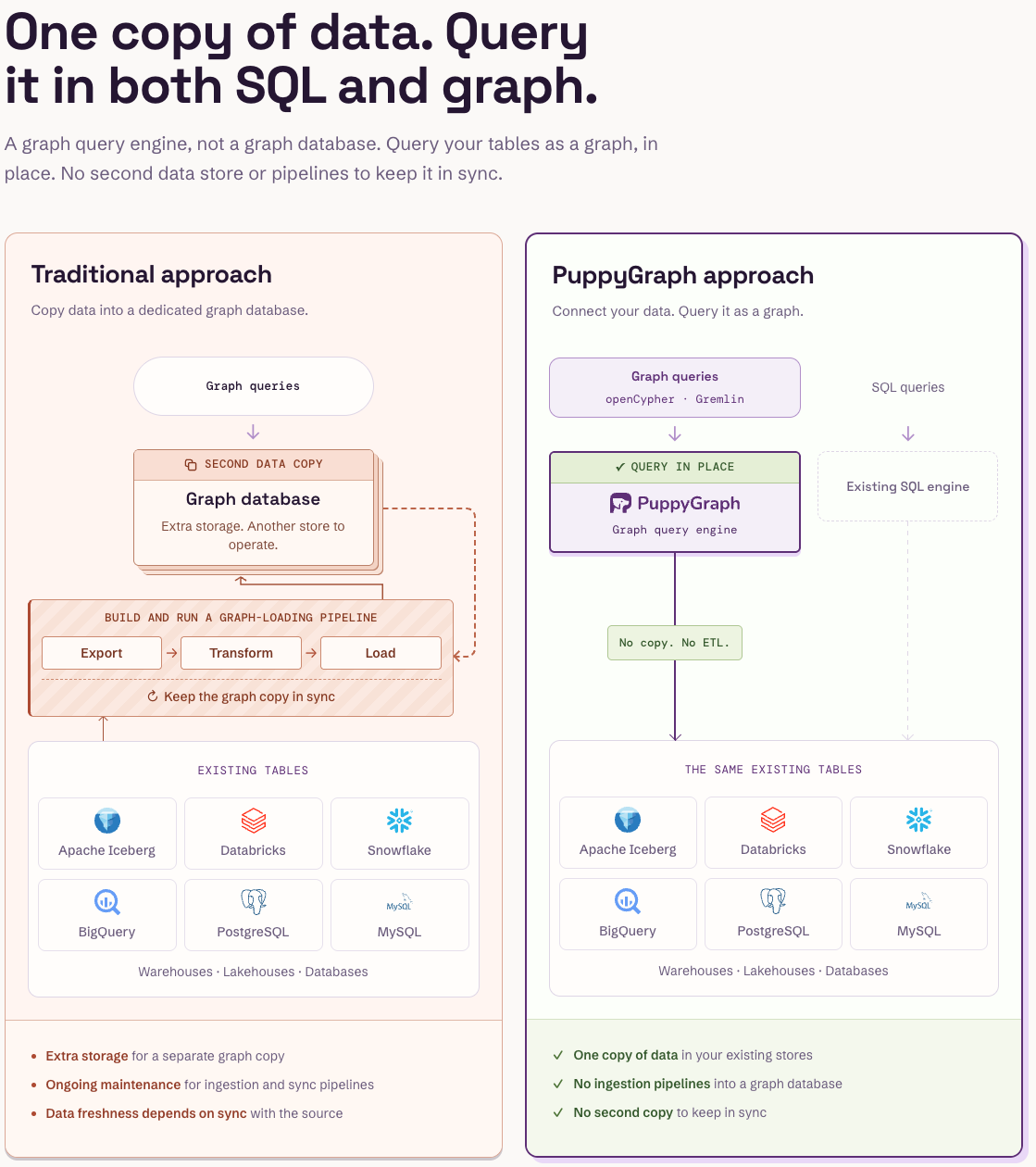
Teams define a graph schema that maps tables and keys to entities, relationships, and properties, then query that model with openCypher or Gremlin. For the account example, the model connects accounts to devices and payment instruments, making shared relationships explicit. Teams supply the mappings and consistent identifiers. This semantic model adds a common vocabulary for relationship questions while existing table-based analytics continue.
PuppyGraph compiles a graph query into a plan of node and edge operators that runs in its own distributed engine. When reading SQL sources, it issues only simple projection and filter SQL; its Delta path reads the open tables directly. This lets the engine optimize specifically for multi-hop traversals. Include PuppyGraph compute and source-read costs in the evaluation, including Snowflake warehouse consumption when using that connector. The benefit is adding graph analysis without making a storage migration a prerequisite.

Conclusion
Delta Lake gives teams transactional open tables and flexibility in the surrounding stack. Snowflake brings query execution and platform administration into a managed service. Choose based on workload behavior, operational ownership, and total cost, with interoperability tested against the actual tables and clients you plan to use.
The two can also coexist. A clear division of write ownership and read responsibilities matters more than treating lakehouse and warehouse as exclusive categories.
Try the forever-free PuppyGraph Developer Edition and book a demo with the team to see how openCypher and Gremlin queries connect entities across warehouse and lakehouse tables, with no graph-specific ETL, while preserving your Delta Lake or Snowflake data architecture.

Hao Wu is a Software Engineer with a strong foundation in computer science and algorithms. He earned his Bachelor’s degree in Computer Science from Fudan University and a Master’s degree from George Washington University, where he focused on graph databases.

Get started with PuppyGraph!


Developer Edition
- Forever free
- Single noded
- Designed for proving your ideas
- Available via Docker install
Enterprise Edition
- 30-day free trial with full features
- Everything in developer edition & enterprise features
- Designed for production
- Available via AWS AMI & Docker install