


Dgraph vs Amazon Neptune: Key Differences & Comparison
Graph databases have become essential for applications that need to model and query highly connected data at scale. Traditional relational databases struggle when traversing multi‑hop relationships or mining connections deep in the dataset, whereas graph databases are purpose-built to perform such tasks with efficiency and clarity. Two prominent examples of graph databases are Dgraph and Amazon Neptune, each with distinctive design philosophies, scalability strategies, and ecosystem integrations. Choosing between them requires an appreciation of their fundamental differences, typical workloads, and operational trade‑offs. This article explores both systems comprehensively, outlining how they compare across data models, deployment models, scalability, performance, query experience, and ecosystem support.
We’ll examine what makes each system unique, how they fare in production scenarios, and which types of applications might benefit from one over the other. Whether you’re building knowledge graphs, real‑time recommendation engines, fraud detection workflows, identity graphs, or semantic web applications, this comparison will help you understand the strengths and boundaries of Dgraph and Neptune. By the end, you’ll also gain insight into when each system fits naturally and the emerging alternatives that might suit evolving graph workloads.
What is Dgraph?

Dgraph is a distributed, horizontally scalable graph database built from the ground up to handle rich relationships and high performance for real‑time use cases. Designed to manage highly connected data, Dgraph stores data as graphs of nodes and edges, where entities and their connections can be traversed with low latency. It’s optimized for horizontal scalability, allowing data to be sharded automatically across nodes as the dataset grows. Unlike some traditional graph systems, Dgraph places a strong emphasis on performance, scale, and developer productivity for graph‑centric applications.
While it is open‑source and usable on your own infrastructure, Dgraph’s distributed nature means that underlying mechanisms automatically balance data and queries across a cluster, so developers don’t have to design sharding strategies manually. Its architecture focuses on low overhead during graph traversals and strong horizontal scale characteristics that help it perform well as graph size grows into billions of relationships. The database is often used in environments where relationship richness and query performance directly impact business value, such as recommendation engines, supply chain models, and identity graphs.
Key features
One of Dgraph’s standout features is its native distributed architecture, which automatically shards data across nodes and can balance load without manual configuration. This architecture supports linear scalability, meaning performance can increase as more machines are added. Additionally, Dgraph offers robust ACID transactions across the distributed system, ensuring data consistency even in concurrent workloads, a major advantage for production systems requiring transactional guarantees.
Another significant capability of Dgraph is its GraphQL‑first query layer (often referred to as DQL), which blends familiar GraphQL syntax with graph traversal semantics. This makes it particularly attractive for developers who want seamless integration with front‑end stacks or who prefer GraphQL for API design. The system also supports advanced indexing strategies and search categories, including full‑text and geo queries. Overall, Dgraph’s blend of scalability, performance, and developer tooling makes it a compelling choice for building fast, responsive graph applications.
What is Amazon Neptune?

Amazon Neptune is a fully managed graph database service offered by AWS, designed for use cases that require consistent performance, high availability, and seamless integration with cloud services. As a managed service, Neptune abstracts many operational tasks such as hardware provisioning, backups, replication, scaling, and software patching. This lets developers focus on data modeling and query logic rather than the underlying infrastructure. Neptune is part of the broader AWS ecosystem, making it especially compelling for teams already invested in AWS tooling and infrastructure.
Neptune supports both property graphs and RDF semantic graphs, allowing you to model your data in whichever paradigm best fits the application. For property graphs, Neptune provides support for popular query languages such as Apache TinkerPop’s Gremlin and openCypher, while for semantic graphs it implements W3C’s SPARQL standard. This multi‑model, multi‑language support provides flexibility for teams with different graph modeling needs. Proprietary infrastructure also delivers high reliability, fault tolerance, and performance at scale.
Importantly, Neptune integrates tightly with other AWS services such as IAM for security, CloudWatch for monitoring, Lambda for event‑based triggers, and SageMaker for machine learning use cases. This makes it a strategic choice for enterprises that want to build complex, interconnected application stacks without managing separate orchestration and monitoring tools manually.
Key features
One of Neptune’s core strengths lies in its fully managed nature: AWS handles provisioning, replication, failover, backups, patching, and maintenance automatically. Developers can deploy graph applications without deep operational expertise in distributed databases, which significantly lowers the barrier to entry for teams focused on product development rather than infrastructure management.
Neptune also excels in high availability and durability. It replicates data across multiple Availability Zones within an AWS region, supports automatic failover, and can scale read capacity with up to 15 read replicas. For globally distributed applications, Neptune’s Global Database feature allows replication across regions with low‑latency reads and disaster recovery capabilities.
On the query side, Neptune’s support for Gremlin, openCypher, and SPARQL enables a rich set of graph querying paradigms. Gremlin supports procedural traversals, openCypher offers SQL‑like declarative syntax, and SPARQL enables semantic reasoning, particularly important for knowledge graphs and ontology‑driven applications.
Dgraph vs Neptune: Feature Comparison
Which One is Right for You?
The right choice depends on how your workload aligns with each platform’s strengths:
Transactional vs Analytical
Dgraph excels at real-time transactional queries and fast traversals, making it suitable for applications that require low-latency access across large, connected datasets. While it can support certain analytical queries, its primary focus is on performance and flexibility for real-time workloads rather than large-scale offline analytics.
Amazon Neptune is a fully managed graph database optimized for complex graph queries, including multi-hop traversals, with predictable performance within AWS environments. Its main focus is on transactional and query workloads, and it provides managed scaling and high availability rather than specialized analytical optimization.
Scaling Boundaries
Dgraph scales horizontally through automatic sharding and replication, allowing graphs to grow with minimal manual configuration. Its distributed architecture ensures that both storage and compute scale together, supporting large-scale, traversal-heavy workloads.
Neptune’s scaling is managed through read replicas and multi-AZ deployments. Read operations can scale horizontally across replicas, but write scaling is limited to the capacity of the primary instance, which may affect write-intensive workloads.
Query Language
Dgraph uses DQL, an extended GraphQL dialect, enabling developers to quickly build queries and integrate with modern applications. This approach favors teams familiar with GraphQL who want rapid development cycles.
Neptune supports Gremlin, SPARQL, and openCypher, providing compatibility with standard graph query languages. While flexible for multi-model graphs, some complex traversals may require more verbose queries compared to Dgraph’s DQL syntax.
Cost
Dgraph is open-source and self-hosted, providing flexibility and avoiding licensing fees. However, operating large clusters requires careful resource planning and operational effort, impacting total cost of ownership.
Neptune is a fully managed service with pricing based on instance size, storage, and I/O. While it reduces operational overhead, large-scale deployments may incur higher recurring costs compared to self-hosted solutions.
Ecosystem Fit
Dgraph is ideal for teams seeking open-source extensibility, cloud-agnostic deployments, and real-time graph performance. It integrates well with modern application stacks and developer tools.
Neptune fits organizations that prioritize AWS-native services, enterprise durability, and multi-model graph support. It is well-suited for teams that want operational simplicity and tight integration with the broader AWS ecosystem.
When to Choose Dgraph vs Neptune
Building on the factors discussed above, the following scenarios illustrate when Dgraph or Amazon Neptune is the more suitable choice. Dgraph is designed for horizontally scalable, high-performance graph workloads with GraphQL-centric workflows, while Neptune emphasizes fully managed service convenience, multi-model support, and deep AWS integration.
Choose Dgraph When:
- You need a distributed, horizontally scalable graph database that can store and query highly connected data in parallel with low latency.
- Your workloads include GraphQL‑driven APIs, and you want a system that can generate a GraphQL API from your schema and serve queries and mutations directly.
- You want to deploy and operate the database yourself on infrastructure you control rather than use a hosted managed service.
- Open‑source licensing and flexibility to run a complete graph database stack without external dependencies are important to your project.
- You require real‑time performance for complex queries over nodes and edges as part of your application stack.
Choose Amazon Neptune When:
- You prefer a fully managed graph database service that handles database provisioning, backups, patching, and high availability for you.
- Your application needs support for multiple graph query languages and models, including Gremlin, openCypher, and the RDF/SPARQL standard.
- You want to launch and connect to your graph database quickly without needing to manage underlying servers or clusters manually.
- Your workflows benefit from built-in integration with AWS security and operations features such as IAM, VPC isolation, automatic storage scaling, and CloudWatch metrics.
- Reducing operational overhead and using a cloud provider’s managed service outweighs concerns about service‑level costs for your project.
Why Consider PuppyGraph as an Alternative
Dgraph and Neptune each provide robust solutions for production graph workloads: Dgraph offers a native distributed graph engine optimized for scalable, multi-hop queries, whereas Neptune provides managed graph storage with tight AWS ecosystem integration. Both, however, require dedicated graph storage and operational overhead: Dgraph needs a sharded cluster with careful resource management, and Neptune relies on provisioning and maintaining separate database instances. This is where PuppyGraph comes in.
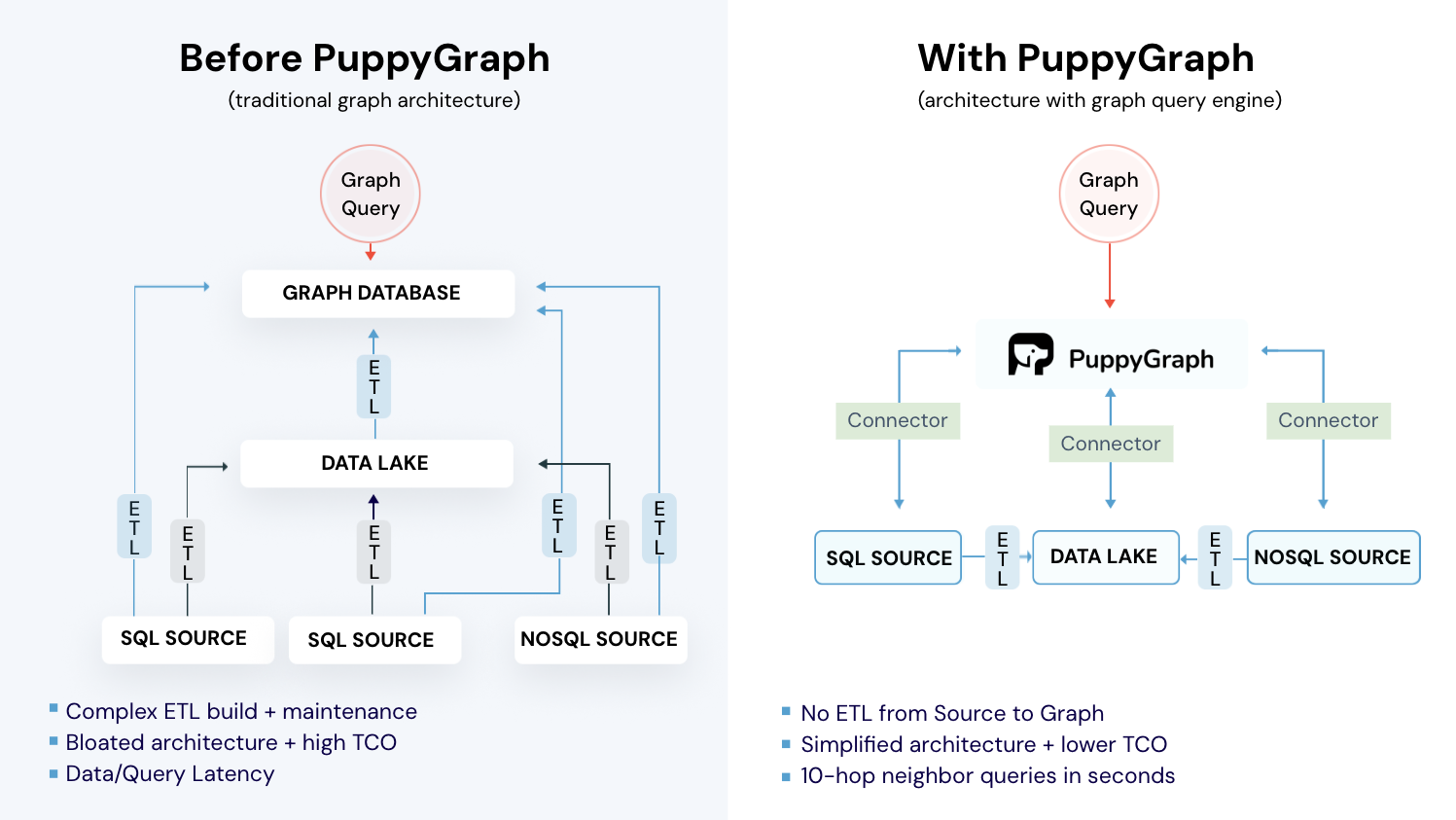
For enterprises with relational databases, data warehouses, or lakehouse environments, PuppyGraph offers a “zero‑ETL” model. It allows real-time graph queries directly on existing data sources without moving or duplicating data into a separate graph database. This approach supports multi-hop analytics, leverages current governance and access controls, and reduces infrastructure complexity. By supporting standard graph query languages like Gremlin and openCypher, PuppyGraph enables teams to explore graph relationships efficiently while maintaining a single source of truth and minimizing operational cost.

PuppyGraph is the first and only real time, zero-ETL graph query engine in the market, empowering data teams to query existing relational data stores as a unified graph model that can be deployed in under 10 minutes, bypassing traditional graph databases' cost, latency, and maintenance hurdles.
It seamlessly integrates with data lakes like Apache Iceberg, Apache Hudi, and Delta Lake, as well as databases including MySQL, PostgreSQL, and DuckDB, so you can query across multiple sources simultaneously.

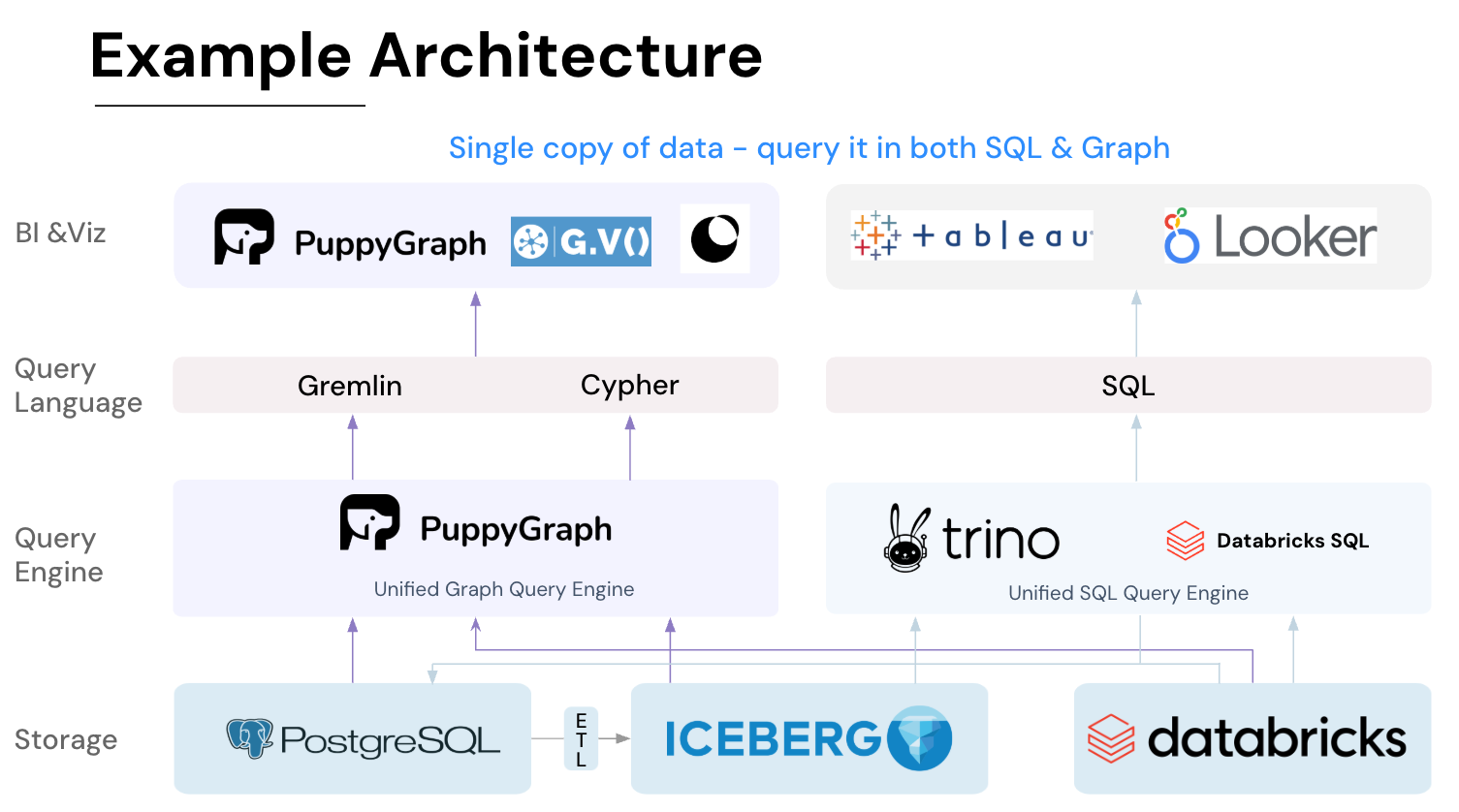
Key PuppyGraph capabilities include:
- Zero ETL: PuppyGraph runs as a query engine on your existing relational databases and lakes. Skip pipeline builds, reduce fragility, and start querying as a graph in minutes.
- No Data Duplication: Query your data in place, eliminating the need to copy large datasets into a separate graph database. This ensures data consistency and leverages existing data access controls.
- Real Time Analysis: By querying live source data, analyses reflect the current state of the environment, mitigating the problem of relying on static, potentially outdated graph snapshots. PuppyGraph users report 6-hop queries across billions of edges in less than 3 seconds.
- Scalable Performance: PuppyGraph’s distributed compute engine scales with your cluster size. Run petabyte-scale workloads and deep traversals like 10-hop neighbors, and get answers back in seconds. This exceptional query performance is achieved through the use of parallel processing and vectorized evaluation technology.
- Best of SQL and Graph: Because PuppyGraph queries your data in place, teams can use their existing SQL engines for tabular workloads and PuppyGraph for relationship-heavy analysis, all on the same source tables. No need to force every use case through a graph database or retrain teams on a new query language.
- Lower Total Cost of Ownership: Graph databases make you pay twice — once for pipelines, duplicated storage, and parallel governance, and again for the high-memory hardware needed to make them fast. PuppyGraph removes both costs by querying your lake directly with zero ETL and no second system to maintain. No massive RAM bills, no duplicated ACLs, and no extra infrastructure to secure.
- Flexible and Iterative Modeling: Using metadata driven schemas allows creating multiple graph views from the same underlying data. Models can be iterated upon quickly without rebuilding data pipelines, supporting agile analysis workflows.
- Standard Querying and Visualization: Support for standard graph query languages (openCypher, Gremlin) and integrated visualization tools helps analysts explore relationships intuitively and effectively.
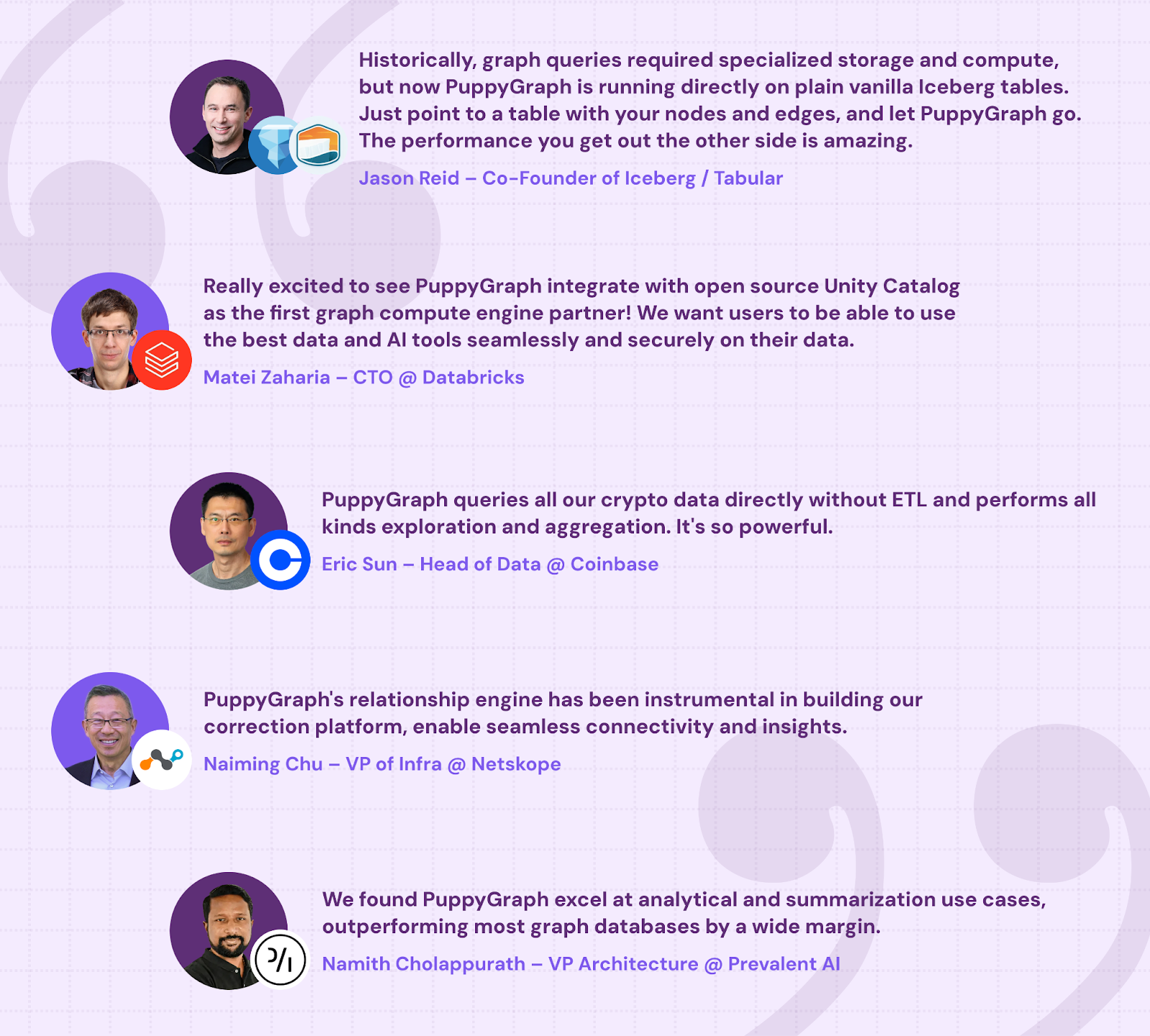
- Proven at Enterprise Scale: PuppyGraph is already used by half of the top 20 cybersecurity companies, as well as engineering-driven enterprises like AMD and Coinbase. Whether it’s multi-hop security reasoning, asset intelligence, or deep relationship queries across massive datasets, these teams trust PuppyGraph to replace slow ETL pipelines and complex graph stacks with a simpler, faster architecture.
As data grows more complex, the most valuable insights often lie in how entities relate. PuppyGraph brings those insights to the surface, whether you’re modeling organizational networks, social introductions, fraud and cybersecurity graphs, or GraphRAG pipelines that trace knowledge provenance.
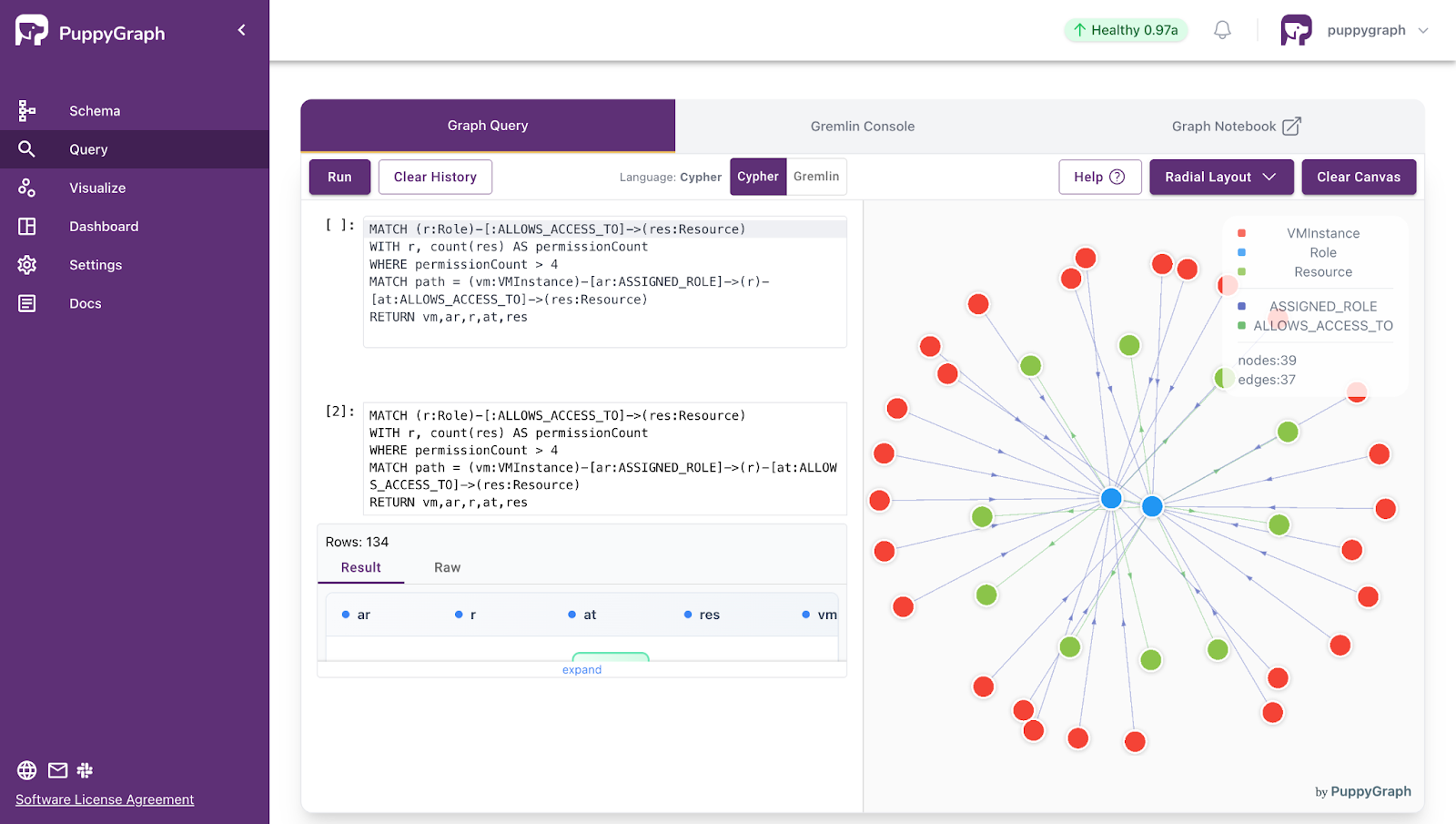
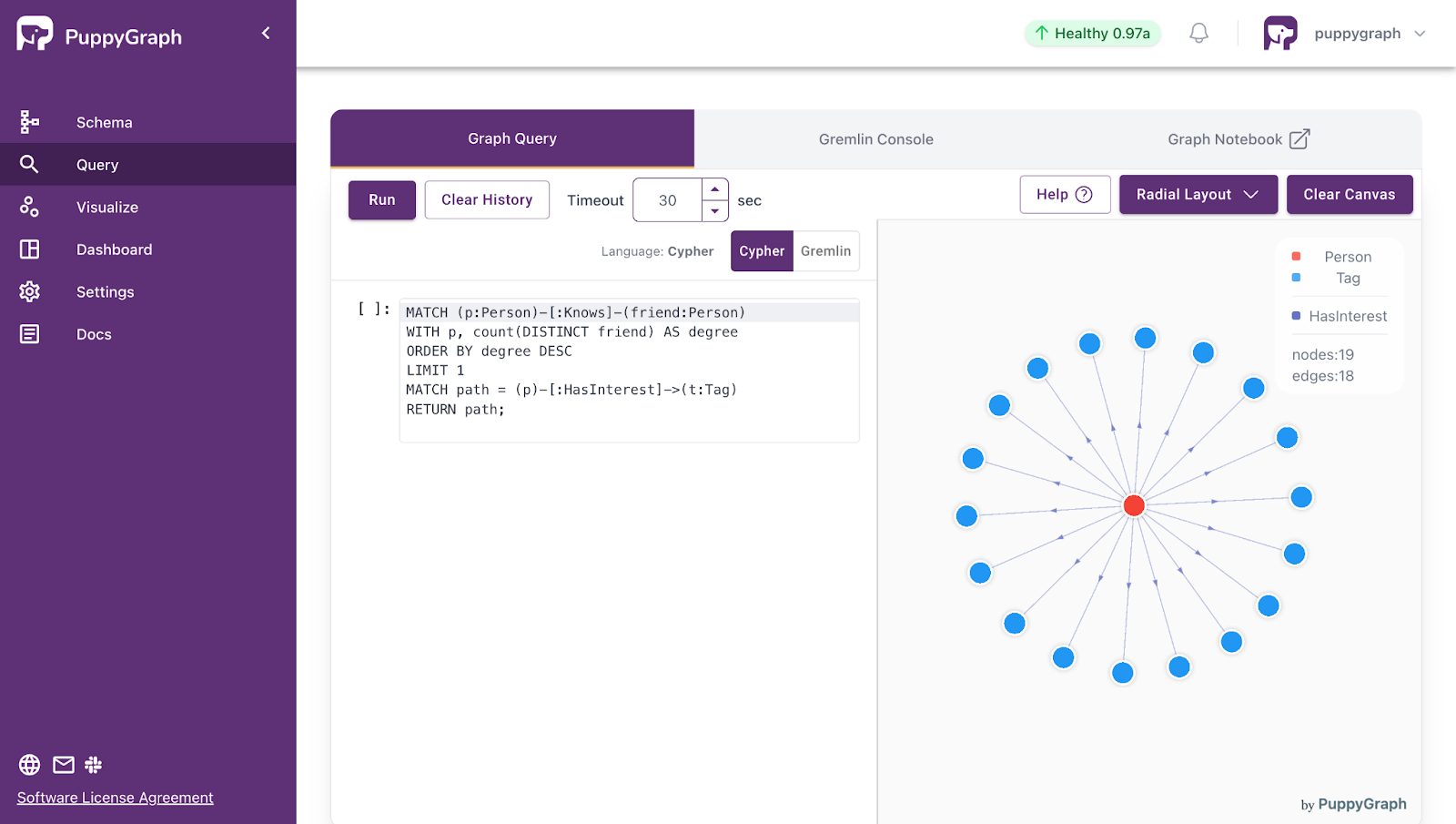
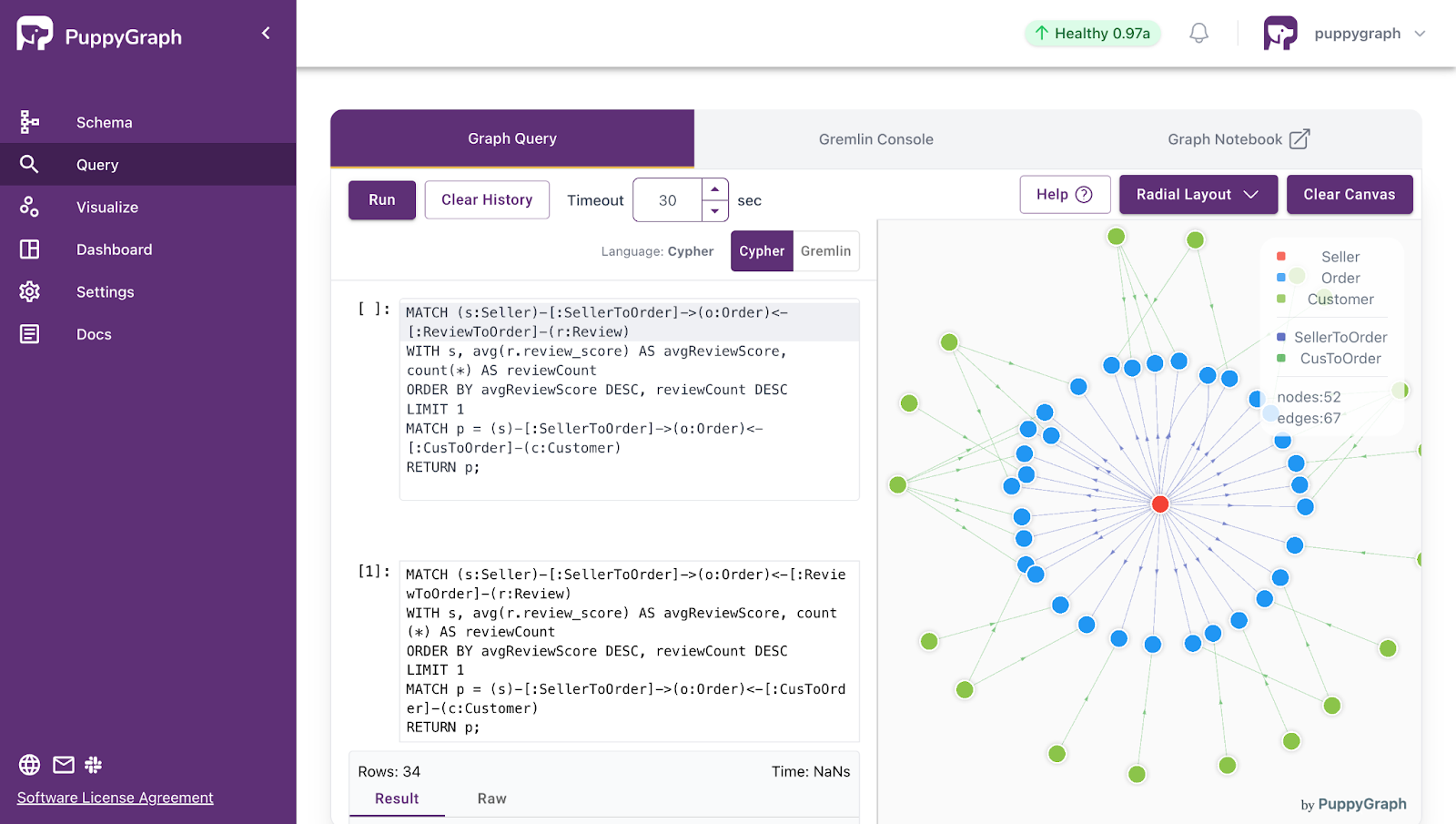
Deployment is simple: download the free Docker image, connect PuppyGraph to your existing data stores, define graph schemas, and start querying. PuppyGraph can be deployed via Docker, AWS AMI, GCP Marketplace, or within a VPC or data center for full data control.
Conclusion
Graph databases like Dgraph and Amazon Neptune offer powerful solutions for modeling and querying highly connected data, each with distinct strengths. Dgraph excels in real-time, distributed, horizontally scalable workloads with GraphQL-centric APIs, making it ideal for teams seeking performance and low-latency multi-hop queries on self-managed infrastructure. Neptune, as a fully managed AWS service, provides high availability, multi-model support, and seamless integration with the AWS ecosystem, simplifying operational overhead for enterprises focused on cloud-native graph applications.
PuppyGraph presents a compelling alternative for organizations that want real-time graph analytics without the complexity of dedicated graph storage. By querying relational databases and data lakes directly, it eliminates ETL, data duplication, and additional infrastructure costs while supporting standard graph query languages like openCypher and Gremlin. Its scalable, distributed engine enables fast multi-hop queries across massive datasets, bridging the gap between traditional SQL workloads and graph-driven analysis, making it a versatile choice for modern, relationship-focused applications.
Explore the forever-free PuppyGraph Developer Edition, or book a demo with our team to experience it firsthand.

Hao Wu is a Software Engineer with a strong foundation in computer science and algorithms. He earned his Bachelor’s degree in Computer Science from Fudan University and a Master’s degree from George Washington University, where he focused on graph databases.

Get started with PuppyGraph!


Developer Edition
- Forever free
- Single noded
- Designed for proving your ideas
- Available via Docker install
Enterprise Edition
- 30-day free trial with full features
- Everything in developer edition & enterprise features
- Designed for production
- Available via AWS AMI & Docker install