


What is Network Threat Hunting ?
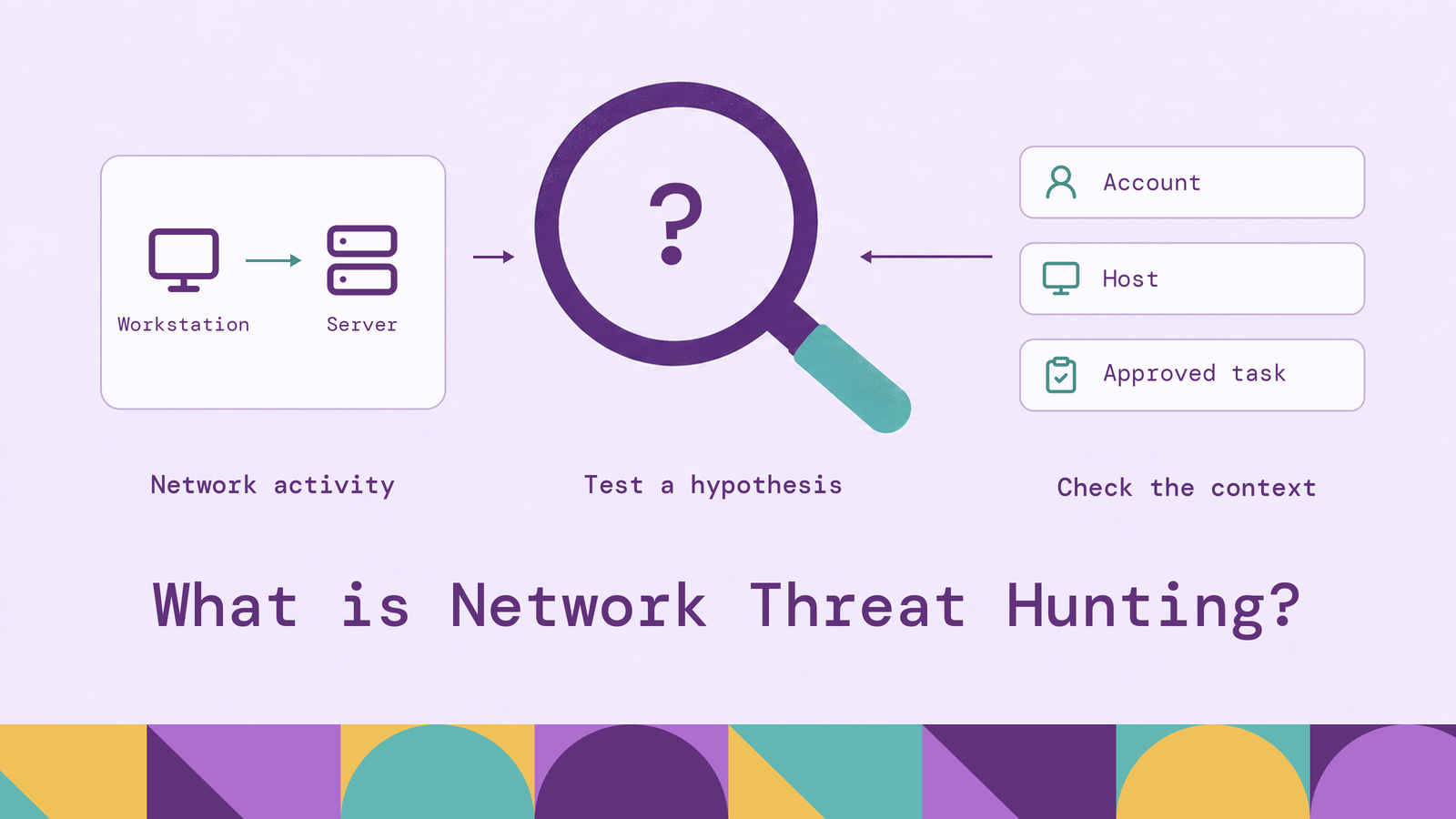
An allowed network connection can still be part of an intrusion. A workstation accessing a file server or a server uploading data over HTTPS may satisfy network policy while serving an attacker's objective. Network threat hunting investigates whether those communications make sense for the systems, accounts, and business activity involved.
The work depends on testable questions and evidence that can support or contradict them. This guide explains where network hunting fits in security operations, how its tools and techniques work, and how to build a repeatable process that improves detection even when a hunt finds no compromise.
What is network threat hunting?
Network threat hunting is a proactive search for malicious activity that routine detection has not identified, using network communications as the primary evidence. Hunters examine connections, DNS requests, protocol activity, and traffic patterns, then correlate those observations with endpoint, identity, and application records.
Its scope includes traffic entering or leaving an environment and communication between internal systems. Choose the scope from the suspected behavior: an outbound callback and an internal administrative connection require different observation points. Document which network segments the hunt actually covers.
A hunt starts with a question that warrants investigation. For example: are employee workstations using administrative file shares to reach servers outside their normal access patterns? The analyst defines the relevant systems and time period, searches for supporting evidence, and tests legitimate explanations before drawing a conclusion.
Monitoring, hunting, and incident response serve related purposes. Monitoring continuously evaluates activity against configured detection logic. Hunting investigates a suspected gap or unexplained pattern, potentially before any alert exists. Incident response manages suspected or confirmed incidents, including containment and recovery. An alert can seed a hunt, and a hunt can trigger incident response.
Tools support that workflow without determining its outcome. Microsoft Sentinel's hunting documentation, for example, describes forming hypotheses, investigating data, and turning findings into analytics rules or incidents. The important distinction is the analyst's question and investigation, rather than whether the search runs in a particular product.
The result should be a defensible finding: evidence of suspicious activity, a supported benign explanation, or a documented limit on what the available data can establish.
Why is network threat hunting important?
Attackers can use legitimate access and familiar protocols. MITRE ATT&CK's SMB/Windows Admin Shares technique describes adversaries using valid accounts with administrator privileges to access remote systems, transfer files, and support remote execution. A permitted SMB connection therefore needs context before an analyst can judge its purpose.
Network hunting is useful for several recurring investigations:
Command and control. Repeated outbound connections can prompt a hunt for an unauthorized process communicating externally. ATT&CK documents web protocols used for command and control. Regular timing is a starting signal, but software updates and health checks can produce similar patterns. Validate the responsible process and destination's business purpose.
Lateral movement. Investigate new communication paths between employee devices, administrative systems, and sensitive servers. Correlating the connection with authentication and remote execution evidence helps distinguish an intrusion from an approved maintenance task.
Data exfiltration. Examine unexpected uploads in the context of the originating host and account. ATT&CK's Exfiltration to Cloud Storage technique explains why an ordinary cloud service can carry stolen data. A service's legitimate reputation does not establish that a particular upload was authorized.
Hunts also expose detection weaknesses. An investigation might reveal that internal server traffic is unobserved or that authentication logs expire before network records. Resolving that gap can make subsequent investigations more conclusive. The benefit extends beyond finding an attacker: each hunt should improve the team's ability to test an important security question.
How network threat hunting works
Network hunting connects three things: observed communications, the entities responsible for them, and an explanation of why the activity might matter. Different sources answer different parts of that question.
Connection and protocol evidence. Flow records summarize communications between addresses and ports. Zeek's connection log, for example, records endpoints, timing, duration, protocol, and traffic volumes. DNS and proxy records add context about requested destinations. Packet captures permit closer inspection of captured traffic, although encryption can restrict what an analyst can interpret.
Identity and host context. DHCP leases, VPN sessions, asset inventory, and authentication events help associate an observed address with a device or account at the relevant time. Endpoint telemetry can identify the process behind a connection. Those associations require explicit time windows; an address alone is not a durable device identifier.
Threat intelligence and behavioral context. Intelligence can supply a known indicator or an adversary behavior worth investigating. Indicator matching checks for specific domains or addresses. Behavioral analysis looks for patterns such as unusual administrative access, repeated callbacks, or changes in upload activity. Compare a host with its own history and with systems performing the same role.
Use MITRE ATT&CK to name the behavior being tested and identify relevant evidence. An ATT&CK mapping organizes the investigation; it does not prove the behavior occurred. Similarly, a threat-intelligence match requires checking the indicator's provenance, observation period, and relevance to the environment.
The tool stack supports different stages of this work:
Cisco's NDR overview describes behavioral analysis of network activity. Open-source tools provide other useful building blocks: Zeek produces network records, while Suricata's EVE output includes alerts, anomalies, metadata, and protocol records. Their outputs can contribute evidence to an investigation; they do not eliminate the need to validate a finding.
For an illustrative hunt, suppose a finance workstation begins contacting file servers it rarely accesses, followed by outbound traffic to an unfamiliar destination. The hunter asks which account authenticated, whether an approved task explains the access, and which process initiated the outbound connection. Each answer determines the next search.
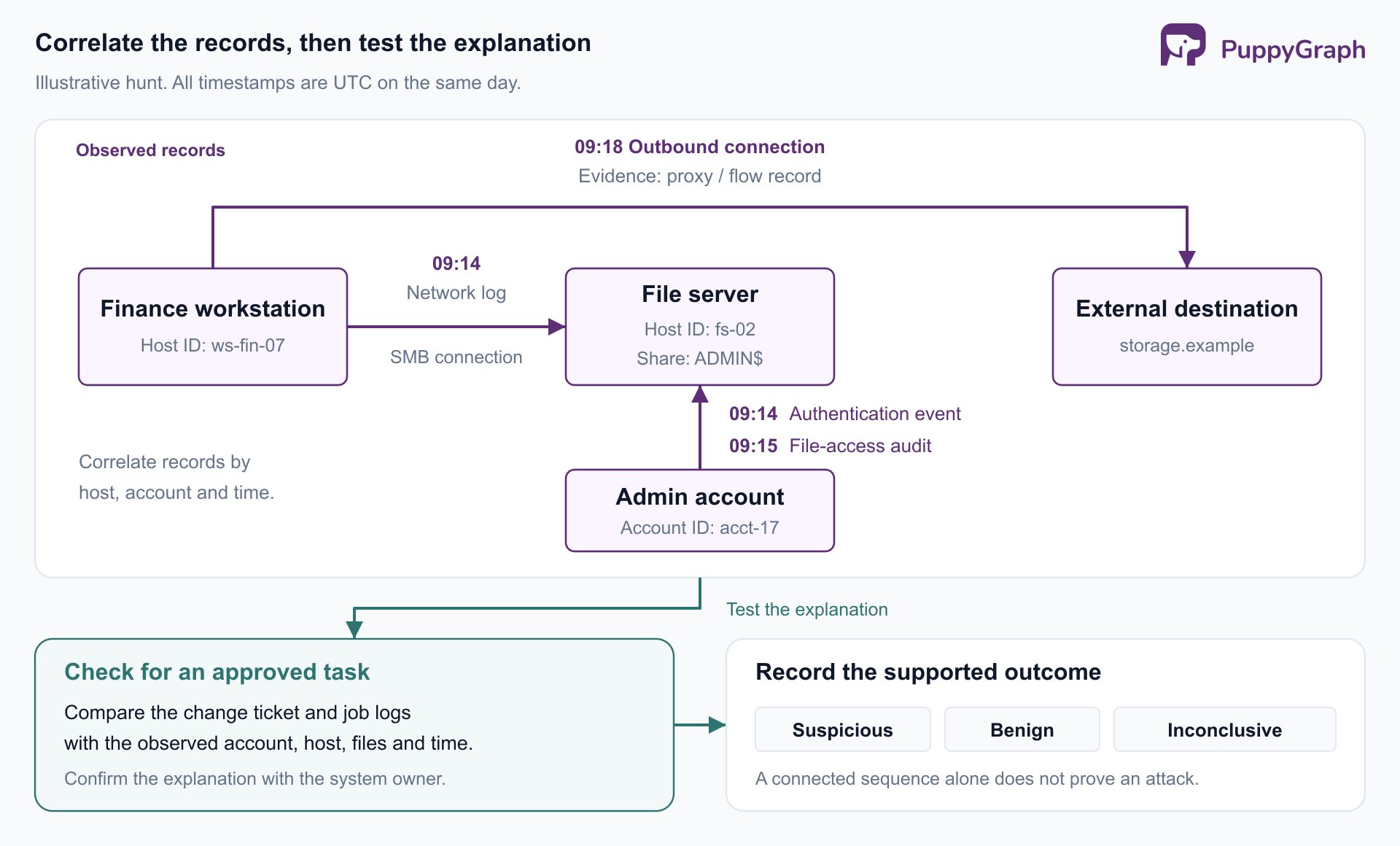
The aim is to assemble a sequence whose individual claims can be checked. Mere proximity in time or a shared IP address is insufficient to establish that events belong to one attack.
Network threat hunting process
A repeatable hunt has a bounded question, an evidence plan, and a recorded outcome. The following process applies those requirements to the illustrative file-server investigation.
1. Form a testable hypothesis. Start with a behavior relevant to an important asset: an unauthorized actor may be using a finance workstation and an account with administrator privileges to access administrative shares on file servers. Define the affected segment, accounts, and investigation period. State what would support the hypothesis and what could contradict it. A documented management task using the expected account and process is one possible benign explanation.
2. Check that the evidence exists. Identify the necessary flow or connection records, server authentication logs, share-access auditing, and endpoint telemetry. Verify collection for both the workstation segment and the servers. Check timestamps, retention, parser health, and missing intervals before treating an empty search as meaningful. If share auditing was disabled, record that limitation instead of inferring that no files were accessed.
3. Find and prioritize candidate activity. Search for workstation-to-server connections consistent with SMB, then compare the source-destination pairs with a preceding baseline. Port information can identify candidates, but it does not establish share access or remote execution. Prioritize unfamiliar paths to sensitive servers, particularly when the associated account has no obvious operational reason to use them. Keep approved scanners, backup tools, and management systems available as comparison groups.
Make the time boundary explicit. For example, an illustrative first pass could examine one day of candidate activity against the previous two weeks. That is a scoping choice, not a universal threshold. Confirm that the baseline contains comparable business activity and that both periods have usable coverage.
Keep enough detail in each candidate to support the next pivot: source device, destination server, connection time, protocol evidence, and the reason it was selected. Carry the original event reference with it. This lets another analyst inspect the same observation without reconstructing how the first search produced its shortlist.
4. Correlate and challenge the explanation. Resolve the source address to the workstation at the event time, identify the account in the server's authentication records, and inspect available share-access and process events. Look for subsequent outbound activity from the systems actually involved. Preserve the distinction between a connection, successful authentication, file access, and execution: each requires its own evidence.
Ask the system owner whether a change ticket or scheduled job explains the sequence, then check the records against that explanation. An owner's recognition of a tool is useful context, but it does not establish that this execution was authorized. Conversely, unfamiliar behavior alone does not justify declaring compromise.
5. Record the outcome and improve detection. Preserve the hypothesis, exact queries, time bounds, source records, affected entities, and reasoning. Escalate credible evidence through the incident-response process with enough context for responders to act. Where behavior is suitable for continuous detection, develop a rule and test it against representative benign activity before enabling alerts.
Distinguish an unsupported hypothesis from an inconclusive hunt. The first means usable evidence did not support the proposed activity within the defined scope. The second means missing or ambiguous evidence prevented a conclusion. A benign explanation should identify the evidence that supports it. This discipline makes a completed hunt useful to the next analyst, including when no incident is found.
Common network threat hunting challenges
Incomplete visibility. A perimeter sensor does not automatically observe communications inside every subnet or cloud environment. Flow logging also has source-specific limitations: AWS documents that VPC Flow Logs exclude some traffic and can skip records. Map the hypothesis to actual collection points and inspect collection health before interpreting an absence of events.
Encryption and missing application context. Encrypted traffic can leave useful timing, endpoint, and volume evidence while hiding application content from passive inspection. Zeek's TLS logging documentation explains the distinction between TLS observations and visibility into HTTP inside HTTPS. Use endpoint, proxy, or application records where available to answer questions the network sensor cannot.
Ambiguous identities and timestamps. Shared egress addresses, reassigned addresses, proxies, and overlapping private address spaces can connect unrelated events if correlation uses IP alone. Preserve network or tenant scope and historical address assignments. Clock differences and ingestion delays can also distort an apparent sequence; retain event time separately from arrival time.
Noisy or contaminated baselines. A backup job can resemble unusual data movement, and a newly deployed service can resemble a rare destination. Compare equivalent systems and review operational changes. Long-running malicious activity can also enter the baseline. The joint SIEM practitioner guidance explicitly cautions against accepting an existing compromise as normal during baselining.
Data volume and analyst capacity. Unbounded searches produce more candidates than a team can investigate. Start with a defined asset group and time window, then expand when evidence justifies it. Preserve the broader question in the hunt record so narrowing the search does not quietly narrow the final claim.
These challenges set the confidence boundary of the result. A useful report explains both what the evidence indicates and which parts of the original question remain unanswered.
How to build a network threat hunting program
Start with a small set of important systems and plausible adversary behaviors. For a company protecting financial records, that might mean unauthorized access from employee devices to file servers, followed by unexpected outbound transfers. Give the initial hunts a named owner, protected investigation time, and an incident-response contact.
Build a coverage inventory for those questions. Record each source's owner, monitored segments, available fields, retention, collection delay, and access restrictions. The joint Best Practices for Event Logging and Threat Detection (2024) recommends consistent timestamps, centralized access, protected logs, and retention that supports investigations. Turn those principles into checks the team can perform before each hunt.
Plan retention across related sources. Keeping connection records is less useful for attribution when the corresponding DHCP or VPN history has already expired. Set access controls for sensitive records and preserve original evidence alongside normalized fields. A reviewer should be able to trace a conclusion back to the source event.
Create a hunt backlog from relevant threat intelligence, incident lessons, exposed services, and unexplained observations. Each entry should specify a hypothesis, business relevance, required evidence, and completion criteria. Review intelligence before reuse so an old indicator does not acquire unwarranted authority merely by appearing in a saved query.
Practice with authorized exercises and known benign events. Check that expected activity appears in the right sources and that analysts can connect it across systems. Save successful queries with their assumptions and field requirements, and assign ownership for maintaining detections developed from hunts. Revisit them when sensors, schemas, or network architecture change.
Include network engineers and service owners in review. They can explain expected routes and administrative jobs, while hunters test those explanations against recorded activity. Agree who resolves collection failures so the same evidence gap does not recur in every investigation.
Measure improvements the team can act on: important hypotheses now testable, visibility gaps closed, investigations supported by reproducible evidence, and useful detections adopted. Review time spent resolving identities or retrieving missing context. Counting hunts completed or alerts created alone says little about whether the program can answer its highest-priority questions.
As investigations span more sources, a shared model of accounts, hosts, services, and observed relationships can make repeated pivots easier to express. Keep observed communication separate from permitted reachability, and retain timestamps and source references. A path through connected entities is a candidate for investigation, not proof of an attack.
PuppyGraph lets analysts query that entity-and-relationship model over existing data in supported SQL databases, warehouses, and data lakes or lakehouses. Teams define a graph schema that maps their tables to nodes, edges, and properties, then investigate relationships with openCypher or Gremlin. By default, the data stays in its existing storage, without requiring a separate graph-data ingestion pipeline.
For network hunting, that can support a time-bounded investigation from an account to the hosts it accessed and their subsequent connections, provided the underlying records contain those relationships. It complements SIEM and NDR workflows through data already available in supported storage. Collection, normalization, identity resolution, and evidence validation remain part of the hunting program.
Conclusion
Network threat hunting turns a security concern into a question that available evidence can answer. Its value depends on knowing what the network observations establish, adding the right identity and endpoint context, and recording the limits of the conclusion. A repeatable program feeds those lessons back into collection, detection, and response.
Try the forever-free PuppyGraph Developer Edition or book a demo to explore how graph queries can connect accounts, hosts, and network activity across your existing security data.

Hao Wu is a Software Engineer with a strong foundation in computer science and algorithms. He earned his Bachelor’s degree in Computer Science from Fudan University and a Master’s degree from George Washington University, where he focused on graph databases.

Get started with PuppyGraph!


Developer Edition
- Forever free
- Single noded
- Designed for proving your ideas
- Available via Docker install
Enterprise Edition
- 30-day free trial with full features
- Everything in developer edition & enterprise features
- Designed for production
- Available via AWS AMI & Docker install