


What Is Ontology Management?
An enterprise ontology becomes useful when applications can depend on its definitions. If procurement changes what qualifies as a supplier, the change can affect integrations, risk reports, and AI-generated queries. Maintaining that shared meaning requires ownership, testing, and a way to release changes without silently altering downstream behavior.
This guide explains how ontology management connects modeling, storage, mapping, versioning, validation, and governance, and how those practices support enterprise data and AI.
What is ontology management?
Ontology management is the ongoing process of creating, maintaining, governing, and publishing a shared model of a domain. It covers the model's definitions and relationships, its connections to source data and other models, and the changes consumers must accommodate over time.
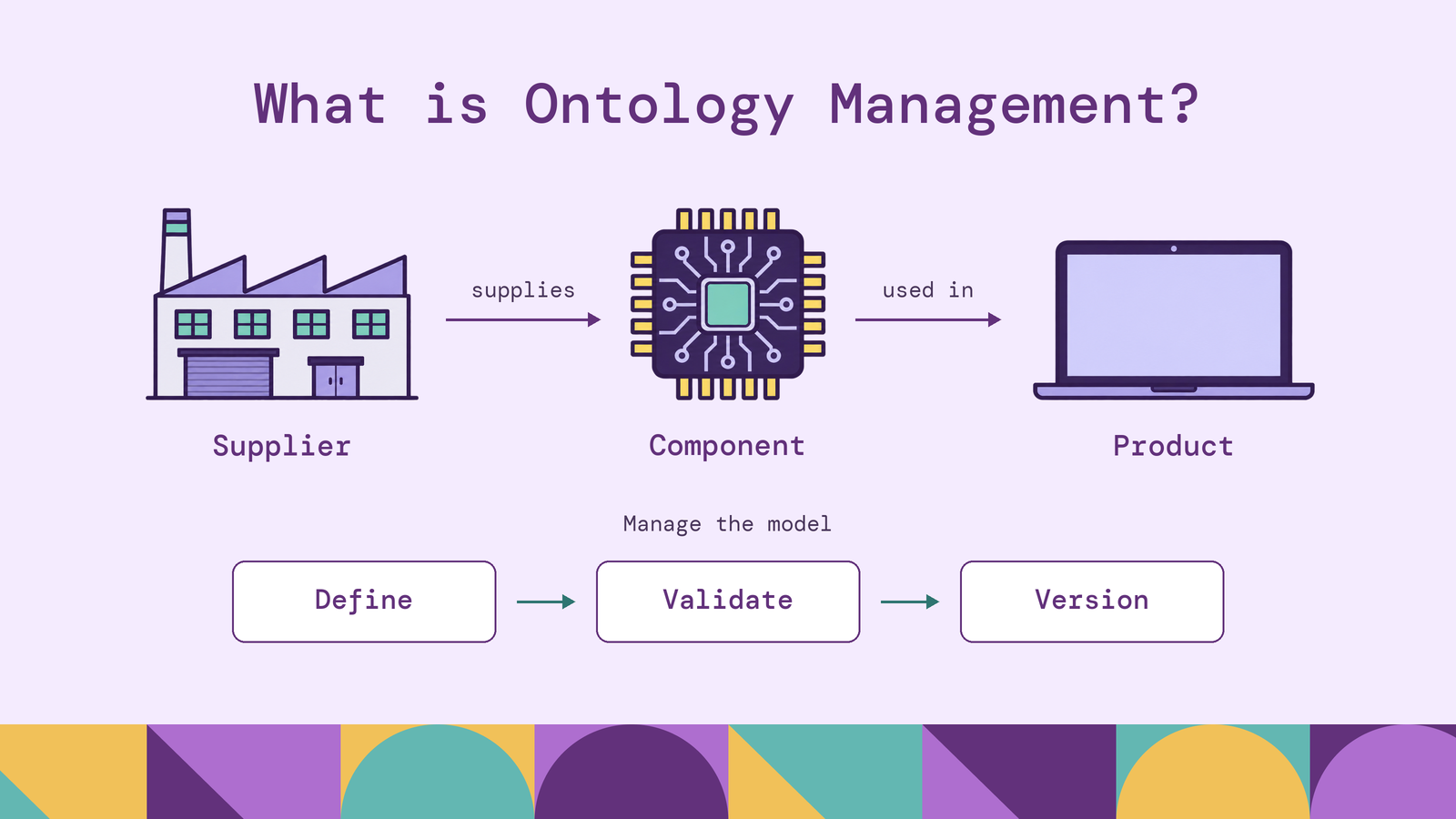
An ontology defines concepts such as Supplier, Component, and Product, together with relationships such as supplies and contains. It can also express formal axioms that support inference. The W3C OWL 2 overview describes one standardized language for representing these classes, properties, and individuals with formally defined meaning.
Ontology management extends beyond writing that initial model. Someone must decide whether Supplier includes distributors, approve a new relationship, document its meaning, and determine which applications can adopt it. The managed artifact therefore includes definitions, identifiers, mappings, dependencies, and release information. A diagram alone does not capture those operating responsibilities.
Why is ontology management important?
Shared definitions determine whether data from different systems can be combined meaningfully. Consider a procurement database where a supplier record represents a legal entity and a shipping platform where it represents a fulfillment location. Joining those records as interchangeable entities can produce a misleading dependency analysis even when every query executes successfully.
Ontology management makes that distinction explicit and gives teams a place to resolve it. The model can distinguish SupplierOrganization from SupplierSite and define the relationship between them. Integration teams can then reuse that decision instead of interpreting it separately in each pipeline.
The same discipline makes change visible. A new source may introduce a different identifier or a narrower definition of an existing concept. Reviewing its mapping before release helps prevent a local assumption from becoming a shared error. The benefit is a model whose meaning remains understandable as systems, teams, and consumers change.
How ontology management works
Start with the questions the model must support. Stanford's Ontology Development 101 recommends defining scope and using competency questions to test whether an ontology contains the information needed for its intended tasks.
For a supply-chain model, one question might be: which products depend on components supplied from a particular facility? Answering it requires Product, Component, Supplier, and Facility concepts, plus relationships that connect them. It also requires a decision about whether those relationships describe current contracts, historical shipments, or approved sourcing options.
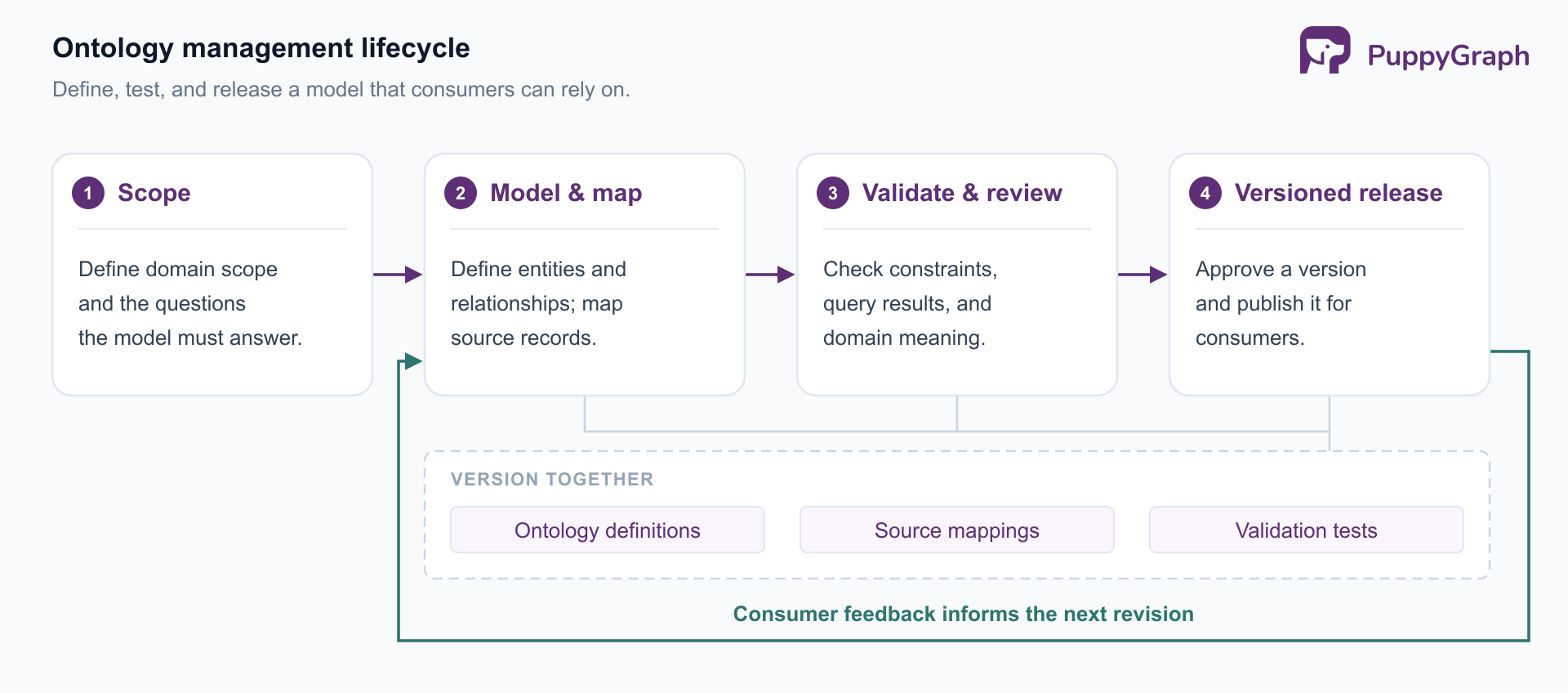
A practical workflow has four steps:
- Define the concepts, identifiers, relationships, and scope with domain experts.
- Map representative source data to the model and document transformation rules.
- Test definitions, constraints, mappings, and expected query results.
- Approve and publish a release, then use consumer feedback to identify the next change.
Keep the initial scope narrow enough to validate against real records. A working model of one dependency path gives reviewers something concrete to challenge before the ontology expands.
Ontology storage and repository management
An ontology repository needs to preserve the model and make approved versions discoverable. The right storage arrangement depends on how teams author the model and how applications consume it.
Version-controlled files support review and reproducible releases. An RDF store can make ontology statements queryable alongside other graph data. A catalog or repository interface can provide search, ownership information, and documentation. These roles can coexist in one system or span several tools.
Keep the main artifacts distinct:
Separate draft work from published releases, and make older releases retrievable. The OBO Foundry versioning principle provides a concrete precedent: consumers must be able to identify the released ontology they used and retrieve an unaltered copy. Backups should preserve dependencies as well as the top-level model.
Ontology mapping and alignment
Ontology alignment identifies correspondences between concepts in different models. A mapping records the intended correspondence so people or software can use it. Mapping source data into an ontology is a related task, but it connects physical records to the model rather than reconciling two conceptual vocabularies.
Suppose one system uses Vendor for any payee while another uses Supplier for organizations that provide components. Those concepts overlap, but they are not equivalent. An approved mapping might include only vendor records with an active component-supply agreement.
Choose a relationship that expresses the strength of the correspondence. For controlled vocabularies, SKOS mapping properties distinguish exact, close, broader, narrower, and related matches. OWL class equivalence makes a stronger formal assertion about class membership; similar names alone do not justify it.
Record the mapping's source and target versions, transformation logic, reviewer, and examples that should remain unmatched. Also separate concept alignment from entity resolution: agreeing on what Supplier means does not establish that two supplier records identify the same company. Identifier matching and duplicate resolution need their own evidence.
Ontology versioning and change management
Versioning records which model a consumer used. Change management determines whether that consumer can safely move to another version.
Assess compatibility by behavior. Correcting a description may leave queries unchanged. Renaming a relationship can break them. Narrowing Supplier to exclude distributors can change results while leaving query syntax valid. Adding an axiom can also change inferred classifications without removing any existing term.
Review the semantic difference, not just the file diff. Identify affected mappings, validation rules, applications, and competency questions. Test the proposed release against representative data and compare expected results before deployment.
Preserve stable identifiers when meaning is unchanged. When a concept's meaning must change substantially, introduce a replacement and explain the migration. The OBO Foundry term-stability principle requires a new term and identifier when a definition change would alter what the term refers to.
A release should state its dependencies and migration requirements. Keep the previous model available, but recognize that restoring its files may not reverse data transformations already performed. Test rollback against the application's actual data and deployment process.
Ontology validation and quality management
Validation asks several different questions. A parser checks whether the model is well formed. Logical reasoning checks what follows from its axioms and whether contradictions exist. Data validation checks whether particular records satisfy declared requirements. Query regression tests check whether the model still answers the intended business questions.
These checks are complementary. Under OWL's open-world semantics, missing information is not automatically false. Stating that suppliers have identifiers does not necessarily make an absent identifier a data-validation error. Domain and range declarations can infer class membership rather than reject an unexpected record.
For RDF data, SHACL expresses constraints against which a data graph can be validated. A shape could require each Supplier to have exactly one string-valued supplier identifier. That tests whether the supplied data satisfies the requirement; it does not establish that the identifier belongs to the correct real-world organization.
Run checks against deliberate failure cases as well as clean examples: missing identifiers, duplicate mappings, unexpected relationship targets, and retired terms. Have domain reviewers inspect representative answers. Technical consistency cannot establish that a relationship captures the business meaning users intended.
Ontology governance and access control
Governance assigns responsibility for meaning. Access control determines who may read, propose, approve, publish, or administer the model.
Give each domain an accountable owner. Domain specialists should review definitions and business implications; engineers should review mappings and operational compatibility. A shared review process can resolve changes that affect several domains without requiring one central team to author every term.
Separate contribution from publication. An analyst may propose a new relationship, while a designated reviewer approves it and a release process promotes it. Record the rationale and approval so later maintainers understand why a distinction exists.
Model access and data access require separate decisions. Permission to browse a definition of Employee does not imply permission to query employee records. An application must enforce authorization through its actual query and storage paths. Likewise, a schema that omits a sensitive concept does not protect a separate data-access route that still exposes the underlying records.
Ontology management for enterprise data and AI
Enterprise data platforms need mappings that connect business concepts to the records applications actually query. An ontology can define a product dependency clearly while its implementation joins the wrong component identifier. Managing the definition and its source mapping together makes that mismatch reviewable.
AI adds another consumer of this shared model. An agent can use approved entity and relationship definitions when constructing queries, but its output still needs validation. Evaluate whether generated queries address the question, use the intended relationships, and return evidence that supports the answer. A query can conform to the model and still answer the wrong question.
PuppyGraph is the first and only zero-ETL graph query engine that lets teams query existing relational data as a graph without building a separate graph ingestion pipeline. Teams define a graph schema over tables in SQL databases, data warehouses, and data lakes or lakehouses. That schema maps source data into entities, relationships, and properties queryable through openCypher and Gremlin. For ontology management, this puts the modeled relationships into use against existing data; the default direct-query path requires no persistent duplicate dataset.
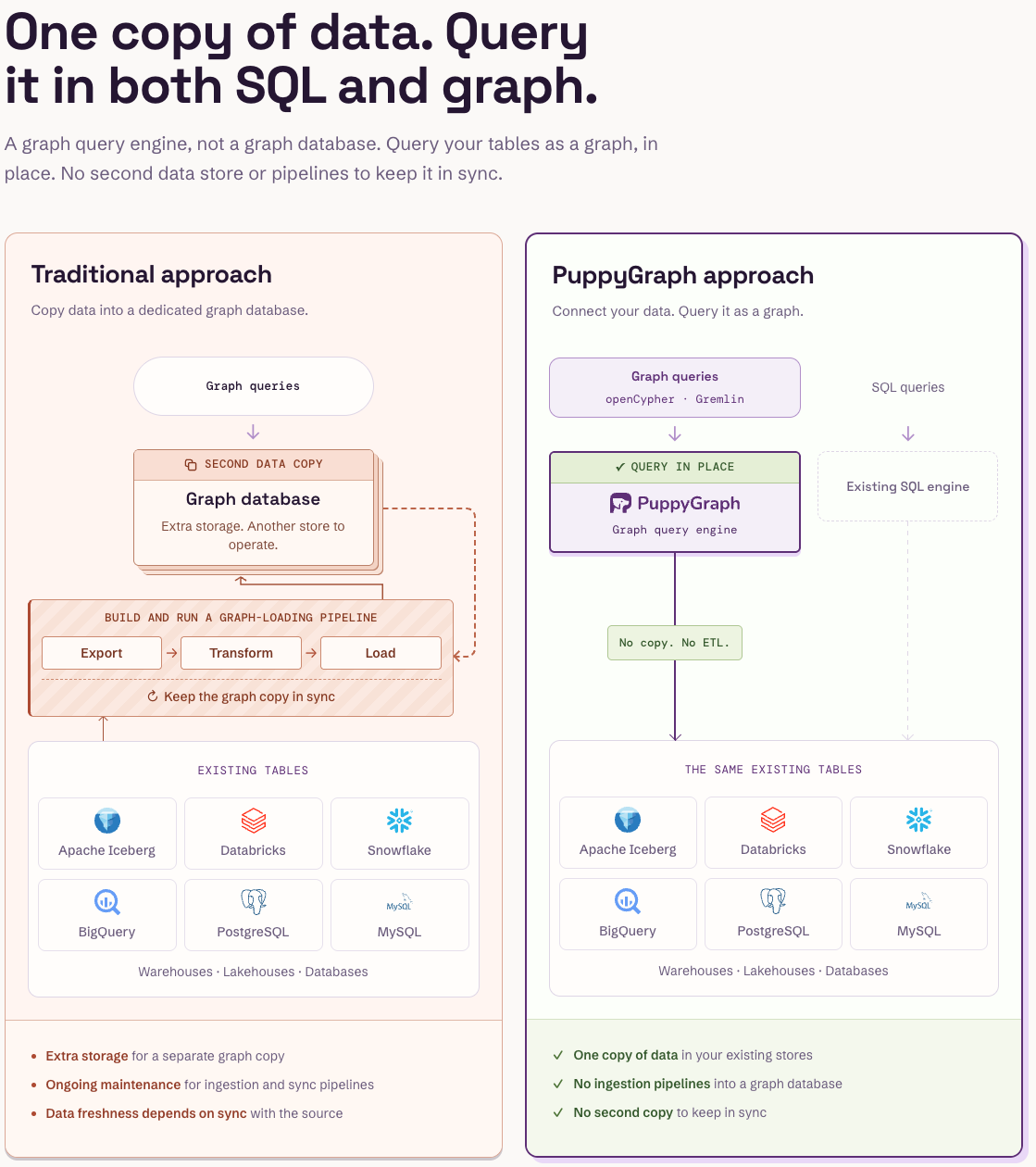
The mapping is also a manageable artifact. PuppyGraph supports exporting and importing its graph schema as JSON, so teams can keep it under version control and review changes alongside business definitions and regression tests. In the supply-chain example, a team could review how Supplier and Facility map to source keys before deploying an updated schema. Domain definitions, approval decisions, and migration planning remain responsibilities of the broader ontology-management process.
For AI consumers, PuppyGraph's schema validation checks openCypher queries for unknown labels, undefined properties, and relationship patterns absent from the model. Validation produces warnings by default; an opt-in strict mode can fail a query on a schema mismatch. Agents can use this feedback to revise queries against the managed model. Keep that responsibility distinct from OWL reasoning or SHACL data validation, and continue testing source quality and answer correctness as part of the surrounding application.
Common ontology management use cases
Supply-chain dependency analysis. A manufacturer can connect products, components, suppliers, and facilities to investigate exposure to a disrupted site. Managing relationship definitions helps distinguish approved sourcing options from actual deliveries and prevents one from being mistaken for the other.
Enterprise data integration. During a merger, teams can align customer and account concepts across systems while preserving distinctions such as billing account versus legal entity. Versioned mappings give integration teams a common reference for interpreting records.
Scientific knowledge integration. Research teams can organize measurements and annotations around shared concepts. Recording the vocabulary release used for an annotation helps later users interpret it when terminology or classification changes.
Service dependency analysis. Operations teams can model applications, services, infrastructure, and ownership. Defined relationship types distinguish a runtime dependency from an administrative association, which matters when estimating the impact of a service failure.
AI-assisted investigation. An assistant can traverse modeled entities to collect evidence for a question. Managed definitions, tested mappings, and recorded model versions make it easier to examine how the assistant arrived at its answer and reproduce its interpretation.
Ontology management challenges
Scope can outgrow demonstrated value. A model that tries to describe the entire enterprise becomes difficult to review. Expand from tested competency questions, and require each new concept or relationship to support a concrete consumer need.
Teams may disagree for valid reasons. Finance and procurement can use different definitions because their responsibilities differ. Preserve scoped concepts and explicit mappings where a single definition would erase a necessary distinction.
Semantic drift can survive technical checks. A source column may keep its name and type while its business meaning changes. Assign mapping owners and include source-system changes in review. Direct data access removes copy synchronization work, but it does not remove this semantic maintenance.
Interoperability has limits. Moving a model between an OWL representation and a property-graph schema requires decisions about which semantics the destination can express and enforce. Test the required behavior rather than assuming that matching labels preserve inference or constraints.
The recurring constraint is ownership. Automating checks reduces repetitive work, but maintainers still need time and authority to resolve ambiguous definitions and coordinate changes with consumers.
Conclusion
Ontology management keeps a domain model usable as definitions, data sources, and applications evolve. Start with concrete questions, preserve stable identifiers, review mappings, and test both formal consistency and expected answers. Release the resulting artifacts with enough context for consumers to adopt changes deliberately.
Try the forever-free PuppyGraph Developer Edition and book a demo with the team to see how openCypher and Gremlin queries connect modeled entities across warehouse and lakehouse tables, with no graph-specific ETL, putting a managed semantic model to work against existing data.

Hao Wu is a Software Engineer with a strong foundation in computer science and algorithms. He earned his Bachelor’s degree in Computer Science from Fudan University and a Master’s degree from George Washington University, where he focused on graph databases.

Get started with PuppyGraph!


Developer Edition
- Forever free
- Single noded
- Designed for proving your ideas
- Available via Docker install
Enterprise Edition
- 30-day free trial with full features
- Everything in developer edition & enterprise features
- Designed for production
- Available via AWS AMI & Docker install