


OrientDB vs Neo4j: Features, Performance, Use Cases
Teams evaluating graph databases usually discover the same tension between flexibility and specialization. OrientDB and Neo4j exist as possible solutions to these competing priorities. OrientDB offers a multi-model engine that combines documents and graphs in one system, for streamlined development and reduced infrastructure sprawl. Neo4j focuses exclusively on graph performance, optimizing traversal speed and query predictability at scale.
This article examines the practical implications of those choices, how each system behaves under real workloads, what operational trade-offs teams should expect, and how to decide which aligns with the data patterns and constraints within your organization.
What is OrientDB?
OrientDB is a multi-model, distributed database that supports graphs, documents, key-values, and object-oriented data under a single storage and execution engine. OrientDB unifies graph semantics to allow modelling entities and their relationships without needing to maintain disparate data engines or ETL layers. Consequently, architectural sprawl is reduced due to there being one query language, one transaction model, and one clustering architecture across all models.
Architecture Overview
OrientDB uses a shared-nothing, masterless distributed architecture; each node stores part or all of the database and can serve read and write operations. This stands out from systems that designate explicit primaries for writes. In OrientDB clusters:
- All nodes accept writes, replicated through a multi-master protocol.
- Data can be partitioned or fully replicated depending on configuration.
- Synchronization relies on Write-Ahead Logging (WAL) and distributed consensus.
This design gives OrientDB horizontal scalability and fault tolerance, but it places higher expectations on cluster tuning. Write conflicts, replication lag, and storage fragmentation require careful operational oversight, especially when modeling high-write or high-concurrency workloads.
Data Model: Combining Documents and Graphs
OrientDB’s most distinctive feature is its native fusion of document and graph models.
It stores all records (vertices, edges, and documents) as schema-less or schema-optional documents in binary form. Vertices and edges behave like documents with special metadata fields:
- Vertices store inbound and outbound edge lists.
- Edges store references to their connected vertices.
- You can query documents as standalone entities or linked into graph structures.
Developers can evolve structures over time without schema migrations while still maintaining graph relationships. However, large, deeply connected graphs may require careful indexing and storage tuning to maintain predictable traversal speed.
Query Language and Execution
OrientDB uses OrientDB SQL, an SQL-inspired language extended with graph constructs, for example:
- TRAVERSE for breadth/depth-first graph navigation,
- MATCH for pattern-based queries,
- CONNECT and CREATE EDGE for relationship creation.
The SQL-like syntax lowers the barrier for teams transitioning from relational systems while still enabling graph-style operations. OrientDB supports both index-free adjacency for fast relationship hops, and lookup-based joins for document-style operations.
The query planner chooses between these paths depending on index availability, record structure, and stored relationship density.
Performance Characteristics
OrientDB delivers strong performance for workloads that mix document operations with light-to-moderate graph traversals. Document-style indexing allows for fast lookups and adaptable filtering. Traversal performance remains competitive when edges and vertices are well-indexed and reside on the same node. In distributed deployments, traversal variance gets higher, where cross-node hops introduce network overhead. Multi-cluster replication at higher scale affects write throughput as well.
The engine works best when the graph is moderately connected and when queries combine both document filtering and graph navigation. Some example use cases in that vein would be customer profiles, supply-chain lookups, or knowledge graphs with limited depth.
Ecosystem and Operational Notes
OrientDB has several operational features that appeal to teams considering a general-purpose graph/document platform:
- Pluggable storage engines (classic and plocal).
- Built-in security with roles, permissions, and auditing.
- Full-text indexing through Lucene integration.
- ETL tooling for importing relational or JSON datasets.
- Studio web console for schema browsing and query execution.
However, OrientDB’s distributed mode requires that you carefully configure WAL sync, node roles, conflict resolution, and storage consistency. Many teams run OrientDB in a mostly replicated, but not fully partitioned deployment to reduce risks.
What is Neo4j?

Neo4j is a native property graph database for highly connected data at scale. In Neo4j, graphs are first-class data structures. Its storage engine and query planner are optimized around relationship traversal; queries can navigate deep, densely connected networks with predictable latency. Neo4j’s design features index-free adjacency, ACID transactions, and a mature clustering model that supports both high availability and horizontal read scaling.
Native Graph Storage and Index-Free Adjacency
Neo4j’s strongest architectural differentiator is its native graph storage engine.
- Nodes: Entities such as users, devices, or events
- Relationships: Directed, typed connections linking nodes
- Properties: Key-value pairs stored on both nodes and relationships
Traversal cost depends only on the number of traversed relationships, not the size of the entire dataset.
Thanks to this model, Neo4j delivers constant-time relationship hops, essential for fraud graph expansion, identity resolution, route finding, or dependency analysis where a single query may traverse millions of edges.
Query Language Cypher
Neo4j introduced Cypher, now standardized as part of openCypher and influencing ISO GQL. Cypher expresses graph logic through its intuitive syntax rather than imperative traversal code:
MATCH (u:User)-[:PURCHASED]->(p:Product)
WHERE u.country = "DE"
RETURN p.id, p.name
Cypher’s declarative pattern matching allows the optimizer to choose execution strategies. It has strong integration with indexes, including BTrees and full-text search. Cypher also supports subqueries, path functions, transactions, and parameterization.
Cypher remains the most widely adopted graph query language, largely due to its readability and the sophistication of Neo4j’s planner.
Performance Characteristics
- Traversal performance is fast due to index-free adjacency and memory-mapped page caching.
- Query latency remains stable even when datasets grow larger than available RAM; the page cache handles hot sets.
- Write throughput is reliable, though impacted by the cost of enforcing transactional integrity and clustered consensus (Raft).
- Analytics is offloaded efficiently to the Graph Data Science (GDS) library for centrality, community detection, embeddings, and ML workflows.
Causal Clustering and High Availability
Neo4j Enterprise Edition provides Causal Clustering, a distributed architecture based on the Raft protocol:
In a cluster:
- Primaries take care of both reads and writes. Writes get synchronously replicated to a majority of primaries before the system acknowledges them.
- Secondaries replicate asynchronously and serve read queries at scale.
- A single leader per database orders writes, while followers maintain consistent logs for durability.
- Bookmarks guarantee causal consistency across clients; client applications can read their own writes, irrespective of the instance they communicate with.
Ecosystem and Tooling
Neo4j’s ecosystem is one of the most complete in the graph database landscape:
- APOC (Awesome Procedures On Cypher): 400+ extensions for ETL, transformations, and utilities.
- Graph Data Science (GDS): Algorithms, embeddings, pipelines, and model serving inside the database.
- Bloom and Neo4j Browser: Visualization and ad-hoc exploration tools.
- Drivers and connectors: Official support for Java, Python, Go, JavaScript, .NET, Kafka Connect, Spark, and BI tools.
Operational Characteristics
Neo4j’s operational model prioritizes durability, consistency, and visibility:
- ACID transactions across all operations.
- Robust backup and restore with hot backups in Enterprise Edition.
- Fine-grained security and RBAC, audit logging, TLS everywhere.
- Monitoring and metrics integrated through Prometheus, JMX, and various observability stacks.
- AuraDB, Neo4j’s cloud platform, provides managed hosting with automated scaling and lifecycle management.
OrientDB vs Neo4j: Feature Comparison
When to Choose OrientDB vs Neo4j
When to Choose OrientDB
Choose OrientDB when your application benefits from a multi-model design and you want to minimize architectural sprawl. If your workload consists of documents, key-values, and graph relationships in the same request path, OrientDB’s unified engine will simplify operations and development. Neo4j focuses exclusively on graph workloads, so integrating document-heavy logic means external systems or additional data stores.
OrientDB also makes sense for moderate relationship depths and when flexible querying has priority over ultra-optimized traversal performance. Since the query language is, syntax-wise, very similar to SQL, it helps teams coming from relational backgrounds adapt quickly. Neo4j’s Cypher requires a more graph-centric mindset. For mid-sized graphs with diverse access patterns, OrientDB gives you a single system to operate instead of building an infra around Neo4j.
Operationally, OrientDB can be advantageous when you prefer a multi-master model, as long as the team can comfortably manage write concurrency and conflict resolution. Neo4j’s clustering is more prescriptive and less flexible, but also more predictable, and therefore ideal for graph-heavy workloads instead of mixed-model ones.
When to Choose Neo4j
If deep, complex, or multi-hop graph traversals constitute your critical use cases, choose Neo4j. Neo4j’s native graph engine far outperforms OrientDB where relationship density, traversal depth, or query complexity grows faster than the dataset itself. OrientDB’s document-based storage architecture cannot match the predictable latency Neo4j achieves through index-free adjacency and graph-optimized caching.
Neo4j is also the stronger choice when your application needs a powerful analytical layer. The Graph Data Science (GDS) library provides graph algorithms, embeddings, and pipeline tooling. Evaluate if your organization relies on centrality metrics, similarity functions, community detection, or large-scale graph ML; then with Neo4j you will get a mature, streamlined workflow that cuts out external compute systems.
For operations, Neo4j’s causal clustering gives you durable writes, consistent reads, and straightforward fault tolerance. Due to its more rigid model, the write-conflict scenarios of OrientDB’s multi-master design are not present here. Neo4j is the appropriate choice provided that correctness, reliability, and graph-first performance matter more than multi-model flexibility.
Which One Is Right for You?
The choice between OrientDB and Neo4j ultimately depends on how your application treats relationships, how much structure changes over time, and where you expect scale-related constraints to appear.
Workload Consists of Structured Data and Graph Semantics
OrientDB aligns better with systems that treat relationships as part of a broader data model rather than the core of the model itself. When your request paths mix document access, property lookups, and occasional graph navigation, OrientDB’s unified engine keeps the architecture compact and reduces the proliferation of specialized data stores. Neo4j can support the same use cases, but it requires adjacency to a document store or an ETL pipeline; it adds integration overhead that matters in smaller or leaner teams.
Relationships Drive the Majority of Logic
Neo4j is the more suitable choice when relationships, not entities, carry the weight of the workload. Deep traversals, algorithmic patterns, path expansion, and multi-hop queries consistently favor Neo4j’s native model. At scale, this advantage is structural; OrientDB’s document-first storage format must juggle indexing, record lookups, and document hydration before traversing edges, which introduces variance that is hard to eliminate. Neo4j’s architecture comes out superior if your application depends on stable, low-latency graph operations.
Unpredictable Future Scale
Graph workloads seldom remain small; many production systems experience non-linear growth once relationships become requisites. Here, the distinction between OrientDB’s multi-model design and Neo4j’s graph-native design becomes more conspicuous. OrientDB can scale horizontally, but its traversal cost and replication model impose operational limits. Neo4j’s causal clustering, on the contrary, provides predictable semantics: write consistency, read scalability, and operational clarity, despite at the expense of supporting only the graph model.
Why Consider PuppyGraph as an Alternative
Both database solutions have merits, but each forces you to accept structural trade-offs. The more your system leans heavily on one dimension, the more pronounced the trade-off becomes. And that gap points toward the need for platforms that unify consistency, distributed scale, and graph-native execution without inheriting the compromises of either design. That’s where PuppyGraph comes in.

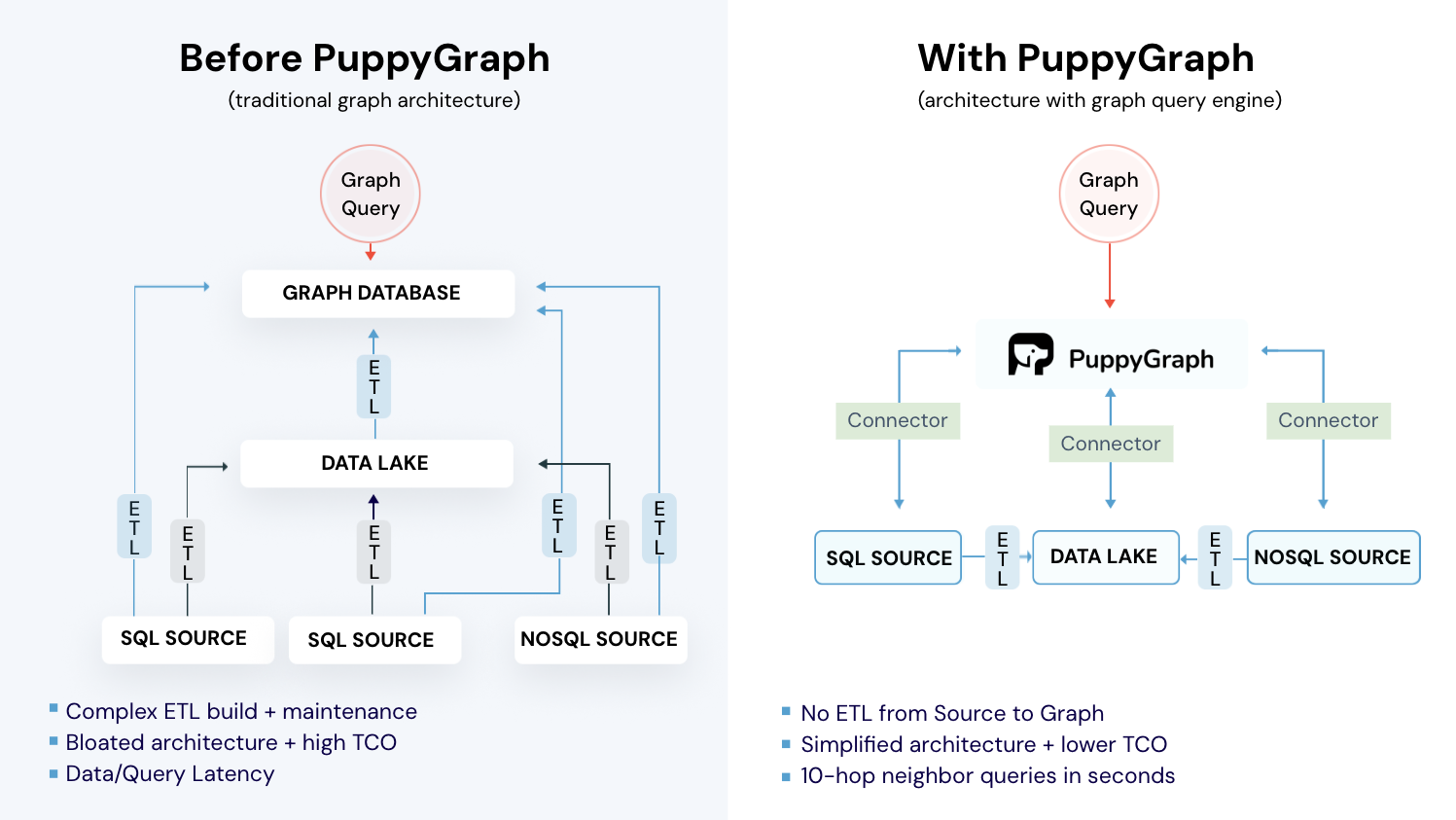
PuppyGraph is the first and only real time, zero-ETL graph query engine in the market, empowering data teams to query existing relational data stores as a unified graph model that can be deployed in under 10 minutes, bypassing traditional graph databases' cost, latency, and maintenance hurdles.
It seamlessly integrates with data lakes like Apache Iceberg, Apache Hudi, and Delta Lake, as well as databases including MySQL, PostgreSQL, and DuckDB, so you can query across multiple sources simultaneously.

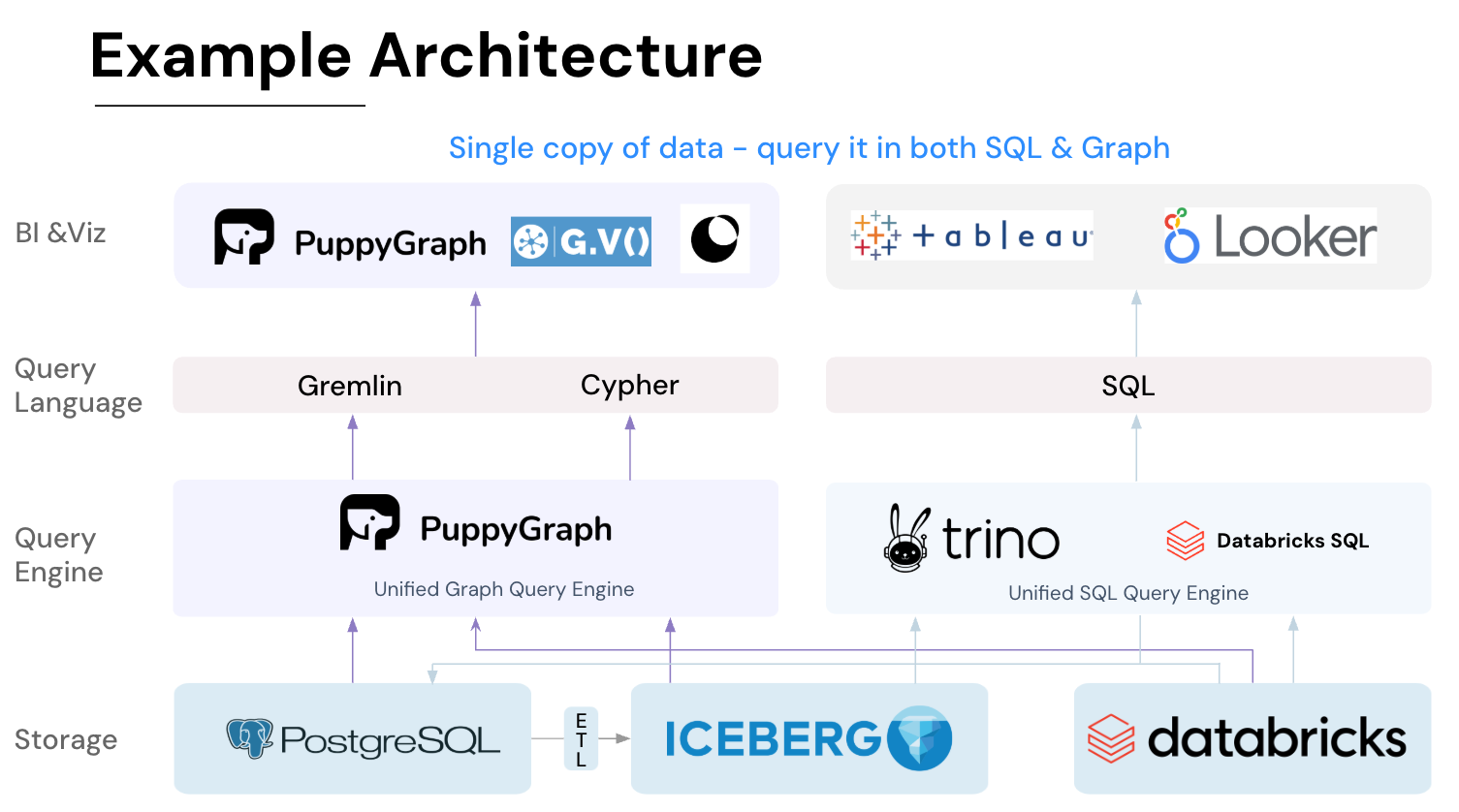
Key PuppyGraph capabilities include:
- Zero ETL: PuppyGraph runs as a query engine on your existing relational databases and lakes. Skip pipeline builds, reduce fragility, and start querying as a graph in minutes.
- No Data Duplication: Query your data in place, eliminating the need to copy large datasets into a separate graph database. This ensures data consistency and leverages existing data access controls.
- Real Time Analysis: By querying live source data, analyses reflect the current state of the environment, mitigating the problem of relying on static, potentially outdated graph snapshots. PuppyGraph users report 6-hop queries across billions of edges in less than 3 seconds.
- Scalable Performance: PuppyGraph’s distributed compute engine scales with your cluster size. Run petabyte-scale workloads and deep traversals like 10-hop neighbors, and get answers back in seconds. This exceptional query performance is achieved through the use of parallel processing and vectorized evaluation technology.
- Best of SQL and Graph: Because PuppyGraph queries your data in place, teams can use their existing SQL engines for tabular workloads and PuppyGraph for relationship-heavy analysis, all on the same source tables. No need to force every use case through a graph database or retrain teams on a new query language.
- Lower Total Cost of Ownership: Graph databases make you pay twice — once for pipelines, duplicated storage, and parallel governance, and again for the high-memory hardware needed to make them fast. PuppyGraph removes both costs by querying your lake directly with zero ETL and no second system to maintain. No massive RAM bills, no duplicated ACLs, and no extra infrastructure to secure.
- Flexible and Iterative Modeling: Using metadata driven schemas allows creating multiple graph views from the same underlying data. Models can be iterated upon quickly without rebuilding data pipelines, supporting agile analysis workflows.
- Standard Querying and Visualization: Support for standard graph query languages (openCypher, Gremlin) and integrated visualization tools helps analysts explore relationships intuitively and effectively.
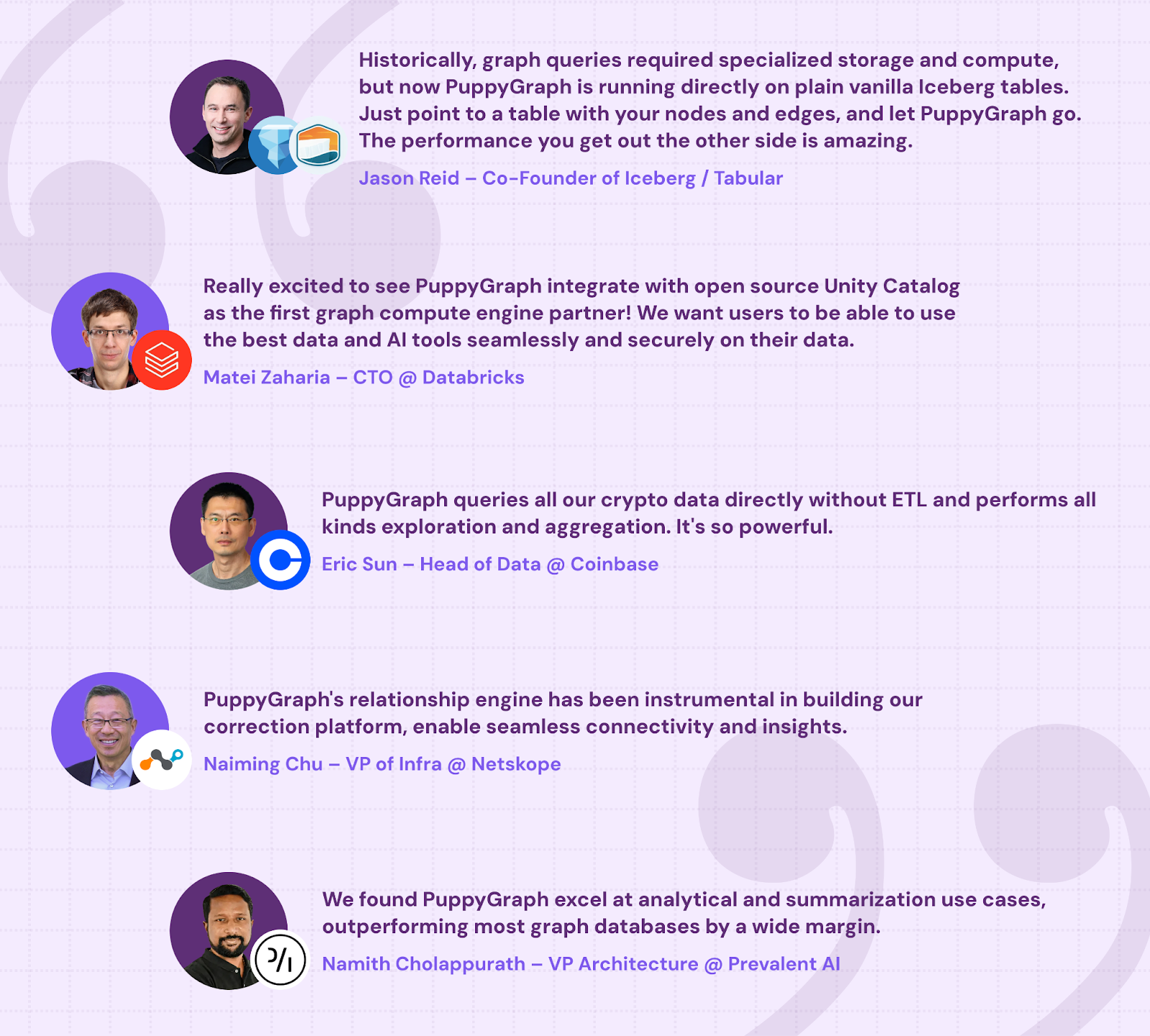
- Proven at Enterprise Scale: PuppyGraph is already used by half of the top 20 cybersecurity companies, as well as engineering-driven enterprises like AMD and Coinbase. Whether it’s multi-hop security reasoning, asset intelligence, or deep relationship queries across massive datasets, these teams trust PuppyGraph to replace slow ETL pipelines and complex graph stacks with a simpler, faster architecture.
As data grows more complex, the most valuable insights often lie in how entities relate. PuppyGraph brings those insights to the surface, whether you’re modeling organizational networks, social introductions, fraud and cybersecurity graphs, or GraphRAG pipelines that trace knowledge provenance.
Deployment is simple: download the free Docker image, connect PuppyGraph to your existing data stores, define graph schemas, and start querying. PuppyGraph can be deployed via Docker, AWS AMI, GCP Marketplace, or within a VPC or data center for full data control.
Conclusion
The right choice depends on how your application balances structure, relationships, and scale. Multi-model workloads are less complicated in OrientDB because of the single engine, while Neo4j performs consistently for deep, connected queries. And with how enterprise data ecosystems are becoming more interconnected, it has become impractical to maintain separate engines for documents, graphs, and analytics.
PuppyGraph brings graph computation to where your data already lives. It avoids fragmentation, works alongside existing storage systems, and offers the performance and consistency needed for evolving, relationship-heavy workloads. If you are building data architectures that must scale without redesigning their storage layers, PuppyGraph provides a forward-looking foundation built for growth.
To explore the platform, try PuppyGraph's forever free Developer edition or book a free demo.

Matt is a developer at heart with a passion for data, software architecture, and writing technical content. In the past, Matt worked at some of the largest finance and insurance companies in Canada before pivoting to working for fast-growing startups.

Get started with PuppyGraph!


Developer Edition
- Forever free
- Single noded
- Designed for proving your ideas
- Available via Docker install
Enterprise Edition
- 30-day free trial with full features
- Everything in developer edition & enterprise features
- Designed for production
- Available via AWS AMI & Docker install