


Security Log Analysis: Techniques, Tools & Best Practices
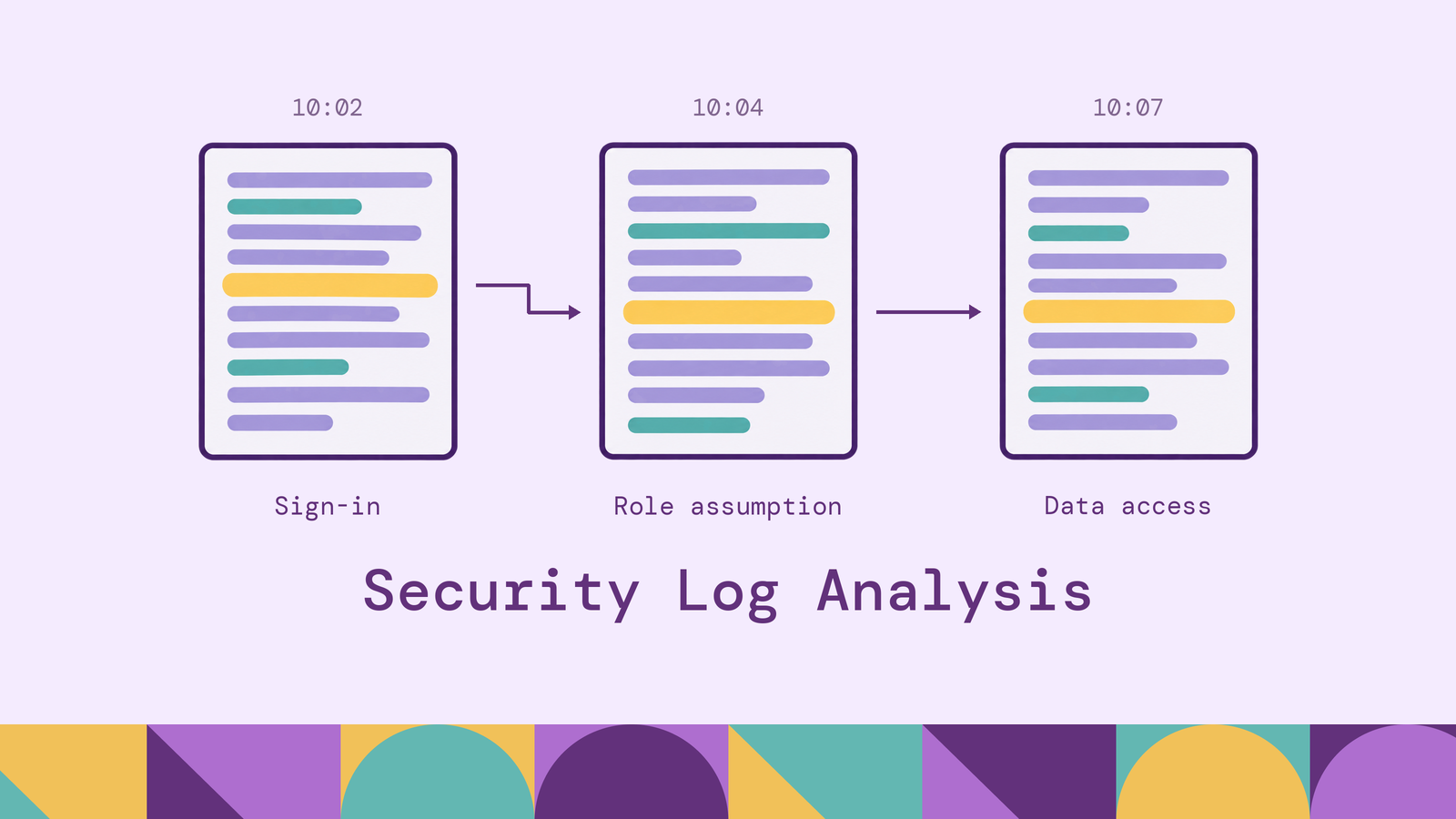
A successful login, a new role assignment, and a database export can each be legitimate. Investigating them together requires knowing which identity performed the actions, whether the events belong to the same session, and what happened between them. Security log analysis supplies that context so responders can distinguish routine activity from a developing incident.
This article covers the logs worth collecting, techniques for analyzing them, threats they can reveal, and a practical workflow for detection and investigation. It also explains where AI and graph queries help when an investigation crosses systems.
What is security log analysis?
Security log analysis is the examination of recorded system, application, identity, and network events to identify suspicious behavior, investigate incidents, and assess security controls. It combines searches, aggregations, detection rules, and cross-source correlation with an analyst's understanding of the environment.
A useful record establishes when an event occurred, who or what initiated it, the action attempted, the target, and the outcome. An authentication failure and a successful authentication describe different outcomes; a permission grant and a subsequent resource read describe different actions. Preserving those distinctions makes later conclusions defensible.
Analysis depends on collection and retention, but has its own purpose: answering a security question. A search for one compromised account supports an investigation; a scheduled rule looking for suspicious account activity supports ongoing detection. Both rely on logs being available and interpretable when needed.
Why is security log analysis important?
Attackers can operate through legitimate accounts and administrative tools. MITRE ATT&CK's Valid Accounts technique describes how compromised credentials support access, persistence, and privilege escalation, sometimes without malware. Successful operations therefore deserve attention alongside errors and blocked requests.
Detection and prioritization. Logs let teams combine suspicious activity with identity privilege and asset importance. An unusual sign-in followed by access to a sensitive repository deserves a different investigation from an isolated failure against an unused account.
Incident reconstruction. Retained records help responders establish the first observed activity, affected systems, and actions taken. An investigation can distinguish resources an account accessed from resources it merely had permission to access, which changes containment priorities.
Control validation. Logs help verify whether authentication policies, access restrictions, and response actions behaved as intended. A session-revocation request records an attempted control action; subsequent activity must be checked to assess the result. The useful output is evidence that supports a decision, with its coverage limits understood.
Types of security logs
Choose sources according to the behaviors you need to investigate. The joint Priority Logs for SIEM Ingestion: Practitioner Guidance (2025) provides source-specific recommendations for building that coverage. Each source contributes a different part of the record.
Logging coverage must be checked explicitly. For example, AWS CloudTrail data events, including S3 object-level operations such as GetObject, are not logged by trails or event data stores by default. Seeing administrative events does not establish that object reads are being captured.
Maintain a coverage inventory that records the source owner, enabled event categories, retention, and last successful delivery. Missing evidence becomes easier to recognize when the team knows what should exist.
Security log analysis techniques
Several techniques work together, from narrowing a search to reconstructing relationships across systems.
Filtering and aggregation. Filter by time, identity, host, action, and outcome, then group records to find patterns. Failed authentications grouped by account answer a different question from failures grouped by source address. Counting distinct target accounts can help surface password spraying that a per-account threshold misses.
Rules and indicator matching. Rules encode known conditions, such as an unexpected privilege grant or contact with an indicator from threat intelligence. Sigma provides a shareable detection format and tooling for converting rules into backend queries. Using converted rules still requires appropriate source fields and local validation. Indicator matches also need context about the indicator's age and confidence.
Temporal and entity correlation. Relate events through stable identifiers and an explicit time window. For an illustrative investigation, connect a sign-in to a role assumption, then connect that role session to object reads. Account names alone may be ambiguous across tenants; IP addresses alone are weak identity keys. Preserve event identifiers so every relationship can be traced back to its records.
Behavioral baselines. Compare activity with an appropriate history or peer group. A service account beginning interactive sessions may warrant investigation even when authentication succeeds. Baselines need context: maintenance, new deployments, and changes in job responsibilities can all explain deviations.
Graph analysis. Represent identities, sessions, hosts, and resources as entities connected by observed activity or configured permissions. Traversals can follow a session across several resources or identify accounts connected to a compromised host. Keep observed access separate from possible access, and apply timestamps to avoid assembling a path from unrelated activity across months.
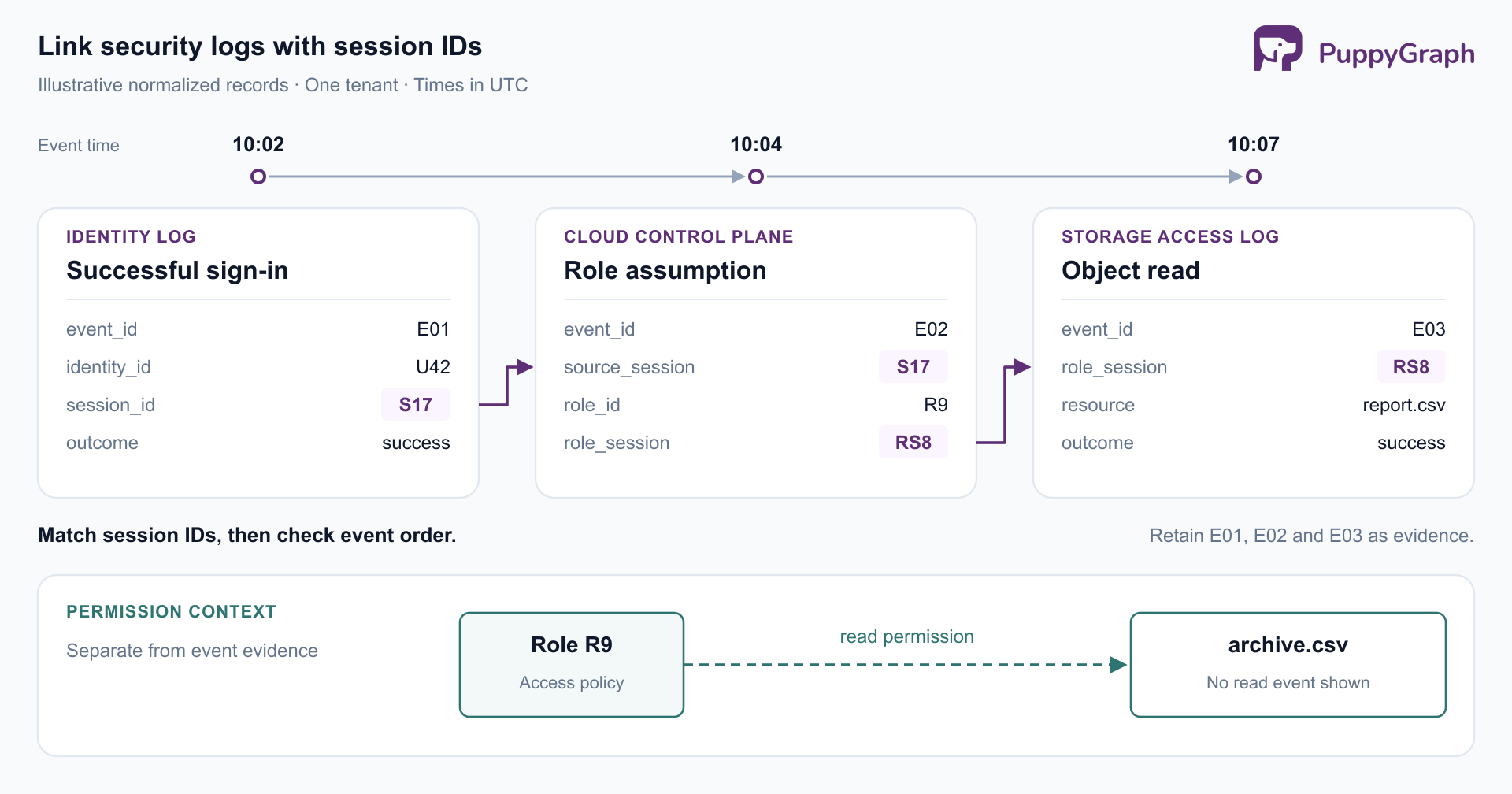
Each technique answers a different question. Aggregation finds concentration, rules recognize specified behavior, and correlation tests whether separate observations belong to the same activity. An investigation often needs all three before it can justify action.
Security threats detected through log analysis
Detection logic should connect a suspicious pattern to the evidence needed to validate it. The following are investigation starting points, not automatic verdicts.
Credential attacks and account takeover. Repeated failures across accounts can suggest password spraying. An unfamiliar successful session followed by sensitive actions can suggest takeover, including cases with no preceding failures. Check authentication method, device context, session identifiers, and the account's expected activity before attributing the session to an attacker.
Lateral movement. Remote logons and subsequent execution on another host can reveal movement through an environment. MITRE ATT&CK's Remote Services technique covers adversary use of services such as SSH and RDP. Correlate source-host activity, destination authentication, and destination processes; administrative tools can produce similar records during authorized work.
Privilege abuse and persistence. Unexpected role assignments, new credentials, or changes to authentication settings merit review. Trace who made the change, the authority used, and subsequent activity under the new permissions. Compare the sequence with approved changes rather than treating every administrative operation as hostile.
Data theft and insider misuse. Unusual exports, object reads, or outbound transfers can identify data-access activity requiring investigation. Establish which data was accessed and where it went. A large transfer may be a backup, and an audit record showing a read does not by itself establish external exfiltration.
Ransomware and destructive activity. File changes, suspicious process execution, and recovery-related changes can contribute evidence. MITRE ATT&CK's Data Encrypted for Impact technique describes encryption that disrupts availability. Detection depends on collecting relevant telemetry; a system recording only sign-ins cannot directly establish that files were encrypted.
How to perform security log analysis
Build the workflow around a concrete investigation question, then verify that collection, queries, and response can support it.
1. Define the behavior and required evidence. Start with a question such as whether a suspicious identity session accessed sensitive storage. Identify the authentication, role-session, and storage events needed to answer it. Document their linking fields and generate a benign test action to confirm that the expected records arrive.
2. Collect and protect the records. Centralize the required sources and retain original records alongside parsed fields. Restrict access, protect transport, and monitor changes to logging configuration. Avoid collecting passwords, access tokens, and unnecessary sensitive payloads; the OWASP Logging Cheat Sheet explains exclusions and log-protection practices. Set retention according to investigation needs and applicable organizational requirements, then test retrieval from archive.
3. Normalize time and identity. Preserve source timestamps and ingestion timestamps separately. Normalize time zones, monitor clock synchronization, and retain tenant or account scope with identity identifiers. The joint Best Practices for Event Logging and Threat Detection (2024) emphasizes timestamp consistency. For correlations, define the event order explicitly; ingestion order can differ when delivery is delayed. Keep the original values available for debugging parser errors.
4. Implement and test the analysis. Choose tools according to the workflow. Microsoft Sentinel supports SIEM detection, investigation, hunting, and automated response. Elastic Security provides scheduled detection rules with queries, look-back windows, and actions. SQL over a security data lake is useful for exploratory joins and aggregations when the relevant events are already in tables. Evaluate source coverage, query expressiveness, retention access, and case handling using your own investigation examples.
For the suspicious-session example, test the sequence below against known benign and suspicious fixtures:
Start with the flagged identity session.
Find role assumptions linked to that session.
Find successful sensitive-object reads by those role sessions.
Require sign-in <= role assumption <= object read.
Apply a bounded investigation window and retain all event IDs.
This is illustrative correlation logic. Test unrelated sessions, duplicate events, missing identifiers, and late delivery before scheduling it. Overlapping searches need deduplication so repeated matches do not generate duplicate alerts.
5. Investigate, respond, and tune. Attach the matching records, identity context, and relevant asset details to a case. Automate repeatable enrichment and routing. Put disruptive actions such as disabling an account behind a tested response policy. Record analyst dispositions and revisit rules that repeatedly flag expected activity. Track source availability and detection-test results alongside alert quality so a quiet queue is not mistaken for complete coverage.
Security log analysis using AI
AI can assist with behavioral detection and with the work of interpreting evidence. These uses need different evaluation criteria.
Anomaly detection. Models can flag deviations that are awkward to express as fixed conditions. For example, Elastic's machine learning rules generate alerts from anomaly-detection jobs when scores meet or exceed a configured threshold. Evaluate results against reviewed incidents and representative benign activity. An anomaly score measures unusualness within the model's assumptions; it does not establish malicious intent.
Query assistance and summaries. A language model can help draft searches, explain unfamiliar fields, or summarize retrieved records. Supply the actual schema and require references to event IDs. Review time windows, join keys, and result completeness before accepting a generated account of an incident. A fluent explanation cannot compensate for a query that omitted the relevant session.
Controlled automation. Logs can contain attacker-controlled text, including request paths and user-agent strings. Applying OWASP's prompt-injection guidance means treating that content as untrusted data, restricting tool permissions, and validating actions outside the model. Separate evidence summarization from authority to execute a response. Measure whether AI reduces investigation effort while preserving evidence accuracy, including cases where the available logs cannot answer the question.
Challenges in security log analysis
Volume and retention costs. Detailed telemetry competes for storage, indexing, and analyst attention. Prioritize events tied to detection and investigation requirements, and choose storage tiers deliberately. Test how long an archived investigation takes to restore and query; retained data has limited operational value if it cannot be retrieved within the response window.
Incomplete or changing data. A parser update, expired collection credential, or disabled audit category can silently remove evidence. Monitor delivery lag, parsing failures, and required-field completeness. Keep representative source records for regression checks when formats change.
Alert quality and ownership. Rules need owners, review dates, and clear response expectations. Scope exceptions narrowly and give them expiry dates. Investigate whether a noisy rule has the wrong threshold, missing context, or a weak hypothesis before suppressing its output.
Relationships across sources. An identity provider, endpoint sensor, and cloud service may describe the same activity using different identifiers. Even after mapping those identifiers, responders must follow the connections from an account through sessions and hosts to affected resources. Repeated investigations benefit from an explicit model of these relationships over the collected data.
PuppyGraph is the first and only zero-ETL graph query engine that lets teams query existing relational data as a graph without loading it into a separate graph database. For security log analysis, teams define a graph schema over event, identity, session, and asset tables in supported SQL databases, data warehouses, and data lakes or lakehouses, including direct reads of open table formats such as Iceberg and Delta Lake. The direct-query architecture adds graph analysis over the storage the logging pipeline already maintains.
Analysts can use openCypher and Gremlin to follow the relationships defined in that schema. For example, a query can start from a flagged identity, follow its recorded sessions, and return the sensitive resources accessed during the investigation window. This makes the cross-source relationship model reusable across investigations while keeping evidence in the existing tables. Teams still define identity mappings, relationship meanings, and time constraints so the resulting paths reflect the activity being investigated.
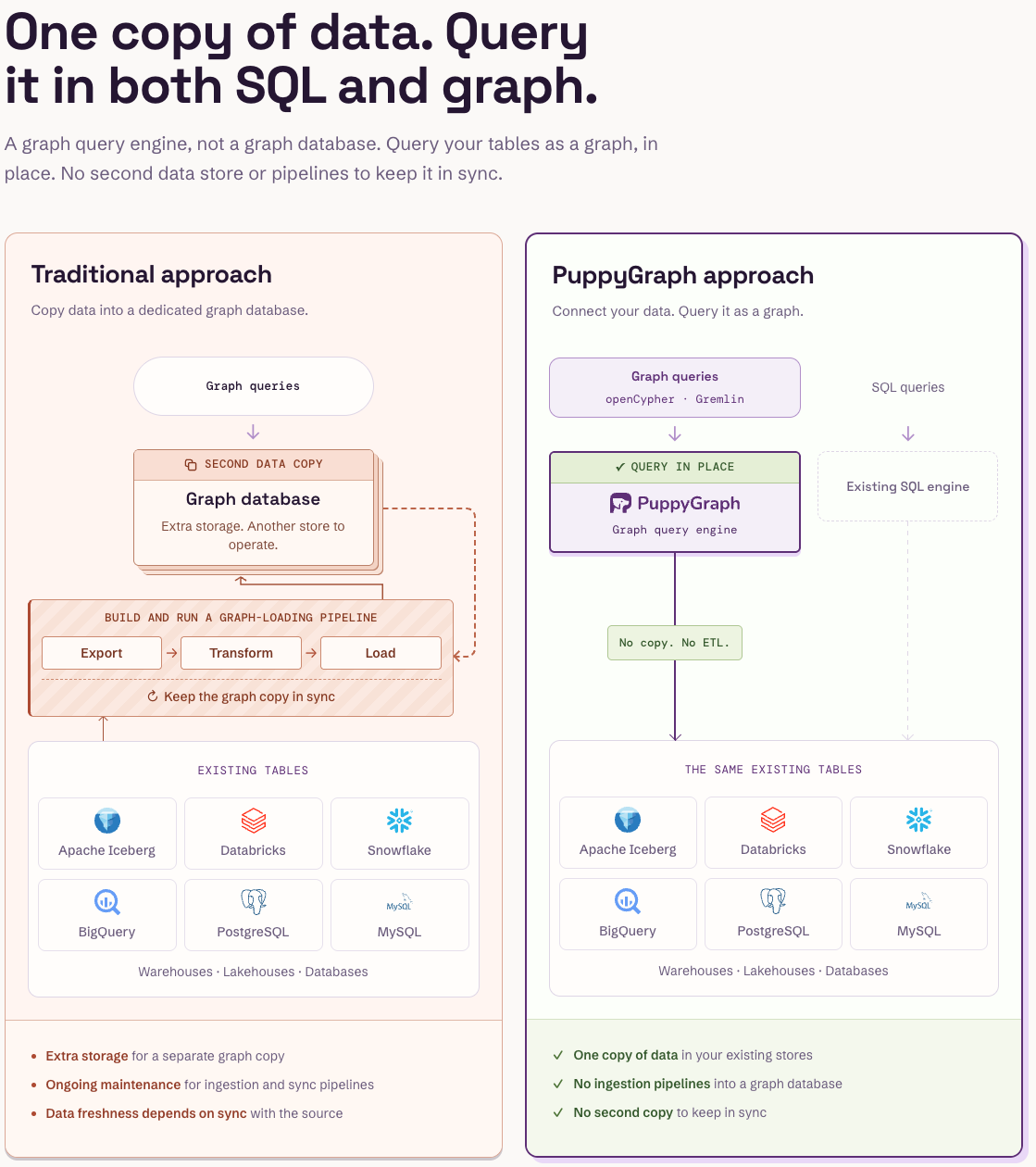
PuppyGraph complements the SIEM's detection and case workflow with this relationship analysis. The logging pipeline continues to collect and normalize events, while PuppyGraph provides a graph view for questions that extend across those records. For a team investigating account compromise, the practical value is being able to trace connected activity and retrieve the supporting events without preparing a separate graph dataset for each investigation.

Conclusion
Security log analysis depends on collecting the right evidence, preserving its meaning, and connecting it to a specific investigation question. Rules, behavioral models, and graph queries each help, but their results depend on source coverage, reliable identifiers, and time-aware interpretation. Start with a small set of important behaviors, validate them end to end, and improve coverage through incident findings and repeatable tests.
Try the forever-free PuppyGraph Developer Edition and book a demo to explore how identities, sessions, and resources in your existing security tables connect during a log investigation.

Hao Wu is a Software Engineer with a strong foundation in computer science and algorithms. He earned his Bachelor’s degree in Computer Science from Fudan University and a Master’s degree from George Washington University, where he focused on graph databases.

Get started with PuppyGraph!


Developer Edition
- Forever free
- Single noded
- Designed for proving your ideas
- Available via Docker install
Enterprise Edition
- 30-day free trial with full features
- Everything in developer edition & enterprise features
- Designed for production
- Available via AWS AMI & Docker install