


TigerGraph vs Amazon Neptune: Key Differences & Comparison
Graph databases have moved from a niche technology used mainly by academic research labs to a core database category powering mission-critical applications across industries. Organizations now rely on graph technology for fraud detection, recommendation engines, cybersecurity threat analysis, network optimization, digital twins, supply chain modeling, and knowledge graph reasoning. As data grows more interconnected and analytical workloads require deeper context, graph databases provide powerful traversal capabilities that traditional relational stores cannot match.
Among the most frequently compared graph systems in the enterprise ecosystem are TigerGraph, a high-performance native parallel graph database, and Amazon Neptune, a fully managed graph service on AWS. Although both systems support graph models and graph query languages, they differ significantly in architecture, deployment model, performance behavior, programming experience, scaling approach, and operational philosophy.
Choosing between them requires a grounded understanding of what each engine excels at, the assumptions baked into their design, and the constraints imposed by real-world workloads. This article provides a thorough comparative guide, covering architecture, GSQL vs Gremlin/SPARQL, indexing strategies, memory layout, consistency models, clustering behavior, and traversal performance, along with scenarios where each option fits naturally. We also introduce PuppyGraph as a flexible alternative for multi-model and multi-engine graph analytics.
What is TigerGraph?
TigerGraph is a distributed, native graph database engine designed for high-performance analytics on very large graphs. Unlike multi-model systems that treat graphs as one of several data types, TigerGraph was built from scratch with a specialized storage engine optimized for deep traversal, parallel computation, and distributed workloads. TigerGraph markets itself as the “fastest graph database for real-time analytics,” emphasizing loading speed, query throughput, and massively parallel execution supported by its GSQL language.
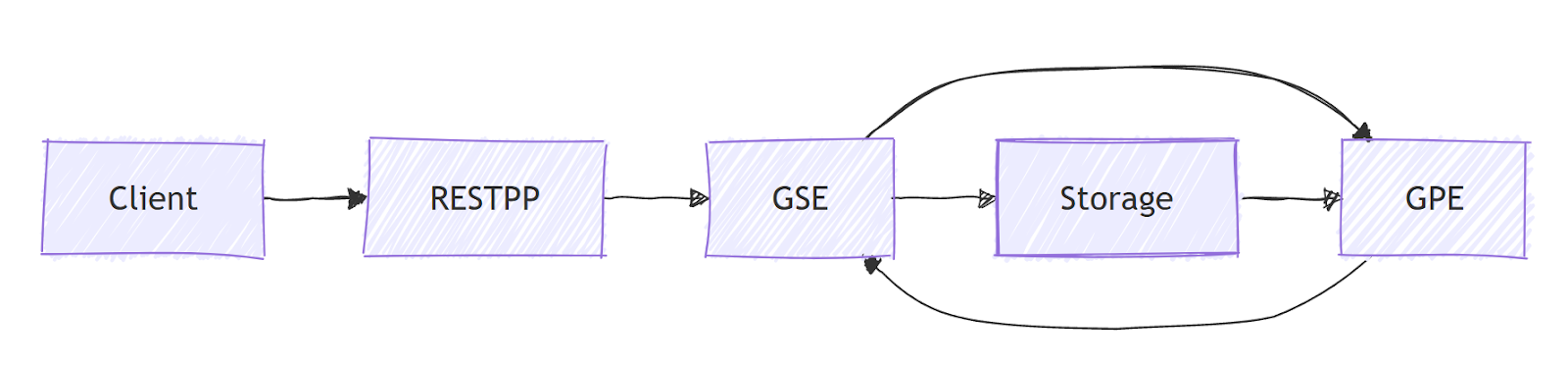
TigerGraph is deployed either via the company’s enterprise edition, cloud SaaS service, or a limited community edition. Its architecture emphasizes deterministic performance on large datasets where queries frequently span multi-hop relationships, making it popular in telecom network analysis, real-time fraud detection, recommendation engines, pharmaceutical research, and financial compliance. TigerGraph’s runtime operates as a distributed C++ system, with GSQL compiled into execution plans that leverage a parallel execution engine capable of distributing graph computation across multiple machines.
Below is an architectural diagram that illustrates the main components of a TigerGraph cluster:
TigerGraph remains attractive for organizations that require very deep traversals or heavy analytical workloads, and want a single system optimized around graph computation without managing the operational complexity of multiple storage backends.
Key Features of TigerGraph
1. Native Parallel Graph Engine
TigerGraph features a tightly integrated parallel engine optimized for graph analytics at scale. All graph objects are stored in adjacency lists in a compressed binary format, enabling fast traversal and cache-efficient access patterns. The internal GSQL compiler translates queries into distributed execution plans using synchronous and asynchronous messages passing across compute partitions. This architecture contrasts with systems that depend on external storage engines, giving TigerGraph greater control over memory locality and traversal speed.
2. GSQL Query Language
TigerGraph introduces GSQL, a SQL-inspired graph programming language that offers both declarative and procedural constructs. GSQL supports control flow, accumulators, pattern matching, graph updates, and built-in parallel execution semantics. Its design encourages writing complex graph algorithms in a relatively compact syntax, enabling developers to implement multi-stage analytics workflows directly inside the database, rather than relying on external systems or Gremlin traversal chains.
3. High-Throughput Loading and Batch Processing
Loading bulk data is one of TigerGraph’s strong suits. The engine includes a high-performance loader capable of ingesting billions of nodes and edges per hour. TigerGraph also emphasizes high-throughput ETL, fast deduplication, and schema enforcement with vertex and edge types. The loader integrates with GSQL, enabling preprocessing logic to run as part of ingestion. This capability is especially appealing for organizations building large-scale knowledge graphs, telecom graphs, and financial transaction networks.
4. Distributed Clustering and MPP Execution
TigerGraph supports multi-node clustering with MPP (massively parallel processing) execution. Graph partitions are distributed across cluster nodes, and queries automatically spawn execution tasks on each partition. TigerGraph’s architecture encourages distributed computation rather than simple read/write sharding. This design makes it suitable for analytics that require deep graph exploration while minimizing cross-node communication overhead.
5. Strong Focus on Real-Time Analytics
TigerGraph positions itself as an engine for real-time analytic applications. Fraud detection systems, recommendation engines, and streaming analytics pipelines often benefit from TigerGraph’s low-latency queries and ability to maintain large working sets in memory. Built-in features such as accumulators support iterative algorithms and multi-stage traversals that run efficiently on massive graphs.
What is Amazon Neptune?
Amazon Neptune is a fully managed graph database service provided by AWS. Developed with cloud-native operations in mind, Neptune is designed to deliver predictable performance, managed infrastructure, fault tolerance, and easy scaling for applications built within the AWS ecosystem. Unlike TigerGraph, which focuses on a single data model and single query language, Neptune is multi-model and multi-language, supporting:
- Property Graph (via Gremlin)
- Labeled Property Graph (via openCypher, in preview/partial support)
- RDF (via SPARQL 1.1)
Neptune uses a storage engine based on a distributed, multi-AZ design. It separates compute from storage, allowing multiple read replicas to scale independently while maintaining a shared underlying cluster volume. Neptune’s managed nature allows developers to avoid operational concerns such as patching, cluster repair, and backup orchestration.
Neptune emphasizes simplicity, integration with AWS services, and consistent performance for transactional graph workloads, making it well-suited for knowledge graphs, identity graphs, fraud analytics, metadata graphs, and semantic web applications. It is frequently used for workloads where Gremlin traversal or SPARQL federated queries are central to application logic.
Below is a simplified architectural diagram of Neptune:

Neptune’s design aims to minimize administrative burden while providing high availability and integration with AWS IAM, CloudWatch, Kinesis, SageMaker, and Glue.
Key Features of Amazon Neptune
1. Fully Managed Cloud-Native Service
Amazon Neptune is delivered as a fully managed service, providing automatic failover, continuous backups to Amazon S3, patching, monitoring, and built-in security configurations. The service abstracts away cluster maintenance, making it appealing for teams that want reliable graph capabilities without the overhead of managing physical machines, distributed storage, or replication logic. Neptune integrates seamlessly with the broader AWS ecosystem.
2. Multi-Model Graph Support
Neptune supports property graphs and RDF, allowing developers to choose between Gremlin, SPARQL, and optionally openCypher. This flexibility makes it suitable for enterprises with heterogeneous graph requirements. Applications built around semantic reasoning or ontology-driven workflows can leverage SPARQL and RDF, while application logic using graph traversals can lean on Gremlin. This multi-model capability allows Neptune to serve as a general-purpose graph store within AWS.
3. Storage-Optimized Design with Read Replicas
Neptune separates storage from compute by using a distributed, fault-tolerant storage backend that automatically replicates data across multiple availability zones. Compute nodes operate as query engines, and applications can scale read performance by adding replicas. This architecture is optimized for read-heavy workloads that benefit from horizontal scaling via multiple read endpoints.
4. Gremlin, SPARQL & openCypher Query Languages
Neptune supports three major graph query languages. Gremlin is used for property graph traversals and is well-suited for operational applications. SPARQL enables semantic queries across RDF knowledge graphs with support for inference. OpenCypher adds a familiar declarative syntax for developers migrating from Neo4j. This multi-language ecosystem makes Neptune flexible but also introduces complexity in optimizing queries for different models.
5. Integration with AWS Analytics and Security Services
Neptune integrates deeply with AWS services such as IAM for authentication, CloudWatch for monitoring, Kinesis for streaming ingestion, SageMaker for machine learning enhancements, and Lambda for serverless triggers. This tight integration streamlines application development within AWS and allows teams to construct pipelines for ingestion, analysis, and monitoring without external infrastructure.
TigerGraph vs Amazon Neptune: Feature Comparison
Below is a high-level comparison table between TigerGraph and Neptune.
Which One is Right for You?
The right choice depends on how your workload aligns with each platform’s strengths:
Transactional vs Analytical
TigerGraph is built for analytical graph workloads, especially deep multi-hop traversals, graph scoring, and multi-stage computation. Its native parallel engine makes it ideal for workloads like fraud analytics, telecom path computation, or real-time recommendations.
Neptune can support analytical use cases through Gremlin and SPARQL, but it is fundamentally optimized for operational graph queries with predictable latency and strong AWS-managed guarantees. For semantic reasoning, metadata catalogs, and identity graphs, Neptune’s RDF/SPARQL stack provides capabilities that TigerGraph does not directly offer.
Scaling Boundaries
TigerGraph scales horizontally through distributed MPP clustering, where both storage and computation scale together. This gives it strong advantages for workloads requiring high write throughput or distributed execution of heavy analytical jobs.
Neptune scales primarily through read replicas and auto-scaling storage. It handles read-heavy workloads well, but write throughput is bound to a single writer node. Cross-AZ replication improves durability but does not provide distributed compute execution like TigerGraph.
Query Language
TigerGraph uses GSQL, a powerful SQL-inspired graph language combining declarative pattern matching with procedural logic. It excels for algorithmic workflows and multi-phase analytics but requires adopting a proprietary query ecosystem.
Neptune supports Gremlin, SPARQL, and openCypher, making it more flexible for teams with existing graph investments. SPARQL support uniquely enables semantic graph and ontology-driven applications. However, Neptune’s openCypher implementation differs from Neo4j’s Cypher, so teams may need to adjust queries during migration.
Cost
TigerGraph deployments, whether self-managed or via TigerGraph Cloud, can deliver strong performance but often require high-memory hardware and careful cluster design, which increases operational cost for large datasets.
Neptune’s pricing follows AWS norms based on instance size or serverless ACUs plus storage. Serverless reduces overprovisioning but cannot scale to zero, meaning idle clusters still incur cost. Neptune simplifies administration but accumulates charges as read replicas and storage volumes grow.
Ecosystem Fit
TigerGraph fits best in environments that prioritize high-performance graph computation, where teams are comfortable managing distributed systems or are deeply invested in GSQL-based analytics.
Neptune is ideal for organizations standardized on AWS, benefiting from IAM, CloudWatch, Glue, Kinesis, and SageMaker integrations. Its multi-model, multi-language design makes it a convenient drop-in for enterprise workloads that mix operational graph use cases with semantic reasoning.
When to Choose TigerGraph vs Neptune
Building on the factors discussed above, the following scenarios illustrate when TigerGraph or Neptune is the more suitable choice. TigerGraph typically excels at compute-intensive graph analytics, deep multi-hop queries, and custom algorithms, while Neptune is better suited for teams seeking fully managed services, AWS integration, and semantic graph support.
Choose TigerGraph When:
- You need deep graph exploration and low-latency queries.
- Multi-stage analytics or custom graph algorithms are central to your workflows.
- You work with large graph datasets requiring high-speed computation.
- Your team is comfortable managing distributed infrastructure or using TigerGraph Cloud.
- Expressive query logic across multiple phases is needed (GSQL advantages).
Choose Amazon Neptune When:
- Your team relies on AWS-native infrastructure and services.
- You need a fully managed graph database with minimal operational overhead.
- Workloads involve knowledge graphs, metadata catalogs, or enterprise data governance.
- You prioritize simplicity, operational predictability, and read scalability.
- Work involves lightweight traversals, lookups, or ontology-driven queries.
Why Consider PuppyGraph as an Alternative
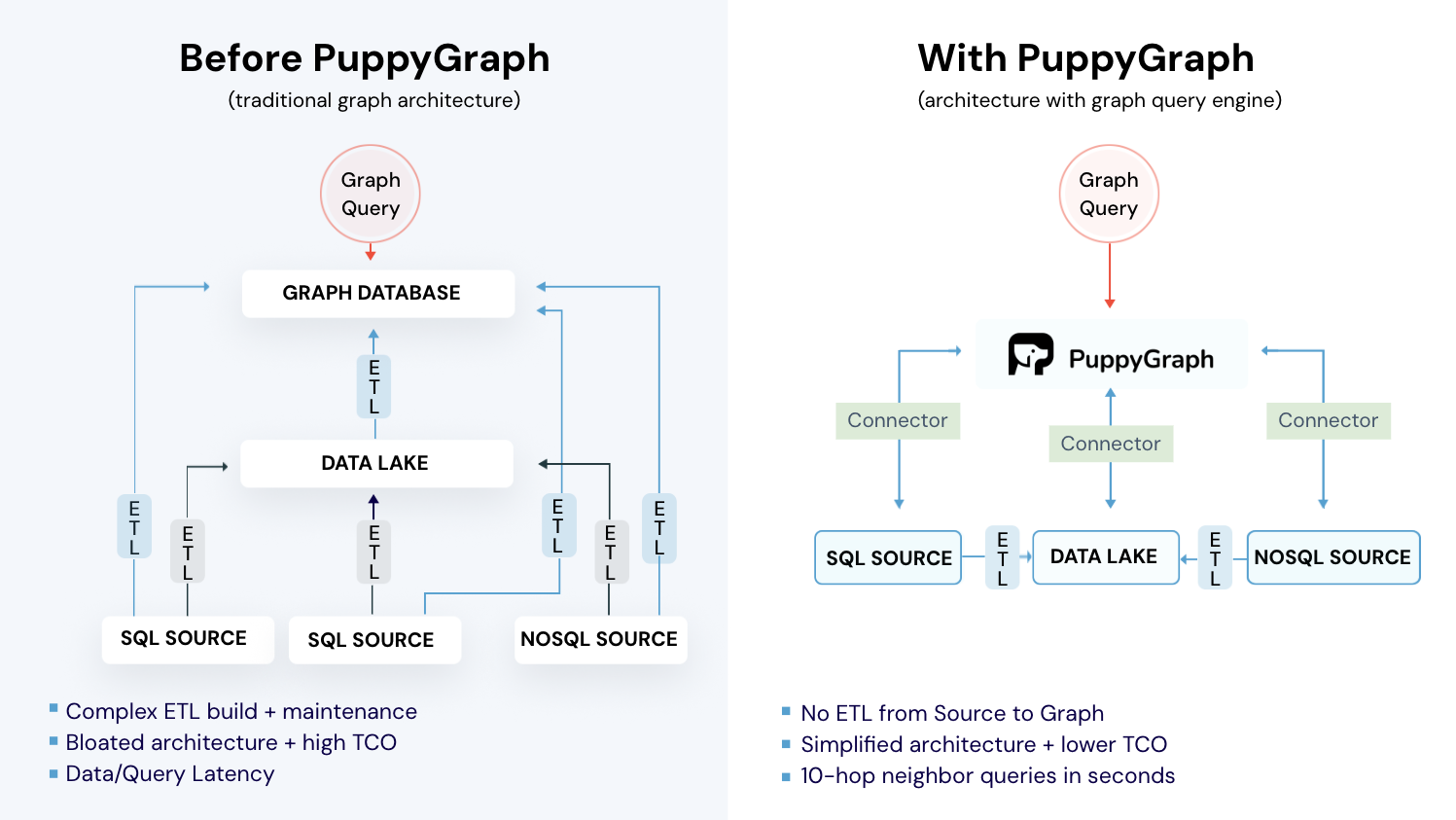
While TigerGraph and Amazon Neptune offer clear strengths, TigerGraph excelling at deep, parallel graph analytics and Neptune providing a fully managed, multi-model AWS experience, both require a separate graph database. This means building ETL pipelines, duplicating data, and maintaining parallel storage, governance, and security. As datasets scale, these operational costs often outweigh the benefits.
Increasingly, teams realize they don’t need a dedicated graph database to run multi-hop analysis. Modern lakehouse and relational systems can support graph workloads directly. This is where PuppyGraph fits, enabling real-time, zero-ETL graph querying on your existing data.

PuppyGraph is the first and only real time, zero-ETL graph query engine in the market, empowering data teams to query existing relational data stores as a unified graph model that can be deployed in under 10 minutes, bypassing traditional graph databases' cost, latency, and maintenance hurdles.
It seamlessly integrates with data lakes like Apache Iceberg, Apache Hudi, and Delta Lake, as well as databases including MySQL, PostgreSQL, and DuckDB, so you can query across multiple sources simultaneously.

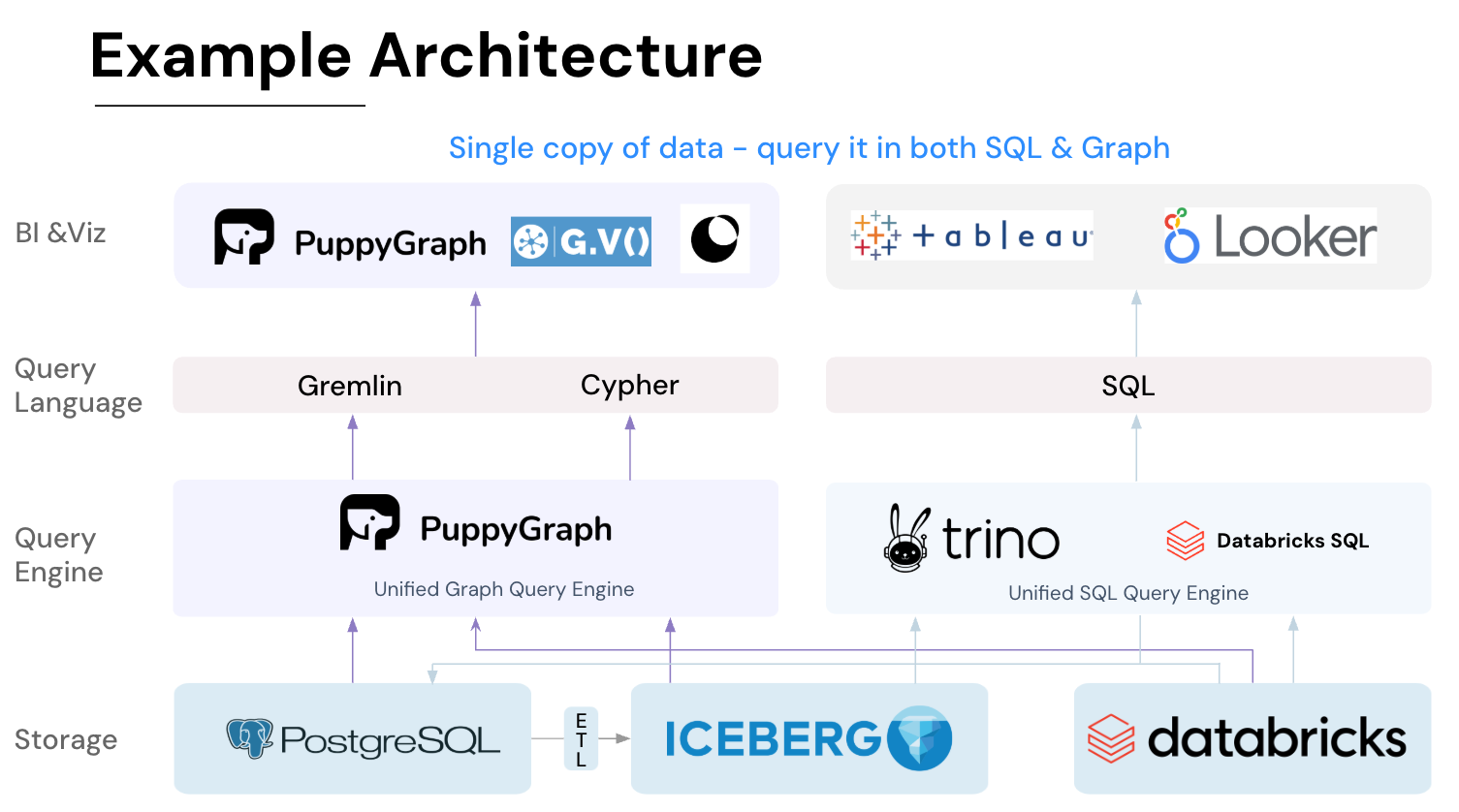
Key PuppyGraph capabilities include:
- Zero ETL: PuppyGraph runs as a query engine on your existing relational databases and lakes. Skip pipeline builds, reduce fragility, and start querying as a graph in minutes.
- No Data Duplication: Query your data in place, eliminating the need to copy large datasets into a separate graph database. This ensures data consistency and leverages existing data access controls.
- Real Time Analysis: By querying live source data, analyses reflect the current state of the environment, mitigating the problem of relying on static, potentially outdated graph snapshots. PuppyGraph users report 6-hop queries across billions of edges in less than 3 seconds.
- Scalable Performance: PuppyGraph’s distributed compute engine scales with your cluster size. Run petabyte-scale workloads and deep traversals like 10-hop neighbors, and get answers back in seconds. This exceptional query performance is achieved through the use of parallel processing and vectorized evaluation technology.
- Best of SQL and Graph: Because PuppyGraph queries your data in place, teams can use their existing SQL engines for tabular workloads and PuppyGraph for relationship-heavy analysis, all on the same source tables. No need to force every use case through a graph database or retrain teams on a new query language.
- Lower Total Cost of Ownership: Graph databases make you pay twice — once for pipelines, duplicated storage, and parallel governance, and again for the high-memory hardware needed to make them fast. PuppyGraph removes both costs by querying your lake directly with zero ETL and no second system to maintain. No massive RAM bills, no duplicated ACLs, and no extra infrastructure to secure.
- Flexible and Iterative Modeling: Using metadata driven schemas allows creating multiple graph views from the same underlying data. Models can be iterated upon quickly without rebuilding data pipelines, supporting agile analysis workflows.
- Standard Querying and Visualization: Support for standard graph query languages (openCypher, Gremlin) and integrated visualization tools helps analysts explore relationships intuitively and effectively.
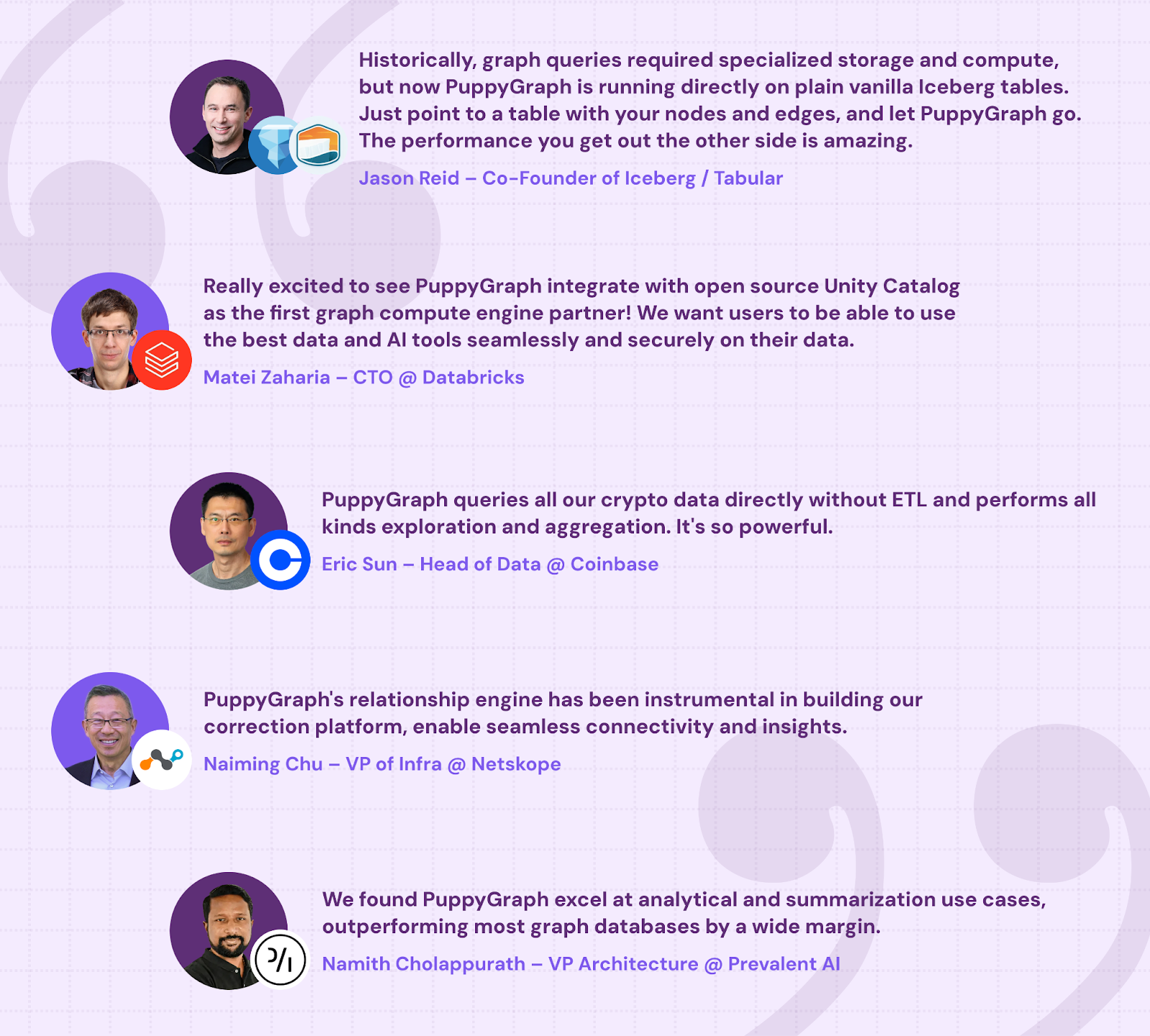
- Proven at Enterprise Scale: PuppyGraph is already used by half of the top 20 cybersecurity companies, as well as engineering-driven enterprises like AMD and Coinbase. Whether it’s multi-hop security reasoning, asset intelligence, or deep relationship queries across massive datasets, these teams trust PuppyGraph to replace slow ETL pipelines and complex graph stacks with a simpler, faster architecture.
As data grows more complex, the most valuable insights often lie in how entities relate. PuppyGraph brings those insights to the surface, whether you’re modeling organizational networks, social introductions, fraud and cybersecurity graphs, or GraphRAG pipelines that trace knowledge provenance.
Deployment is simple: download the free Docker image, connect PuppyGraph to your existing data stores, define graph schemas, and start querying. PuppyGraph can be deployed via Docker, AWS AMI, GCP Marketplace, or within a VPC or data center for full data control.
Conclusion
In this article, we have compared TigerGraph and Amazon Neptune across architecture, query languages, performance characteristics, scaling models, and ideal use cases. TigerGraph and Amazon Neptune exemplify two different approaches: TigerGraph delivers native, high-performance graph computation optimized for deep multi-hop traversals and parallel analytics, while Neptune offers a fully managed, multi-model service integrated tightly with AWS, emphasizing operational simplicity and semantic querying.
Both solutions, however, require maintaining a separate graph database, building and operating ETL pipelines, and managing duplicated storage and governance layers, which can introduce complexity and cost as data scales. PuppyGraph presents a modern alternative by enabling real-time, zero-ETL graph analytics directly on existing relational and lakehouse data stores. It combines fast multi-hop traversal, distributed compute, and flexible schema modeling without duplicating data or adding operational overhead.
For graph analytics on your current data stores, explore the forever-free PuppyGraph Developer Edition or book a demo with our team.

Hao Wu is a Software Engineer with a strong foundation in computer science and algorithms. He earned his Bachelor’s degree in Computer Science from Fudan University and a Master’s degree from George Washington University, where he focused on graph databases.

Get started with PuppyGraph!


Developer Edition
- Forever free
- Single noded
- Designed for proving your ideas
- Available via Docker install
Enterprise Edition
- 30-day free trial with full features
- Everything in developer edition & enterprise features
- Designed for production
- Available via AWS AMI & Docker install