


What Is a Semantic Layer? Architecture, Benefits & Use Cases
Ask three analysts to define "active customer" and you will often get three different SQL queries and three different numbers. This is the problem a semantic layer exists to solve: a layer of business meaning placed between raw, technical data and the people and tools that consume it, so that a metric, entity, or relationship means the same thing everywhere it's used. As organizations connect more BI tools, applications, and now AI agents to the same underlying data, that consistency has stopped being a nice-to-have and become a prerequisite for trustworthy analytics. This article covers what a semantic layer is, why organizations build one, how it works architecturally, and how to implement it. It also looks at a newer dimension of the same idea: using a semantic layer to ground AI and LLM applications, where PuppyGraph's approach to enforcing that layer at query time is directly relevant.
What Is a Semantic Layer?
A semantic layer is an abstraction that sits between physical data storage and the tools people use to query it, translating business-friendly terms like "revenue," "active user," or "churned account" into the technical logic, joins, and filters required to compute them correctly against the underlying tables. Instead of every dashboard, report, or application re-deriving that logic independently, the semantic layer defines it once, centrally, and every downstream consumer inherits the same definition automatically. This decouples how data is stored, which can change as systems evolve, from how it is described and consumed, which should stay stable so that a metric named "monthly active users" means the same thing in a quarterly board deck as it does in an ad hoc query.
The term is closely related to, but not identical with, an ontology, a concept with roots in the Semantic Web era describing a structured model of entities, their properties, and the relationships between them. A semantic layer in the BI sense is usually metric-and-dimension focused; an ontology is usually broader, modeling the entities and relationships themselves, independent of any specific metric. In practice, the two ideas increasingly overlap, particularly once AI agents are added as consumers, since an agent benefits from both a shared vocabulary for metrics and a structural map of how entities connect.
Why Do Organizations Need a Semantic Layer?
The immediate driver is metric consistency. Without a shared layer, each team's analysts and each BI tool's internal modeling produce their own version of a calculation, and small differences in filters or join logic quietly produce different numbers for what should be the same metric. A semantic layer eliminates this by making the definition the single source of truth, so a discrepancy becomes a bug to fix in one place rather than a permanent reconciliation exercise between teams. This matters more as the number of tools querying the same warehouse grows, since every additional BI tool, notebook, or application is another place the same logic could silently drift.
A second driver is enabling self-service analytics safely. Business users generally cannot, and should not have to, write the SQL required to correctly join a dozen normalized tables. A well-designed semantic layer lets them ask questions in terms they understand, "sales by region last quarter," while the layer handles the underlying joins, aggregations, and filters correctly every time. This lowers the burden on data teams to field every ad hoc request personally, while still guaranteeing that self-service users get answers that match what a data engineer would have produced by hand.
A third, related driver is portability across tools. Organizations rarely standardize on a single BI product for the life of a data platform; tools get replaced, new applications get built, and vendors get switched. Without a semantic layer, every one of those transitions means re-deriving business logic that was previously buried inside the outgoing tool's proprietary models. With a semantic layer sitting independently of any single BI product, the definitions survive the transition, and only the presentation layer on top needs to change, which meaningfully lowers the cost of switching tools later.
How Does a Semantic Layer Work?
Mechanically, a semantic layer works by maintaining a model, metadata describing entities, metrics, dimensions, and their relationships, that is separate from the physical schema of the underlying data. When a consumer, whether a BI tool, an application, or a person typing a question, requests a piece of information using the business vocabulary, the semantic layer's query engine translates that request into the actual query the underlying data source needs, executes it, and returns the result in the vocabulary the consumer used. The translation step is what makes the abstraction useful: users interact with stable business concepts, while the underlying tables, columns, and join paths can change without requiring every consumer to be rewritten.
This translation can happen at different points in the stack. Some semantic layers are embedded inside a specific BI tool and only serve that tool's queries. Others run as an independent service that multiple BI tools, applications, and increasingly AI agents can query through a shared API or query language, which is the architecture that scales best once an organization has more than one consumer of the same data. The independent-service pattern is also what makes a semantic layer viable as a grounding layer for AI applications, a use case covered later in this article.
Semantic Layer Architecture Explained
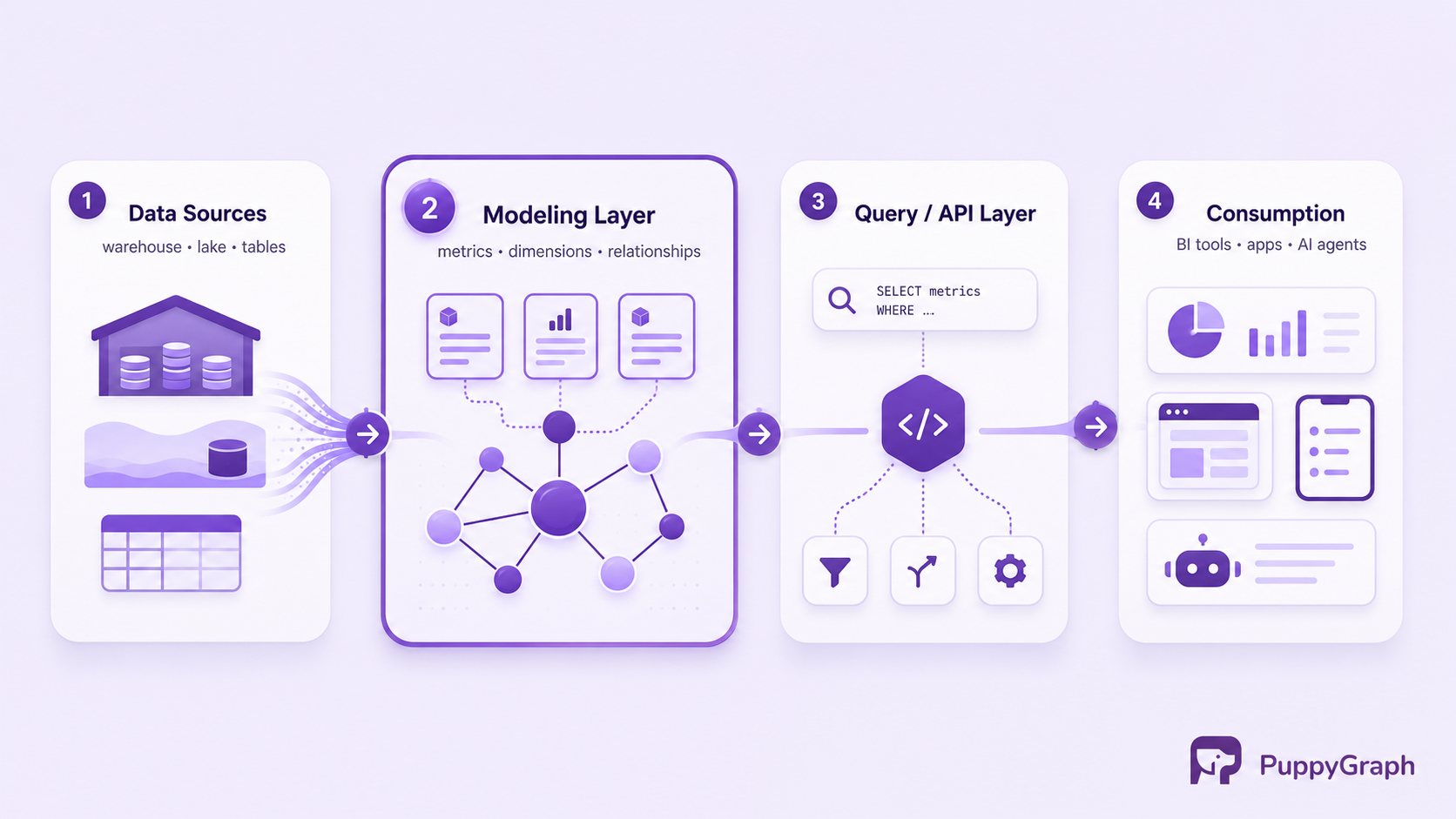
A semantic layer's architecture is usually described in four parts: the data sources it sits on top of, a modeling layer that defines metrics, dimensions, and relationships, a query or API layer that consumers interact with, and the consumption layer itself. Data sources are typically a warehouse, a data lake, or increasingly an open table format like Apache Iceberg. The modeling layer is where business logic lives, expressed declaratively rather than duplicated in application code. The query layer exposes that model through SQL, a dedicated query language, or an API, and the consumption layer is whatever tool, dashboard, or agent issues the requests.
What distinguishes a mature semantic layer architecture from a collection of shared SQL views is governance and enforcement at the model itself. A set of shared views still lets a consumer join tables incorrectly or reference a column outside the intended definitions. A proper semantic layer constrains what can be asked in the first place, since the model only exposes the entities, metrics, and relationships it was designed to expose. This distinction becomes especially important once the consumer asking questions is not a person who can sanity-check a result, but an automated process or an AI agent generating queries on its own.
How To Implement the Semantic Layer
Implementation typically starts with an inventory of the metrics and entities that actually need shared definitions, rather than attempting to model an entire warehouse on day one. Interview the teams producing the most-cited reports, capture how they currently calculate their key numbers, and reconcile any disagreements before those definitions get encoded into the model. This scoping step is where most of the organizational friction shows up, since agreeing on a single definition of "active customer" is a business negotiation as much as a technical one, and skipping it just moves the disagreement downstream into the semantic layer itself.
Once definitions are agreed upon, the technical build involves choosing where the model will live, an embedded BI feature or a standalone semantic layer platform, and connecting it to the underlying data sources without duplicating that data into a new store. From there, expose the model to consumers incrementally: start with the highest-value dashboards, validate that the numbers match what teams previously produced by hand, and only then open access more broadly. Plan for maintenance from the start, since source schemas and business definitions both change, and a semantic layer that is not kept current becomes a second source of drift rather than a fix for the first one.
Benefits of Using a Semantic Layer
The clearest benefit is consistency: one definition of a metric or entity, enforced everywhere it's used, which removes the class of bugs where two reports disagree because they computed the same number two different ways. Closely related is governance, since a centralized model is a natural place to apply access control, so that sensitive fields or entities can be restricted at the model level rather than reimplemented as a permission check in every downstream tool. Together, these reduce the operational burden of proving that a number is correct, because the answer is "the model defines it that way," not "let me check five queries."
The second major benefit is speed. Business users and analysts get self-service access to consistent metrics without waiting on a data engineer to write a custom query, and new BI tools or applications can be onboarded against the existing model rather than each rebuilding the underlying logic from scratch. This compounds over time: the first consumer of a semantic layer costs the most to build against, and every consumer after that inherits the model for free, which is the opposite of the maintenance curve for an organization running dozens of independently written queries against the same tables.
Semantic Layer for AI and LLMs
AI agents and LLM applications have turned the semantic layer from a BI convenience into something closer to a requirement. An LLM generating a query against a raw schema has no way to know which joins are valid, which column actually represents "revenue," or which entities exist at all beyond what it can guess from column names, and it will confidently produce a query that runs and returns a wrong answer, a failure mode worth naming precisely: a semantically hallucinated query, one that is syntactically valid SQL or graph syntax but wrong in a way a syntax checker cannot catch. A semantic layer gives the agent a defined, bounded vocabulary of entities and relationships to query against instead of the raw schema, which is the same grounding function it has long served for human analysts.
This is the layer PuppyGraph occupies, described specifically as an ontology: a semantic model of entities, relationships, and properties that a team defines over data already sitting in a SQL database, warehouse, lake, or open table format like Iceberg, using a schema designer rather than an ETL pipeline that copies the data elsewhere. What makes the model useful for agents specifically is enforcement: every query is validated against the ontology before it executes, and a query referencing an entity or relationship that does not exist is rejected, with structured, LLM-readable feedback explaining the violation in domain terms rather than a database stack trace. That feedback is what closes a self-correction loop, letting an agent revise its own query against the actual model instead of a person debugging it after the fact.
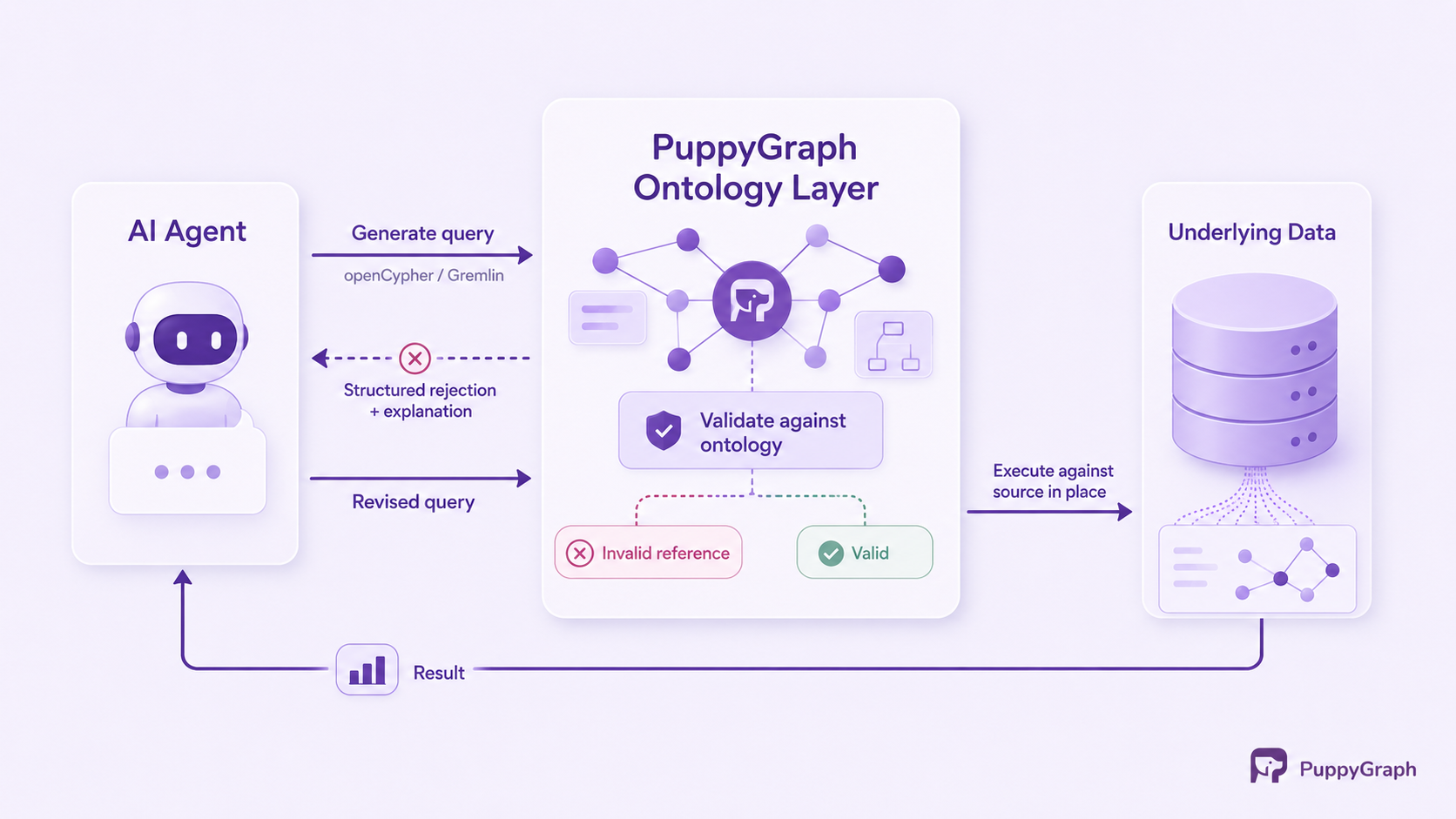
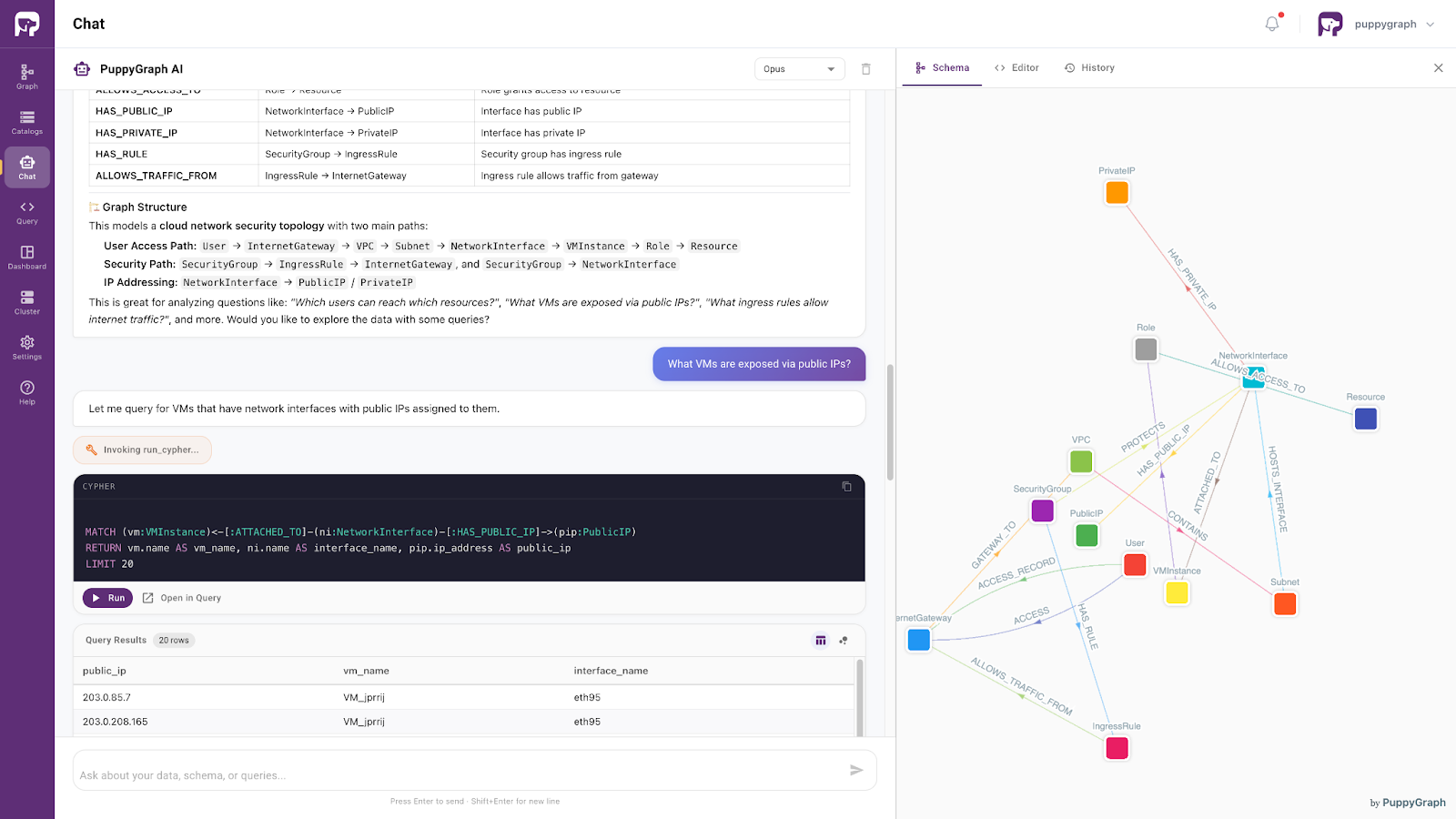
It's worth keeping two things distinct here. PuppyGraph ships a built-in AI assistant that accepts natural-language questions, generates queries against the enforced ontology, and uses that same rejection feedback to self-correct, which is a useful existence proof of the mechanism. Separately, a team can build its own AI agent and give it the ontology-enforced layer as its only path to enterprise data, in which case the agent's reach is bounded by whatever the ontology exposes; an entity left out of the model is simply unreachable through query. That bounded-reach property is a configuration-driven consequence of grounding, worth stating precisely rather than oversold: the mechanism is designed to catch semantic errors, not to serve as a defense against adversarial input like prompt injection, though limiting what an agent can reach does incidentally bound how far an injected instruction could act even if the grounding argument is not framed around that scenario. AMD's public description of building a graph layer over its Apache Iceberg data, spanning tickets, code, logs, and telemetry, is one concrete example of an ontology defined this way over an existing lake rather than a copy of it.
Challenges and Limitations of Semantic Layers
The first challenge is organizational, not technical: getting different teams to agree on a single definition of a shared metric is often slower than building the model itself, and a semantic layer cannot resolve a disagreement that the business hasn't actually settled. Skipping that negotiation and encoding one team's definition unilaterally tends to produce a model that a different team quietly routes around, recreating the original inconsistency problem one layer up. The technical build is the easy part; sustained buy-in to use the shared model instead of a private query is the part that determines whether the investment pays off.
The second challenge is upkeep. A semantic layer is only as accurate as its last update, and both source schemas and business definitions change continuously, which means a model with no clear ownership drifts out of sync with reality just as easily as the scattered queries it replaced. There is also a performance consideration: any translation layer between a consumer's request and the underlying query adds a step, and a poorly optimized implementation can turn a fast query into a slow one. None of these are reasons to avoid a semantic layer, but they are reasons to plan for ongoing ownership rather than treating the initial build as a one-time project.
A narrower but increasingly common limitation is relationship depth. Many semantic layers were designed primarily to model flat metrics and dimensions, and they handle multi-hop relationships, such as tracing a chain of connected entities several steps removed from the starting point, less naturally than a model built around a graph structure from the start. This does not disqualify the metric-focused approach for most reporting use cases, but it is worth recognizing as a limitation before committing to a specific implementation for a use case, like fraud detection or asset relationship mapping, where the relationships between entities matter as much as the metrics computed over them.
Conclusion
A semantic layer exists to solve a problem every growing data organization eventually hits: the same metric computed differently by different teams, tools, and now AI agents, each producing a plausible but different answer. Defining entities, metrics, and relationships once, and enforcing that definition everywhere they're used, is what turns scattered queries into a shared, trustworthy source of truth. That need has only grown sharper with AI agents in the mix, since an agent generating its own queries needs the same grounding a human analyst does, with the added requirement that invalid queries be caught and explained automatically rather than manually.
If your organization is exploring an ontology-enforced semantic layer for AI agents or analysts querying data in place, PuppyGraph’s forever-free Developer Edition lets you try it directly against your own data. To see how ontology enforcement and a self-correction loop could apply to your specific schema, you can also book a guided demo with the team.

Hao Wu is a Software Engineer with a strong foundation in computer science and algorithms. He earned his Bachelor’s degree in Computer Science from Fudan University and a Master’s degree from George Washington University, where he focused on graph databases.

Get started with PuppyGraph!


Developer Edition
- Forever free
- Single noded
- Designed for proving your ideas
- Available via Docker install
Enterprise Edition
- 30-day free trial with full features
- Everything in developer edition & enterprise features
- Designed for production
- Available via AWS AMI & Docker install