

AI Accountability Frameworks: The Ultimate Guide
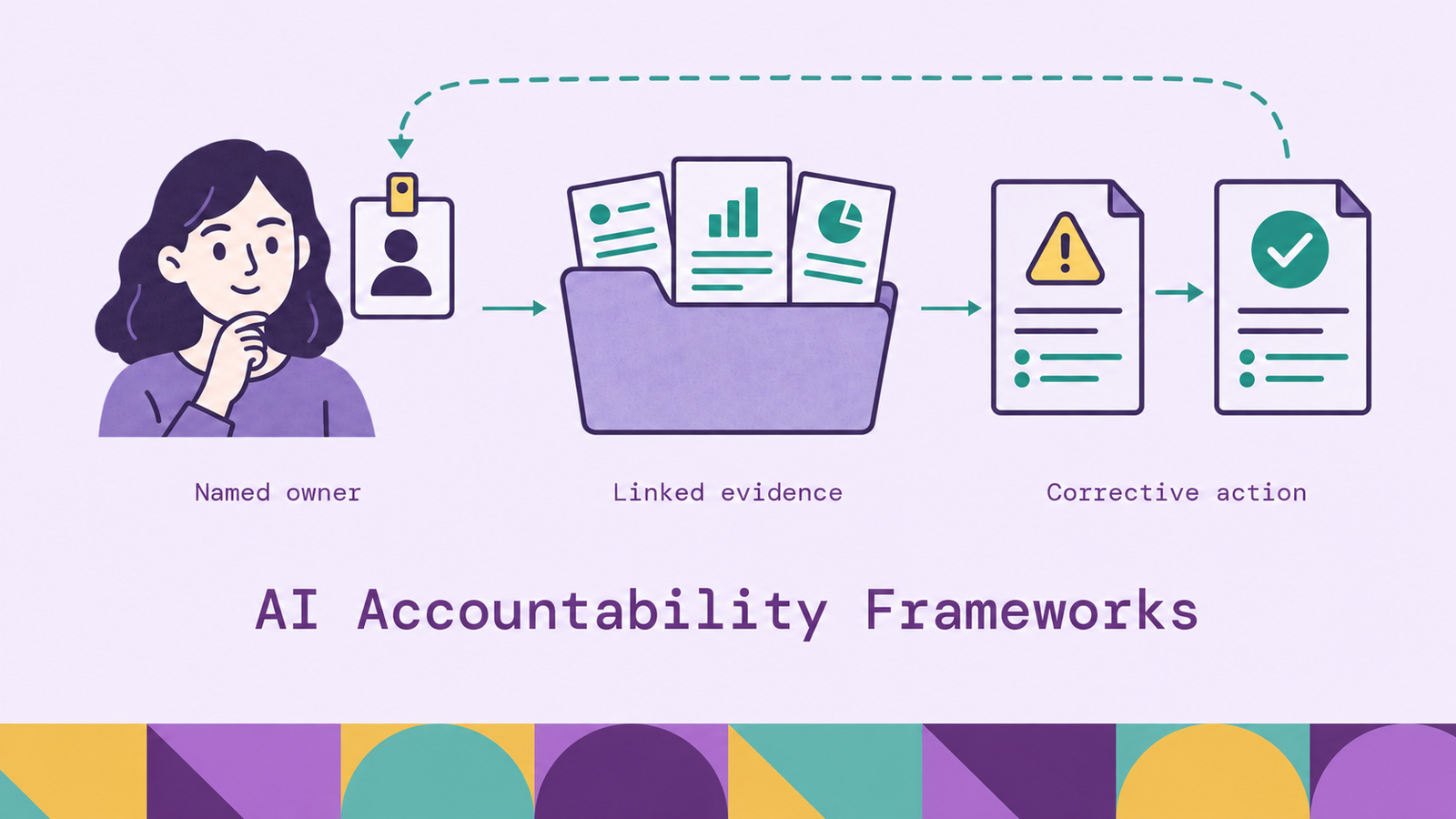
An AI system needs an accountable owner for the decisions it influences, evidence that its use is justified, and a way to correct harmful outcomes. A release approval becomes difficult to defend when nobody can connect it to the model version, evaluation results, operating conditions, and person who accepted the remaining risk.
AI accountability frameworks organize those connections. This guide explains the main frameworks and standards, the responsibilities they help assign, and how to turn them into working controls throughout an AI system's lifecycle.
What are AI accountability frameworks?
AI accountability frameworks are structured arrangements of policies, responsibilities, controls, and evidence that make organizations answerable for how they develop and use AI. They establish who can authorize a use, what must be demonstrated before deployment, how performance and harm are monitored, and what happens when a system fails.
Accountability sits within the broader work of AI governance. Governance sets direction and decision rights; risk management identifies and treats potential harms; accountability connects decisions and outcomes to people who must explain them and act. A technical explanation of a prediction contributes evidence, but an accountable organization also needs authority to investigate and remedy the consequences.
For example, consider an assistant that drafts customer refund recommendations. Its accountability framework should identify the business owner, approved refund policies, permitted data sources, reviewer responsibilities, and escalation route for disputed recommendations. It should also distinguish permission to recommend a refund from permission to execute one.
Several principles make that arrangement concrete:
Ownership and answerability. Assign a named owner to the use case and explicit decision rights to the people approving releases, exceptions, and corrective actions.
Transparency and traceability. Give users appropriate information about the system, and preserve enough evidence to investigate what happened. Link decisions to relevant inputs, system versions, and approvals.
Fairness and proportionality. Examine who bears the consequences of errors. Scale controls to potential harm and test relevant groups and operating conditions rather than relying only on average performance.
Human oversight and recourse. Define when people intervene, what authority they have, and how affected people can request review or correction.
Security, privacy, and reliability. Protect data and system access, test foreseeable failures, and set conditions under which the system must stop or fall back to a safer process.
These principles become useful when each has an owner, an observable control, and evidence that the control works.
Why are AI accountability frameworks important?
AI accountability becomes difficult at organizational handoffs. A vendor supplies a model, a platform team connects data, a product team designs the interface, and an operations team handles the resulting decisions. A failure can involve several of those choices at once. Clear responsibilities let an incident move directly to investigation and corrective action.
Accountability also makes deployment decisions more specific. The refund assistant might perform well on ordinary requests while recommending exceptions that contradict company policy. Its release decision should therefore cover policy adherence, the review process, and the actions available to the assistant. A general language benchmark would leave those questions unanswered.
Business decisions become reviewable. A documented approval records the expected benefit, identified risks, evidence considered, and conditions attached to continued use. When circumstances change, the owner can revisit the assumptions behind that decision.
Operational response becomes actionable. A monitoring alert should identify the affected deployment and route to someone able to pause it, restrict its use, or restore a previous configuration. An alert without an owner leaves the response undefined.
Legal obligations become implementation work. Applicable requirements need to be mapped to specific systems, roles, controls, and records. The European Commission's AI Act overview illustrates why scope matters: obligations differ across prohibited practices, high-risk systems, transparency-related uses, and general-purpose AI models.
The practical benefit is a shorter path from an unresolved question to a decision supported by evidence. That applies before launch, during normal operation, and when someone challenges an outcome.
Common AI accountability frameworks and standards
Organizations encounter principles, voluntary risk frameworks, management-system standards, and legislation in the same discussion. These instruments serve different purposes. Select them according to the governance question you need to answer.
The OECD accountability principle connects answerability to an actor's role and context. It calls for traceability across datasets, processes, and lifecycle decisions, alongside ongoing risk management. It is a useful policy foundation when responsibilities span developers, suppliers, deployers, and users. Translate it into concrete expectations for the evidence each party supplies.
The NIST AI Risk Management Framework provides voluntary guidance for incorporating trustworthiness into AI development and use. Its four core functions are Govern, Map, Measure, and Manage. They address organizational direction, the context of use, risk assessment, and responses to identified risks. Governance runs across the other functions, and the activities are iterative rather than an ordered release checklist. NIST also publishes a generative AI profile to help organizations address risks associated with generative systems.
ISO/IEC 42001 specifies requirements for establishing, maintaining, and continually improving an AI management system. Its focus is the organization's management processes. If certification is part of your assurance strategy, examine which organizational activities and services the certificate covers; avoid presenting it as proof that every individual output is correct or every use is legally compliant.
ISO/IEC 23894 supplies guidance on AI-specific risk management and its integration into organizational activities. It can inform the risk work within a broader management system. The distinction is useful: ISO/IEC 42001 addresses management-system requirements, while ISO/IEC 23894 helps structure AI risk-management practices.
The EU AI Act establishes a legal regime with requirements that vary by role and use case. Its high-risk requirements cover areas including risk management, data quality, documentation, logging, human oversight, accuracy, robustness, and cybersecurity. Maintain a system-specific obligations register that records the relevant provisions, responsible legal entity, and applicable dates. Do not treat every AI application as having identical duties or one common compliance deadline.
These instruments can support one implementation. Use shared control records and evidence where appropriate, while preserving the distinct scope and acceptance criteria of each requirement.
How AI accountability frameworks work
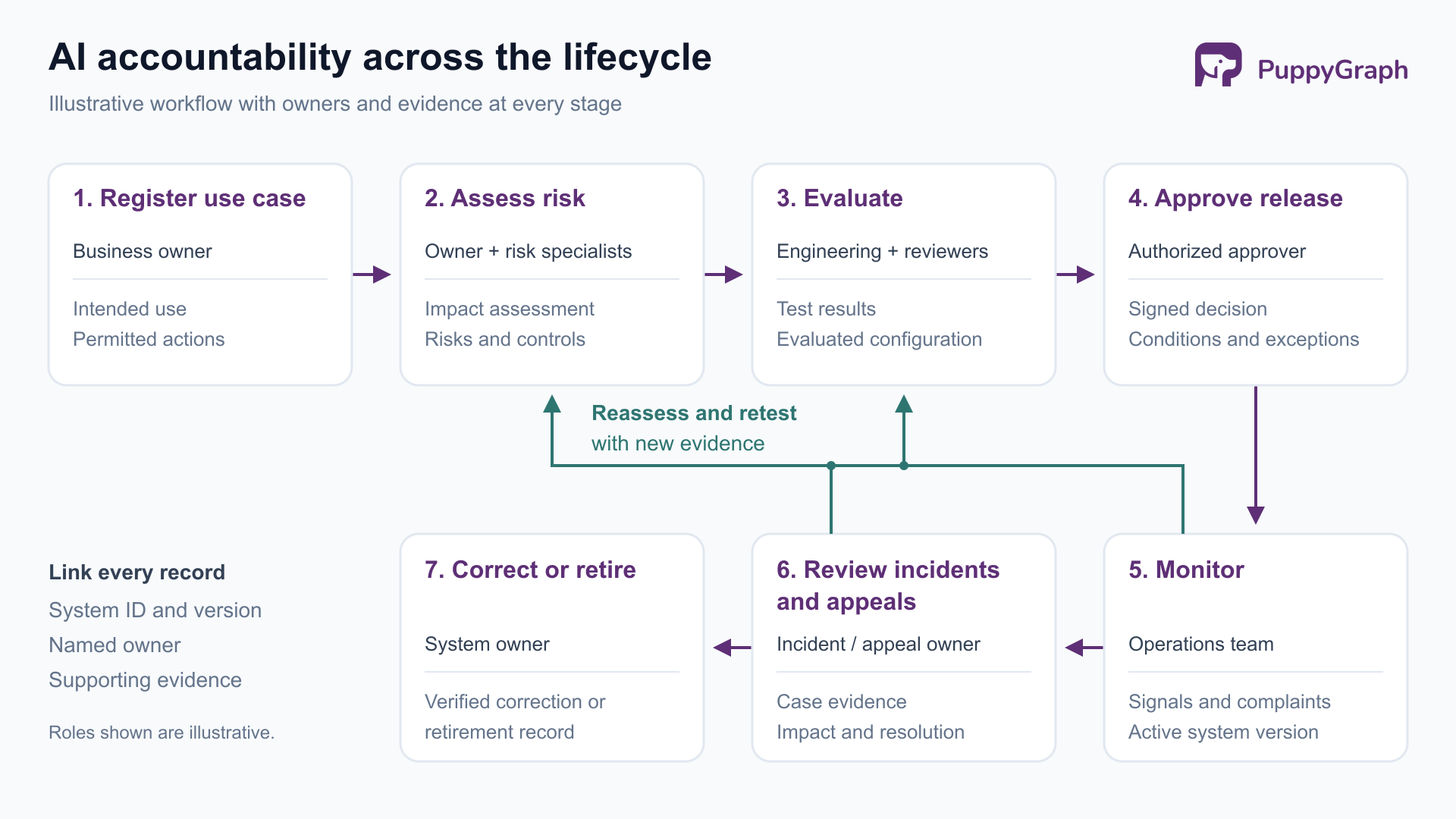
An accountability framework operates through recurring decisions supported by evidence. For each AI use, establish what the system may do, how its risks will be evaluated, who may authorize it, and what would cause that authorization to change.
In the refund example, the proposed boundary might allow the assistant to draft recommendations using approved policy documents and order records. A trained employee decides whether to issue the refund. Expanding the assistant to execute refunds changes its authority and should trigger a fresh assessment.
Before release, create a linked evidence package: the intended-use statement, risk assessment, evaluated configuration, test results, unresolved limitations, and approval. Define release criteria before reviewing the results so that a disappointing outcome cannot quietly change the standard for acceptance. Record exceptions separately with an owner and expiration condition.
After deployment, connect operational signals to those release assumptions. A rise in unsupported recommendations might trigger a review of retrieval sources, policy versions, or model changes. Customer complaints can reveal failures that aggregate technical metrics miss. The response should specify who investigates, who decides whether to pause the system, and what evidence supports resumption.
Traceability depends on preserving the right identifiers. A decision record might reference the deployment, model version, prompt template, retrieved document versions, tool actions, policy version, and human review. Capture the fields that support investigation, with appropriate access and retention controls. Avoid collecting sensitive content merely because logging is available.
Keep historical evidence distinguishable from current state. An approval for one configuration should not appear to authorize a later configuration automatically. A corrected document should not erase the version involved in an earlier incident. Investigation requires the circumstances of the original decision, even when the live system has already changed.
Roles and responsibilities in AI governance
Assign roles around decisions and operational duties. A central governance group can define policy, but each deployed use case needs someone accountable for its business purpose and acceptable operation. The following allocation is an implementation pattern, not a universal staffing requirement.
Separate preparation, challenge, and approval where the stakes justify it. A developer can produce test evidence while a different reviewer evaluates whether the tests support the proposed use. If staffing requires overlapping roles, record that limitation and arrange additional review for consequential decisions.
Human oversight needs operational capacity. Reviewers need relevant information, training, enough time to assess a recommendation, and authority to override it. In the refund workflow, they should be able to inspect the applicable policy and order record, record a disagreement, and escalate recurring problems. A review button alone establishes none of those conditions.
Supplier arrangements should make responsibilities explicit too. Request documentation, change notifications, incident contacts, and relevant evaluation evidence. Record what the supplier cannot provide and decide whether that uncertainty is acceptable for the proposed use. The organization deploying the application still needs to assess its own workflow and integration choices.
How to build an AI accountability framework
Start with one real use case and carry it through a complete governance cycle. This exposes missing evidence and unclear authority before you standardize the process across a portfolio.
- Inventory systems and define their boundaries. Include internally developed systems, embedded vendor features, and AI services used in business workflows. Record purpose, owner, users, affected people, data sources, supplier dependencies, and permitted actions. Distinguish a shared model from the separate applications that use it.
- Assess impact and determine applicable obligations. Describe plausible failures, affected groups, severity, reversibility, and the degree of automation. Involve domain specialists and people familiar with the affected workflow. Document legal applicability separately from the internal risk tier so that an internal label does not silently substitute for a statutory classification.
- Convert requirements into testable controls. For each material risk, identify a preventive or detective control, its owner, and the evidence that demonstrates operation. A requirement for policy-grounded refund recommendations could become a versioned retrieval source, evaluations against policy exceptions, and mandatory review before a transaction.
- Define release and change decisions. Specify required evaluations, decision-makers, stop conditions, and the evidence package for approval. Include changes to prompts, retrieval data, tools, permissions, vendors, and intended use. Decide which changes require full reassessment and which can follow a narrower review with a recorded rationale.
- Exercise monitoring, incident response, and retirement. Test a realistic failure: introduce an outdated policy into a controlled environment and follow the response. Confirm that someone detects the problem, identifies affected decisions, suspends the relevant workflow, and verifies the correction. Define how to remove access and preserve required evidence when the system is retired.
For a pilot, maintain a compact control register. Each entry should connect a risk to a control, owner, test, evidence location, review cadence, and escalation rule. Reuse established security, privacy, procurement, and change-management processes where they already address the need. Add AI-specific work where model behavior or the surrounding decision process requires it.
Connected evidence becomes particularly useful as systems share dependencies. If a policy dataset is withdrawn, reviewers need to identify affected applications, their approved configurations, open exceptions, and accountable owners. Model these links explicitly, using stable identifiers and effective dates. Define whether a relationship means that an application could use a source or actually used it in a recorded decision.
PuppyGraph lets teams define a graph schema over existing SQL databases, data warehouses, and data lakes or lakehouses, including direct reads of Iceberg and Delta Lake tables. For accountability analysis, that schema could connect systems, datasets, evaluations, approvals, incidents, and owners. Teams can query those relationships with openCypher and Gremlin while records remain in their underlying stores on the default direct-query path. The organization supplies the records and mappings; evidence capture, retention, and approval workflows remain responsibilities of the surrounding systems.
For agents querying that evidence, PuppyGraph's ontology enforcement validates queries against the defined entities and relationships before execution and returns structured feedback for invalid references. This supports grounding in the governance model. Evidence completeness and the correctness of an approval still depend on the source records and the people responsible for them.
AI accountability framework best practices
Keep the framework close to the decisions it governs. A control earns its place when it changes what the team can approve, detect, investigate, or correct.
Make oversight observable. Review a sample of human interventions and disagreements. Check whether reviewers had enough context to identify an error and whether repeated disagreements led to changes. A high approval rate could reflect accurate recommendations or ineffective review; investigate before treating it as a success measure.
Test beyond aggregate accuracy. Evaluate the failure modes that matter to the use case. For the refund assistant, these include unsupported policy exceptions, incorrect order associations, privacy exposure, and inappropriate escalation. Select fairness measures in context and document their limitations. Avoid treating a single score as a complete account of system quality.
Keep exceptions bounded. Every accepted gap needs a decision-maker, rationale, compensating measures, and a review date or termination condition. Surface overdue exceptions in portfolio reviews. Otherwise, temporary permission can become an undocumented operating policy.
Measure the response process. Track whether deployed systems have owners, whether evidence matches active configurations, and how quickly teams resolve serious findings. Investigate orphaned records and missing links. A governance report should distinguish a completed assessment from a verified remediation.
Provide usable routes to challenge outcomes. Give affected people a clear way to request review, and give the receiving team a process for investigation and correction. Feed recurring complaints into evaluation cases and control changes. Protect sensitive information in both the original records and the review process.
Periodically rehearse one disputed decision from intake to resolution. The team should be able to identify the system state, retrieve relevant evidence, explain who authorized the use, and carry out a correction. Missing steps become a concrete improvement backlog.
Conclusion
AI accountability frameworks connect authority, evidence, and corrective action across an AI system's lifecycle. Principles establish expectations, risk frameworks organize assessment, management-system standards structure organizational practice, and legal requirements define applicable duties. The implementation succeeds when those inputs produce decisions that named people can explain and revisit.
Start with one use case, define its operating boundaries, and test the evidence trail through an actual review or simulated incident. As the portfolio grows, preserve the relationships between systems, data, approvals, and owners so that shared dependencies remain visible.
Try the forever-free PuppyGraph Developer Edition and book a demo with the team to see how openCypher and Gremlin queries connect accountability records across warehouse and lakehouse tables, with no graph-specific ETL, to trace dependencies from affected systems to their evidence and owners.

Hao Wu is a Software Engineer with a strong foundation in computer science and algorithms. He earned his Bachelor’s degree in Computer Science from Fudan University and a Master’s degree from George Washington University, where he focused on graph databases.


