

AI Gateway: What It Is, How It Works & Benefits
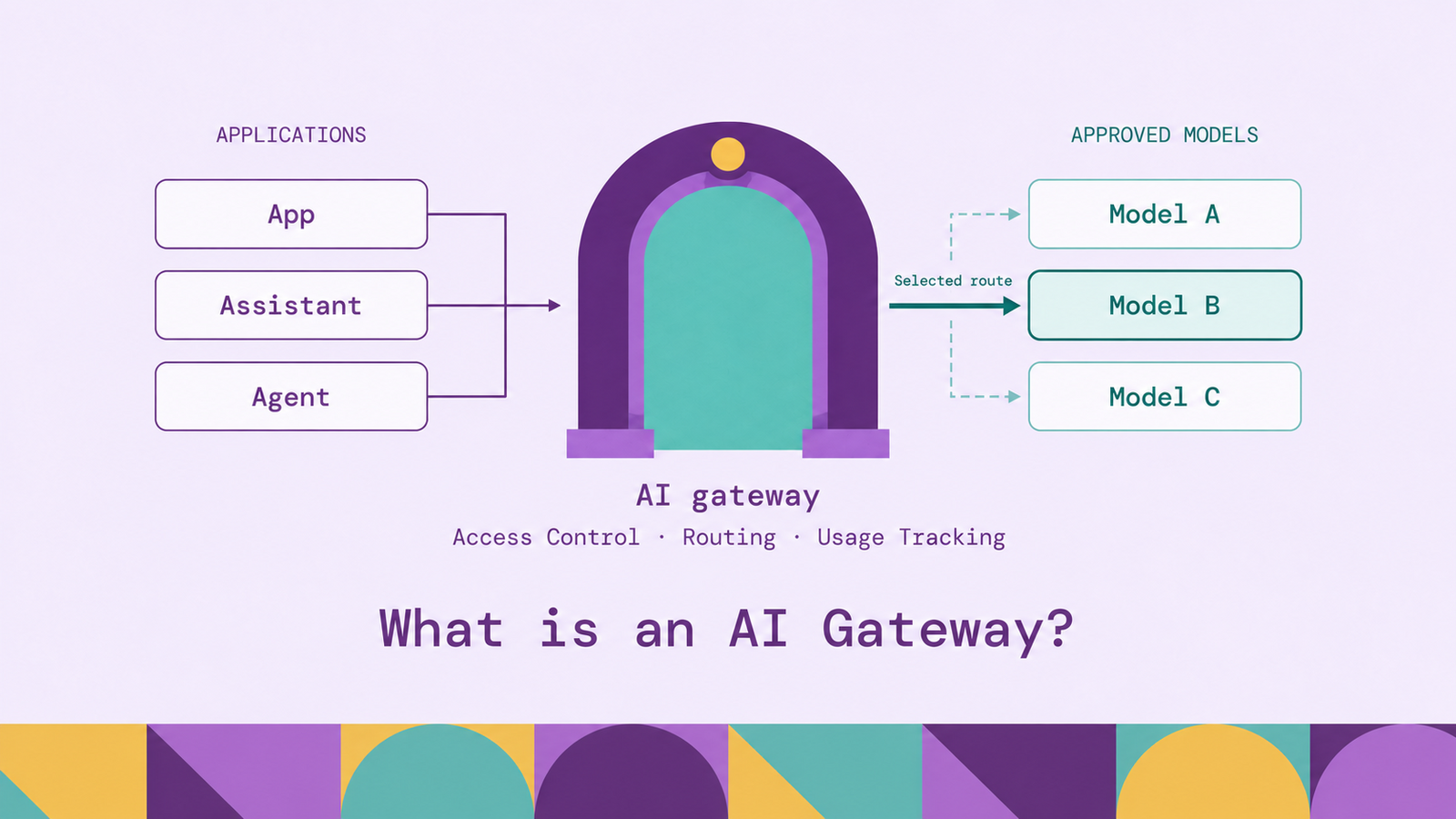
Operating model access across applications requires decisions about credentials, approved providers, spending, failures, and request visibility. An AI gateway puts those shared controls on the request path so application teams can use centrally managed policies.
The architectural question is which responsibilities belong there. This guide explains how AI gateways work, how they overlap with API gateways and proxies, and how to implement routing, cost controls, and governance while keeping application and data responsibilities explicit.
What is an AI gateway?
An AI gateway is an intermediary that manages requests between applications and AI services. It receives traffic, applies configured policies, forwards permitted requests to an appropriate backend, and returns responses. Depending on the implementation, it can also normalize provider interfaces, meter tokens, cache responses, and record usage.
Its scope varies. Some gateways focus on language-model inference; others also manage tools and agent endpoints. For example, Azure API Management's AI gateway capabilities extend its existing API gateway to cover models, agents, and tools.
The gateway operates on traffic that passes through it. A service retaining direct provider access can bypass its controls, so deployment topology and credential distribution determine how consistently policies apply.
How does an AI gateway work?
Consider a support application requesting a draft reply. A typical gateway request follows this sequence:
- Identify the caller. Authenticate the application and establish trusted tenant or project context.
- Check policy. Evaluate model permissions, usage limits, and applicable content or data-handling rules.
- Select a backend. Resolve a model alias to an eligible provider or deployment using routing policy.
- Forward the request. Apply provider credentials and any required request-format translation.
- Handle the response. Return a complete response or relay streaming events, recording the selected backend and available usage information.
The exact sequence depends on the product and enabled features. Caching or external policy checks introduce additional steps.
Failure handling needs its own policy. LiteLLM's fallback documentation distinguishes general failures, context-window errors, and content-policy failures. Configure which failures justify another attempt; a policy rejection should not automatically become a search for a provider that accepts the request.
AI gateway architecture
A useful reference architecture separates the request-processing data plane from the configuration control plane. The data plane authenticates, evaluates policy, routes traffic, and relays responses. The control plane manages credentials, model catalogs, routing rules, and configuration changes. These are logical responsibilities; a deployment may package them together.
Supporting services can include a secrets manager, shared quota counters, a cache, and telemetry storage. Each dependency introduces a failure decision. If a quota store becomes unavailable, decide explicitly whether requests stop or continue under a bounded local policy.
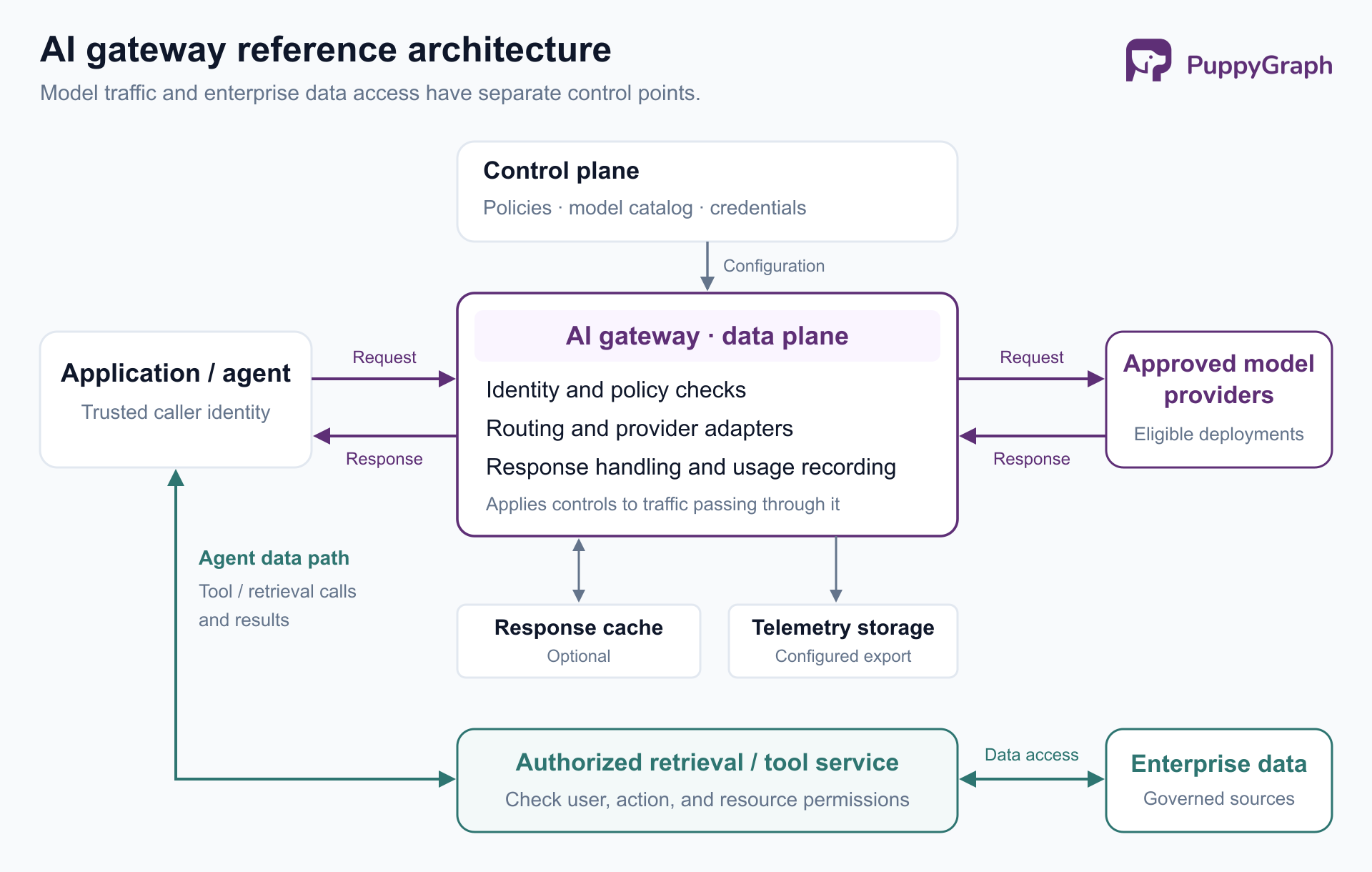
The gateway also needs capacity and availability planning. Microsoft's gateway architecture guidance discusses the additional complexity and potential bottleneck introduced by this intermediary. Test concurrent streams, connection lifetimes, and dependency failures as well as ordinary request throughput.
Key features of an AI gateway
Evaluate features against specific workloads. The following capabilities address different operating needs:
Identity and credentials. Authenticate callers, restrict eligible models, and keep upstream credentials under platform control. Tenant identity should come from verified authentication context.
Provider mediation. Offer a consistent client interface where supported, while preserving necessary provider-specific parameters. Interface translation requires compatibility tests for tool calls, structured outputs, and streaming events.
Routing and resilience. Select eligible backends, distribute traffic, and apply bounded retries or fallback. A fallback needs to satisfy the original request's capability and policy requirements.
Usage controls. Meter consumption and enforce quotas. Token limits address a different resource than request counts: a short classification and a long document summary can each be one request. Azure's token-limit policy illustrates token-based controls keyed to a consumer identifier.
Inspection and telemetry. Record operational metadata and apply configured content checks. Treat prompt logging as a separate data-handling decision because it creates another stored copy of potentially sensitive content.
AI gateway vs API gateway
An AI gateway applies gateway patterns to AI workloads. An existing API gateway may acquire these capabilities through policies or extensions, so the distinction describes specialization rather than mutually exclusive products.
These roles can coexist in one deployment. Streaming failures also affect general gateways: Kong's proxying documentation explains that it cannot retry an upstream stream after response bytes have reached the client. Start with the gateway platform already operating in your environment, then identify which AI-specific behaviors require additional support.
AI gateway vs AI proxy
A proxy forwards requests between a client and an upstream service. In AI deployments, that forwarding point may also translate provider formats, manage credentials, and collect usage information.
The labels overlap in practice. LiteLLM calls its server a “Proxy Server (LLM Gateway)” and documents authentication hooks, logging, cost tracking, and rate limiting. Calling a product a proxy does not establish that it lacks governance features.
Compare implementations through operational questions: Can callers bypass policies? Are quotas shared across replicas? Can operators audit routing changes? Does the service preserve the response formats your application consumes? Those answers reveal more than the product's chosen label.
AI gateway vs LLM gateway
An LLM gateway emphasizes language-model access, including prompts, generated responses, tokens, and model selection. AI gateway is a broader label that may encompass additional inference modalities or tool and agent traffic.
Neither name establishes an exact feature boundary. LiteLLM, for example, supports embedding endpoints alongside language-model generation. Check protocol support separately for each endpoint.
Build a compatibility matrix from the endpoints you actually need: text generation, embeddings, image generation, real-time audio, or remote tools. Test each independently. Successful chat requests provide little evidence about bidirectional audio transport or how a gateway handles asynchronous jobs.
Benefits of using an AI gateway
Consistent operating policy. Teams can apply common access rules, quotas, and approved backend lists across applications. This reduces the number of separate integrations that operators must inspect when a policy changes.
Controlled provider changes. A stable client endpoint and model aliases can reduce application changes when deployments move. Teams still need to evaluate output quality and compatibility before redirecting traffic.
Shared accountability. Attributing consumption to projects and tenants gives platform owners a basis for capacity allocation and cost discussions. Attribution is most useful when it connects to a business operation, such as resolving a support ticket.
These benefits come with another service to operate. For a small application using one provider, existing SDK behavior and provider controls may be sufficient. A gateway becomes more valuable when multiple consumers need the same independently enforced policies.
AI gateway use cases
Customer support. A support platform can separate tenant budgets, use an approved model for reply drafting, and record which backend served each request. The application still controls which customer records enter the prompt.
Document processing. An invoice-processing service can route extraction requests to models evaluated for its document types. Schema validation and business-rule checks remain necessary before extracted values enter accounting workflows.
Developer assistance. An internal coding assistant can use an approved provider list and project-level allocation. Repository access and restrictions on sending source code outside the organization require explicit policies at the relevant boundaries.
Enterprise search. A search assistant can share gateway controls for embedding and generation calls. Retrieval permissions belong in the search or data service, where the requesting user's access can be checked before context is returned.
Each scenario benefits from shared model controls while retaining workload-specific validation.
AI gateway for LLMs and generative AI
Generative applications need more than a successful HTTP response. The integration must preserve conversation roles, tool definitions, output constraints, and streaming events across every supported backend.
Streaming makes inspection and recovery more complicated. If an application displays tokens immediately, a later content check cannot retract what the user has already seen. Buffering the full response allows inspection before release but delays delivery. Choose the behavior for the workload and test it explicitly.
Likewise, do not assume fallback can continue a generation after a stream fails. Define whether the application discards partial output, presents an interruption, or retries the whole operation. Verify cancellation behavior too: a disconnected client should trigger the intended upstream cancellation path, and usage accounting must handle incomplete responses.
AI gateway for AI agents
An agent can make several model calls and tool calls for one user task. Gateway accounting should therefore carry an application-generated run identifier across requests. A per-request limit alone cannot bound a workflow that repeatedly makes permitted requests.
Set workflow-level limits in the agent runtime, alongside gateway quotas. Tool execution needs authorization at the tool service, including checks on the requested action and resource. Routing model traffic through a gateway does not automatically put tool traffic under the same controls.
Agents querying enterprise data also need a defined model of its meaning. PuppyGraph lets teams define a graph schema over existing SQL databases, data warehouses, and data lakes or lakehouses. That schema functions as an ontology of entities, relationships, and properties. On the default direct-query path, data remains in those stores without graph-specific ETL, and agents can query through openCypher or Gremlin.
PuppyGraph's ontology enforcement validates queries against that model before execution. Invalid entity or relationship references receive structured feedback that an agent can use to revise its query. This complements gateway controls by grounding the data-query path; source accuracy, user authorization, and action approval still require their own checks.
AI gateway for model routing
Model routing selects a backend for a request. Separate eligibility from preference. First establish which backends satisfy authorization, data-handling policy, context size, modality, and required features. Then choose among eligible candidates using availability, expected quality, latency, and cost.
For example, an application could assign routine ticket classification to a model validated for that task and reserve another route for complex troubleshooting. These are application policies that need evaluation data; a router cannot infer acceptable business quality from token prices.
Fallback must preserve eligibility. An approved deployment being unavailable does not authorize sending the prompt to an unapproved region or provider. Log the actual selected backend alongside the requested alias so operators can investigate changes in behavior after routing updates.
AI gateway for AI cost optimization
Cost control starts with attribution and admission policy. Identify which project initiated a request, estimate its permitted scope, and reconcile against reported usage afterward. Under concurrency, verify whether budget enforcement reserves capacity for in-flight requests or only checks previously recorded spending.
Caching offers several distinct mechanisms. When enabled, Cloudflare's response cache can reuse responses for identical requests. Semantic response caching uses similarity to find reusable answers, which requires evaluating whether similar wording actually permits the same response. Provider-side prompt caching reuses prompt-prefix processing while still generating a new answer.
For response caches, include the relevant tenant, authorization scope, model settings, and source freshness in the reuse decision. Disable caching where equivalence is difficult to establish.
Measure cost per successfully completed task, including retries and gateway overhead. A cheaper model call can increase total cost if it causes repeated attempts or additional human correction.
AI gateway for security and governance
A gateway can be an enforcement point for approved providers, caller permissions, quotas, and content policies. Its effectiveness depends on coverage: restrict direct provider credentials and network paths where centralized enforcement is required.
Treat prompts, responses, caches, and logs as separate data flows. For each, specify where content is processed, whether it is retained, who can read it, and how deletion works. Routing to an approved model does not settle what a separate logging service stores.
Content filters provide one layer of control. OWASP's prompt-injection guidance recommends layered mitigations, including constrained behavior, least privilege, and human approval for high-risk actions. Keep authorization outside model-generated instructions.
Governance also needs ownership and evidence. Assign policy owners, version configuration, review changes, and retain enough metadata to reconstruct routing decisions. A gateway can enforce defined rules; the organization must decide which rules are appropriate.
AI gateway observability and monitoring
Monitor the request path and the user outcome separately. A gateway can observe latency, errors, selected models, and reported usage, while the application knows whether the answer resolved the task.
For streaming workloads, distinguish time to first token from total completion time. Break failures into caller errors, gateway rejections, upstream failures, and interrupted streams. Otherwise a rise in deliberate quota rejections may look like declining provider availability.
Record requested model aliases and actual backends, tenant or project identity, retry attempts, cache status, and correlation identifiers. Link model calls to retrieval and tool spans in application tracing. Keep high-cardinality identifiers in appropriate trace or log fields rather than making every run a metric label.
Begin with metadata-only logging. Capture prompt bodies only where justified, with explicit access controls and retention. Operational visibility should not quietly create an unrestricted archive of enterprise data.
How to choose an AI gateway
Evaluate a gateway with representative traffic and deliberate failures. A useful selection checklist covers four areas:
- Compatibility: Required endpoints, model parameters, streaming behavior, tool calls, and structured outputs survive the request path.
- Enforcement: Identity, model permissions, quotas, and routing restrictions behave consistently across replicas and retries.
- Operations: Configuration rollback, monitoring integration, secret rotation, and outage behavior fit the platform team's practices.
- Deployment: Network placement, data processing locations, licensing, service charges, and support match organizational requirements.
Require evidence for the features that matter to your workload. In a proof of concept, test a throttled provider, a disconnected stream, an exhausted budget, and an unavailable policy dependency. Compare total operating effort as well as feature coverage.
How to implement an AI gateway
Begin with one application and an explicit request contract. Document its model features, expected traffic, sensitive data, and failure behavior before changing the endpoint.
- Inventory access. Identify provider credentials, direct network paths, existing retries, and application owners.
- Establish identity. Map authenticated callers to trusted projects or tenants and configure approved model access.
- Introduce the request path. Validate ordinary requests, streaming, cancellation, and response compatibility with production-like test cases.
- Add controls incrementally. Configure quotas, bounded retries, and eligible fallback routes. Coordinate SDK and gateway retries to avoid multiplying attempts.
- Test isolation and failures. Check tenant cache separation, budget behavior under concurrency, and policy enforcement during dependency outages.
- Roll out and operate. Shift traffic gradually, monitor task-level outcomes, and keep a tested rollback configuration that preserves required controls.
Assign ownership before expanding adoption. Someone must maintain model mappings, review policy changes, respond to incidents, and reconcile usage. The implementation is complete when those operating responsibilities are as clear as the request path.
Conclusion
An AI gateway gives teams a shared place to manage model access, routing, consumption, and request visibility. Its value depends on tested policies, compatible backends, and a deployment that brings intended traffic through those controls. Applications still own task quality, tool authorization, and grounded access to enterprise data.
Try the forever-free PuppyGraph Developer Edition and book a demo with the team to see how openCypher and Gremlin queries connect entities across warehouse and lakehouse tables, with no graph-specific ETL, to supply relationship context for agents alongside gateway-managed model access.

Hao Wu is a Software Engineer with a strong foundation in computer science and algorithms. He earned his Bachelor’s degree in Computer Science from Fudan University and a Master’s degree from George Washington University, where he focused on graph databases.


