

12 Best Big Data Tools in 2026
“Big data” describes a tooling category more than a single problem in 2026: the same phrase covers distributed file systems, streaming platforms, cloud warehouses, lakehouse platforms, federated query engines, distributed NoSQL stores, search engines, workflow orchestrators, and, increasingly, purpose-built compute engines that sit on top of the rest. Twelve entries on a “best big data tools” list only earn their place if they are picked to cross those layers rather than pit twelve variations of one layer against each other. A useful shortlist looks less like a ranking and more like a stack.
This post assembles twelve tools that together cover the layers a modern big-data stack actually needs. Two short sections first settle what “big data” means in 2026 and how big-data data looks in practice; a criteria section then feeds a comparison table and detailed per-tool notes. The evaluation dimensions are shared across those three sections so the criteria, the table, and the entries stay coherent.
What is big data?
Big data is the class of data problems that outgrow a single machine and require distributed systems to store, move, or process. The framing that has stuck is the three Vs first articulated in a 2001 META Group research note by Doug Laney: volume (scale beyond what one server holds), velocity (arrival rate faster than a single pipeline can absorb), and variety (mixed formats and schemas rather than one relational shape). Later vendor commentary added veracity (uncertain quality of upstream data) and value (whether the analytics justify the infrastructure cost). The five-V version is widely repeated, though Laney has argued that the later additions, useful as they are, should not be treated as definitional.
The practical boundary is horizontal scaling. A vertical analytics database that scales by adding CPU and RAM to one node solves large problems, but a big-data tool is engineered to spread work across many nodes and to keep working when nodes fail. That distinction, more than any raw byte threshold, decides whether a workload belongs on the tools in this article or on a conventional data warehouse.
Types of big data
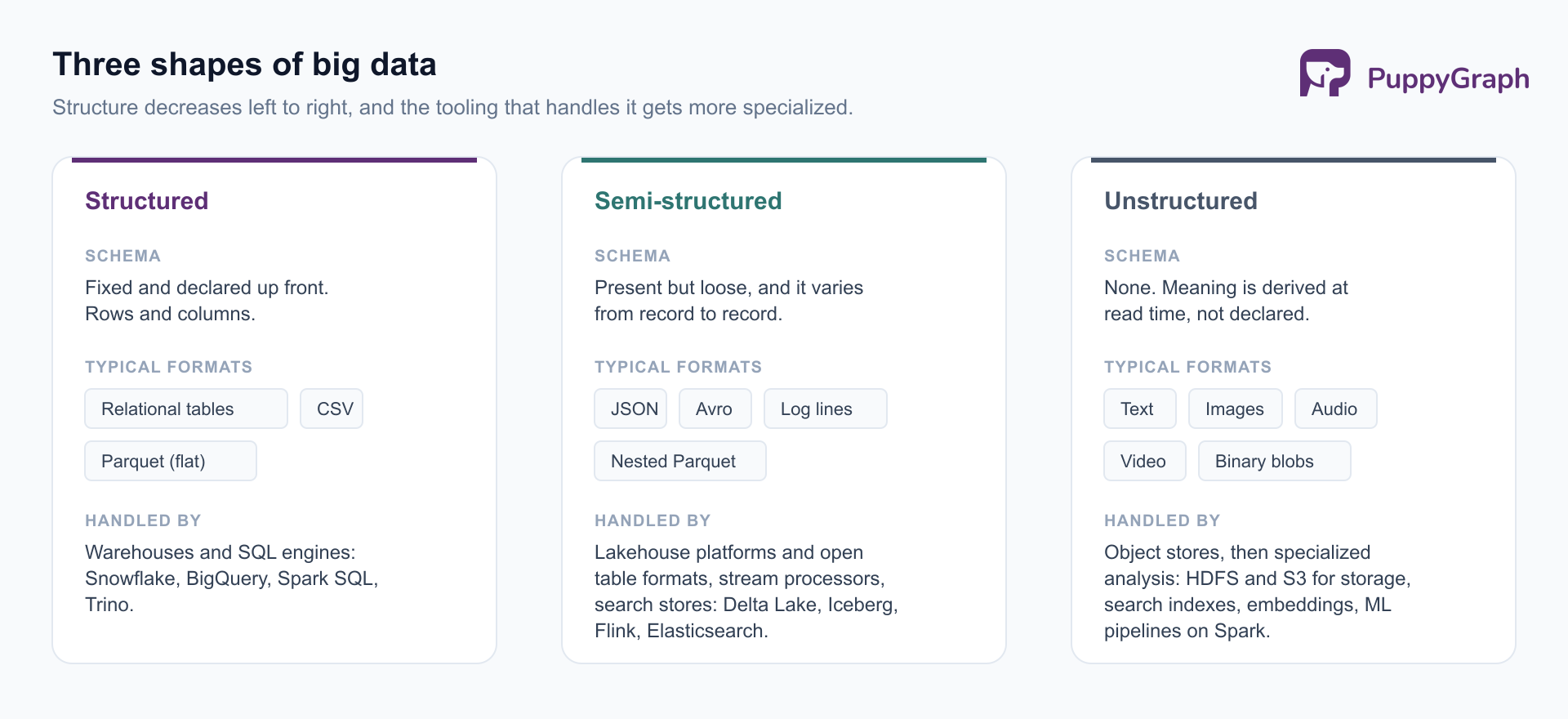
Big data is usually classified by how much structure it carries, because that decides which tools handle it well.
Structured data arrives with a defined schema: rows and columns of the sort a relational database or a data warehouse holds. Point-of-sale transactions, inventory ledgers, and CRM records are canonical examples. Structured data flows naturally into warehouses (Snowflake, BigQuery) and processing engines that speak SQL (Spark SQL, Trino).
Semi-structured data has a schema, but the schema is loose or evolves per record. JSON payloads from application events, Avro records on a Kafka topic, and columnar files like Parquet with nested types all fall here. Log formats sit in the same bucket. Lakehouse platforms and open table formats (Delta Lake, Apache Iceberg) were designed for this shape, and stream processors like Flink and search stores like Elasticsearch handle it natively.
Unstructured data has no explicit schema at all: free text, images, audio, video, and binary artifacts. Distributed file systems and object stores (HDFS, Amazon S3, Google Cloud Storage) hold it, and specialized tools do the analysis. Search engines index text, vector stores index embeddings for similarity search, and ML pipelines on Spark or Databricks turn it into features for downstream models.
Most real stacks handle all three at once. A retailer might land clickstream JSON in Kafka, batch-process the day’s transactions in Spark against Snowflake tables, and index product descriptions and reviews in Elasticsearch, all sequenced by one orchestrator.
How to evaluate big data tools
Big-data tools rarely fail the demo; they fail the third year. The dimensions below are the ones that decide whether a tool still fits when the workload grows, the team turns over, and the surrounding infrastructure gets renegotiated.
Three of them come from the work itself: what the workload looks like, where the data sits, and how the bill scales with it.
Workload shape. Distinguish batch (nightly ETL, backfills), streaming (sub-second reactions to events), and interactive (analyst SQL over recent data) explicitly. Tools built stream-first, like Flink, are always more comfortable at low latencies than tools that added streaming later. The reverse is also true: a query engine tuned for interactive analytics is rarely the right place to run a twelve-hour join.
Data location and openness. A tool that stores your data in a proprietary format quietly ties the roadmap of your analytics to the roadmap of one vendor. Tools that read in place from open table formats (Iceberg, Delta Lake, Hudi) leave the storage layer under the customer’s control. This is one of the larger architectural shifts of the last few years and is worth weighing explicitly.
Scaling and cost model. Elastic serverless (BigQuery on-demand), cluster-provisioned (Spark on YARN or Kubernetes), and consumption or credit-based (Snowflake warehouses, Databricks jobs) each price differently and reward different usage patterns. Cost that scales with active use is friendly to spiky workloads and painful for continuous ones; cost that scales with provisioned capacity is the opposite.
The other four come from the team and the stack around it: who operates the tool, what it connects to, what it costs in engineering hours, and what it can answer for in an audit.
Deployment model. Managed cloud services (Snowflake, BigQuery, Databricks) trade money for operational surface; self-hosted open source (Spark on Kubernetes, Kafka, Flink, Trino) trades money for control. Neither is the right default across every environment. What matters is that the team owns the choice explicitly and understands what the operational surface looks like on-call.
Ecosystem and interoperability. A tool’s usefulness is bounded by what it connects to. Reading the catalogs the rest of the stack already uses (Hive Metastore, AWS Glue, Unity Catalog), the file formats already in the lake (Parquet, ORC), and the protocols existing applications speak (JDBC, ODBC, Bolt, gRPC) is often the difference between a tool that lands and one that stalls.
Operational overhead. Cluster upgrades, state migrations, secret rotation, patching, and on-call. Self-hosted big-data systems are among the least forgiving on this axis; managed offerings are the argument for paying vendor prices at all. A small team should count these hours honestly before adopting a distributed system.
Governance and lineage. Metadata catalog integration, IAM, audit logs, and the ability to answer “who queried this and when.” Governance is often the last dimension added and the first one asked about in an audit; a tool that ignores it forces the surrounding stack to bolt it on.
These dimensions compound. Data location decides which tools can even read the data; deployment model decides who runs them; workload shape decides which of them fits; the rest is contract terms.
Comparing top big data tools
The table below places each of the twelve tools against the same criteria used in the section above. It is a scan aid, not a ranking; the per-tool sections that follow expand on each row.
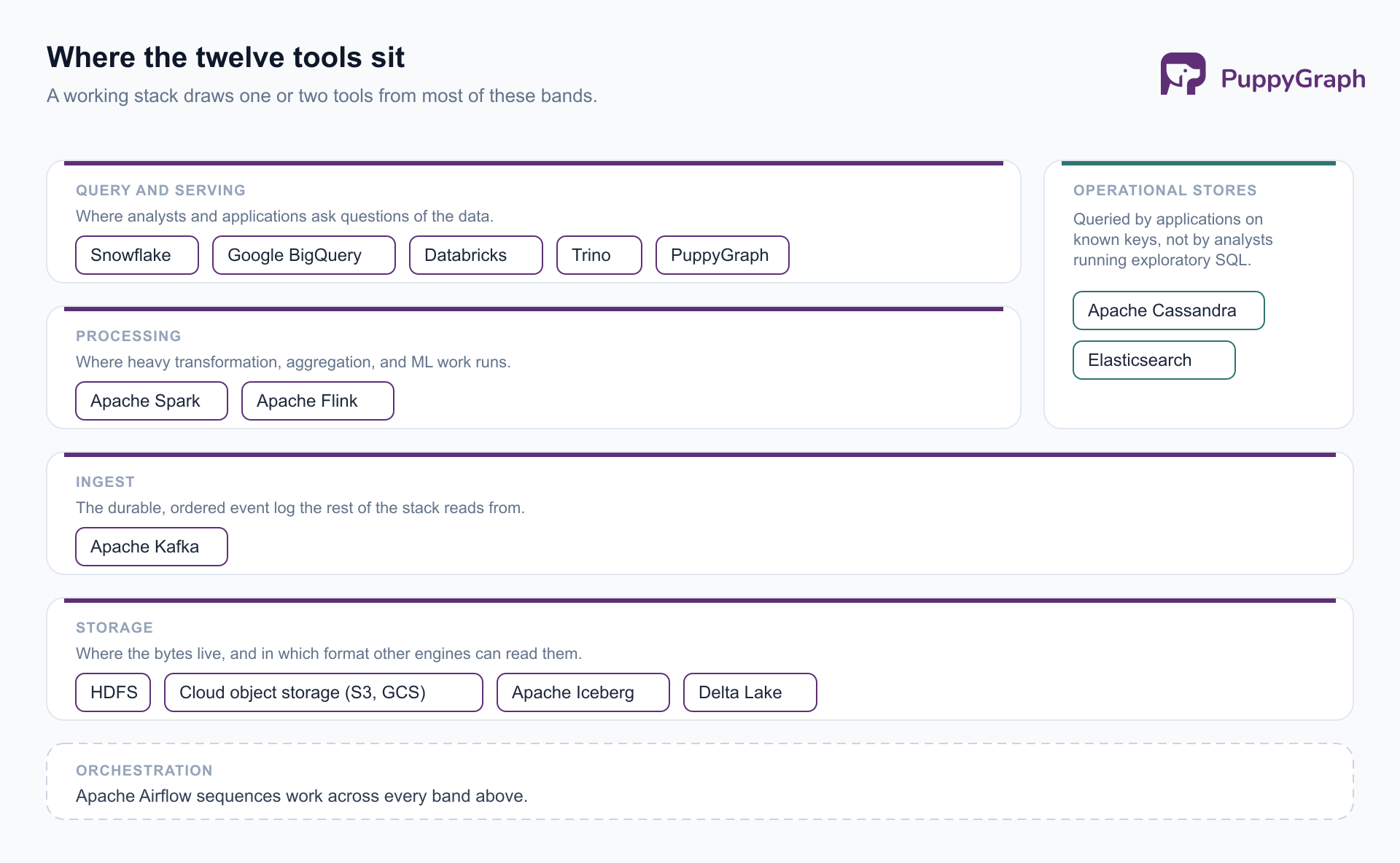
The twelve entries are complements at different layers of the same stack, not head-to-head substitutes. A realistic architecture picks a processing engine (Spark or Flink, sometimes both), an event backbone (Kafka), a warehouse or lakehouse target (Snowflake, BigQuery, or Databricks), a query layer for ad-hoc or federated access (Trino), one or two operational stores for shapes the warehouse handles poorly (Cassandra for high-write operational data, Elasticsearch for search and logs), an orchestrator to sequence the pipelines (Airflow), and, when relationship queries become a load-bearing pattern, a graph query layer (PuppyGraph). The real selection question is not which of these to buy; it is which layers the team’s workloads actually need, and how each layer’s deployment model fits the team’s operational appetite.
Top 12 big data tools to consider
Apache Spark
Apache Spark is the general-purpose distributed processing engine most big-data teams still centre their batch and SQL workloads on. It runs Scala, Java, Python (PySpark), R, and SQL over a JVM engine and exposes four connected surfaces: Spark SQL (the DataFrame and Dataset APIs), Structured Streaming, MLlib for machine learning, and GraphX for graph algorithms, which the official Spark documentation still labels alpha even though it ships with every release. Deployment is flexible: it runs on Kubernetes, YARN, and a standalone cluster manager, and on managed services such as Databricks, Amazon EMR, and Google Dataproc. Spark’s argument is coverage: one engine handles nightly ETL, ad-hoc SQL analytics, and feature engineering for ML, so a team does not need three separate systems for those workloads. The honest limit to state is streaming. Structured Streaming runs as micro-batches by default, which is fine for many pipelines but not a match for the sub-second, event-time-heavy workloads that Flink was designed for. Cluster sizing and shuffle tuning remain the areas where Spark demands the most operational attention as workloads grow.
Apache Hadoop
Apache Hadoop is the historical anchor of open-source big data: HDFS as a distributed file system, MapReduce as the original compute framework, and YARN as the cluster resource manager. HDFS remains a viable storage layer, particularly for on-premises deployments where writing to a POSIX-like distributed file system is preferable to standing up an S3-compatible object store. MapReduce, on the other hand, has been largely superseded by Spark and by SQL engines like Trino and Hive on Tez for new workloads; a surviving “Hadoop” environment now commonly means HDFS plus Spark plus a Hive Metastore, rather than the classical MapReduce jobs the framework introduced. YARN still schedules those workloads competently. The honest place for Hadoop on a 2026 shortlist is either as an existing anchor a team is migrating away from, or as a pragmatic on-prem storage foundation when cloud object storage is not an option. Committing to net-new MapReduce is not the right call for most new projects.
Apache Kafka
Apache Kafka is the distributed, append-only log that most modern event pipelines are built around. Producers write records to topics partitioned across brokers; consumers read them in order, at their own pace, with the log itself as the durable source of truth. Kafka’s four APIs (producer, consumer, Kafka Streams for lightweight processing, and Kafka Connect for source and sink integrations) plus the broader connector ecosystem cover most event-integration patterns without extra infrastructure. The KRaft consensus protocol removed Kafka’s dependency on ZooKeeper for cluster metadata, and as of Kafka 4.0 it is the only supported mode; that has simplified operations for self-hosted deployments. Managed offerings include Confluent Cloud and Amazon MSK. Kafka’s honest limit is that it is a log, not a database: aggregations, joins, and analytical queries happen in downstream tools (Flink, Spark, or a lakehouse). Sizing partitions, retention, and consumer groups correctly is where the operational learning curve concentrates; the pattern rewards teams that treat the log as an interface, not an implementation detail.
Apache Flink
Apache Flink is the stream-first alternative to Spark: a distributed engine built from the ground up around event-time semantics, stateful processing, and exactly-once guarantees via checkpoints. Its programming model treats batch as a special case of streaming rather than the other way around, and that shows up in operational feel. Windowing, late-arriving events, and long-lived keyed state are first-class concerns. State backends (RocksDB on local disk, checkpointed to object storage) handle very large application state without pushing it back into a database. Flink is the standard choice for real-time analytics, fraud detection, personalisation pipelines, and any workload where the latency budget is sub-second and event ordering matters. Managed offerings exist (Amazon Managed Service for Apache Flink, Ververica Cloud, Confluent Cloud for Apache Flink), and Flink SQL has closed much of the accessibility gap with Spark SQL. The honest cost is operational: checkpoint tuning, state backend sizing, and job upgrades demand more attention than batch-only tools, and a team without streaming experience should plan for the ramp.
Snowflake
Snowflake is the managed cloud data warehouse that popularised the separation of storage and compute in mainstream analytics. Data lives in a compressed, columnar, cloud-native format in Snowflake-managed storage on the cloud platform the account runs on (AWS, Azure, or GCP), and one or more virtual warehouses (independent compute clusters) are spun up on demand to run queries against it. Different teams can query the same tables at the same time from independent warehouses without contending for the same resources, which is often the single biggest operational win a team feels when migrating in. Governance, cross-account and cross-cloud data sharing, and time travel are first-class features. Snowflake has also added Iceberg tables, where the data sits in external cloud storage the customer manages, so an open format and Snowflake as the query engine are no longer an either-or. The honest cost model is consumption-based credits per warehouse-second, which can be difficult to forecast without workload monitoring and warehouse right-sizing discipline. For teams that want warehouse-quality SQL without owning a cluster, Snowflake is the default to evaluate.
Google BigQuery
Google BigQuery is the serverless cloud data warehouse at the centre of the Google Cloud data stack. There are no clusters to size or start; users submit SQL queries and Google’s infrastructure allocates the slots to run them. Two pricing models are available: on-demand pricing by bytes scanned per query, or capacity pricing where you provision slots, either as an autoscaling range or as a baseline plus autoscaling. Storage is priced separately from compute and drops in rate for any table or partition that has gone unmodified for ninety consecutive days; querying it does not reset that clock. Deep integration with the rest of GCP is BigQuery’s structural advantage: Dataflow for pipelines, Looker and Looker Studio for BI, Vertex AI for machine learning, Dataproc for Spark, and BigLake for reading external Iceberg or Delta tables. It suits teams that want a warehouse they never have to size and that live inside GCP already. The honest limit is inside the pricing model: on-demand pricing rewards disciplined partitioning and clustering, and a table scanned in full by a common dashboard can produce a surprising invoice. BigQuery is one of the strongest defaults for GCP-first shops.
Databricks
Databricks is the lakehouse platform built on Apache Spark and Delta Lake. Its argument is that the historical split between the data lake (cheap open storage, weak governance and SQL) and the data warehouse (strong SQL, closed storage) is no longer necessary. Open table formats such as Delta Lake and Iceberg let the lake carry transactional guarantees, and Photon, Databricks’ vectorized query engine, brings the SQL surface on top close to warehouse performance. Unity Catalog provides the governance layer (permissions, lineage, discovery) shared across engineering, analytics, and Mosaic AI’s ML and AI workloads. Deployment is managed across AWS, Azure, and GCP. Databricks fits organizations with data-engineering capacity that want one platform for engineering, analytics, and machine learning on open data. The honest cost is that the lakehouse abstraction is not fully leak-free (users still think about clusters, cluster sizes, and Photon-eligible SQL), and consumption pricing on top of cloud infrastructure needs governance to keep predictable.
Trino
Trino is the distributed federated SQL query engine formerly known as PrestoSQL, renamed in 2020. It holds no data of its own, querying data where it lives through a large library of connectors (Hive, Iceberg, Delta Lake, PostgreSQL, MySQL, Kafka, Elasticsearch, Cassandra, and many others). Queries can join across sources in one SQL statement, which is Trino’s headline capability. Two workload shapes it handles well are ad-hoc SQL over a lakehouse (Hive, Iceberg, or Delta tables on object storage) and federated queries that combine a warehouse table with an operational store. Amazon Athena is a managed offering built on the Presto/Trino lineage, and Starburst provides a commercially supported managed Trino service; the open project remains active. The honest cost is that performance depends on the underlying source. Pushdown and partition pruning work well against columnar lakehouse tables and poorly against a busy transactional database that a large federated query happens to touch. Self-hosted Trino, like Spark and Flink, expects someone on the team to own cluster operations.
Apache Cassandra
Apache Cassandra is the distributed wide-column NoSQL store originally developed at Facebook and open-sourced in 2008. Its design combines a masterless, peer-to-peer replication model (Dynamo-style) with a wide-column data layout (BigTable-style) and tunable consistency levels per operation. That combination is what earns it a place on any big-data list: it accepts very high write throughput linearly across nodes, remains available under node failure, and stretches naturally across data centres. CQL, its SQL-like query language, keeps it accessible to teams that would otherwise need a driver-heavy API. Managed offerings include DataStax Astra DB and Instaclustr. Cassandra is the operational store many high-scale applications reach for when the workload is write-heavy time-series, user profiles, telemetry, or event history queried by known keys. The honest cost is the modelling discipline it demands. Joins are not first-class, ad-hoc queries against arbitrary attributes are unfriendly, and the schema needs to be designed around the queries the application will actually run, not the queries an analyst might invent later.
Elasticsearch
Elasticsearch is the distributed search engine built on Apache Lucene, with a JSON document model, a REST API, and near-real-time indexing. It is the search and log-analytics store behind the widely deployed Elastic Stack (Elasticsearch plus Kibana plus Beats or Logstash, sometimes shortened to ELK). Full-text search, structured filtering, aggregations, and geo queries are all first-class, and the Elastic Common Schema encourages standardised field naming that pays off for observability and security use cases. The licensing story is worth naming honestly. Elastic moved off Apache 2.0 in 2021 to the Server Side Public License and Elastic License 2.0, which prompted AWS to fork Elasticsearch and Kibana as OpenSearch. Elastic has since added an AGPL-3.0 option alongside the source-available licences, so an OSI-approved path is available again for Elasticsearch itself, and OpenSearch now sits under the OpenSearch Software Foundation at the Linux Foundation. Managed offerings include Elastic Cloud, Amazon OpenSearch Service, and various third-party providers. The honest cost is operational: index sizing, shard counts, and rolling upgrades under load remain the areas where teams learn the hard way.
Apache Airflow
Apache Airflow is the Python-native workflow orchestrator originally developed at Airbnb. Pipelines are defined as directed acyclic graphs of tasks in Python; a scheduler places them onto workers, tracks state in a metadata database, and provides retry, backfill, and SLA semantics per task. The size of Airflow’s provider ecosystem (operators for Spark, Snowflake, BigQuery, dbt, Kubernetes, and dozens of other tools) is the practical reason it lands in most stacks: the connective tissue to run pipelines across the rest of this list already exists. Managed offerings include Amazon Managed Workflows for Apache Airflow (MWAA), Google Cloud Composer, and Astronomer’s Astro platform. Airflow 3 introduced the Task Execution API, moving task execution to a client-server architecture that separates running tasks from the scheduler and opens the door to tasks written in languages other than Python. The honest cost is operational surface even so (scheduler, metadata DB, workers), and newer entrants such as Dagster (asset-oriented) and Prefect argue the imperative DAG model shows its age; teams that want asset-first lineage often evaluate them before committing to Airflow.
PuppyGraph
PuppyGraph runs openCypher and Gremlin queries over warehouse and lakehouse tables, including direct reads of open table formats like Apache Iceberg and Delta Lake. It compiles a graph query into a plan of node and edge operators that runs in its own distributed engine. Because the query is represented as graph operators end to end, the engine optimizes specifically for multi-hop traversals, which is where its traversal performance comes from. On the read side, PuppyGraph issues only simple projection and filter SQL to the underlying store and does the pattern-matching and multi-hop work itself. A schema designer maps existing tables and columns to a graph model (nodes, edges, properties), so the graph is defined on top of governed source data without copying it. The reason to want that model is vocabulary. The questions worth asking of a big-data stack are usually about entities and how they connect, while the warehouse’s own vocabulary is tables and joins, so every such question gets written as a translation first. A graph model over the same tables lets it be asked directly. Standard graph algorithms (PageRank, Louvain, label propagation, weakly connected components, and others) are built in and callable from openCypher and Gremlin, which is worth noting on a list that already contains Spark and its GraphX module: relationship analytics does not require a separate algorithm framework. PuppyGraph deploys as a self-hosted engine alongside the warehouse or lake; storage, retention, and access control stay with the underlying source. It is used by teams at Coinbase, eBay, AMD, Dawn Capital, and Prevalent AI. The honest scope to state is that PuppyGraph is a compute layer: it adds a graph query surface over storage the tools above already provide, so it slots into a stack rather than displacing part of one.
Conclusion
A big-data stack in 2026 rarely consists of one tool. Even a modest architecture usually contains an event backbone, a batch processing engine, one or two warehouse or lakehouse targets, an operational store or two, an orchestrator, and increasingly a query layer for a workload the warehouse handles poorly. The twelve tools above are picked because they anchor those distinct layers. The evaluation exercise is less “which of these wins” and more “which layers does the team’s workload actually need, and which deployment model each of those layers should run in.”
The right way to shortlist starts from the data. Where does the data land first, what shape does it arrive in, and what formats do the rest of the systems (BI, ML, agents, operational applications) need to read? Answering those three questions eliminates roughly half of any candidate list and moves the remainder to a proper evaluation against the criteria above, rather than a demo tour.
Try the forever-free PuppyGraph Developer Edition and book a demo with the team to see how openCypher and Gremlin queries run over warehouse and lakehouse tables, with no graph-specific ETL, so the relationships hiding across your big-data stack become queryable without standing up a separate graph database.

Hao Wu is a Software Engineer with a strong foundation in computer science and algorithms. He earned his Bachelor’s degree in Computer Science from Fudan University and a Master’s degree from George Washington University, where he focused on graph databases.


