

Best Data Catalog Platforms in 2026
Choosing among data catalog platforms starts with the decisions your team needs to make. An analyst looking for an approved revenue dataset, a steward assigning ownership, and an engineer investigating a broken dashboard need different evidence from the same catalog. A useful evaluation tests those tasks against your actual data estate, including the systems where metadata is incomplete.
This guide explains what data catalog platforms provide, how to evaluate them, and where six options fit: Collibra, Alation, Atlan, Microsoft Purview, DataHub, and OpenMetadata. The comparisons draw on official product documentation and describe suitability for particular operating models, rather than a universal ranking or a hands-on performance benchmark.
What are data catalog platforms?
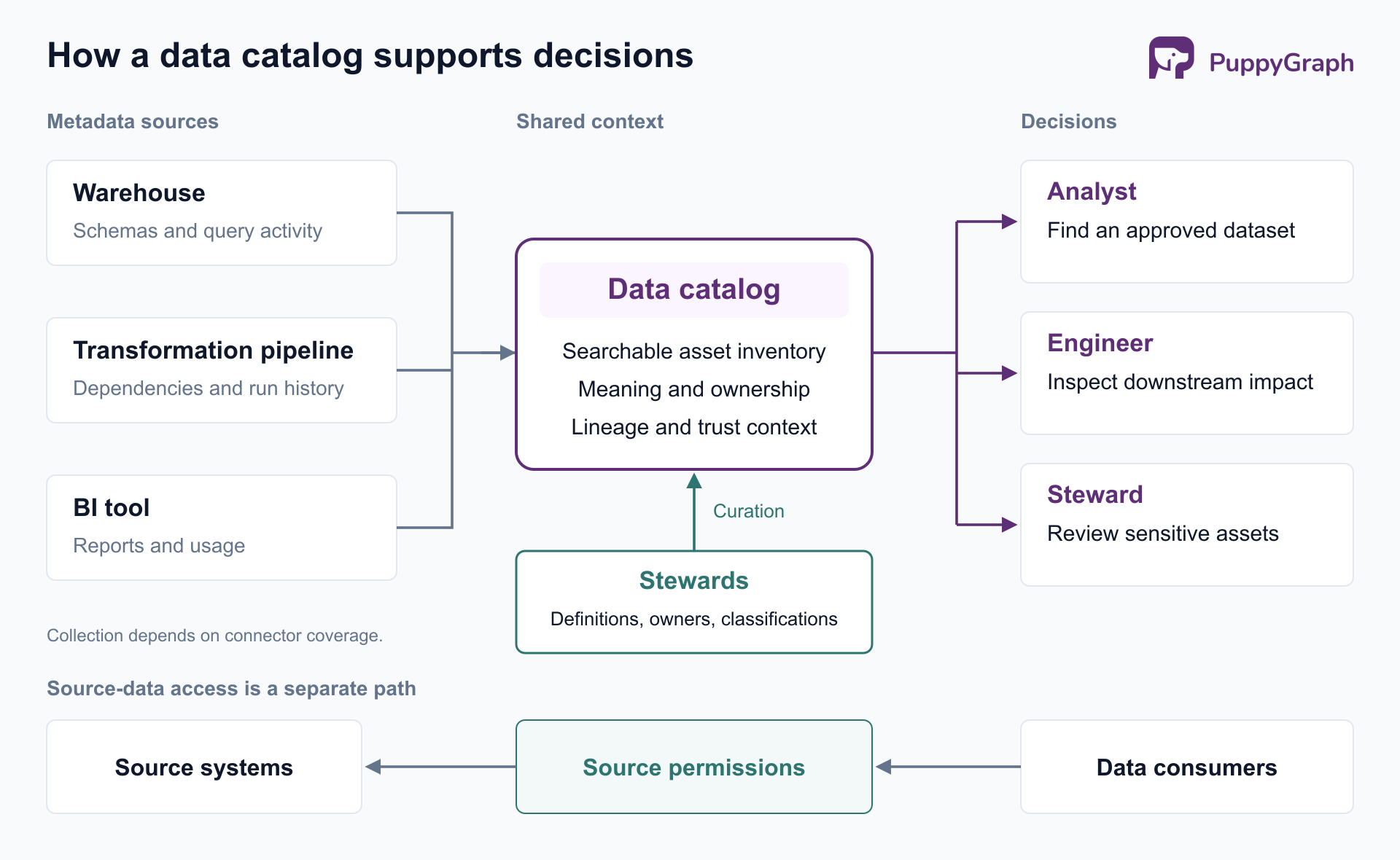
Data catalog platforms collect and organize metadata so people can discover data assets, understand their meaning, identify owners, and assess whether the data suits a task. A data catalog can describe tables, columns, dashboards, pipelines, and other assets across multiple systems. Its inventory connects technical details with the business context needed to use those assets responsibly.
Three kinds of metadata make that inventory useful. Technical metadata describes schemas, types, and locations. Business metadata adds definitions, ownership, classifications, and approved uses. Operational metadata describes activity, such as refresh history, usage, and quality results. Platforms differ in how they obtain and connect these layers; a connector that imports column names does not necessarily collect query history or transformation dependencies.
For example, searching for customer revenue might return several plausible tables. A useful catalog helps distinguish the finance-approved dataset from a staging table by showing its owner, definition, dependencies, and relevant quality evidence. The reader can then determine whether revenue includes refunds, when the dataset refreshes, and whom to contact when the numbers disagree.
Cataloging also supports engineering and governance work. Before changing a column, an engineer can inspect captured downstream dependencies. A steward can find assets missing owners or carrying sensitive-data classifications. During a warehouse migration, a team can use documented usage and lineage to investigate which assets need attention. These are different uses of the same connected metadata.
The word catalog also appears in storage infrastructure. A metastore or table catalog helps engines locate and interpret tables. This article focuses on enterprise discovery and governance across systems. Some products span both areas, so evaluate their documented scope rather than treating every product with catalog in its name as interchangeable.
Metadata collection does not normally require replicating the full business dataset. However, optional sampling, profiling, and query-log ingestion can expose values or query text. Review those collection settings explicitly. Likewise, documenting an access policy and enforcing permissions at the source are separate capabilities. A catalog's governance value depends on the evidence it captures and the controls connected to it.
How to choose a data catalog platform
Start with a bounded pilot: one important dataset, its producing pipeline, its consuming dashboard, and the people responsible for them. Include a known documentation gap or lineage break. This makes it possible to compare platforms on the work your team must complete, rather than the number of assets a demonstration can display.
Verify connector depth. List the systems on that path and the metadata each must contribute. For a warehouse, this might include schemas, views, query activity, and column lineage. For a BI tool, it might include reports and their upstream models. Check authentication, required privileges, network access, and refresh behavior for each connector. Microsoft's Data Map scanning documentation, for example, distinguishes source registration from scanning that captures metadata and applies classifications. Successful connection is only the start of the test.
Ask what happens when an asset is renamed, deleted, or recreated. Determine whether the next scan updates the existing record, creates a duplicate, or leaves stale metadata behind. A catalog that looks complete on its first day may become confusing after routine schema changes. Include ingestion failures in the pilot so administrators can demonstrate how they detect and repair missing updates.
Test lineage against a known dependency path. Choose a path your engineers can independently explain, then compare it with the catalog's representation. Check whether lineage reaches the required columns, transformations, and reports. Identify which edges come from parsed SQL, pipeline integrations, APIs, or manual entries. Alation's lineage documentation describes multiple lineage inputs, illustrating why a lineage feature must be evaluated together with its collection methods.
The key failure case is an apparently complete graph with an unobserved transformation in the middle. Ask how missing coverage becomes visible and who maintains manually supplied relationships. For impact analysis, a clear boundary around known dependencies is more useful than an unexplained claim of end-to-end coverage.
Make ownership and trust actionable. Have a steward define a business term, assign an owner, and review an asset's suitability for use. Then have an analyst find it without knowing its table name. Evaluate whether the user can see who approved the definition, what the quality evidence measures, and when that evidence was updated. A certification badge should have a review process behind it; a popular table can still contain the wrong metric.
Test the permissions around metadata itself. Restricted table names, descriptions, sample values, and query text may need different visibility rules. Walk through an access request from discovery to approval and actual source access. Identify which steps the platform handles and which require an external identity system, warehouse administrator, or service workflow.
Once functional fit is established, evaluate the effort required to sustain it.
Compare the operating model and total cost. For a commercial service, request a quote tied to your intended sources, environments, users, and capabilities. Establish what the proposal includes for lineage, quality, support, and implementation. For self-hosted software, budget infrastructure, upgrades, backups, security maintenance, and connector troubleshooting. Open-source licensing changes procurement options; it does not eliminate operational work.
Measure adoption and portability. Ask analysts to find an approved dataset and engineers to assess a proposed change. Record task completion, unresolved questions, and administrator effort. Also test exporting descriptions, ownership, glossary terms, and relationships through supported interfaces. The metadata your people curate should remain usable in other workflows, including if you later change platforms.
Give AI-assisted features the same evidence standard. If a catalog generates descriptions or answers questions, test ambiguous terminology and assets with incomplete documentation. Check how users inspect the supporting metadata and correct mistakes. Fluent summaries are useful only when the team can distinguish an approved definition from an inferred one.
The pilot should end with a decision about both software and responsibility: which workflows improve, which gaps remain, who owns curation, and who operates ingestion. Without those assignments, even a technically successful rollout can leave users relying on stale context.
Data catalog platform comparison
The following table summarizes the six platforms by evaluation priority. These suggested fits are editorial judgments based on the documented capabilities linked in each row, not exclusive use cases. All six deserve testing against the same source systems and business tasks.
A governance-led shortlist might begin with Collibra and Microsoft Purview. An analyst-discovery pilot could start with Alation and Atlan. A team that wants an open-source foundation and direct integration control should examine DataHub and OpenMetadata. These are starting points, not boundaries: the decisive evidence is how each platform handles your least straightforward source and most important user task.
6 best data catalog platforms
Collibra
Collibra merits evaluation when the catalog must connect technical discovery to an established governance program. Its Data Catalog brings together asset inventories, classification, business terms, policies, and certification. The useful question is how well those relationships represent the decisions your organization already makes about data ownership and acceptable use.
Consider a finance team with a shared revenue definition and several implementations across business units. The evaluation should establish whether stewards can connect that definition to the relevant assets, explain differences, and identify responsibility for corrections. Search becomes more valuable when the result carries enough context to settle which dataset belongs in a report.
Collibra also distinguishes technical and business lineage. Its documentation explains that technical lineage can contain objects that are not registered as catalog assets. This matters during evaluation: seeing an object in a technical dependency graph does not by itself mean it has the ownership, glossary links, or governance context expected in the catalog.
The implementation consideration is the governance model itself. Decide which asset types, relationships, and review responsibilities you actually need before configuring a broad rollout. Test a definition change from proposal through its effect on connected assets, and measure the work imposed on contributors.
Collibra is a reasonable starting point when formal stewardship is central to the purchase. Make the acceptance criterion a working governance process with traceable technical context, and confirm the capabilities included in the proposed commercial package.
Alation
Alation is worth evaluating when the immediate problem is helping analysts find useful data and understand how colleagues use it. Its catalog combines search with descriptions, definitions, policies, lineage, endorsements, and other trust signals. This makes discovery and assessment a natural focus for a pilot.
A distinguishing mechanism is query log ingestion, which processes database query logs to derive information about cataloged objects. Usage context can help users understand which assets colleagues rely on and how those assets participate in existing work. Its value depends on the sources and activity the deployment can actually observe.
For example, give an analyst a business question with several plausible datasets behind it. Have them identify a suitable table, inspect its definition, locate useful context, and explain why they chose it. Include an older, heavily used table whose replacement has been approved more recently. That tests whether curation can guide the decision when historical popularity points elsewhere.
The operational consideration is access to the evidence. Query-log availability, permissions, and collection configuration should be part of the evaluation. Determine what remains visible when a source contributes schemas but no usage history, and review how collected query text is handled.
Alation fits a shortlist focused on analyst adoption and reuse. Evaluate whether its discovery experience changes real decisions, including whether a user can recognize a known caveat before reusing a familiar dataset.
Atlan
Atlan is a candidate for teams that want metadata connected across warehouses, transformation tools, and BI platforms. Its documentation describes cross-source discovery, ownership and certification filters, lineage, and metadata enrichment. The evaluation should focus on whether that connected context remains useful throughout the team's normal development cycle.
Its playbooks provide rule-based automation for metadata updates. This creates a concrete pilot opportunity: select a repeatable curation task, define its matching conditions, run the automation, and inspect both intended and unintended changes. Automation is particularly useful when the team already understands the rule it wants to apply.
For example, a team might assign ownership based on a well-maintained source namespace. The test should include an exception whose ownership differs from its neighbors. Determine how the platform handles that exception during subsequent automation runs and how administrators review the result. Bulk updates save work only when the rules preserve deliberate distinctions.
Also test lineage across an actual source-to-dashboard path. A connected toolchain is valuable when the metadata from its components joins into a coherent picture. Verify that the same asset is identified consistently across tools and that missing links are understood.
Atlan belongs on a shortlist where integration and ongoing enrichment are major priorities. Assess the administrative effort required to keep that automation aligned with changing team boundaries, naming conventions, and asset lifecycles.
Microsoft Purview
Microsoft Purview is a natural candidate for organizations evaluating governance alongside a substantial Microsoft data estate. Microsoft's governance overview separates two principal components: Data Map scans sources and captures metadata, while Unified Catalog provides the experience for discovery, curation, and governance. Keep that division clear when designing the pilot.
Unified Catalog organizes governance around concepts including domains and data products. A useful test is to assemble a data product that serves a recognizable business purpose, associate its relevant assets and definitions, and have someone outside the owning team find and assess it. That tests business usability as well as technical discovery.
For a Microsoft-centered organization, include a representative dependency path through its analytics environment. Then extend the test to a non-Microsoft source used by the same business process. The existence of broad multicloud support should lead to a connector-level evaluation of your particular systems, permissions, and metadata requirements.
The operational consideration is the boundary between collection, catalog curation, and access. Microsoft's scanning guidance describes registration, credentials, and scan configuration as distinct setup concerns. Verify those alongside the user workflow, and confirm how approved access reaches the underlying source.
Purview is a useful starting point when Microsoft alignment matters to administration and procurement. Scope the proposal to the governance components you need, and test cross-platform coverage before assuming that an existing Microsoft relationship settles the catalog decision.
DataHub
DataHub suits evaluation by engineering teams that want programmatic control over metadata collection and integration. The open-source project is Apache-2.0 licensed and provides discovery, lineage, and metadata management capabilities. DataHub Cloud is also available as a managed commercial offering; evaluate the actual edition and deployment being proposed.
Its ingestion architecture supports both pulling metadata from sources and pushing metadata changes from systems that produce them. The documented framework includes Python-based ingestion and interfaces for submitting metadata updates. This gives a platform team options for integrating systems whose context is difficult to capture through a standard scheduled scan alone.
A representative pilot might combine warehouse ingestion with lineage emitted by a custom processing job. Engineers should demonstrate how those inputs refer to the same datasets, how a failed update is detected, and how ownership metadata survives subsequent ingestion. Merely sending events successfully is insufficient if they create duplicate or disconnected asset records.
For a self-hosted deployment, the team also owns service operation. Exercise backup and recovery, an upgrade, and a broken ingestion job before treating the catalog as dependable infrastructure. For a managed deployment, identify the boundary between the provider's platform responsibilities and your team's source-specific integration work.
DataHub is a strong candidate when a catalog forms part of a broader metadata engineering effort. Its fit depends on whether the organization wants and can sustain that integration responsibility, with a clear owner for both platform reliability and metadata usefulness.
OpenMetadata
OpenMetadata merits evaluation when the team wants discovery, ownership, lineage, and data quality in the same working environment. Its open-source project is Apache-2.0 licensed. The project's discovery documentation describes keyword search, relationship-based discovery, and more detailed queries for finding assets.
A particularly useful evaluation path connects discovery to profiling and data quality tests. Have a user locate a dataset and inspect the evidence about its contents and quality. Then introduce a controlled failure, such as unexpected nulls in an identifier, and follow the process through investigation and correction.
The test should establish who sees the failure, who owns the affected asset, and whether consumers can understand the consequence. A test result becomes more useful when someone can connect it to the dataset's purpose. A null identifier might be acceptable in a staging table and unacceptable in a published customer dimension.
Profiling also changes the source-access requirements. Establish which jobs inspect values, how much data they scan, how they are scheduled, and what results are retained. Coordinate that configuration with warehouse owners so the quality workflow has an understood cost and access model.
OpenMetadata is a useful candidate when engineers and data owners want to work from shared catalog and quality context. For self-hosting, include routine operations and upgrades in the pilot, and evaluate the complete path from discovering a problem to resolving it.
Conclusion
The best data catalog platform is the one your team can keep accurate while completing important work. Use the shortlist to test discovery, ownership, lineage coverage, and operational effort against the same business process. Prefer demonstrated coverage and clear responsibilities over a large inventory that nobody maintains.
Once teams agree on the entities and relationships their data represents, they may also need to query records through that model. PuppyGraph lets them define a graph schema over existing tables and query those relationships with openCypher and Gremlin. Its schema mappings define nodes, edges, and properties; the default direct-query path leaves the underlying data in its supported source stores without requiring a persistent duplicate graph dataset. For example, a team can model customers, accounts, and transactions to investigate connections across those records. This complements catalog discovery and stewardship, with the graph model configured explicitly by the team.
Try the forever-free PuppyGraph Developer Edition and book a demo with the team to see how openCypher and Gremlin queries connect records across warehouse and lakehouse tables, with no graph-specific ETL, using an explicit model of the entities and relationships your team works with.

Hao Wu is a Software Engineer with a strong foundation in computer science and algorithms. He earned his Bachelor’s degree in Computer Science from Fudan University and a Master’s degree from George Washington University, where he focused on graph databases.


