

What Is a Data Catalog? Benefits, Features & Use Cases
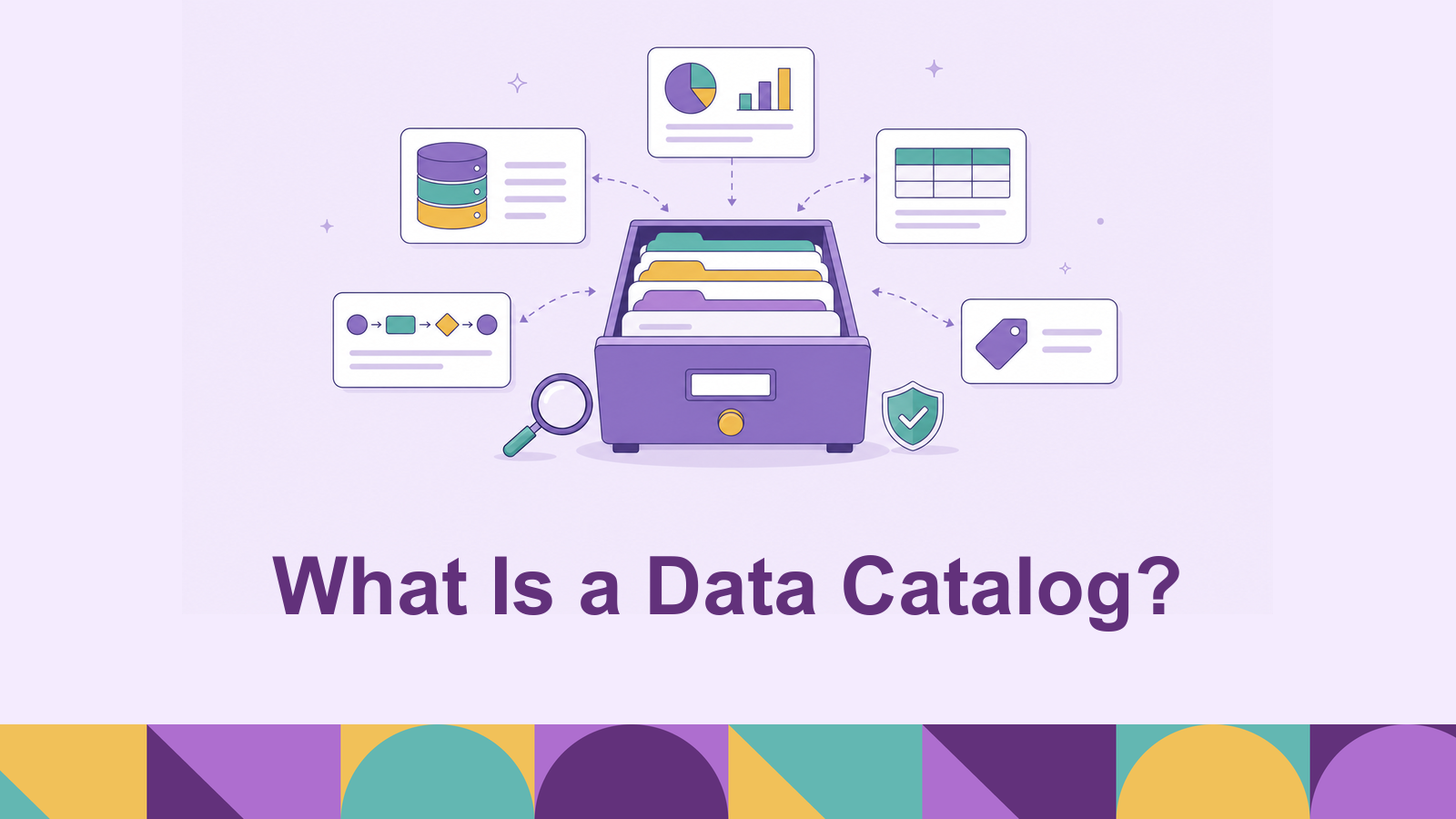
Every data project begins with an unglamorous step: finding the data. In most organizations that step is archaeology. Someone messages a senior engineer, greps schema dumps for a plausible table name, runs a few trial queries, and hopes the table that looks right is the one the last team actually trusted. The knowledge of what exists, what it means, and whether it can be believed lives in people’s heads, and it stopped scaling with the estate years ago, as data spread across warehouses, lakes, operational databases, and a long tail of SaaS tools that each accumulate their own tables. AI raises the stakes further, because a model or agent consuming that estate cannot message the senior engineer at all.
This guide covers what a data catalog is, why organizations adopt one, how the machinery works, the features that distinguish modern catalogs, the benefits and use cases that justify the investment, how AI is changing both what catalogs do and what is asked of them, and how to choose a solution.
What is a data catalog?
A data catalog is an organized, searchable inventory of an organization’s data assets, built from metadata rather than from the data itself. Like a library catalog, it records what exists, where it lives, what it is about, and who to ask, so that finding an asset takes a search instead of an excavation. The assets it describes span tables, views, files, dashboards, reports, pipelines, and increasingly ML features and models.
What the catalog actually stores is several layers of metadata. Technical metadata is harvested from the systems themselves: schemas, column names and types, partitions, sizes, storage locations. Business metadata is authored by people: what a table means, which glossary term a column maps to, who owns it, how it is classified. Operational metadata records behavior over time: when the asset was last refreshed, which pipeline produces it, who queries it and how often. Some catalogs add a social layer on top, such as endorsements, warnings, and discussion threads. The technical layer is cheap and abundant; the business layer is expensive and carries the context automation cannot infer; the operational layer is what separates an inventory from a living map.
One disambiguation saves a lot of confusion, because two different kinds of tool share the name catalog:
This article is about the first kind. The second kind, the metastore that maps file paths to logical tables so engines have something to plan against, is not a competitor to the enterprise catalog but one of its richest sources: the enterprise catalog harvests the metastore along with everything else.
Why organizations need a data catalog
The case for a catalog rests on a handful of costs that grow with the estate rather than with the team.
Discovery stopped scaling with people. Tribal knowledge works until the people carrying it change teams or leave. Past a certain size, no individual holds the map, and every project pays a rediscovery tax: time spent finding, interrogating, and re-verifying data that someone else already found, interrogated, and verified.
Trust is reconstructed instead of recorded. When two dashboards disagree, someone reconciles them by hand. When a metric’s definition varies by team, every cross-team analysis opens with a negotiation. A catalog gives the organization a place where the definition, the owner, and the freshness of an asset are written down once, instead of being re-derived in every meeting that touches it.
Governance needs an inventory before it can govern. Classification, access policy, retention, and audit all presuppose knowing what data exists and where it lives; an organization cannot protect a dataset it has not found. The gap is measurable in breach outcomes: IBM’s Cost of a Data Breach Report 2024 found that 35% of breaches involved shadow data, data held in unmanaged sources invisible to IT, and that those breaches cost more and took longer to identify and contain than breaches of inventoried data.
Unfindable data gets rebuilt. When nobody can locate the original, teams create a slightly different copy, and each copy is a second place the same data must be secured, refreshed, and eventually reconciled. The copies multiply faster than controls do.
Undocumented data now fails at machine speed. Models and agents assemble their training sets and retrieval context from the estate as it actually exists, undocumented corners included, and they consume it without the pause a suspicious analyst would take. Ambiguity that used to surface as a question in a channel surfaces as a confident wrong answer; what that demands of the catalog is the subject of a later section.
Each of these costs is individually absorbable, which is why organizations absorb them for years. The catalog’s argument is that they compound: the same knowledge is re-derived project after project, and the estate grows faster than the tribal map of it.
How a data catalog works
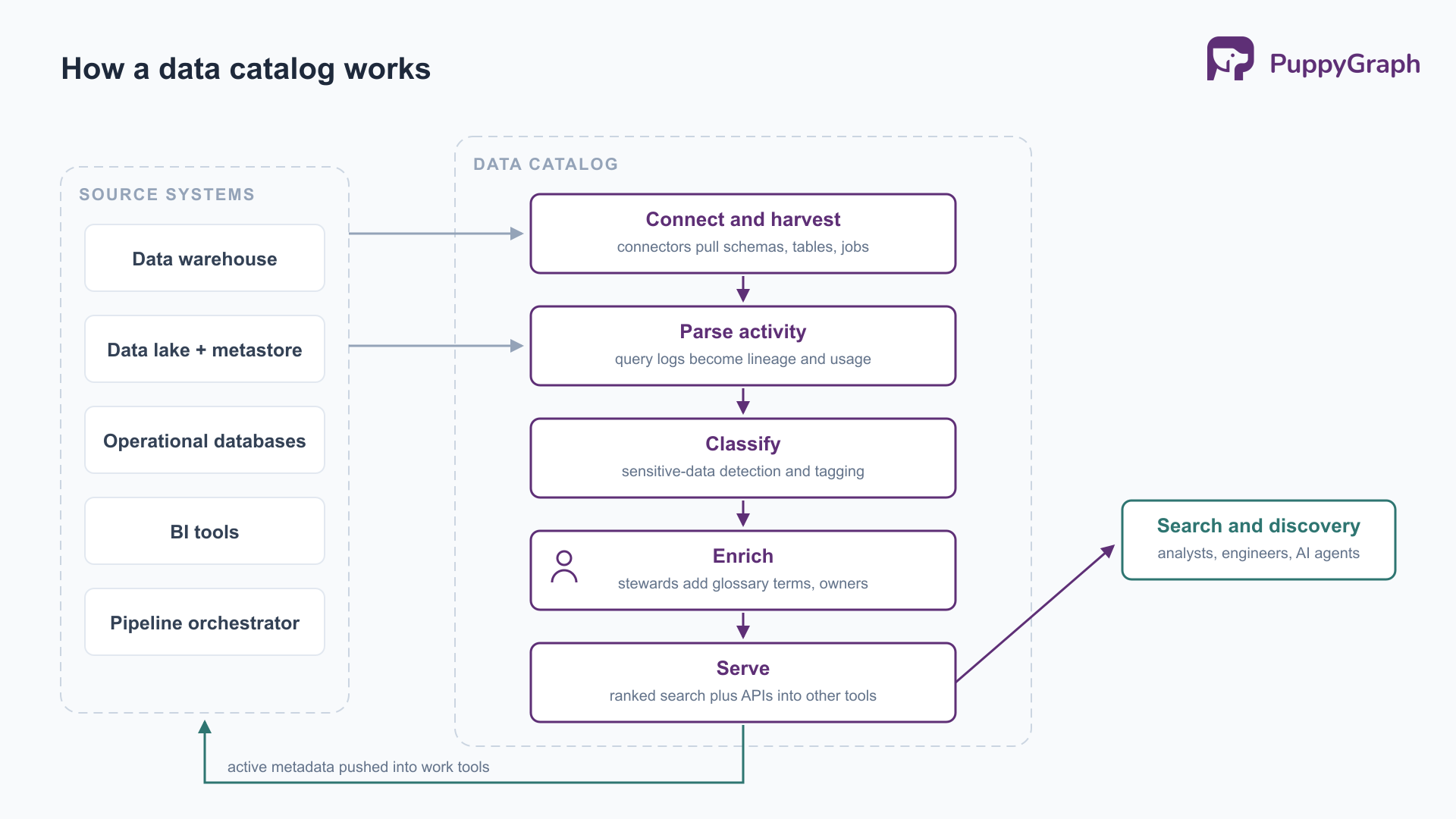
Modern catalogs converge on the same pipeline: harvest broadly by machine, enrich selectively by hand, and serve the result where people work.
Connect and harvest. Connectors authenticate against source systems (warehouses, lake metastores, operational databases, BI tools, pipeline orchestrators) and pull technical metadata on a schedule: schemas, tables, columns, dashboards, jobs. This is the automated backbone; it establishes coverage without human effort and re-scans to pick up drift.
Parse activity. The catalog ingests query logs and pipeline run history, and reconstructs from them what no one would ever document by hand: lineage, the chain of which tables feed which transformations feed which dashboards, and usage, which assets are queried often, by whom, and how recently. Usage doubles as a relevance signal; the table half the company queries daily probably matters more than its abandoned twin.
Classify. Pattern matching and ML models scan column names, types, and sampled values to flag sensitive data such as personal information, and propagate those tags along lineage so a sensitive column stays flagged in the tables derived from it.
Enrich. People add the layer automation cannot: stewards and owners write descriptions, bind columns to business glossary terms, record ownership, and certify the assets that deserve trust. This is the expensive step, and the one that determines whether the catalog reads as a map or as a scan.
Serve. A search interface ranks results by relevance and usage, and APIs push metadata back into the tools where work happens, so that a warning on a deprecated table appears in the BI tool and the query editor, not only in the catalog. The industry calls this pattern active metadata: the catalog as a hub that distributes context, rather than a website that hopes for visits.
The division of labor is the design insight. Automation gives breadth nobody could type; curation gives meaning nothing can infer; and the catalog’s value at any moment is the product of the two, which is why a catalog with stalled harvesting or absent stewards decays so quickly.
Core features of a modern data catalog
Catalog features cluster into three jobs: building the inventory, attaching meaning and trust to it, and pushing both into daily work.
Building the inventory. Automated harvesting across the estate’s systems, with scheduled re-scans so the inventory tracks reality. Search and ranking tuned for data assets, where popularity, freshness, and certification weigh results, because fifteen tables will match the string “customer”. Column-level lineage, assembled from query-log parsing, showing where an asset came from and everything downstream of it.
Attaching meaning and trust. A business glossary that defines terms once (what counts as an active customer, how revenue is recognized) and binds them to the physical columns that implement them. Classification and sensitivity tagging, automated where patterns suffice and manual where judgment is required. Certification and endorsements that distinguish the table the finance team stands behind from its lookalikes, and deprecation warnings that mark the ones to avoid.
Pushing context into daily work. Governance workflows such as access requests, approval routing, and policy attachment, run where the inventory lives rather than in a parallel ticket queue. Collaboration signals: documentation, questions and answers, and change announcements attached to the asset they concern. Quality signals surfaced from tests and observability tools, so a failing freshness check is visible at the point of discovery. And open APIs, because a catalog that can only be browsed becomes a destination nobody visits; one that pushes warnings, definitions, and classifications into query editors and BI tools becomes infrastructure.
A reasonable way to compress the feature checklist: harvesting and lineage are table stakes, glossary and certification are where the organizational work concentrates, and the API surface decides whether any of it reaches the moment a person actually chooses a table.
Benefits of using a data catalog
Discovery becomes self-service. The search that used to route through the data team’s Slack channel routes through the catalog, which shortens projects and frees the small set of people who used to serve as the human index.
Trust gets a shared anchor. Certified assets, recorded owners, and visible freshness give consumers a basis for belief that does not require re-verifying the data themselves. Disagreements move from “whose number is right” to “which definition are we using”, which is a cheaper argument to have.
Governance scales without scaling headcount. Classification attached in the catalog reaches every consumer who finds the data through it; access workflows run against the inventory; audits start from a live record of what exists and how it is classified, instead of from a quarter-long discovery exercise.
Duplication drops. Data that can be found gets reused instead of rebuilt, which contains the sprawl of near-identical copies that inflates storage, pipelines, and the governed surface.
Onboarding accelerates. A new hire, or a newly connected tool, can learn what a table means and whether to use it without six months of absorbing tribal knowledge. As the next sections argue, this benefit now extends to machine consumers.
The through-line is leverage: the catalog converts knowledge that lived in individual heads into infrastructure the whole organization queries, and each documented asset makes the map more worth consulting.
Common use cases for data catalogs
Self-service analytics. The founding use case: analysts find, evaluate, and use data without a gatekeeper in the loop. The catalog’s ranking and certification signals do the steering that a data team used to do by hand.
Regulatory compliance. Privacy regimes such as GDPR and CCPA ask questions only an inventory can answer: what personal data is held, where, under what protection, and feeding what. Data subject requests turn into catalog lookups over classified assets; audits turn into reports over the inventory rather than expeditions across it.
Impact analysis and change management. Before a schema change or a table deprecation, lineage answers the question that determines the blast radius: what is downstream of this, directly or through three intermediate transformations. Teams that lack this answer learn it from the incident channel instead.
Cloud migration and rationalization. Usage metadata makes migration triage empirical. Assets nobody has queried in a year are candidates for retirement rather than migration, near-duplicate tables are candidates for consolidation, and the estate that arrives on the new platform is the one worth having.
AI and ML development. Teams building models use the catalog to find training data, check its provenance and quality signals, and reuse features that already exist. Model documentation and dataset lineage also feed the audit trail that AI regulation increasingly expects.
Across the use cases the pattern repeats: the catalog is the estate’s queryable self-description, and each use case is a different consumer asking it a different question.
How AI is transforming data catalogs
AI changes the catalog from both sides: it automates work inside the catalog, and it raises the standard for what the catalog must provide to consumers.
AI inside the catalog. The expensive layer of catalog work has always been the human one, and that is the layer language models are eroding. Modern catalogs generate draft descriptions from schemas, sample values, and query patterns; propose glossary bindings; and answer natural-language questions (“where is churn defined?”) instead of keyword searches. Classification improves the same way, with models catching sensitive data that regex patterns miss. The steward’s job shifts from author to reviewer, which matters because authoring was the bottleneck. The caveat is that generated descriptions inherit the ambiguity of what they were generated from; certification by someone accountable remains the trust anchor, and a catalog full of plausible unverified prose is a failure mode of its own.
The catalog as input to AI. The reverse direction is more consequential. Agents and copilots that query enterprise data need what new hires need, the knowledge of what exists and what it means, but they need it machine-readable and they consume it without judgment. Gartner predicted in February 2025 that through 2026, organizations will abandon 60% of AI projects unsupported by AI-ready data, and its prescription for getting there sits squarely in catalog territory: data governance requirements identified for AI, and metadata evolved from passive to active. The same release reports that 63% of organizations either do not have or are unsure they have the right data management practices for AI. The catalog, long positioned as a productivity tool for analysts, turns out to be a load-bearing dependency of the AI roadmap.
There is a structural gap, though, between what a catalog provides and what an agent needs. A catalog documents meaning; nothing about it binds a consumer to that meaning. A human who misreads a description writes a wrong query and, usually, catches it in review. An agent that misreads, or never reads, produces queries that are syntactically valid but semantically wrong, joining tables the model never intended to relate or referencing entities that do not exist, and it produces them confidently and at scale. For machine consumers, the definitions need to sit on the query path itself, not beside it in documentation. That is the role of a semantic layer in the form of an ontology: a model of the business’s entities, relationships, and properties that queries are validated against before they execute.
PuppyGraph implements that layer as a graph. The schema it defines over existing warehouse and lakehouse tables functions as an enforced ontology: every openCypher or Gremlin query is validated against the model before execution, a reference to an entity or relationship the model does not define is rejected before it touches any data, and the rejection returns as structured feedback that explains the violation in domain terms rather than as a stack trace, which lets an agent grounded on that feedback correct itself and retry instead of returning a confident wrong answer. The relationship to the catalog is complementary, and the glossary is the bridge: the entities, relationships, and definitions a catalog records are the raw material for the ontology, restated as a model that executes. And because PuppyGraph queries the source tables in place, with no ingestion and no duplicate copy, adding the layer adds no new copy of the data for the catalog to track: the data keeps living in the governed warehouse or lake, under the ownership, classification, and lineage already recorded for it. Both directions of the shift land in the same place: metadata does more work, for more kinds of consumer, than the catalog’s original readers ever asked of it.
Choosing the right data catalog solution
Catalog evaluations fail most often by scoring features in the abstract instead of against the estate the catalog will actually describe. The criteria that separate outcomes fall into two groups.
The first three test the tool against the estate it will describe.
Connector coverage against your actual stack. Score coverage against your inventory of systems, including the unfashionable ones, because the uncovered remainder is precisely where shadow data hides. A catalog that covers the modern 80% of the estate leaves the risky 20% as invisible as before.
Lineage depth. Cross-system, column-level lineage assembled from real query-log and pipeline parsing is where products differ most. Test candidates against your own hardest cases, the dense stored procedures and the legacy ETL, not against the vendor’s demo environment.
Automation versus curation burden. Ask what arrives harvested and what must be typed in, because stewardship hours are the dominant recurring cost of ownership and the first budget to quietly disappear.
The remaining three test the tool against the organization that will run it.
Governance fit. If stewardship is federated across domains, the catalog needs workflows that match: domain-scoped ownership, approval routing, certification, and policy attachment that integrates with the platforms that actually enforce access.
Openness and integration surface. Open-source catalogs (DataHub, OpenMetadata) trade the polish and managed operations of the commercial platforms (Alation, Collibra, Atlan, Microsoft Purview) for control and an open metadata model, though both now have vendor-managed cloud editions as a middle path. In either case the API surface matters more than the browsing experience, because the catalog earns adoption by pushing context into other tools.
Adoption ergonomics. A catalog only works at the rate people consult it. Relevance-ranked search, integrations into query editors and BI tools, and low-friction contribution decide whether it becomes the default first stop or shelfware with a login page.
One selection error outranks the rest: buying the catalog before assigning the decision rights. A catalog without named owners and resourced stewards goes stale within quarters, and a stale catalog is worse than none, because people trust it. The tool amplifies a governance program that already exists.
Conclusion
A data catalog is the layer that makes a data estate self-describing: harvested technical metadata for breadth, curated business metadata for meaning, operational metadata for trust, served into the tools where data work happens. The costs it attacks, rediscovery, reconciliation, ungoverned sprawl, are the ones that grow with the estate rather than the team, which is why the catalog has moved from a nice-to-have to standing infrastructure. AI sharpens both sides of the bargain: models now do some of the documentation work, and the documentation now has consumers that read it without judgment, which pushes organizations to extend the catalog’s recorded meaning into semantic layers that validate queries rather than merely inform them. The estates that handle that shift well will be the ones where the catalog was treated as a product, owned, curated, and measured, rather than procured and abandoned.
Try the forever-free PuppyGraph Developer Edition and book a demo with the team to see how openCypher and Gremlin queries run over warehouse and lakehouse tables, with no graph-specific ETL, putting the definitions a catalog records onto the query path itself.

Sa Wang is a Software Engineer with exceptional mathematical ability and strong coding skills. He holds a Bachelor's degree in Computer Science and a Master's degree in Philosophy from Fudan University, where he specialized in Mathematical Logic.


