


What Is Zero-ETL? Complete Guide
Data pipelines are an expensive part of the analytics stack that few teams chose on purpose. A 2021 Wakefield Research survey commissioned by Fivetran found that enterprise data engineers spend 44 percent of their time manually building and maintaining data pipelines, at an average cost of about $520,000 per year per company. Zero-ETL is the industry’s answer to that line item: a family of integration patterns that make data queryable in analytical systems without a pipeline your team writes, schedules, and gets paged for.
This guide explains what zero-ETL actually means, how the mechanics work, the building blocks of the architecture, where the approach helps and where it falls short, how it compares with traditional ETL and the other integration methods it is often confused with, and how the same principle extends to querying data by its meaning rather than its tables.
Understanding zero-ETL
Zero-ETL is an umbrella term for data integration approaches in which data produced in one system becomes available for analysis in another without a user-built extract-transform-load pipeline in between. The integration still happens; it changes hands. Either the platform vendor runs the movement as a managed service, or the movement disappears entirely because the analytical engine reads the source data where it already lives.
The term’s current usage comes from AWS. At re:Invent 2022, CEO Adam Selipsky announced the first Aurora zero-ETL integration with Redshift and pitched it as a step toward a “zero-ETL future”. AWS has since grown the pattern into a family of zero-ETL integrations covering its relational, NoSQL, and SaaS-application sources, and other vendors have adopted the label, from Microsoft Fabric’s mirroring of operational databases into OneLake to the zero-copy integrations between Salesforce Data Cloud (now Data 360) and warehouses like Snowflake.
The “zero” is easy to over-read, because the term is marketing-born. Zero-ETL does not mean zero transformation: data still needs cleaning, conforming, and modeling before it supports trustworthy metrics; that work moves downstream rather than vanishing. Nor does it always mean zero data movement: several flagship zero-ETL products replicate continuously under the hood. What it reliably means is zero pipeline code that you own, deploy, monitor, and fix at 3 a.m.
That definition covers two architecturally distinct flavors, and keeping them apart clarifies almost every comparison later in this guide. Managed replication keeps two copies of the data but makes the copying invisible: the platform captures changes from the source and applies them to the analytical store continuously, as in AWS’s Aurora-to-Redshift integrations or Fabric mirroring. Direct access keeps one copy: the analytical engine queries the source in place, whether through federation, through zero-copy data sharing, or by pointing multiple engines at the same open-format tables in object storage. Both flavors move the integration burden from your team to the platform; they differ on whether a second copy exists.
How zero-ETL data integration works
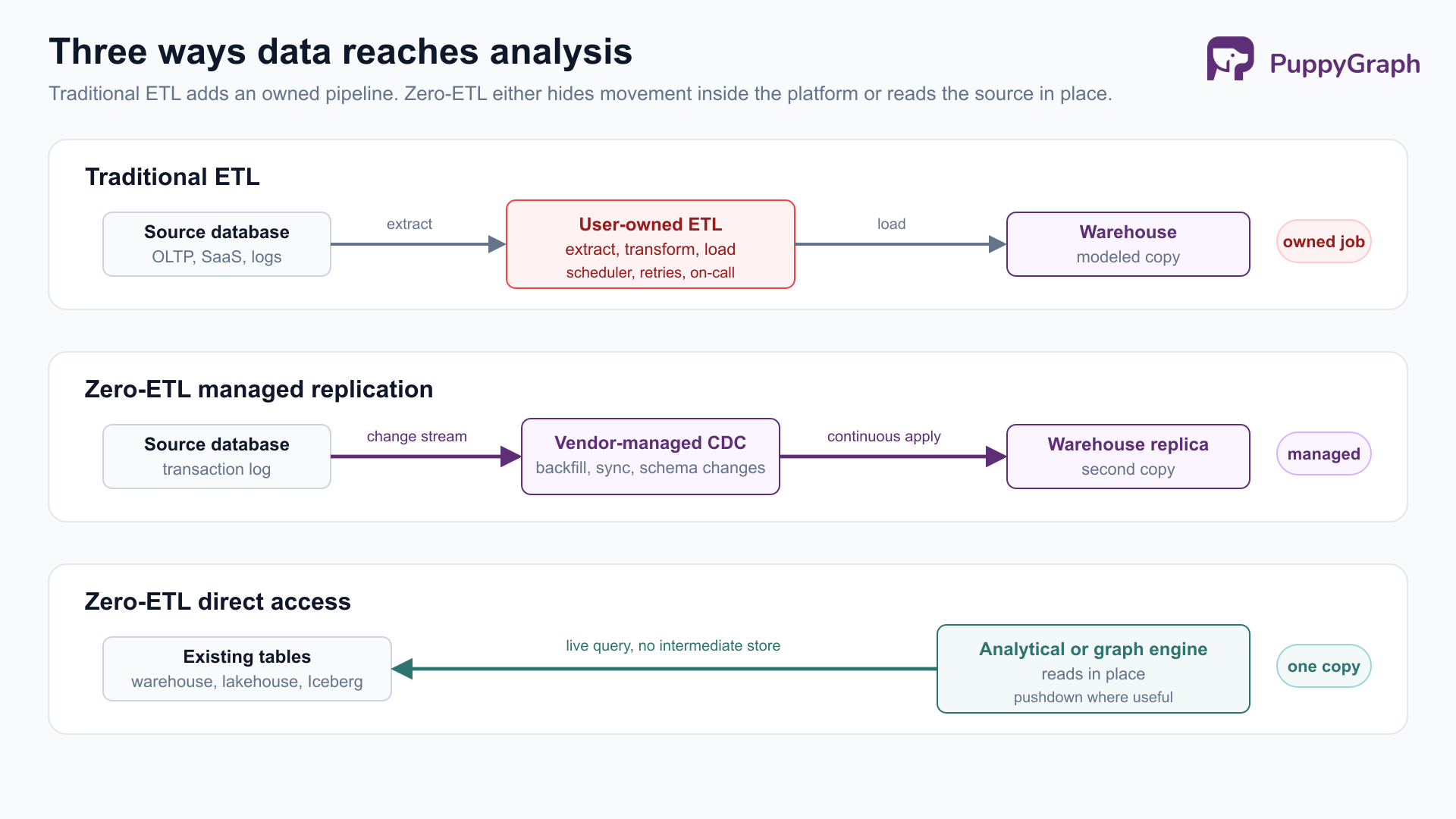
Managed replication is, mechanically, change data capture run by the vendor. The source database already maintains a transaction log for durability and replication; the zero-ETL integration reads changes from that log or from the storage layer beneath it, converts them into the target’s format, and applies them continuously. In AWS’s Aurora zero-ETL integration, committed transactions become available in Redshift within seconds to minutes, and the service handles the parts that make hand-rolled CDC pipelines fragile: initial backfill and seeding, continuous application of committed changes, data type mapping, and propagation of many schema changes. From the user’s perspective there is no job to schedule and no cluster to size, only an integration to create and a replica that stays seconds to minutes behind the source.
Direct access removes the copy instead of hiding it. In query federation, the analytical engine reads the source live at query time, pushing filters and projections down so only relevant data crosses the wire; BigQuery’s federated queries and engines like Trino work this way. In zero-copy data sharing, two platforms agree on read access to the same stored data, so a consumer queries the producer’s tables without either side exporting anything, the pattern behind the Salesforce-Snowflake integrations. And in the open-table-format pattern, the integration step is simply that many engines can read the same Iceberg or Delta Lake tables on object storage through a shared catalog, so getting data into a new engine means registering tables, not building a pipeline.
The two flavors trade off along a consistent axis. Managed replication buys predictable analytical performance (the data is already in the target’s optimized format) at the cost of a second copy and a small replication lag. Direct access buys a single source of truth and zero lag at the cost of query-time work: load on the operational source, network latency, or dependence on how well the engine pushes computation down. Real architectures mix both, replicating hot operational sources while reading lake data in place.
Core building blocks of a zero-ETL architecture
Zero-ETL offerings usually assemble a few recurring components rather than introducing one new technology. Recognizing those components makes vendor offerings much easier to evaluate.
Change data capture at the source. Everything in the managed-replication flavor rests on the source database’s transaction log. CDC turns that log into an ordered stream of row-level changes without imposing query load on the source, allowing continuous sync from a production OLTP database that batch extracts would strain.
A managed replication service. The vendor-operated machinery that consumes the change stream, applies it transactionally in the target, and surfaces lag and error metrics; the direct replacement for the pipeline code a data team would otherwise own.
Open table formats on shared storage. Iceberg and Delta Lake give lake storage the table semantics (schemas, transactions, snapshots) that used to require loading data into a proprietary store. Because the formats are open, one physical copy can serve many engines, which is the direct-access flavor in its purest form and the foundation of the modern lakehouse.
A shared catalog. For multiple engines to read the same tables safely, they need one answer to “what tables exist, what schema do they have, and where are their files.” Catalogs (Hive Metastore, AWS Glue, Unity Catalog, and the increasingly adopted Iceberg REST catalogs) are what turn a pile of files into an integration point, and increasingly where access control is enforced.
Engines that query data in place. The consuming side of direct access: warehouses reading external tables, federated SQL engines, and specialized engines that project a different model onto the same storage. This last category is broader than SQL; a graph query engine reading warehouse tables in place applies the same principle to a different query model, a case covered below.
None of these components is new in isolation; CDC, catalogs, and federation each predate the term by years. What the zero-ETL label marks is the point at which vendors began wiring them together and operating them as a product, so that the integration a team used to build becomes a capability the platform simply has.
Benefits and limitations of zero-ETL
The benefits are real, and they concentrate in a few places.
Freshness. Managed replication delivers operational data to the analytical side on a much shorter cadence than a nightly batch cycle, moving fraud checks, live dashboards, and inventory decisions from yesterday’s data to current data.
Less pipeline toil. The engineering time that goes to pipeline maintenance is largely spent on failure handling, schema drift, and backfills, exactly the work managed integrations absorb. That capacity goes back into modeling and analysis.
Fewer copies and less drift. Every hand-built pipeline is an opportunity for the copy to diverge from the source: silent failures, partial loads, subtly different type handling. Direct-access patterns eliminate the copy; managed replication makes the copy’s correctness the vendor’s contractual problem instead of an on-call one.
Faster onboarding of new sources. When a source is covered by a supported integration, connecting it is configuration, not a project. The marginal cost of asking a new question of a new source drops sharply.
The limitations deserve equal weight, because they define where the approach stops.
Transformation relocates downstream. Zero-ETL delivers raw source schemas. Conforming keys across systems, deduplicating entities, building the modeled layer that business metrics sit on: all of that still has to happen, now as post-load transformation inside the target. Teams that hear zero-ETL and expect zero data engineering rediscover this quickly.
Coverage follows vendor ecosystems. The polished integrations connect a vendor’s own operational databases to that same vendor’s analytical stores. Cross-vendor and cross-cloud paths are thinner, and a topology the vendor has not productized puts you back in pipeline-building territory.
Edge cases persist. Managed replication supports many schema changes but typically not all DDL; some data types do not map cleanly; and lag, though small, can grow under heavy write load. Failures are rarer than a cron-driven pipeline’s but more opaque when they occur, because the machinery is a black box.
Compliance can require transformation before landing. If regulation demands that data be masked, tokenized, or filtered before it reaches the analytical platform at all, a pattern premised on replicating the source faithfully needs a transform-on-ingest step reintroduced in front of it.
The honest summary is that zero-ETL removes the extract-and-load toil and leaves transformation and modeling as the durable engineering discipline. That is a large win, but it is a narrower one than the name implies.
Common business use cases for zero-ETL
The first group of use cases depends on fresher operational data reaching analytical systems with less pipeline work.
Real-time operational analytics. The founding use case: order, inventory, and usage data flowing from a production database into the warehouse continuously, so dashboards and alerts reflect the business as of minutes ago.
Fraud and risk detection. Fraud models are only as good as the recency of their inputs; a stolen card can create damage long before an overnight batch completes. Managed replication gets transaction streams into the analytical environment fast enough for near-real-time scoring without a bespoke streaming pipeline.
Customer 360 across platforms. Zero-copy sharing between systems of engagement and systems of analysis (the Salesforce-Snowflake pattern) lets marketing and analytics teams work from one copy of customer data instead of reconciling exports, which is as much a governance win as a latency one.
The second group depends on reuse: one governed copy of data serving multiple analytical, security, and ML workloads.
Security and observability analytics. Telemetry volumes make copying data a cost problem, so security teams increasingly land logs once in an open-format data lake and point multiple engines at it; the shared-storage flavor of zero-ETL is what keeps that lake queryable by many tools without multiplying storage bills.
Fresh features for ML and AI. Models and, increasingly, AI agents need current data at inference time. Zero-ETL paths shorten the distance from operational event to model input, and shared open formats let training, serving, and analytics read the same tables.
Across all five cases the pattern is the same: the value comes from asking questions of data that is both current and un-copied, and the zero-ETL architecture is what makes that economically routine rather than a per-question engineering project.
Zero-ETL vs. traditional ETL pipelines
The useful comparison asks which failure modes and costs your situation can absorb. Traditional ETL buys unlimited topology and the ability to shape data before it lands, and charges for it in engineering time and staleness. Zero-ETL buys freshness and operational simplicity, and charges for it in ecosystem commitment and in transformation work relocated downstream. Mature stacks run both: managed integrations for the operational sources the vendor covers, deliberate pipelines for the conformance-heavy work (multi-source identity resolution, regulatory shaping) where transformation before landing is the point.
Comparing zero-ETL with other data integration approaches
ELT. Extract-load-transform moved transformation after loading but kept the extract-and-load pipeline as user-owned tooling. Zero-ETL is best read as ELT’s next step: the same transform-in-the-warehouse philosophy, with the E and L absorbed into the platform. The transformation layer that grew up around ELT carries over unchanged.
CDC replication tools. Standalone CDC (Debezium, commercial replication services) uses the same log-based mechanism as managed zero-ETL integrations, but you operate the machinery and it connects arbitrary sources to arbitrary targets. Zero-ETL integrations are CDC with the operational burden and the topology flexibility both removed. When your source-target pair is covered, the integration is simpler; when it is not, CDC tooling is the fallback.
Data virtualization and federation. Federation engines query many sources live without moving data, which makes them the direct-access flavor of zero-ETL from before the term existed. The trade-off is performance coupling: every query hits the operational sources at their speed. Virtualization suits occasional cross-source questions; sustained analytical load usually justifies a replicated or shared copy.
Streaming platforms. Kafka-style event streaming solves a more general problem: many producers, many consumers, arbitrary in-flight processing. It remains the right tool when events feed applications, not just analytics, or when transformation must happen in motion. Zero-ETL integrations cover the narrower but very common case where the destination is analytical and the processing can wait until after landing, with far less infrastructure to run.
Data sharing. Warehouse-native sharing (Snowflake shares, and the cross-platform zero-copy agreements built on the same idea) is zero-ETL between organizations or platforms rather than within a stack: consumers query the producer’s single copy in place. Its reach is bounded by both parties’ platform support, which is the same ecosystem constraint in a different guise.
The through-line is that zero-ETL packages familiar mechanisms (CDC, replication, federation, shared storage) with the operational responsibility moved to the platform. The evaluation question for any zero-ETL offering is therefore always the same two-parter: which mechanism is actually underneath, and which of your topologies does it cover.
Semantic queries with zero ETL
So far every consumer in this guide has asked its questions in the source’s own vocabulary: tables, columns, joins. For a growing class of consumers, that vocabulary is the wrong one. Human analysts reasoning about accounts, devices, and transactions, and AI agents even more so, think in terms of what the data means: entities and the relationships between them, not the foreign keys that happen to encode them. Every query they write in table vocabulary is a translation, and the translation step is where the effort and the errors live. The conventional way to remove that translation step is a semantic layer built as a knowledge graph project: design the model, stand up a graph database, and build the pipeline that feeds it, which reintroduces everything zero-ETL exists to remove, and at its worst, because a semantic model typically spans many sources at once.
PuppyGraph applies the direct-access pattern to this layer. It is a graph query engine that connects to SQL databases, warehouses, and lakehouses, including direct reads of open table formats like Iceberg and Delta Lake, and it takes its shape from a schema you declare over the tables you already have: which tables are entities, which foreign keys are relationships, which columns are properties. That declaration is a semantic model of the data, in other words an ontology, and queries run against it in openCypher and Gremlin, with no data movement and no separate graph store. Asking which accounts connect to a flagged one through shared devices becomes a sentence in the model’s vocabulary:
MATCH (a:Account {flagged: true})-[:USED_DEVICE]->(d:Device)<-[:USED_DEVICE]-(b:Account)
WHERE a <> b
RETURN b.account_id, count(DISTINCT d) AS shared_devices
ORDER BY shared_devices DESC
Nothing ran ahead of this query to make it answerable: no export job, no load into a graph store, no sync to fall behind. PuppyGraph compiles a graph query into a plan of node and edge operators that runs in its own distributed engine, issuing only simple projection and filter SQL to the source. Because the query is represented as graph operators end to end, the engine optimizes specifically for multi-hop traversals and pattern matching, which is where its traversal performance comes from.
The consumers with the most to gain are AI agents. An agent handed raw tables has to guess what the schema means, and its characteristic failure is not a syntax error but semantic hallucination: a query that parses and runs while joining the wrong tables or referencing entities that do not exist. An ontology layer built for agent consumption closes that gap at the gate: every query is validated against the ontology before execution, references the model does not contain are rejected, and the rejection comes back as structured feedback in domain terms the agent can use to correct its next attempt. The ontology works as a two-way contract: it tells the agent what exists, and it holds the agent to asking only for what exists.
The zero-ETL mechanics are what make the contract trustworthy. Because the ontology is a mapping over live tables rather than a knowledge graph materialized through its own pipeline, standing it up is a schema definition rather than a data engineering project, and it cannot drift from the data it describes; the model the agent reasons against and the data it queries are never two versions apart. That is the direct-access idea at full strength: the same principle that lets many engines share one copy of the data also lets meaning be layered onto that copy, queryable the moment it is declared.
Is zero-ETL the right choice for your organization?
The decision reduces to a few concrete questions rather than an architectural philosophy.
Are your source-target pairs actually covered? Inventory where operational data lives and where analysis happens. If the pairs fall inside one vendor’s supported integrations, or your lake already standardizes on open table formats, zero-ETL adoption is mostly configuration. If your topology crosses clouds and vendors in unsupported ways, the label will not save you from building pipelines.
Does freshness change outcomes? If the business decisions downstream are made weekly, nightly batch is not a problem worth re-architecting away. If minutes matter (fraud, operations, security), the freshness gain is the whole argument.
Where must transformation happen? If compliance requires masking or filtering before data lands in the analytical platform, the replicate-faithfully premise needs a transform step in front of it, and classic ETL or in-stream processing remains the shape of that path. If transformation can run post-load, zero-ETL fits.
Can you absorb the ecosystem commitment? Deep use of one vendor’s integrations is a real dependency. Teams standardizing on open table formats and shared catalogs hedge this: the storage layer stays portable even when the replication path is proprietary.
Do you have query models beyond SQL? If relationship-heavy questions are pushing you toward a graph database, or vector and ML workloads toward their own stores, ask whether an engine can serve that model over the data in place before you build the pipeline that copies data into a specialized silo.
A reasonable default for most organizations in 2026: adopt zero-ETL integrations wherever a supported path exists and freshness or maintenance cost is a live concern, keep deliberate ETL for conformance-heavy and compliance-gated flows, and treat every proposed new data copy as a question to answer before building another pipeline: can something query the existing copy instead?
Conclusion
Zero-ETL names a real architectural shift wrapped in an overreaching word. The shift is that data movement, the least differentiated and most failure-prone layer of the analytics stack, is becoming a platform capability instead of a team’s backlog, either as vendor-managed replication or as engines reading shared data in place. The overreach is the implication that integration work disappears; transformation, modeling, and governance remain yours. Teams that internalize both halves get the compounding benefit: fresher data, fewer copies, and engineering time reallocated from moving data to modeling it, across every query model their questions require, SQL and graph alike.
Try the forever-free PuppyGraph Developer Edition and book a demo with the team to see how openCypher and Gremlin queries run over warehouse and lakehouse tables, with no graph-specific ETL, applying the zero-ETL approach to the relationship questions your pipelines were never built to answer.

Sa Wang is a Software Engineer with exceptional mathematical ability and strong coding skills. He holds a Bachelor's degree in Computer Science and a Master's degree in Philosophy from Fudan University, where he specialized in Mathematical Logic.

Get started with PuppyGraph!


Developer Edition
- Forever free
- Single noded
- Designed for proving your ideas
- Available via Docker install
Enterprise Edition
- 30-day free trial with full features
- Everything in developer edition & enterprise features
- Designed for production
- Available via AWS AMI & Docker install